Listening for the enemy
Before radar, the way to find an aircraft was to listen for it. The idea was simple. A large curved concrete surface gathers the faint sound of engines far out over the sea and focuses it on a microphone or a listener. Along the south and east coasts of Britain, between the First World War and the early 1930s, the military built a series of these devices, which are known as sound mirrors, or acoustic mirrors.
Kent has some of the best of them. They stand on the cliffs and shingle closest to the continent, the places where aircraft would first be heard. They are strange objects, part dish and part wall, made of reinforced concrete and standing in empty places, and they were abandoned within about two decades of the first trial.
The First World War
The War Office first referred to listening devices for aeroplanes in 1915. A 16 ft mirror was trialled that year, dug into chalk near Maidstone, and in 1916 Professor Mather of the City and Guilds Engineering College in Kensington ran experiments on sound mirrors. Their use was adopted in the later stages of the war.
The first practical results came on the coast. At Fan Bay, east of Dover, a 15 ft mirror was cut into the cliff by 1917, and the same year it detected an enemy raid at a range of 12 to 15 miles. A 20 ft mirror was added by 1920 to give a longer range. At Joss Gap, on the Kent coast, there was an experimental station run by the Signals Experimental Establishment, with a 20 ft rotating sound disc on a wooden gantry and a 15 ft mirror cut into the chalk. That 15 ft mirror was the first operational fixed concrete sound mirror. The ranges of the Fan Bay and Joss Gap mirrors overlapped at the French coast, so together they covered the south Kent coast and the Channel.
The man most closely tied to this work is Major William Sansome Tucker. He developed the sound mirrors from 1916 until the mid-1930s, and from 1918 he led secret acoustic trials at Joss Bay. Those included a disc experiment, tuned metal pipes in a tower south of the bay, and parabolic sound beams aimed at North Sea lightships. One source says his scheme for linking stations to pinpoint enemy aircraft was later given to the early radar team, although that claim is marked as needing a citation.
Hythe, Abbot’s Cliff and Greatstone
In 1922 the experimental work moved to near Hythe, to a research station at The Roughs. A 20 ft concrete mirror was built at West Hythe that year, and it was tested in 1925. The Hythe station also controlled a chain of mirrors along the Kent coast to Dover.
In 1927 a proposal called for three 20 ft mirrors along the coast. Only two were built, at Greatstone and at Abbot’s Cliff, between Folkestone and Dover, and both were completed in 1928. A branch railway line, the War Department Branch, was built off the Romney, Hythe and Dymchurch Railway to carry men and materials to the sites, and it closed in 1951.
The biggest mirrors came next. In 1929 and 1930, 30 ft mirrors were built at Greatstone and West Hythe, and a 200 ft mirror was completed at Greatstone and made ready for use. A two-storey concrete listening room was added to the 200 ft mirror in 1933. Exercises between 1932 and 1934 tested the six concrete mirrors in Kent, three at Greatstone, two at West Hythe and one at Abbot’s Cliff.
The Denge mirrors
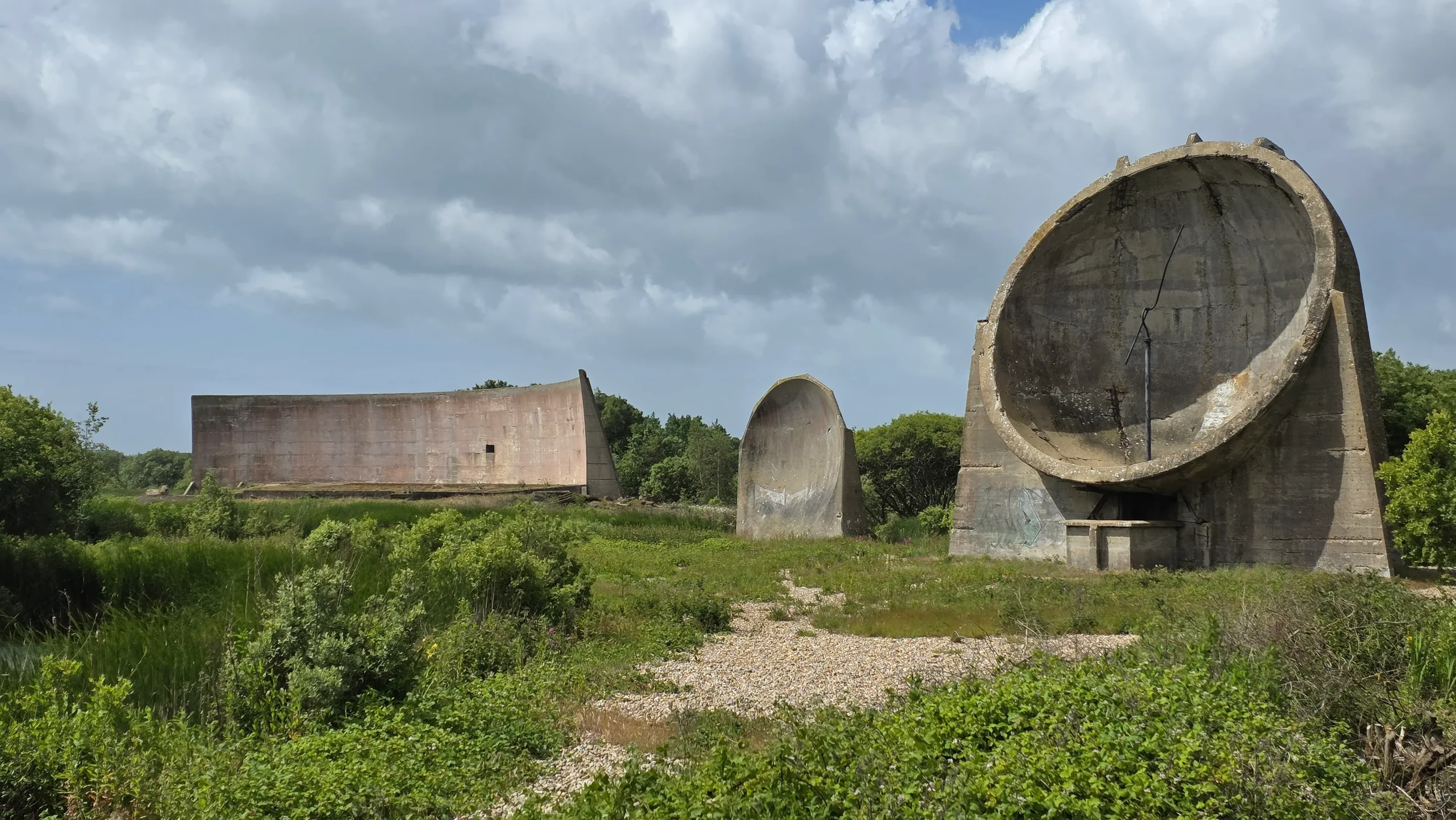
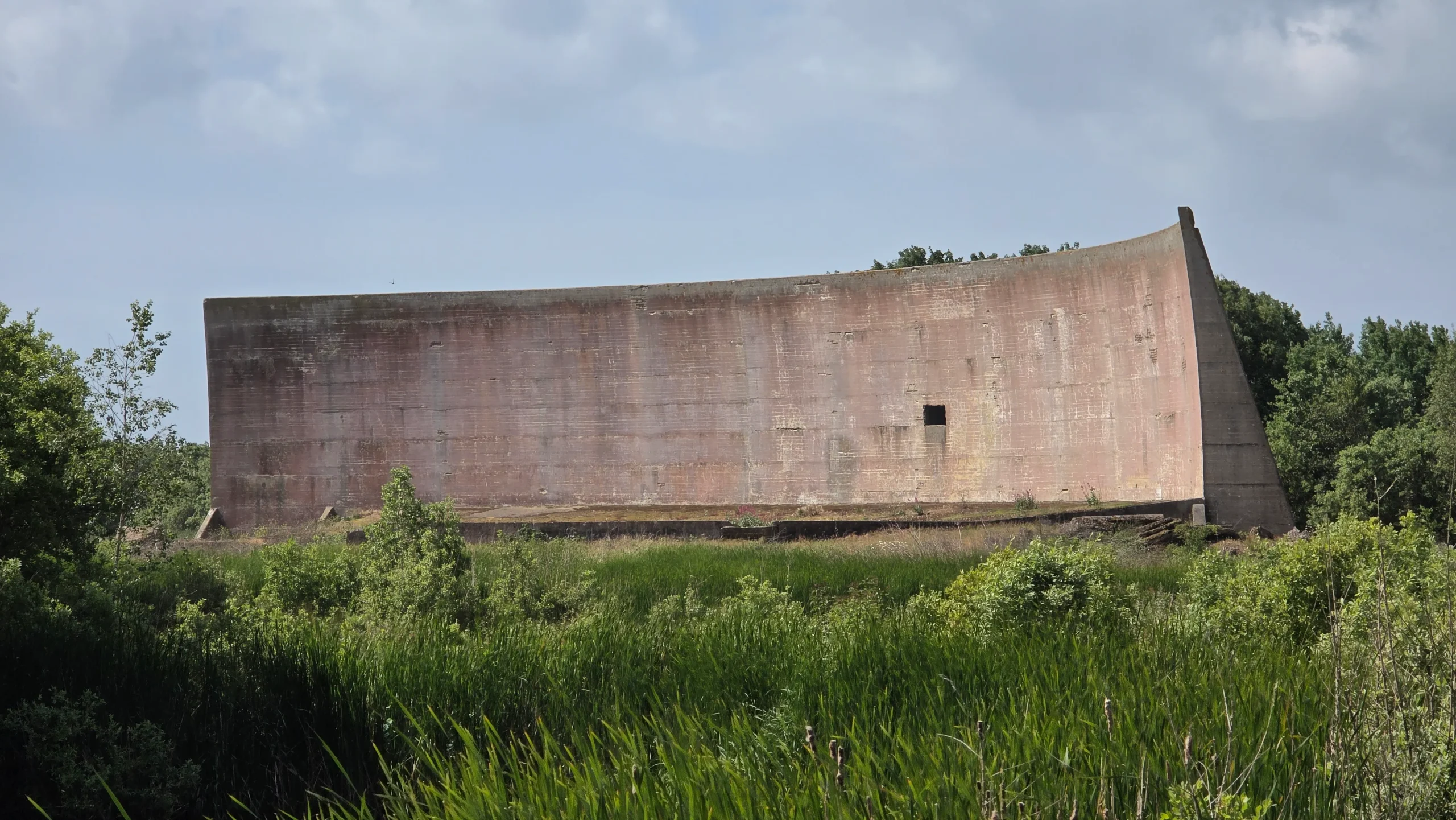
The group at Denge, on the Dungeness peninsula between Greatstone-on-Sea and Lydd Airport, is the one most people mean when they talk about the Kent sound mirrors. Records call the group Greatstone or Denge, and they mean the same site. It consists of three mirrors, and the design of each is different.
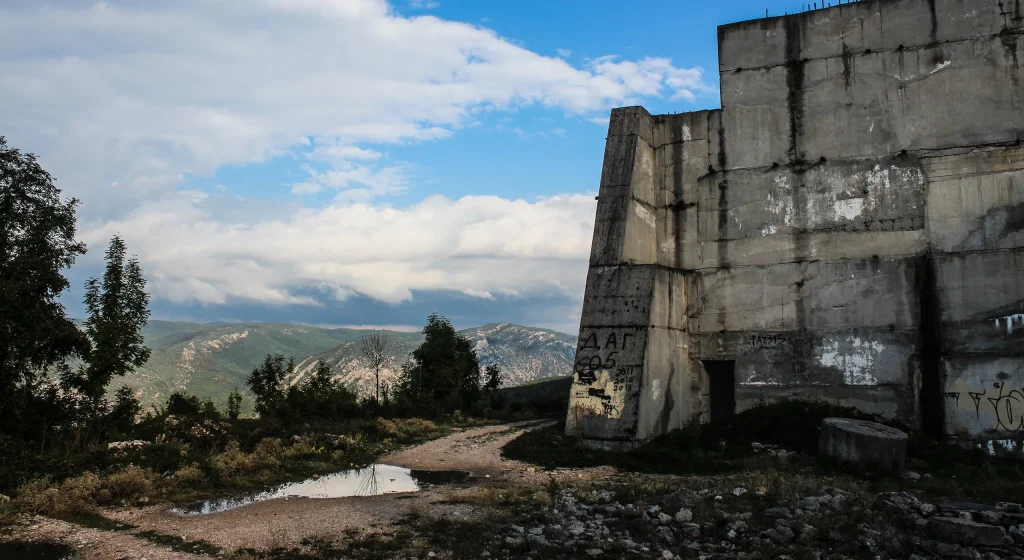
- The 200 ft mirror is a near-vertical curved wall about 60 metres long, with buttresses behind it and a flat apron in front. Its length is also given as 70 metres, and its height as about 5 metres or 7.9 metres. It is one of only two similar mirrors in the world, and the other is at Magħtab in Malta.
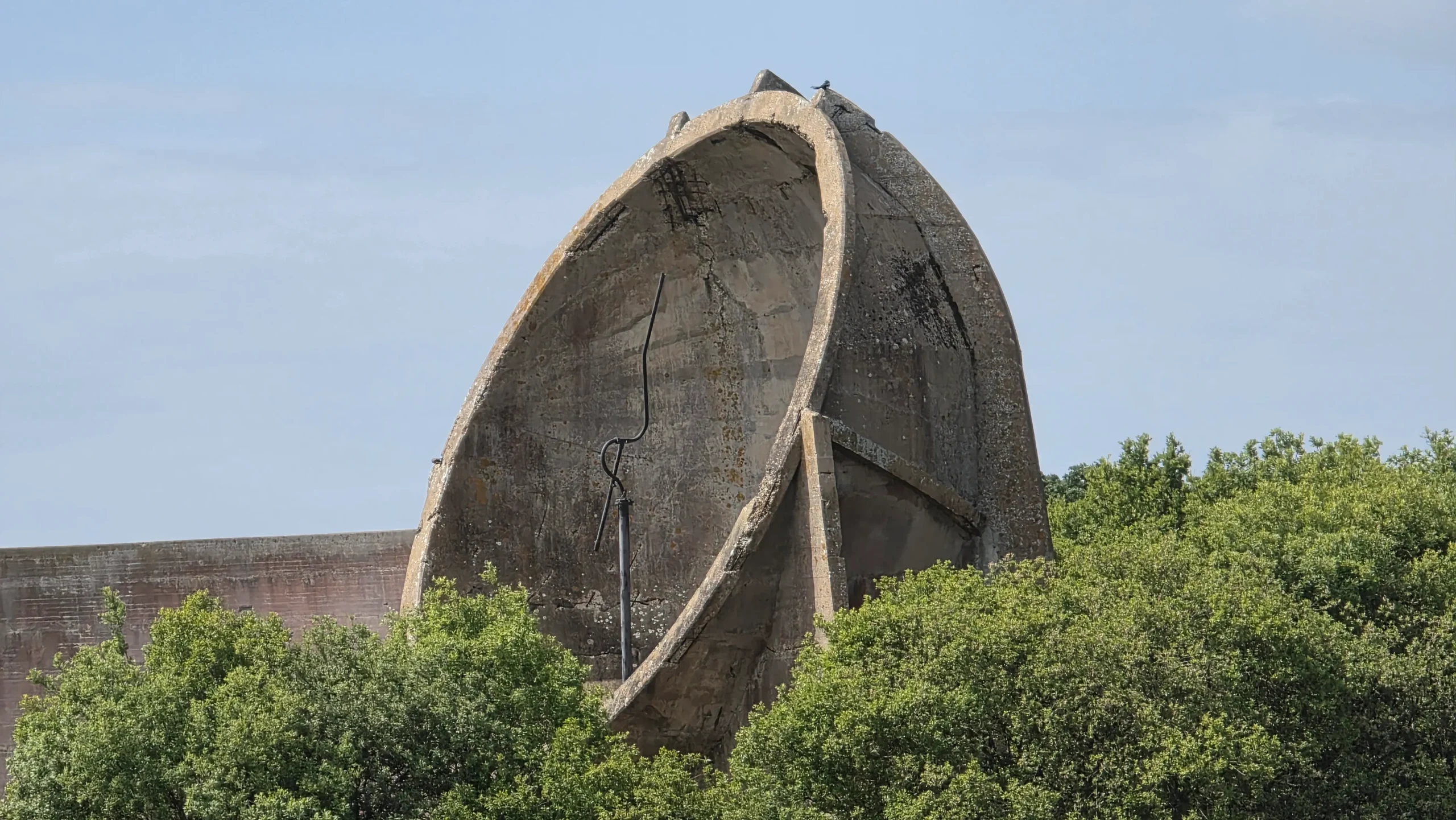
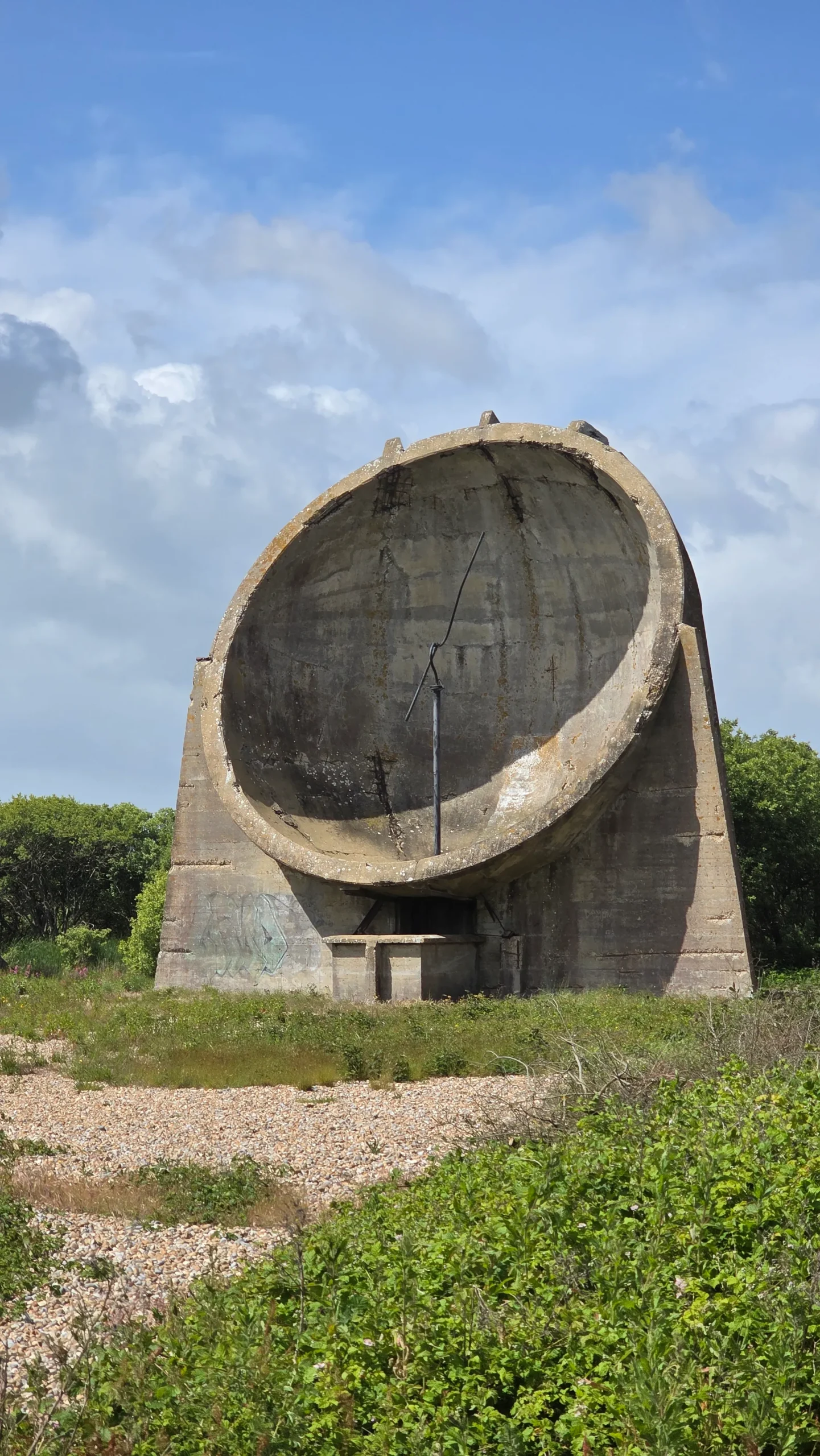
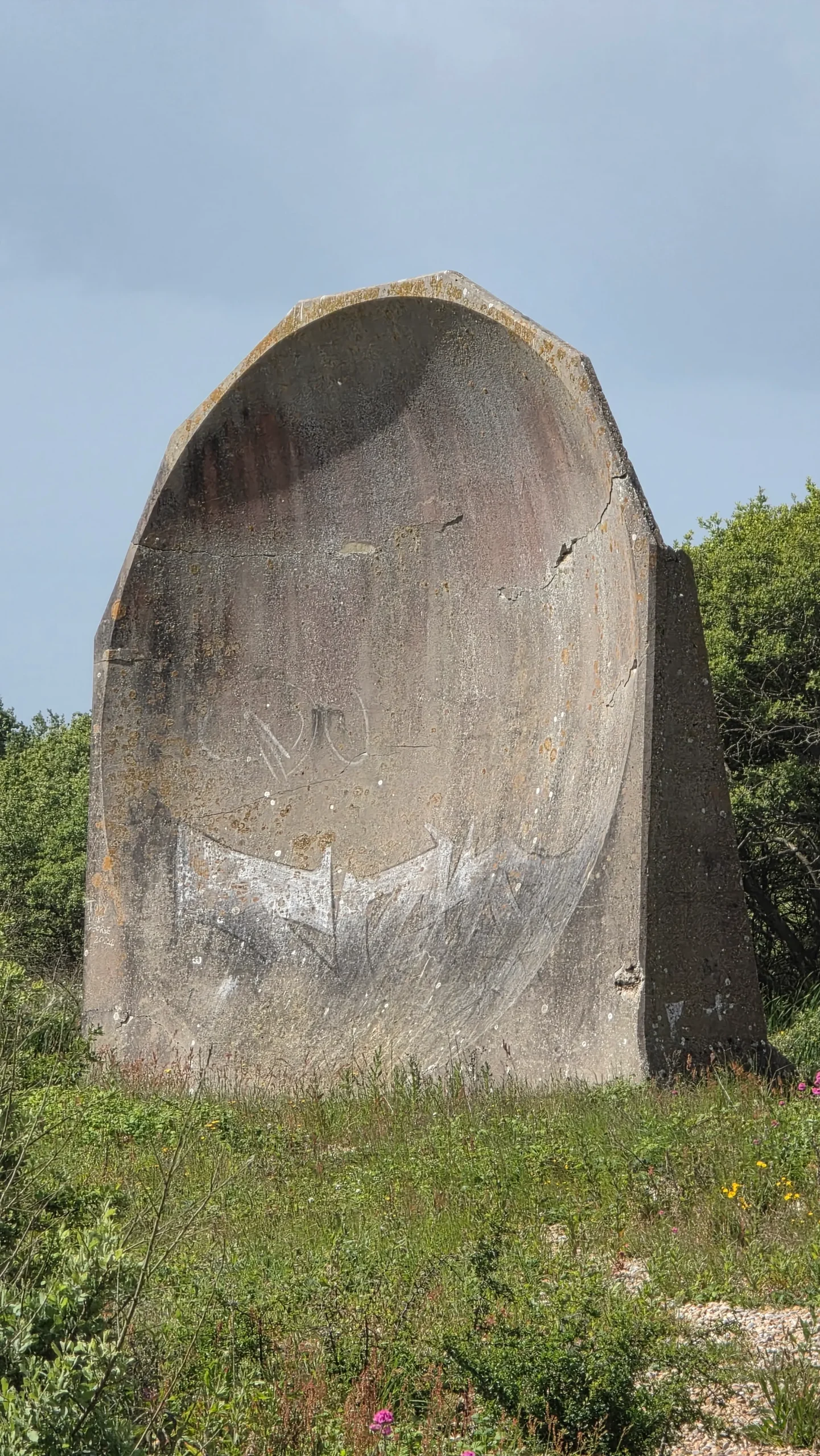
- The 30 ft mirror is a circular dish about 9 metres across, held up on concrete buttresses, and angled towards the sky. It has a listening chamber beneath, and the metal microphone pole, or sound trumpet fixture, is still in place.
- The 20 ft mirror is a smaller, shallower dish about 6 metres across, standing on a free-standing block. Its design is close to the mirror at Kilnsea in the East Riding of Yorkshire.
The mirrors are spherical, not parabolic, and microphones were placed at their focus. One record says they could detect the sound of aircraft about 8 to 24 miles away in favourable conditions, and that they were tested with varying success in air defence exercises into the mid-1930s. One source says they did work, but operators found it hard to tell aircraft from ships at sea.
Why they failed
The limits were built in. Aircraft became faster through the 1930s, so by the time an aeroplane was heard, it was already too close to be intercepted. The listening was also hard to do. Noise from new housing at Greatstone and Lydd-on-Sea, in 1935, led to proposals to abandon Greatstone for a new site at Dungeness, and in 1937 the realignment of the railway branch line to New Romney caused further problems.
Radar settled the argument. The first practical radar system was produced in 1935, with trials at Orfordness in Suffolk, and sources date the end of the mirrors to between 1932 and 1936 depending on how it is counted. Planned mirrors for the Thames Estuary were abandoned, and the 200 ft Greatstone mirror closed in 1937. A plan for a chain of stations from The Wash to Swanage was never built. In 1939 the General Staff ordered the six Kent mirrors to be destroyed, but the order was never carried out, and five still exist. The sixth, the 20 ft Hythe mirror, was lost only to natural causes.
What happened to the others
Several of the early sites have gone. At Joss Gap, the 15 ft mirror was decommissioned in 1936 and the 20 ft disc in 1939. The mirror has been lost to cliff erosion, and possible remains of the gantry survive about 70 metres south of the Joss Bay boardwalk, on a site that is not open to the public. A feature in the northern cliffs at Joss Bay, first spotted in 2018, may be the last trace of a horizontal disc experiment from Tucker’s station there, and in 2020 volunteers helped record it with measured plans and photographs. Activity at the bay had wound down by 1921, and the station moved to Hythe in 1922.
The Fan Bay mirrors were buried by the local council in the 1970s. They were excavated and restored by the National Trust in 2014. According to a 2016 report, they could be visited with the Fan Bay Deep Shelter at the White Cliffs of Dover during the season. On the Isle of Sheppey, a 15 ft mirror at Warden Point was built between 1917 and 1923 and decommissioned in 1936. It fell from the cliff in the late 1970s, and lies on the beach near the Chain Home Low radar station that replaced it.
Conservation at Denge
At Denge, the problem was different. The mirrors stand on a former gravel pit, and gravel extraction undermined at least one of them. Marine conditions corroded the reinforcement and caused the concrete cover to peel away. A Kent record says the 20 ft mirror and the front and south edges of the wall were gradually subsiding into the flooded quarry, while the 30 ft mirror was stable.
In 2003 English Heritage obtained 500,000 pounds from the Aggregates Levy Sustainability Fund and the EU Interreg programme, administered by Kent County Council. The money repaired damage from the gravel works and paid for a swing bridge, now the only way on to the site, which also reduces vandalism. Repair work included like-for-like patch repairs to match the original texture and finish, and an English Heritage specialist, Chris Wood, experimented with yoghurt to encourage lichen to regrow on the concrete. The mirrors are scheduled monuments, and the site is also part of the Dungeness Site of Special Scientific Interest.
The Denge mirrors have also found a place in popular culture. The artist Tacita Dean made a film inspired by the site, and the mirrors have appeared on album covers and in music videos.
Visiting
The Denge mirrors stand on an island in an old gravel pit at Greatstone Lakes, part of an RSPB reserve. Close access is limited to a few times a year, through RSPB open days, guided tours and photography sessions, which are usually held in summer. The mirrors can be seen from a footpath on the east side of the south lake and from the land side of the swing bridge. At an open day in 2009 organised by the Romney Marsh Countryside Project, visitors paid a 2 pound donation at the bridge and walked across shingle from the Lade car park, with the expert Dr Richard Scarth present.
The sources do not all agree about access. One Kent record says the land belongs to a company that runs the gravel works, that there is no public right of access, and that the mirrors can be seen over the southern boundary fence. Check the current position with the RSPB before you plan a visit, and do not climb the fence or the structures.
Conclusion
The Kent sound mirrors belong to a short period when listening was the best way to warn of an air raid. They worked well enough to detect a raid in 1917, and the research behind them lasted nearly twenty years, but they could not keep up with faster aircraft, and radar overtook them within a few years of the largest mirrors being finished.
What survives is a set of odd shapes on the Kent coast. The Denge group is the most complete, and it is the one most visitors come to see.
Did you know?
- A 15 ft sound mirror at Fan Bay detected an enemy raid at 12 to 15 miles in 1917.
- The 200 ft wall at Denge is one of only two similar mirrors in the world; the other is in Malta.
- The Denge mirrors are spherical, not parabolic, with microphones placed at their focus.
- A 30 ft mirror at Denge still has its metal sound trumpet fixture.
- Exercises in 1932 to 1934 tested the six concrete mirrors in Kent.
- A General Staff order in 1939 to destroy the six Kent mirrors was never carried out.
- The Fan Bay mirrors were buried in the 1970s and restored by the National Trust in 2014.
- In 2003 English Heritage obtained 500,000 pounds to repair the Denge mirrors and build a swing bridge.
- An English Heritage specialist experimented with yoghurt to encourage lichen to grow on the mirrors.
- The Warden Point mirror fell from its cliff on the Isle of Sheppey in the late 1970s.