The first one
At about 5:29 on the morning of 16 July 1945, a device the Los Alamos scientists called the Gadget was fired from the top of a steel tower in the New Mexico desert. It was the first nuclear explosion in history. The Gadget was a plutonium implosion bomb, the same basic design that would fall on Nagasaki less than a month later, and the test was code-named Trinity. The ground it was fired on, the ranch house where the core was put together and the people who lived downwind have their own post, Trinity Site. This one is about the weapon, the argument over whether to test it, the people in the bunkers and what the result set in motion.
The name has an uncertain history. Wikipedia says it is often attributed to Oppenheimer, who in a 1962 letter to Groves said he did not know exactly why he had chosen it, but linked it to a John Donne poem, “Batter my heart, three person’d God.” A history of the site hosted on Project Gutenberg adds a rival account, retold from historian Ferenc Szasz, that credits a major named Lex Stevens and a railroad siding called Pope’s Siding. Nobody seems able to settle it.
The problem with plutonium
The Manhattan Project was building two kinds of bomb. The uranium weapon was a gun: fire one piece of uranium into another and let it go critical. The plutonium weapon was supposed to work the same way, in a design called Thin Man. In April 1944 that plan fell apart. Emilio Segrè found that plutonium made in the X-10 reactor at the Clinton Engineer Works contained plutonium-240, which undergoes spontaneous fission thousands of times faster than plutonium-239. The stray neutrons would set off a gun-type weapon too early, giving a fizzle far weaker than a full explosion.
The way out was implosion. Instead of firing one piece into another, you surround a ball of plutonium with explosives that all go off at the same moment and squeeze it to a much higher density, so that it reaches critical mass faster than the neutrons can spoil it. The idea was not new. Wikipedia’s Fat Man article places an early suggestion in 1942 and records that Seth Neddermeyer’s group began implosion work in early 1943 as a hedge. In September 1943 John von Neumann proposed shaped explosive charges, the lens concept that made a symmetrical squeeze look possible. After Segrè’s result, Los Alamos dropped the gun-type plutonium work in the summer of 1944, with 17 July 1944 given as the date, and reorganised the laboratory around implosion in August.
That was the real worry behind Trinity. A gun-type uranium bomb was simple enough that nobody thought it needed a full-scale trial. An implosion bomb depended on a dozen things going right in the same fraction of a second, and there was no way to know if they would without trying.
Anatomy of the Gadget
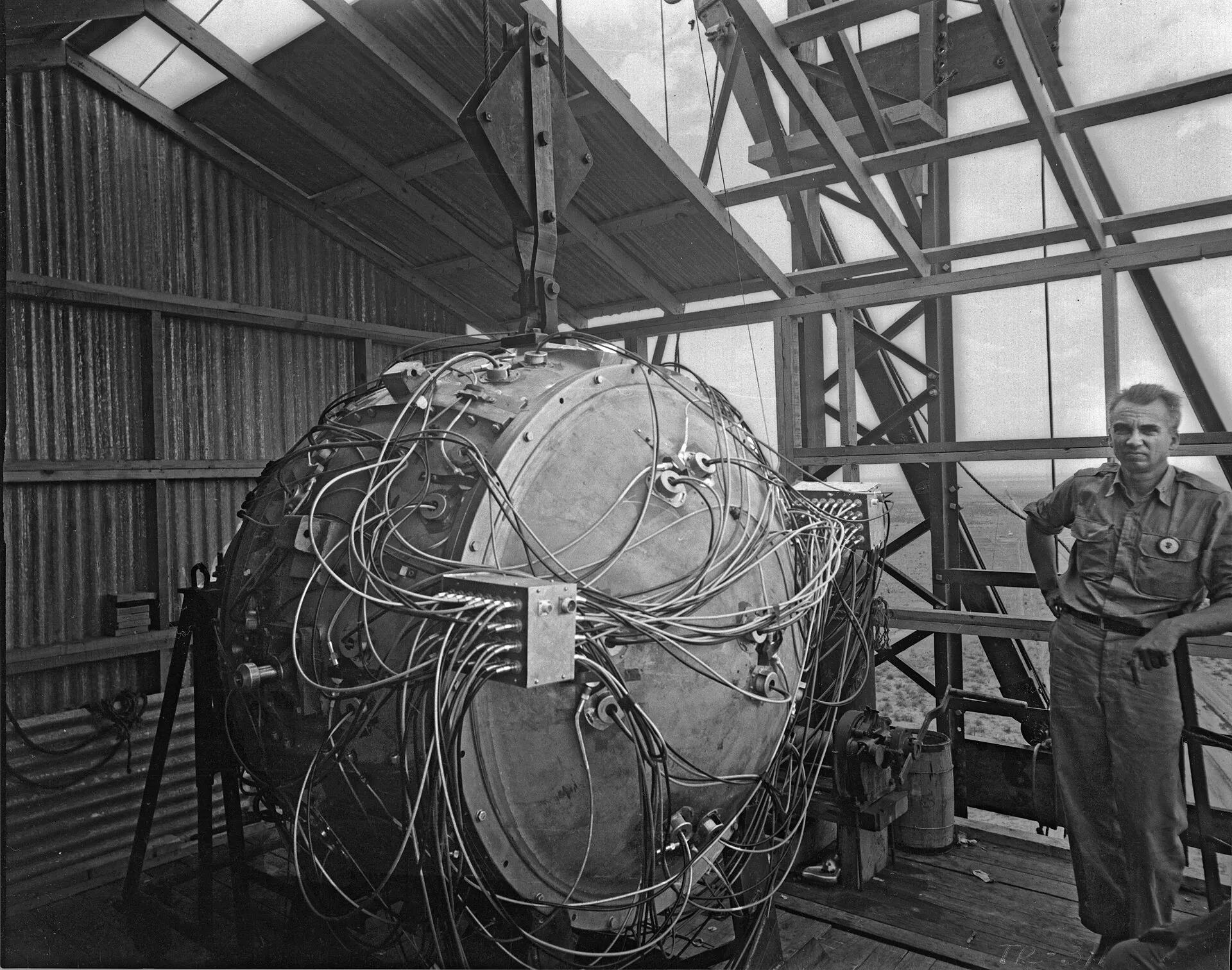
The official designation of the device was Y-1561. It was an implosion bomb of the Fat Man type without fuzing or the outer ballistic casing. At its centre was a plutonium core, a nearly solid sphere known as the Christy pit, after Robert Christy, who developed the solid design from an idea of Edward Teller’s. It was made of two hemispheres of delta-phase plutonium alloyed with 5 percent gallium, which keeps the metal in its more workable form. Wikipedia gives its weight as 6.19 kg (13.6 lb) and says it gave off about 15 watts of heat from its own radioactivity. The Fat Man article gives the pit’s diameter as about 92 mm, or 3.6 inches. The silver plating on the Trinity core blistered, so it was wrapped in gold foil. Later cores were nickel-plated.
At the middle of the core sat an initiator nicknamed Urchin, a small polonium-beryllium device that gave off a burst of neutrons at the moment of compression. Around the pit went a natural-uranium tamper, which reflects neutrons back into the core and can fission itself. Around the tamper went a boron shell, then an aluminium pusher, which carried the shock from the explosives into the uranium with less turbulence, and a cap of Duralumin. Gold foil filled gaps. The loaded capsule weighed about 105 lb.
The outside was the clever part. Thirty-two shaped explosive lenses were arranged around the sphere in the pattern of a truncated icosahedron, the same geometry as a football. Each lens combined a fast explosive, Composition B, with a slow one, Baratol, so that the detonation wave bent as it travelled and arrived as a single converging sphere. Wikipedia says thirty-two Model 1773 exploding-bridgewire detonators set them off, and that the lenses were inspected by William Bradbury and George Kistiakowsky and the best sets chosen. A non-nuclear test at Pajarito Canyon, run by Edward Creutz, produced magnetic measurements that hinted at an uneven implosion, and Hans Bethe worked overnight on the results and reported that they were consistent with a perfect one.
When the compression came, the plutonium would be squeezed to about twice its normal density. Not much of it would actually fission. Wikipedia says that only about 1.4 kg of 5.9 kg of plutonium fissioned at Trinity, while the Fat Man article gives about 1 kg of 6.19 kg for the design, so the figure depends on the source.
Arguing for a test
General Groves was reluctant about a test at first. In February 1944 Norman Ramsey suggested a small-scale version, with the explosion held inside a containment vessel so that the plutonium could be recovered. Groves worried about having to explain the loss of a billion dollars’ worth of plutonium if a test went wrong. Oppenheimer argued the other way. According to Wikipedia he said the bomb had to be tested in conditions where the energy release was comparable with what was planned for the real thing.
The bomb must be tested in a range where the energy release is comparable with that contemplated for final use.
J. Robert Oppenheimer, as quoted by Wikipedia’s account of the Trinity test
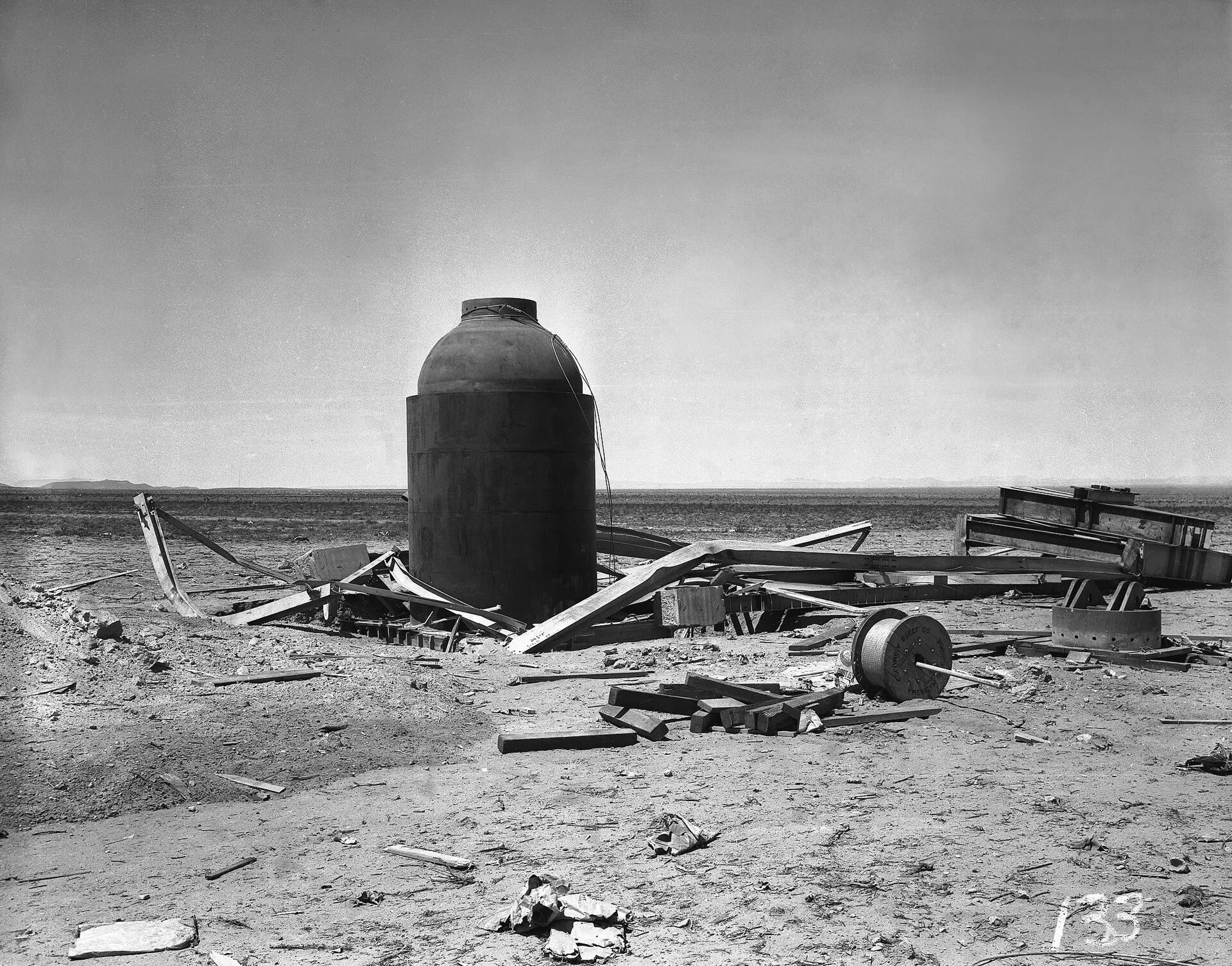
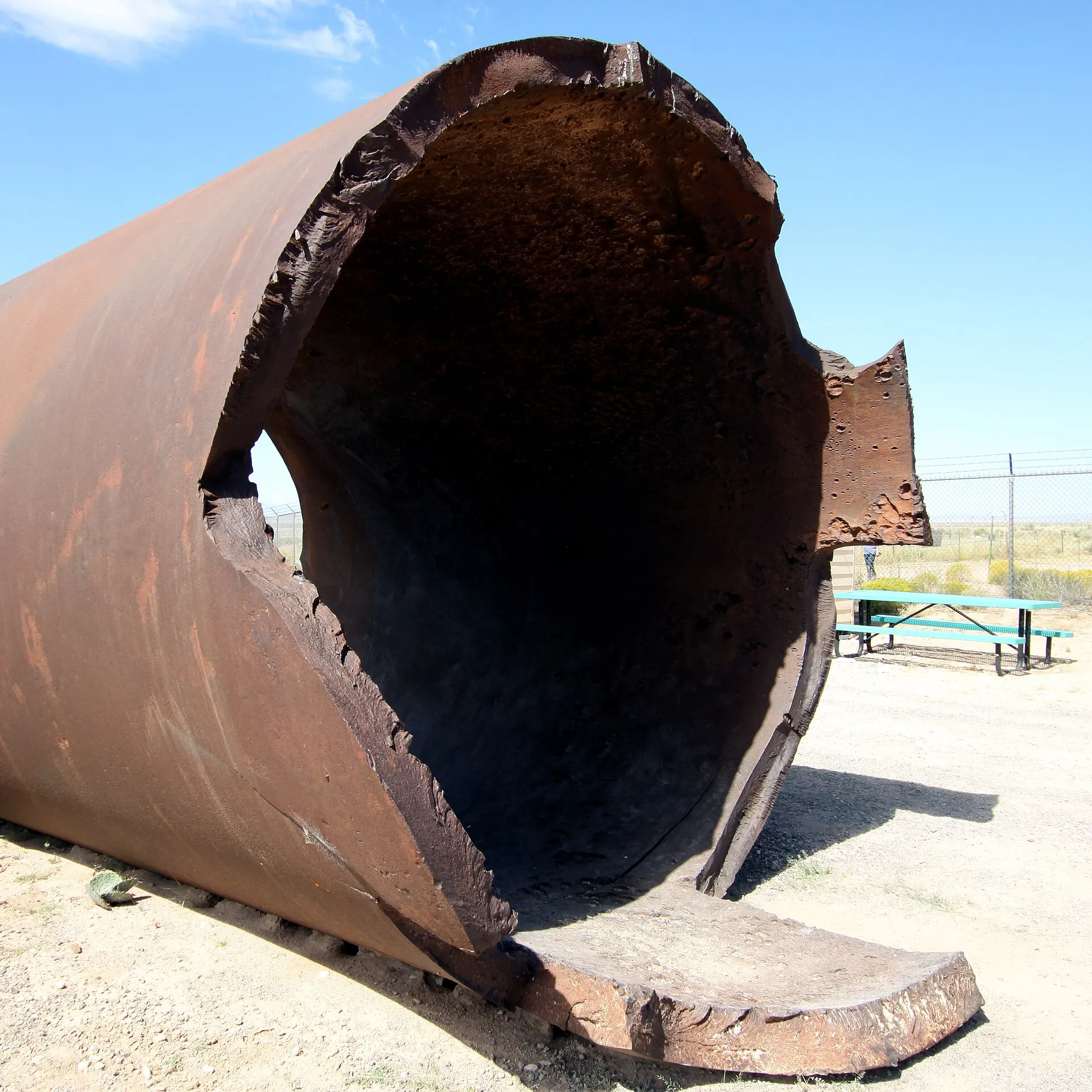
By March 1944 Oppenheimer had Groves’s tentative approval for a full-yield test as long as it was done inside a containment vessel. That led to the strangest piece of hardware in the whole story, a 214-ton steel vessel nicknamed Jumbo, which has its own section in the site post. By spring 1945 it had been set aside. More plutonium was becoming available, the physicists believed in the design, and a blast above about 100 tons of TNT would have shredded the vessel and spoiled the measurements. Oppenheimer was reportedly confident that there would be enough plutonium for a second attempt. Alternatives such as covering the bomb with a cone of sand or suspending it in a tank of water were also rejected.
Kenneth Bainbridge, a Harvard physicist, was put in charge of the test. Wikipedia says he limited the invitation list to ten VIPs.
A rehearsal with 108 tons
Bainbridge decided there should be a rehearsal, because the main event could only be done once. Oppenheimer was reportedly sceptical at first and later agreed that it helped. On 7 May 1945 a stack of conventional explosive was set on a 20-foot platform about 800 yards south-east of where the tower would stand. Wikipedia gives the charge as about 108 short tons of TNT equivalent in one place and 89.75 tons of TNT plus 14.91 tons of Composition B in another, which is close enough to the same thing. It was spiked with a Hanford slug carrying about 1,000 curies of beta activity and 400 of gamma, dissolved and poured into the charge tubing.
The rehearsal was scheduled for 4:00 a.m., and it slipped 37 minutes for the observation B-29. Then an electrical signal set off the charge a quarter of a second early, which ruined the split-second experiments. Dust thrown up by vehicles also interfered with instruments, so about 20 miles of road were later sealed. Piezoelectric gauges recorded about 108 tons of TNT. The airborne gauges flown by Luis Alvarez and Bernard Waldman did much worse,.
The ranch house and the tower
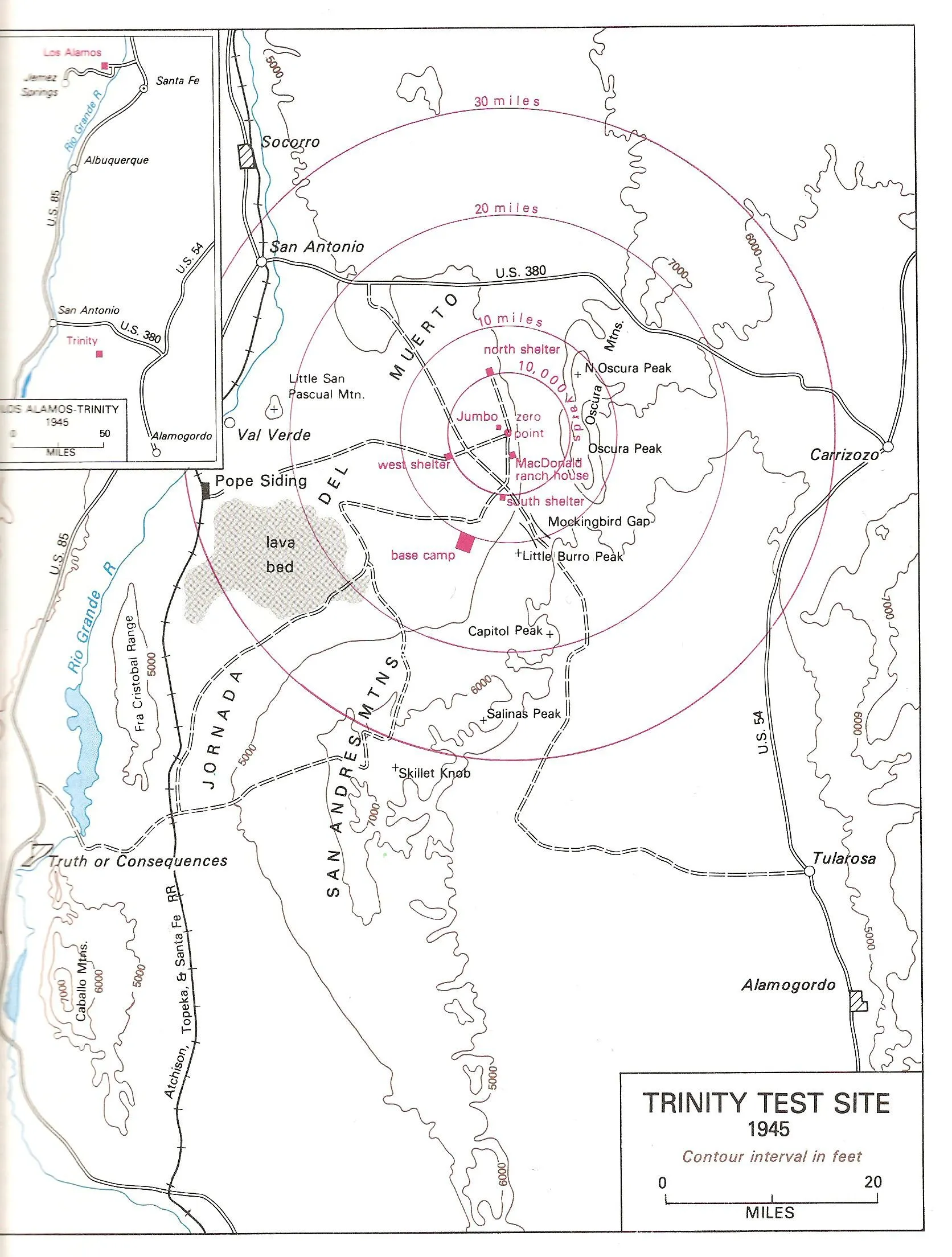
The pieces for the Gadget came together in the second week of July. According to the Los Alamos history on OSTI, the plutonium core was taken to the test area in an army sedan on 12 July, and the non-nuclear components set out at 12:01 a.m. on Friday 13 July. At the McDonald Ranch House the master bedroom served as a clean room. Louis Slotin placed the initiator, Cyril Smith fitted the core into the tamper and the active assembly was finished at 17:45 that evening. The Gutenberg history adds that jeeps stood outside with their engines running for a quick exit and that the core was warm to the touch, which is simply the heat of plutonium’s radioactivity.
A hitch came with the fitting. According to Wikipedia, as the capsule was lowered into the uranium tamper it jammed, because heat from the core had expanded it while the tamper had cooled overnight. Robert Bacher saw that keeping the capsule in contact with the tamper would equalise the temperatures, and it slid in within minutes. The Gutenberg history places a similar jam during the first attempt to insert the core at the ranch. They may be telling the same story from different places.
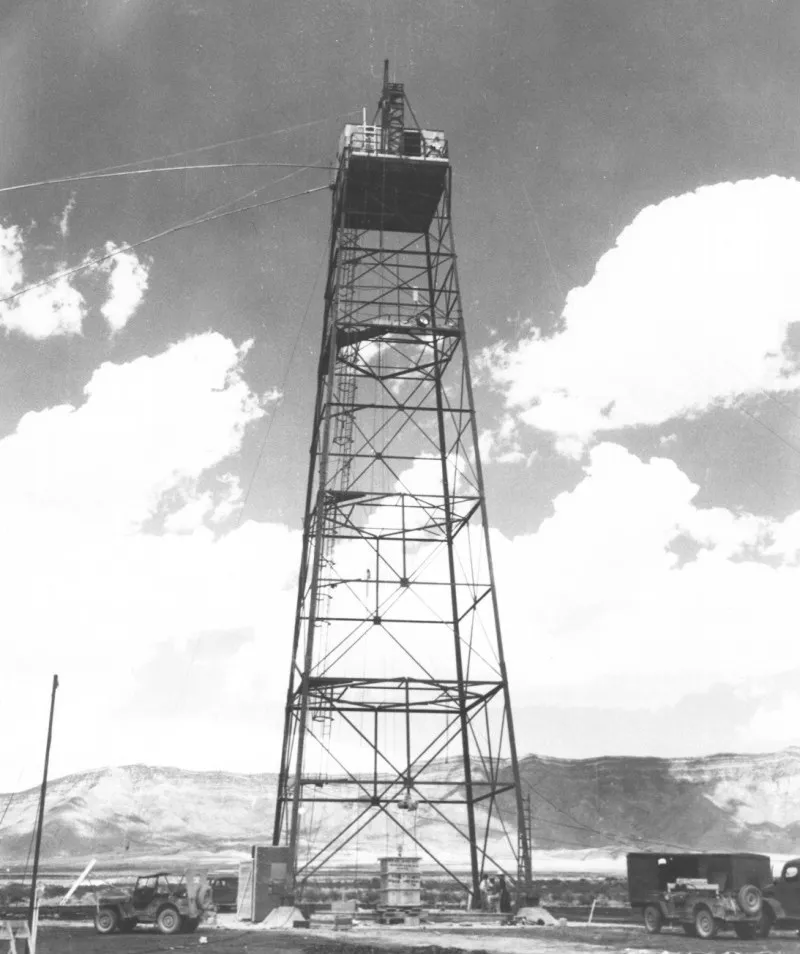
The Gadget was then raised to the top of a 100-foot steel tower. It sat on an oak platform inside a corrugated-iron shack and was winched up. A truckload of mattresses was laid under the tower in case it fell, and Wikipedia notes they would not have protected it but did make the men feel better. Accounts differ on the exact day. The Gutenberg history has the device raised on 14 July, while OSTI says it was in place by 5:00 p.m. on 15 July. The seven-man arming party, Bainbridge, Kistiakowsky, Joseph McKibben and four soldiers, drove out soon after 10:00 p.m. on the 15th.
The betting pool
The mood at Los Alamos came out in a pool on the yield. Wikipedia lists the guesses. Teller predicted 45 kilotons. Ramsey chose zero. Oppenheimer picked 0.3 kilotons and Kistiakowsky 1.4. Bethe went for 8, the same figure Segrè had calculated. Isidor Rabi, the last to arrive, took 18 and turned out to be closest. A junior member of the laboratory had worked out 20.
Enrico Fermi, meanwhile, offered wagers on whether the atmosphere would catch fire. The worry went back to 1942, when Edward Teller raised a question among a group of about eight physicists at Berkeley: could colliding nitrogen nuclei release enough energy to spread a reaction through the air? Bethe recalled in an interview that Oppenheimer thought it a terrible possibility and took it to Arthur Compton. Bethe calculated that two nitrogen nuclei were incredibly unlikely to react, and papers by Emil Konopinski and another author, he said, put the question at rest. Compton, according to Bethe, was never shown the calculations and was not reassured.
Bethe’s calculation had settled the matter for most people, though some were anxious for a while. Bethe’s own worry at Trinity was that the initiator might fizzle. Wikipedia says that Bainbridge was furious with Fermi for frightening the guards. Fermi’s wager was a way to ease the mood, and Bethe thought a few people took it.
One more story comes from a single book, Lansing Lamont’s Day of Trinity, via the Gutenberg history: a B-29 tail gunner is said to have fired his machine guns at antelope while instruments were being set up, sending several scientists diving to the ground. Treat it as a story and not a record.
A storm before dawn
The date was not a free choice. Wikipedia says the best weather was forecast for 18 to 21 July, but President Truman wanted the test finished before the Potsdam Conference opened on 16 July, so the shot was set for the earliest day the components would be ready. It was scheduled for 4:00 a.m. on Monday the 16th, and that night a violent thunderstorm rolled across the basin. Lightning raised fears of a premature detonation.
Robert Cahn’s account of the night, written for the Christian Science Monitor on the fiftieth anniversary, says Bainbridge, Kistiakowsky and McKibben reached the foot of the tower just before midnight, and that Donald Hornig, who had spent a tense few hours guarding the bomb through the storm, went back to the control shelter, South 10,000. Oppenheimer and Groves drove out there too. Rain was still falling, winds over ground zero were poor, and the meteorologist, Jack Hubbard, could not promise a clearing. Groves reportedly warned the governor of New Mexico that martial law might be needed.
Bainbridge ruled out the 4:00 a.m. shot and agreed that they could wait until 5:30, when daylight would begin to spoil key measurements. The rain stopped shortly after 3:00. At 4:45 Hubbard’s instruments showed favourable winds at altitude, and Bainbridge gave the order to prepare to fire at 5:30. He closed the circuit at the tower end, which armed the bomb, and switched on a floodlight as an aiming point for the B-29s overhead. Samuel Allison, a physicist from the University of Chicago, was chosen to call the countdown. At 5:10 the first announcement went out: twenty minutes to zero.
Cahn fills in the last minutes. Groves left for the base camp at minus 20, and the B-29 pilots, unable to see the floodlight, gave up. At minus 10 Hornig took his place beside McKibben, holding a knife switch that could halt the detonation if something went wrong. At minus five Oppenheimer stood in the doorway looking pale. Hornig tried a joke about panicking and pulling the switch, and Oppenheimer questioned him sharply to see if he was serious before withdrawing. He told himself that he must remain conscious, and leaned against a wooden pillar. At minus 45 seconds McKibben switched to the automatic timer, four warning lights showed that the firing unit was charged, and Allison called the last seconds from ten.
The rest of the world was waiting too, without knowing it. In a motel cabin at Carrizozo, Los Alamos scientists Alvin and Elizabeth Graves were minding a seismograph and a Geiger counter. In Albuquerque, security officers were on the phone with more than twenty agents. At base camp, Marshall Holloway lay in a trench, doubting that he had assembled the core correctly. Groves and James Conant lay on the ground facing away. Most visiting VIPs watched from Compania Hill.
5:29 a.m.
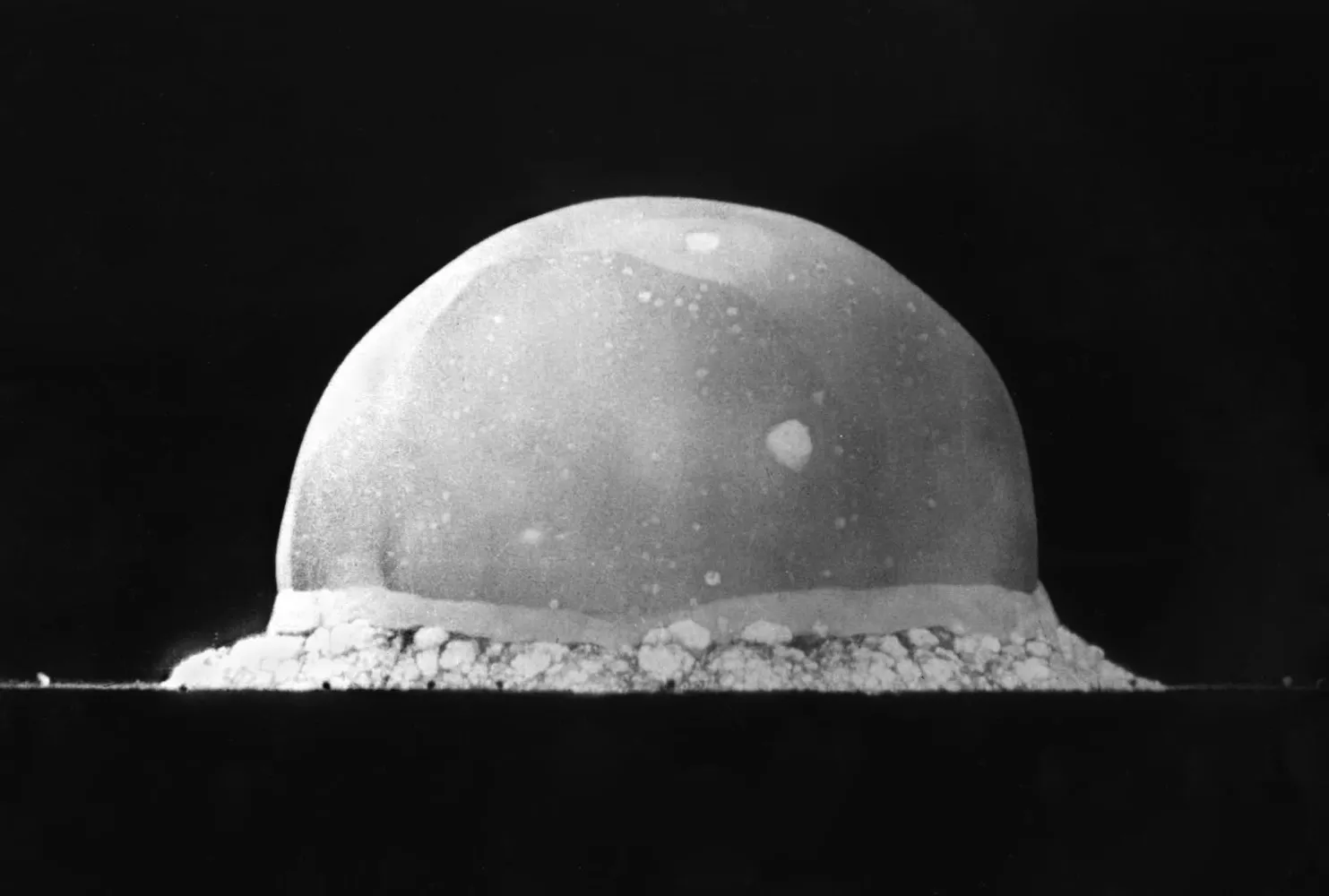
The device went off at 5:29:21 Mountain War Time according to Wikipedia, plus or minus 15 seconds. The Gutenberg history says 5:29:45, so the seconds depend on whom you read. Allison’s count had ended, the shelter was suddenly lit through the open door, and what came next was recorded by the people who watched.
Conant said afterwards that the enormity of the light and its length had stunned him. Bethe described it as looking like a giant magnesium flare, which seemed to last a minute but was one or two seconds. Phillip Morrison felt the heat of the sun on his face from ten miles away, and when the real sunrise came minutes later, he felt it again and said they had seen two sunrises. A military policeman named Davis said the heat felt like opening an oven door even at that distance. Joan Hinton, who Wikipedia says slipped in as a guest, said it was like being at the bottom of an ocean of light.
Brigadier General Thomas Farrell, Groves’s deputy, wrote one of the best-known accounts. Wikipedia quotes his first reaction as an exclamation that the long-haired scientists had let it get away from them, and his report called the effects unprecedented, magnificent, beautiful, stupendous and terrifying. Kenneth Bainbridge’s reaction, as he gave it to Oppenheimer, was blunter.
Now we are all sons of bitches.
Kenneth Bainbridge, to J. Robert Oppenheimer, after the Trinity test
Oppenheimer himself remembered, years afterwards, a line from the Bhagavad Gita. Wikipedia notes that Time printed it with the word “shatterer,” not “destroyer.”
Now I am become Death, the destroyer of worlds.
J. Robert Oppenheimer, recalling the Bhagavad Gita after the Trinity test
Fermi did something more practical. He had torn up pieces of paper and dropped them from about six feet as the shock wave reached him, and he measured how far they were blown, about 2.5 metres. From that he estimated the yield at about ten thousand tons of TNT. Von Neumann’s guess was at least 5,000 tons and probably a great deal more.
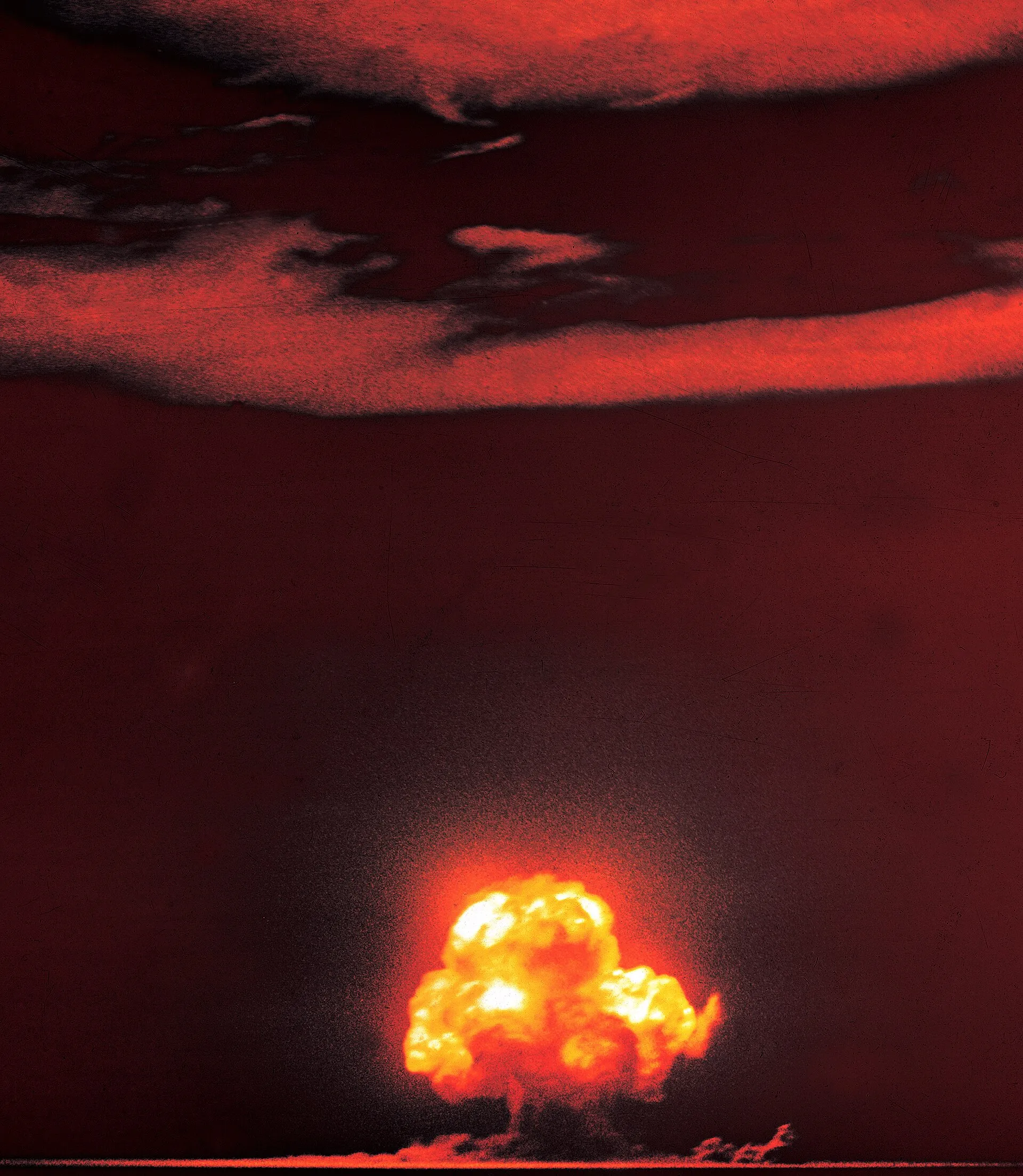
Two B-29s circled overhead carrying members of Project Alberta, including Deak Parsons, Luis Alvarez, Harold Agnew, Bernard Waldman, Wolfgang Panofsky and William Penney, but overcast skies blocked much of the view. About 50 cameras recorded the explosion on the ground, including Fastax cameras running at 10,000 frames a second and spectrographs. Wikipedia says Jack Aeby, brought in by Segrè, took the only well-exposed colour photograph.
Weighing the blast
The yield is still not settled. The Department of Energy gives 18.6 kilotons, the figure from radiochemical analysis of soil samples taken by lead-lined Sherman tanks. Wikipedia gives 21 kilotons as the official estimate. Aluminium diaphragm gauges had indicated about 9.9 kilotons, a 2021 re-analysis put it at about 24.8, and the pre-test prediction from Los Alamos had been 5 to 10. The Gutenberg history says about 20,000 tons. Whatever the figure, Rabi’s 18 was the closest bet in the pool.
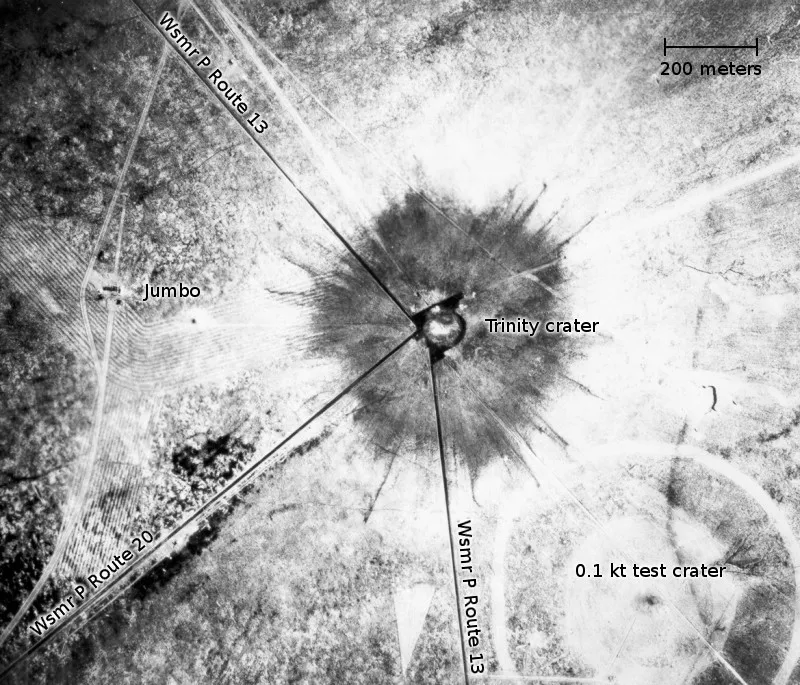
Descriptions of the cloud and crater vary too. Wikipedia gives a mushroom cloud 7.5 miles high and a crater about 88 yards wide and 4.7 feet deep, while the Gutenberg history has the cloud above 38,000 feet and the crater almost 2,400 feet across and about ten feet deep in places. The OSTI history says the cloud topped out at 25,000 feet, and Wikipedia’s article on the fallout says an estimated 60,000. The tower was vaporised. Only the stumps of its legs were left. The sand beneath it fused into pale green glass, first called atomsite and then trinitite. The shock wave was felt over 100 miles away, and a single account says windows broke at Silver City, 120 miles off. In Los Alamos, more than 200 miles to the north, scientists’ wives who had stayed up all night saw the light and then heard the sound.
The tank crews who drove in to collect soil received between about 7 and 15 roentgens, according to Wikipedia. No observer at the 10,000-yard positions exceeded 0.1 roentgen on their film badges.
The magazine story
The light could be seen across a huge part of New Mexico, so the Army needed an explanation. The Second Air Force put out a statement that an ammunition magazine at the Alamogordo Army Air Base had exploded, that no one had been hurt, and that a few civilians might need to be evacuated. William Laurence, the science writer attached to the project, drafted it. He prepared four versions, ranging from a successful test to disaster. New Mexico newspapers printed the magazine story and East Coast papers largely ignored it.
Not everything stayed hidden. In August 1945 the Kodak company found fogging on batches of film. Wikipedia says that a Kodak physicist, J. H. Webb, traced it to an explosion somewhere in the United States and kept the matter secret until 1949. The real story came out only after Hiroshima. The Smyth Report, released on 12 August 1945, gave the first public account, and on 9 September Groves and Oppenheimer led a press party out to the site.
Potsdam
The result reached Potsdam as a cable from George Harrison to Henry Stimson, which spoke in medical code. Wikipedia quotes it.
Operated on this morning. Diagnosis not yet complete but results seem satisfactory and already exceed expectations.
George Harrison, cable to Henry Stimson at Potsdam, 16 July 1945
A fuller report from Groves arrived on 21 July and said the test had been successful beyond the most optimistic expectations of anyone. On 25 July Truman wrote in his diary that he had learned of “the most terrible bomb in the history of the world.” His account of the test has details that do not match other records. He described a 60-foot tower, where the usual figure is 100 feet, and a crater 1,200 feet wide and 6 feet deep. His figures differ from the other records.
The news changed what Truman needed from the Soviet Union. Learning of the test sharply reduced the value of Soviet help against Japan. According to the OSTI history of the Potsdam decision, on the evening of 24 July Truman told Stalin, without an interpreter, that the United States had a new weapon of unusual destructive force. Stalin showed little interest and replied only that he hoped it would be used well against the Japanese. The same page notes that Soviet intelligence had been following the atomic programme since autumn 1941, which may explain his composure. On 25 July the order to use the bomb was issued with General Marshall, naming Hiroshima, Kokura, Niigata or Nagasaki as targets after 3 August.
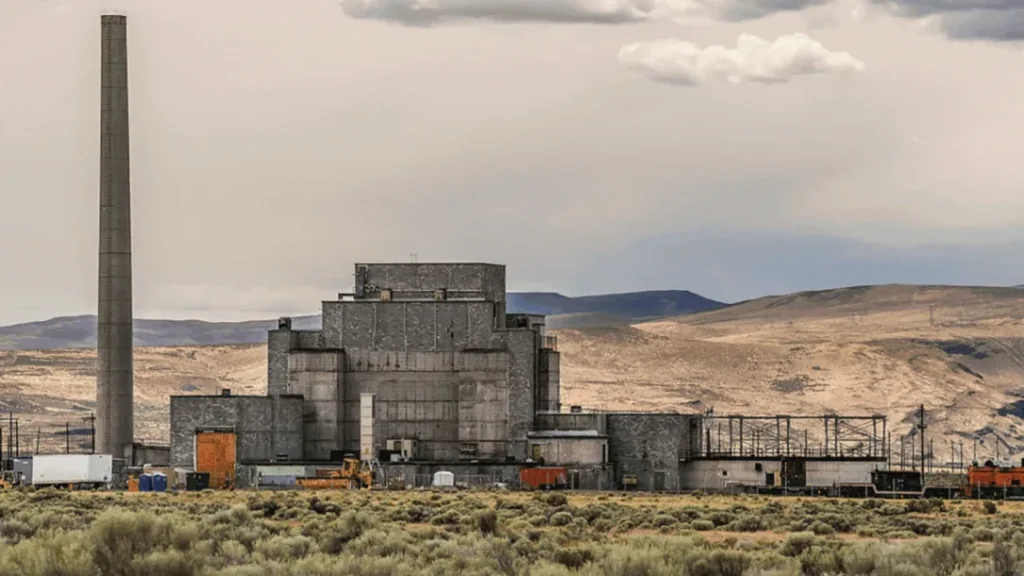
Trinity also fed straight into the next two weapons. Blast data from the test was used to set the burst heights for the real bombs, 1,885 feet over Hiroshima and 1,650 feet over Nagasaki. Because implosion had worked, Oppenheimer recommended using uranium-235 more economically in composite plutonium-uranium cores for Fat Man-type bombs. The plutonium for Trinity and Nagasaki came from Hanford, which we cover in our B Reactor post.
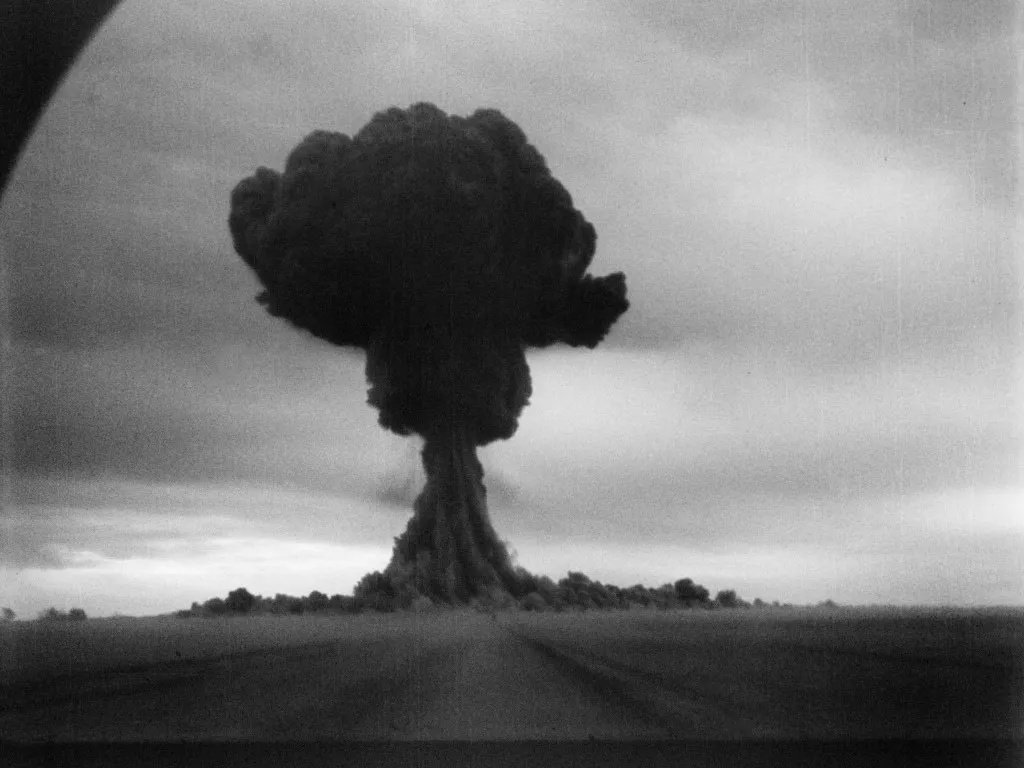
The Soviet Union’s first bomb, tested in August 1949, was closely based on Fat Man, according to the Fat Man article, and our RDS-1 post tells that story.
What was left in the air
Only a fraction of the plutonium fissioned. Wikipedia says about 4.5 kg of 5.9 kg was dispersed, and what rose into the cloud came down on land where people lived. Residents were not told and were not evacuated. How the cloud drifted, what fell on ranches such as Hot Canyon, and how the families nearby fought for recognition for 80 years are told in the Trinity Site post, and not repeated here.
Conclusion
Trinity is usually remembered for its last second, the flash and the quotations. The more interesting story is the long argument before it. A weapon was designed around a flaw in plutonium that nobody had known about until April 1944, and the laboratory reorganised around a design that had never been fired. The people who built it argued about whether to test it at all and then bet on how big it would be.
The answer, in a morning of rain and a minute of light, was that it worked. That answer shaped the next month. It changed what Truman wanted from Stalin, it set the heights of the Hiroshima and Nagasaki bursts, and it started a race that the Soviet Union was already running. The test took about a second, and the argument over what it meant has lasted eighty years.
Did you know?
- Emilio Segre found plutonium-240 in reactor plutonium in April 1944, which killed the gun-type plutonium bomb.
- The Trinity core was gold-wrapped because its silver plating blistered.
- The Trinity core gave off about 15 watts of heat from its own radioactivity.
- The explosive lenses were arranged like the panels of a football, 32 in all.
- A rehearsal on 7 May 1945 used about 108 tons of high explosive and went off a quarter of a second early.
- Los Alamos staff bet on the yield; Edward Teller guessed 45 kilotons, Ramsey guessed zero and Isidor Rabi won with 18.
- Enrico Fermi offered wagers on whether the atmosphere would ignite, and Kenneth Bainbridge was furious with him for frightening the guards.
- Phillip Morrison said that, ten miles away, he felt the heat of the blast and then again at the real sunrise, so he saw two sunrises.
- Jack Aeby took the only well-exposed colour photograph of the explosion.
- Kodak found fogged film in August 1945 and a physicist traced it to the test, keeping it secret until 1949.
- Truman's diary entry called it the most terrible bomb in the history of the world and gave a tower height of 60 feet.
- Blast data from Trinity was used to set the burst heights over Hiroshima at 1,885 feet and Nagasaki at 1,650 feet.