

The problem the FCDA had
In 1953 the United States was four years into an atomic arms race and the government had a delicate message to deliver. It wanted Americans to take the threat seriously, enough to build shelters, stock food and take part in air-raid drills, but not so seriously that they gave up. The agency charged with this was the Federal Civil Defense Administration, set up at the end of 1950. Its leaders had inherited a difficult piece of public relations. The weapons were getting more powerful, the Soviet Union had its own bomb, and the best data about what an atomic explosion did to people and buildings came from two Japanese cities in 1945.
The FCDA wanted new evidence that would speak directly to Americans. It wanted to see what happened to a wooden house of the kind in which most of them lived, a family car of the kind most of them drove, and a backyard shelter of the kind it was telling them to build. And it wanted them to see the result. That second aim shaped everything about the test. Officials said openly that the point was to
show the people of America what might be expected if an atomic burst took place over the doorsteps of our major cities.
Federal Civil Defense Administration, on the aim of Operation Doorstep
Millard Caldwell, the agency’s first director, had stressed that ordinary men and women would be the “prime target” of any attack, and the FCDA’s view was that those men and women needed to see what that meant. The name Doorstep came from that phrase. The bomb was to go off, figuratively, on the doorstep of an American family.
The test it piggybacked on
The FCDA did not have a bomb of its own. It borrowed one. Operation Upshot-Knothole was a series of eleven nuclear tests at the Nevada Test Site between March and June 1953, run by the Atomic Energy Commission and the Department of Defense mainly to develop new weapons. The Department of Defense supplied about 20,100 people to the series, and a Desert Rock exercise, Desert Rock V, used troops to test how soldiers might fight on a nuclear battlefield.
The first shot of the series was code-named Annie. It was a weapons-development shot, fired from a 300-foot tower in Area 3 of Yucca Flat. It had been planned to yield 15 kilotons and measured about 16, which was roughly the size of the bomb that destroyed Hiroshima. For the weapons scientists this was one experiment among many. According to Wikipedia, Annie was used to investigate how a weapon’s yield depended on the timing of its initiation, a question with nothing to do with houses or families. The civil defence effects test was added on top of that programme, and it is the reason Annie is remembered at all, because the scientific results were never going to appear on a television screen. For the FCDA it was an opportunity. The shot was big enough to wreck buildings, and it opened the series.
The FCDA announced its plan in a press release dated 5 March 1953, which gave only twelve days’ notice, and the arrangements that followed were remarkably quick. Much of the work was done by volunteers and by American companies who saw the publicity value.
Building a street in the desert
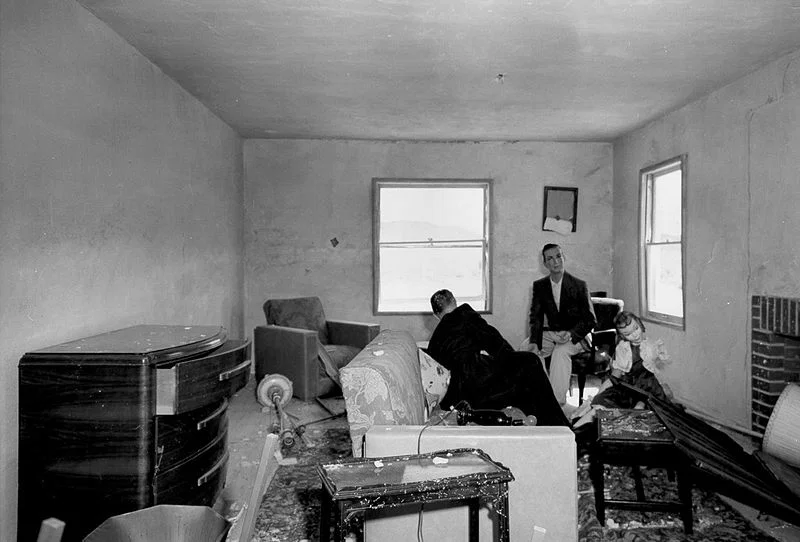
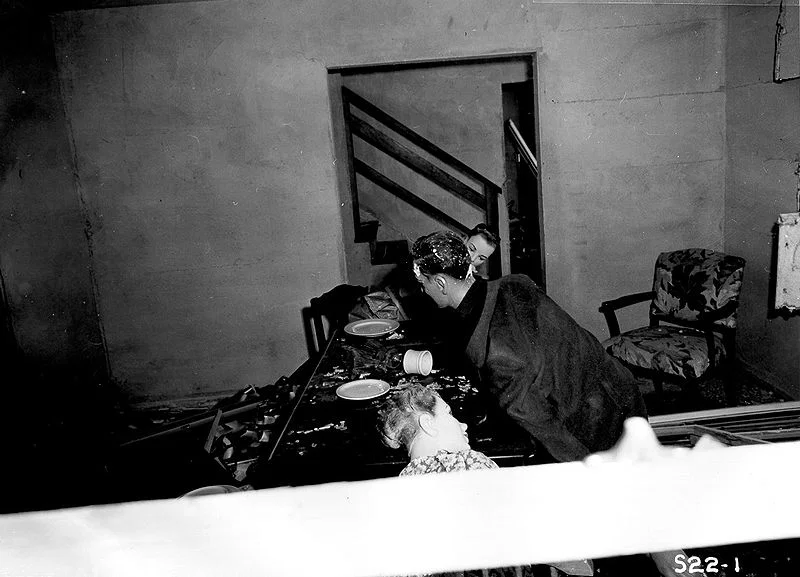
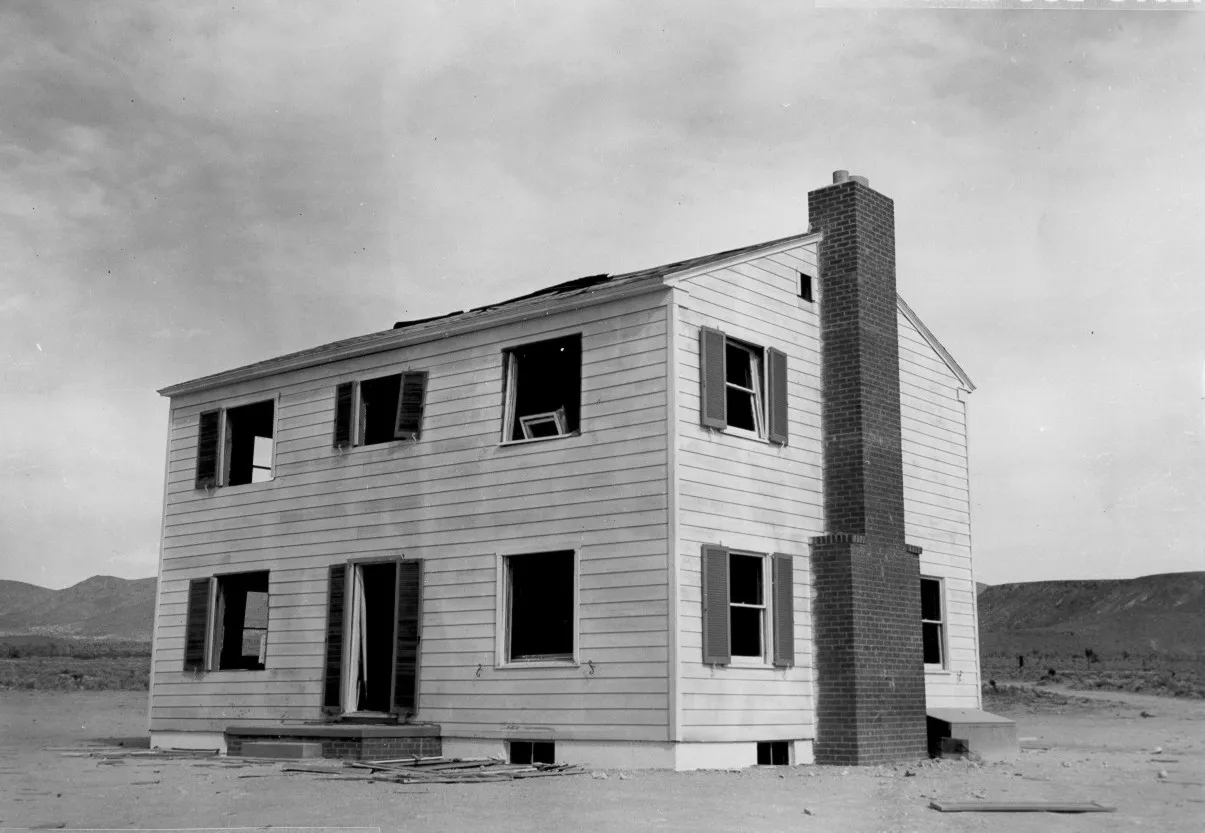
The buildings were put up in a matter of days. Two houses were built to the same design: wood-frame, two storeys, colonial in style, with white-painted exteriors to resist fire from the thermal flash. They had no electricity, plumbing, heating or gas, but they were fitted as real homes, with aluminium venetian blinds in the windows facing the blast and government-supplied furniture in the rooms. The interiors were plastered but not painted, and the wood trim, doors and floors were left unfinished. Fresh food flown in from San Francisco and Chicago was set out with the mannequins in the kitchens and dining rooms,. The National Lumber Manufacturers Association helped build them. A removals company, North American Van Lines, delivered the furniture for nothing, and a Las Vegas firm, Atlas Furniture, supplied furnishings. Standard Oil supplied the petrol, and local car dealers lent the vehicles.
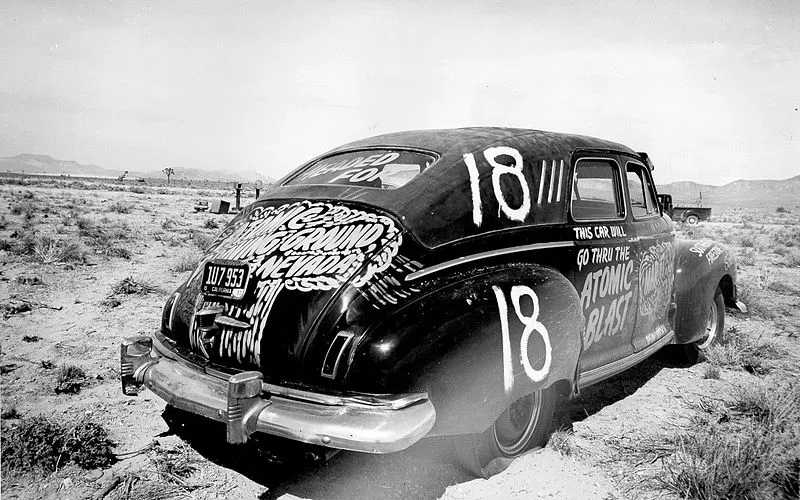
The first house stood 3,500 feet from the tower, a little over two thirds of a mile. The second was 7,500 feet away, nearly a mile and a half. They had been chosen to show two things: what an atomic blast did to a house at close range, and what it did to one at a distance where, the FCDA hoped, a family might live through it. Between them and around them were 50 automobiles, set at various angles and distances to answer another question that officials thought important, whether the family car could give effective protection. FCDA administrator Val Peterson had suggested publicly that a car was relatively safe beyond about ten blocks, provided some windows were left open so the roof would not cave in on the passengers. The test was designed to find out whether this was true.
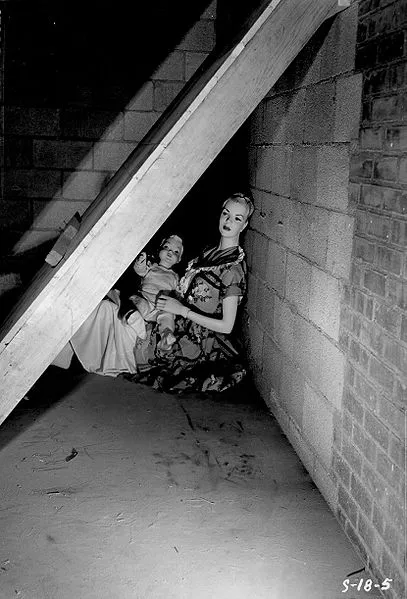
There were also shelters. Eight different outdoor underground shelters of the kind a family might build in its own garden had been dug near the houses, so that the FCDA could study how much protection each gave.
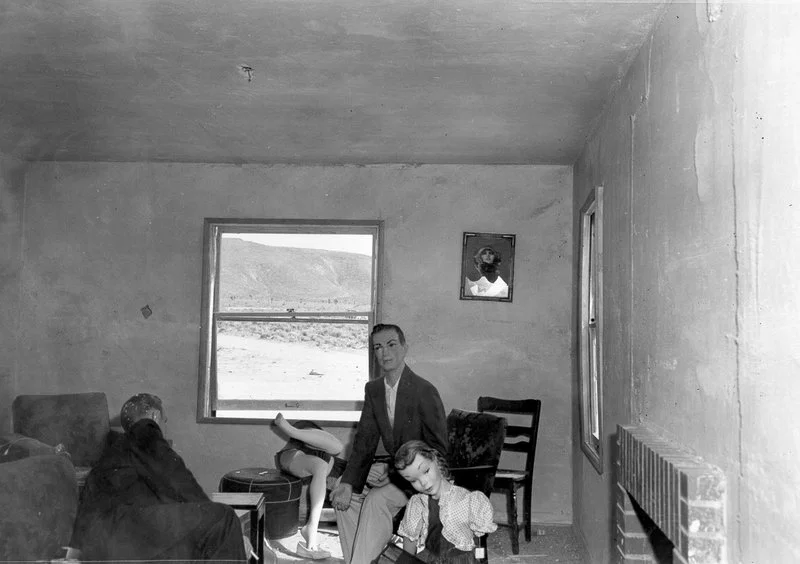
The farther house contained a dining room, a living room and a bed, and scenes were staged around the site: a family sheltering in a basement, a single figure under a lean-to, and a mother with a baby under another.
What the houses were for
The FCDA listed three objectives, and they show how practical the experiment was meant to be. The first was to find out what would happen to a typical American home exposed to an atomic blast. The second was to study the protection given by eight different outdoor underground shelters. The third was to determine how well a car protected its passengers, and what the blast did to a vehicle’s ability to run. The houses were heavily instrumented, and they had been given different materials and exteriors so that the results could be compared.
It was also, quite deliberately, a consumer test. The towns were stocked by American firms, and Wills has argued that this made them symbols of a new kind of suburban life as much as test sites. The venetian blinds, the furniture, the cars, the petrol and the clothes were all products that someone had made and hoped to sell. A bomb that left a Penney’s dress intact was an advertisement, and one that tore it apart was a warning.
The mannequins
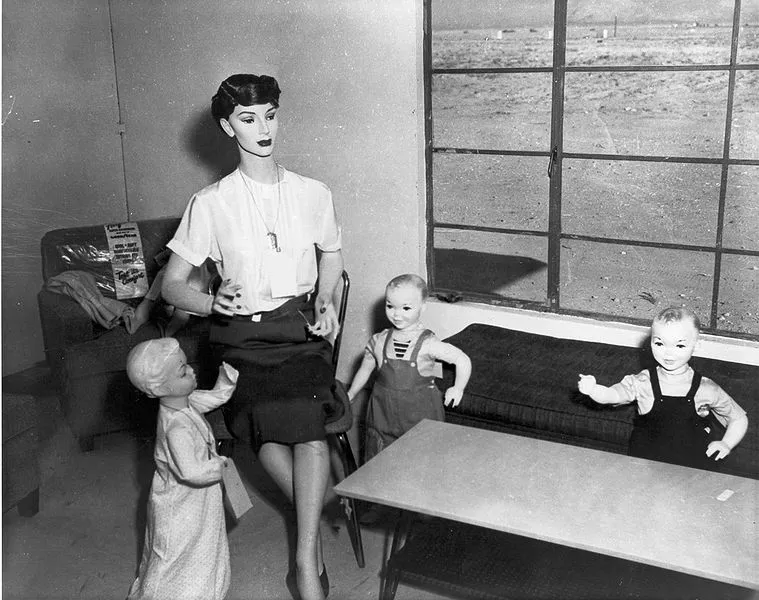
The people in the houses were mannequins. They came from a Michigan firm, the L.A. Darling Company, and about fifty of them were ordered. The FCDA wanted them to behave like human bodies in the blast, so most were weighted with sand. The exception was one child, which was left light. Film badges and fusion strips, which melt at a measured temperature, were attached to them to record radiation and heat.
Clothing them became a project of its own. J.C. Penney supplied the outfits and spent well over $2,500 on them, and the company’s Las Vegas manager, Hillman R. Lee, said the way the fabrics held up might be “a powerful factor in deciding fashion trends”. The store dressed them so that, in its words, no two mannequins were alike, and the Review-Journal reported that “all known varieties of American clothing, excepting a mink coat” had been put on them. Penney’s advertisements in the Las Vegas Review-Journal in April 1953 showed before-and-after pictures of fifty ensembles above the words “These mannikins could have been live people, in fact, they could have been you!”
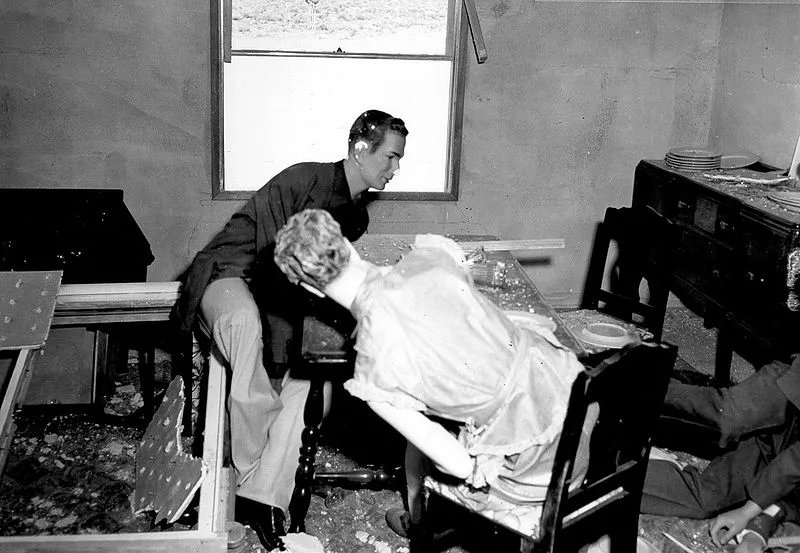
The newspapers were charmed. The pair at the table became “Mr. and Mrs. America”, the “Darling family”. The San Antonio Express ran the headline “‘Happy Family’ Awaits A-Bomb” on 16 March, the day before the test. Among the workers they were just “Mom” and “Dad”. One tale, told much later, says that in the days before the test the crew arranged some of the figures in undressed and suggestive poses as a joke, and that a senior official found them and had them put back as intended, with Dad at the window reading a paper and Mom in the kitchen. The source for this is a recollection by a former test-site worker, so I give it as a story rather than a fact.
One of the cars had a mannequin in the driver’s seat. It would become one of the most reproduced images of the test, and one of the most disturbing.
Waiting for dawn
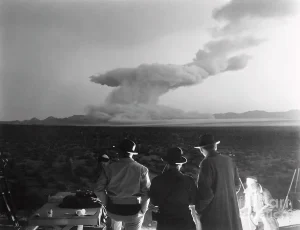
Reporters and observers were taken out to the site in the early hours. The press were placed on a rise called News Nob, about seven and a half miles south of the tower, although Archaeology magazine puts it at ten miles. More than 600 civil defence observers and members of the media saw the test. The CBS correspondent Walter Cronkite was there, and he described the blast live to a national television audience. It was the first time a nuclear test had been broadcast live across the United States. The FCDA estimated afterwards that about 70 per cent of the population had watched, though the basis for that figure is not clear.
The army was there too. Desert Rock V had about 1,700 personnel at the Annie shot. Of those, 1,181 troops in two battalion combat teams took part in the manoeuvre, taking up positions in trenches before the blast. Twenty reporters went to the trenches with them.
17 March 1953
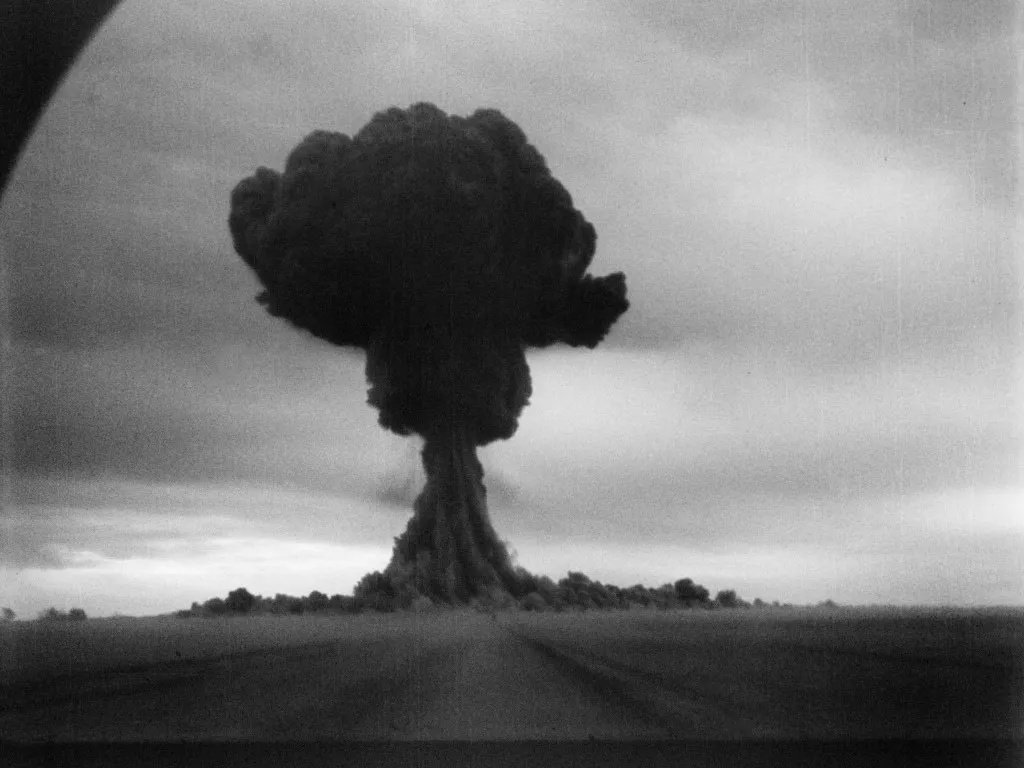
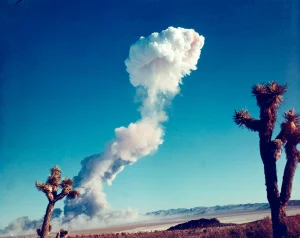
At about 5:20 in the morning, the device on top of the tower detonated. The flash lit Yucca Flat, and the fireball climbed into a column and then a cloud, while the radio and television commentators struggled for words.
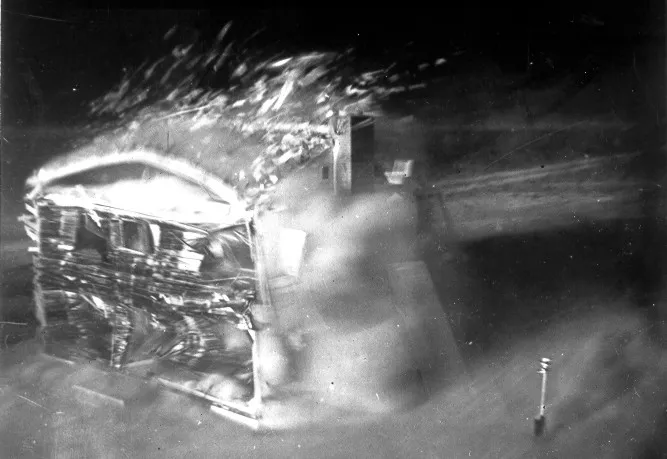
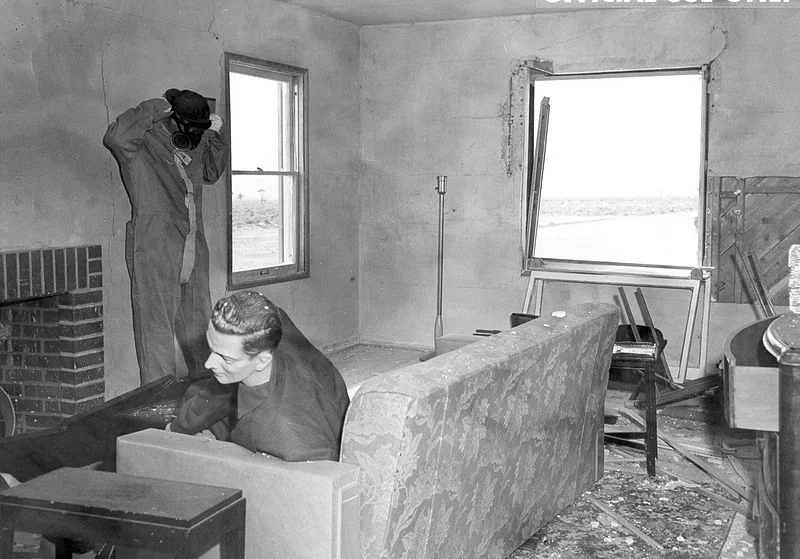
At the houses, the sequence was over in seconds. The nearer one stood 3,500 feet from the tower. Cameras had been set up to film it, and one of them, according to one account, was protected by a two-inch lead sheath. In another frame, the only light was the blast itself. The time-lapse film the FCDA released showed the house collapsing in a little over two seconds, and another account says less than three. An automatic camera took eight photographs. The damage was put at 90 to 95 per cent, and the basement stayed intact.
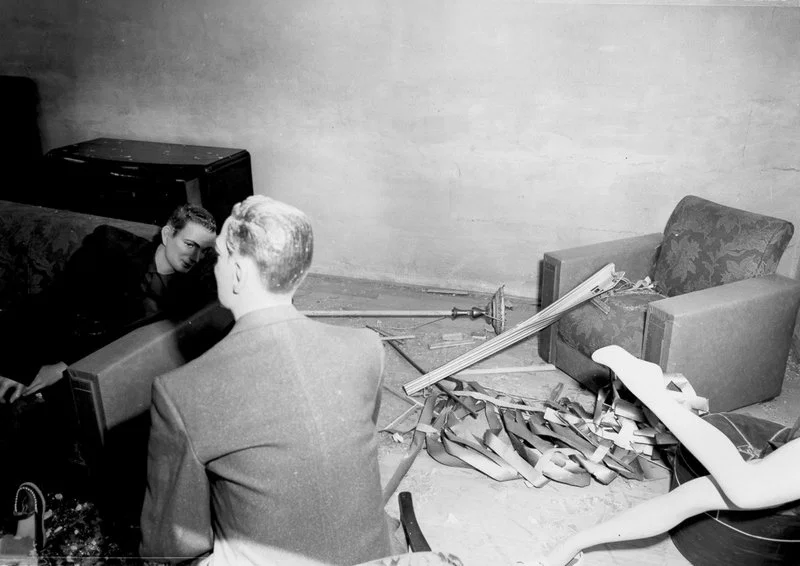
The house at 7,500 feet did not fall. It was badly damaged and charred, but it remained standing. The mannequins inside were disturbed to varying degrees. In the photographs the FCDA later published, one figure in the living room seemed to be smiling, and one lady mannequin was left surprisingly undisturbed.
Most of the 50 cars were damaged, and most were driven away afterwards. One, known as Car 50, had a mannequin at the wheel. A technical report noted that its roof was severely dished, its windows broke and its bonnet blew open, and the driver had a crushed head. A shoe from one of the mannequins was found seven miles away.
An account in the Public Domain Review adds a note of caution. It says blast-measuring instruments had not been installed for lack of funds, so the test was more a demonstration than a measurement. That is one author’s reading, but it matches the sense in other accounts that the FCDA cared as much about the pictures as the numbers.
The footage
The film of the test has had a second life. The footage is held by Los Alamos National Laboratory and is in the public domain. In April 2016 the historian Alex Wellerstein, of the Stevens Institute of Technology, received high-resolution copies of it from Los Alamos, and Lawrence Livermore National Laboratory put its own declassified test films online not long before. When Popular Science published the Annie clip in 2017, it noted the heat as well as the blast. A house close to the explosion is destroyed outright, while farther away the main danger is heat, and in the footage the fire climbs the house before the wood splinters, until dense smoke hides the camera.
One detail in the film has been puzzling viewers ever since. In some frames an object is thrown out of the house’s second-storey floor. Popular Science described it as toilet-shaped when it first covered the test in 1953, and in some frames it does look like one, but not in all. Wellerstein says that what it was may be unknowable from the footage alone.
The day after
Reporters were allowed to walk out to the houses afterwards. The Las Vegas Review-Journal’s Elton Fay went into the wreck and called it a “house of death”.
Newspapers across the country published before-and-after photographs. The Las Vegas Sun printed three frames of one home, in morning sun, then on fire, then destroyed. Journalists began to file their stories with the dateline “Doom Town, Nev.”, and the Los Angeles Examiner ran the headline “A-Boom Town Is a Doomtown”. The FCDA sold a booklet of the full study, with its before-and-after photographs, for 25 cents.
Caldwell said national interest had been “greatly stimulated” by the test, and the agency presented the results as encouraging. It pointed to the survival of the farther house, the intact basement and the cars that could be driven away as evidence that an atomic burst could be survived with the right precautions.
The surviving mannequins went on show at the J.C. Penney store at Sixth Street and Fremont in Las Vegas about two weeks after the test, and then on a tour of department stores. Their fate after that is not recorded. The houses were demolished and the site was cleared. Nothing of Doorstep remains today, apart from a bare patch of desert.
What people made of it
If the FCDA expected relief, it did not get it. The responses collected by the historian John Wills in his studies of Doom Town show a mixture of fascination, horror and unease.
Some people took the lesson as it was meant. Most of the coverage, though, found its way to something darker. The New York Times critic Jack Gould, writing on 18 March 1953, asked whether the emphasis on destruction might encourage a fatalistic attitude. He worried that it might “promote an almost fatalistic attitude”, and the Portsmouth Times gave that mood a name, “fission-osophy”. A Wyoming Eagle editorial, “An Awesome Thing”, said that “it is a fearful thing to know” that man can destroy so much in an instant, and the New Mexican joked that car advertisements would soon boast of radiation absorption per horsepower.
The strongest reaction came from the images. They were domestic. They showed a table, a bed, a kitchen, a family. Shirley Smith, writing in the Oakland Tribune, noticed that her own gray-and-white house was nearly identical to the one in Doom Town. Rae Ashton, a member of the American Legion’s women’s auxiliary from Bountiful, Utah, who watched the March test, said that the bomb was “hardly a household teaspoonful of a bomb” and that she felt “spun like a child’s toy top”. She worried that science could destroy the world.
The FCDA had one aim, which it described itself as
To allay fear, combat rumor, and restore confidence and the will to win.
Federal Civil Defense Administration, report on its 1953 civil effects tests
Historians are sceptical about whether it s쳮ded. Joseph Masco, writing about the Cold War, describes the strategy as an attempt to “nationalize nuclear fear”, and in that sense Doorstep worked all too well. Wills goes further. He calls Doom Town an American Hiroshima, an “indisputably American nuclear disaster” in which the mannequins became the casualties that the real war had not yet produced. The images of ruined houses and broken figures, he argues, spread a sense of dread that worked against the FCDA’s message.
Wills notes a shift in the way the cameras worked. In the first atomic tests, the picture had been the mushroom cloud. At Doom Town the camera turned to the suburban street underneath it, and the destruction became personal. The Nevada magazine Highways and Parks called the desert a near-wasteland and described the tests as “holocausts” confined to it, but once the pictures were in the papers, the holocaust was no longer confined to the desert.
That tension runs through the contemporary reaction. The newspapers loved the mannequins. They gave them names, a family life and a surname. Then they photographed them in a ruined house. Wills compares the coverage to the horror films of the period, such as Them! and Godzilla, in which an ordinary town is attacked by something it cannot understand.
A rehearsal for Operation Cue
Doorstep taught the FCDA what a wood-frame house did at two different distances from a bomb of this size, and showed that a basement could stay intact beneath a house that was otherwise destroyed. It also showed how much attention the public paid to the pictures.
Two years later, in May 1955, the agency returned to the Nevada Test Site with a whole town, ten houses, a radio station, a power station and about 150 industrial partners, as part of Operation Cue. An FCDA memo shows that its officials wanted to keep the name “Doomtown” out of the press, and chose the plain code name Cue partly for that reason. The 1955 test has its own article.
The Annie shot itself was the opening of a longer series. Ten more tests followed, among them Nancy, Ruth, Dixie, Ray, Badger, Simon, Encore, Harry, Grable and Climax. Grable, fired on 25 May, sent a 15-kiloton atomic shell from a 280 mm cannon.
Conclusion
Operation Doorstep lasted a few seconds. A little after 5:20 on a March morning, a house was destroyed, and a country that had been invited to watch it had to decide what it had seen. The FCDA wanted it to see that an atomic attack could be survived by those who prepared. The reporters, the soldiers and the people at home saw a family at a table, a car with a ruined driver and a street that no longer existed.
The test was not a failure in a technical sense. It gave the agency usable information about wood-frame houses and cars, and showed that a basement could stay intact beneath a house that was otherwise destroyed. Its failure was one of communication. The images were too powerful for the argument. The government had set out to show Americans that they had nothing to fear on their own doorstep, and it ended by giving them a picture of what it would look like.
Nothing remains at the site except the empty desert and the name. That is why Doom Town is still remembered. The houses were built to be destroyed, and they were. The pictures they made were not.
Did you know?
- The Annie shot was fired at about 5:20 a.m. on 17 March 1953 from a 300-foot tower.
- Its yield was about 16 kilotons, close to the Hiroshima bomb.
- Two houses were built at 3,500 and 7,500 feet from the tower.
- The nearer house was destroyed in a little over two seconds, according to the time-lapse film.
- Fifty cars were placed on the site to test whether the family car could protect its passengers.
- Walter Cronkite described the blast live on television.
- J.C. Penney spent more than $2,500 on clothes for the mannequins.
- The FCDA sold a booklet of before-and-after photographs for 25 cents.
- The press name for the site, Doom Town, appeared in datelines within days.
- Nothing of the two houses remains today.