Round two
The first Doom Town had been a hit and a puzzle. In March 1953, the Federal Civil Defense Administration (FCDA) had destroyed two wooden houses and fifty cars under the Annie shot and put the pictures on television. The agency liked the result. The public’s reaction was more complicated, and the test had also been small. Two houses made a limited experiment. If the FCDA wanted to say anything about the way a whole community would fare, it needed a whole community.
So in 1955 it built one. The test was a civil effects programme with about 40 separate projects attached to a single shot. The agency named the project Survival Town. The press already called the earlier one Doom Town, and they used the name again for the new site. This time the officials tried to head the nickname off. A memo from the FCDA’s Harold Goodwin, written in February, explains that the code name Cue was chosen to stop reporters from writing “Doomtown”. Val Peterson, the agency’s chief, himself called the operation “Operation Q”.
It did not work. The nickname stuck, and when the test was delayed the press added another. Lloyd Norman of the Salt Lake Tribune called the whole business “the biggest flop in show business” and retitled it “Operation Mis-Cue”.
The bomb behind the town
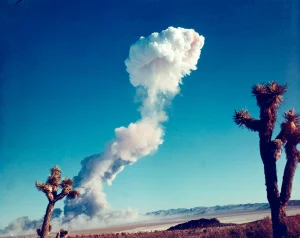
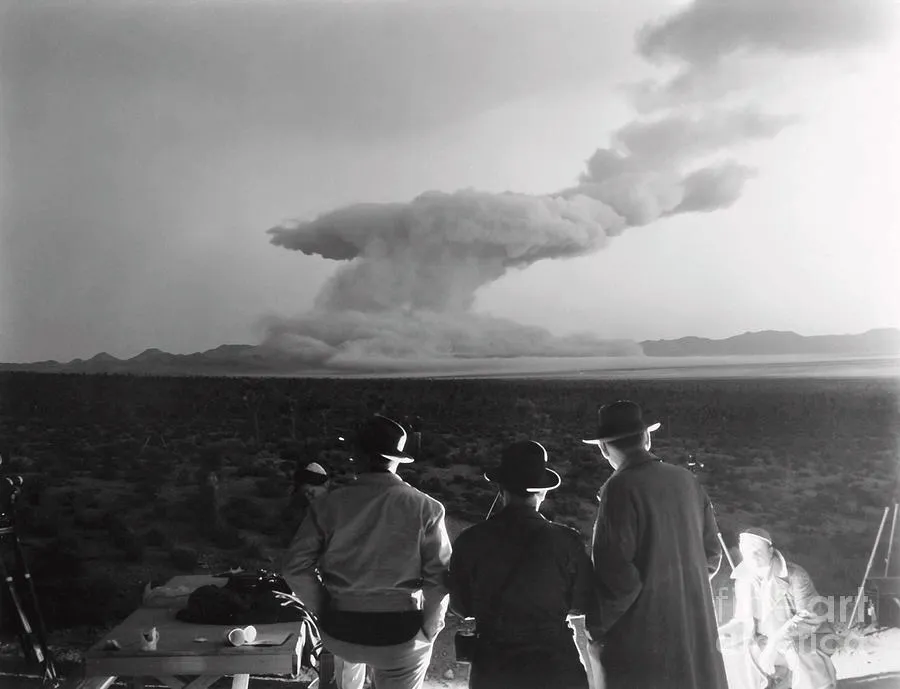
As in 1953, the FCDA did not supply its own bomb. It borrowed one. Operation Teapot was a series of fourteen tests at the Nevada Test Site between 18 February and 15 May 1955, beginning with a shot called Wasp and ending with Zucchini, and the biggest of them, Turk, yielded 43 kilotons. The shot the FCDA used was Apple-2, a second Apple device that was fired as a retest of an earlier one. It was part of the Desert Rock VI troop exercises. The Nevada National Security Site gives its yield as about 29 kilotons, a figure repeated by Wikipedia, although other sources put it at 30, 31, 35 or even 37. The bomb sat on a tower of about 500 feet in Area 1 of Yucca Flat.
That made it almost twice the size of the Annie shot, and roughly twice the Hiroshima bomb, which the New York Times pointed out when it called Apple-2 “twice as powerful” as the weapon that destroyed the Japanese city. The Oakland Tribune said the same thing in different words, that it had “twice the punch”.
Selling the test
A project on this scale needed money, goods and public relations. The FCDA turned to American industry, and industry came. About 150 companies took part, among them Airstream, Edison Electric, Ford, Kaiser Aluminum, Union Carbide, TWA, the National Automobile Dealers Association and the Venetian Blind Association. Some lent equipment, some supplied materials, and all of them recognised an unusually dramatic way to test a product. A car dealer in Dallas, D.L. Johnson, donated a car to the test on one condition, that he get it back, damaged or not, so that he could advertise the fact.
The FCDA also hired a public relations firm, the Freeman Company of Beverly Hills. Its advice, as it appears in the documents Wills has studied, shows how carefully the project was managed. It urged secrecy during the planning, in order to “crush” criticism before it began. It advised the agency to include children in the story, and it pushed a scheme it called Operation Tot-Tag, in which children would wear identification tags. The firm proposed that youngsters should watch Cue wearing theirs, and that tags should be shipped to the schoolchildren of Las Vegas. Jean Fuller, who headed the FCDA’s women’s activities, was enthusiastic and called Cue “terrific, interesting and exciting”.
All of this had a purpose. Officials described the test as a way to gather information and to correct public “misinformation” and “myths” about atomic weapons. The FCDA’s pamphlets, such as one called 4 Wheels to Survival, were designed to show what to do. The agency also made a documentary about the test, which included a “mass feeding” experiment.
Building Survival Town
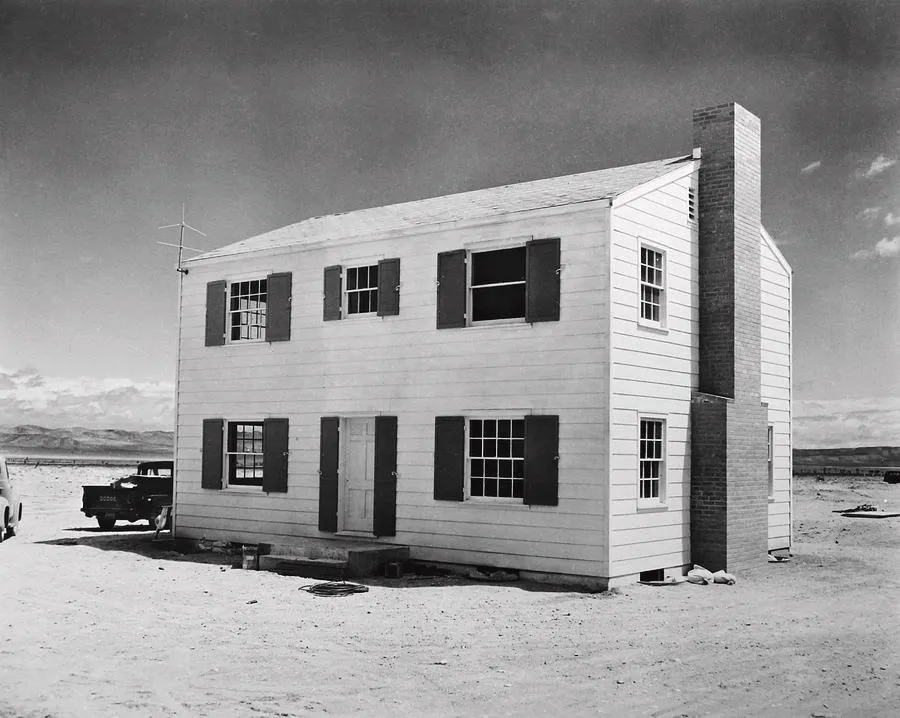
The town was larger and more varied than the first. It had radio towers, public utilities and a trailer park, and the American Institute of Architects helped with the modelling of its design, which resembled a scaled-down Lakewood, California. Construction took only a few months. The centrepiece was ten houses, arranged in five pairs, and each pair used a different kind of construction: single-storey ranch houses on concrete slabs, two-storey brick houses with basements, concrete block houses, precast concrete houses and reinforced two-storey frame houses. One house of each pair stood nearer to the tower than the other, closer to the point where collapse was expected, so that the engineers could compare the types. The NNSS fact sheet describes the group slightly differently, as two double-storey and three single-storey houses, and the Seattle Times counted 19 houses and other buildings, so I use “about ten”.
The other buildings were chosen to test the infrastructure that a real town would need. There was an electrical transformer station, a radio station, a propane tank filling station, a weigh station and several small buildings. Three steel buildings from Behlen Manufacturing of Columbus, Nebraska, stood on concrete footings at different distances, each beside two competing makes. There were also houses at about 5,500 feet, a shed beside a tank of liquefied gas, mannequins at 7,000 feet and a radio tower about two miles out. Cars and fire engines stood in the streets, and there was a trailer park. Dr. Harold Edgerton, a Nebraska native who developed high-speed cameras, had his cameras placed throughout the town.
The houses were furnished, and their pantries were stocked. The FCDA used about 90 food products, tinned and packaged, and flew in frozen food from Chicago on the day before the test. Then there were the mannequins.
What was on the shelves
The food was as carefully chosen as the houses. The FCDA selected 90 food products on the basis of the largest volume and most frequent use in the American diet. Tinned and packaged goods were stocked in kitchen pantries, and about 80 cans and jars were stored in kitchens and shelters. Some food was buried underground, to test whether it was still safe to eat afterwards. The National Association of Frozen Food Packers and the Evaporated Milk Association were among the sponsors. Fruit-flavoured gelatin, chocolate pudding, rice, macaroni and oatmeal were all tested afterwards and found to be normal.
A separate experiment covered feeding people. The civilian observers were housed in barracks that were named Survival City, and they were used to test how food for thousands of people could be flown and trucked in. The donors included the restaurant association and private firms, among them the Omaha hotelier E.C. “Gene” Eppley. The reporter Joan Collin tried the mass-feeding meals and praised the beef. The Venetian Blind Association of America had its own test.
Seventy dummies
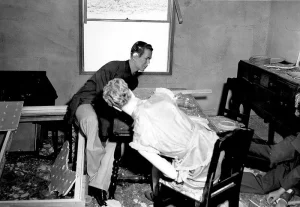
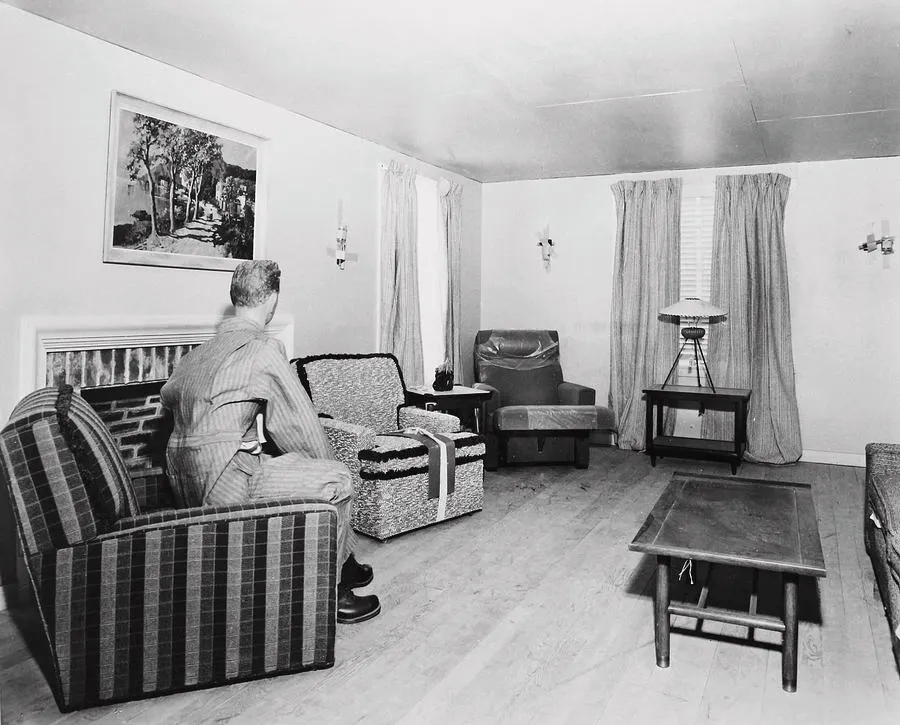
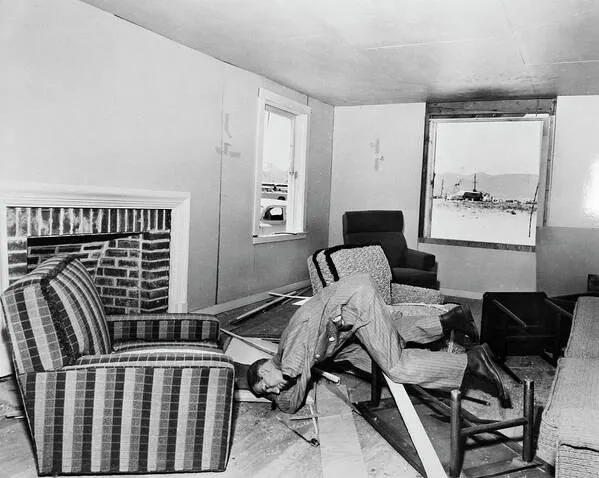
Archaeology magazine counts about seventy clothed figures in the town. J.C. Penney supplied the clothing again. The mannequins were arranged in domestic scenes: asleep in beds, seated before television sets, and loaded into cars and trailers. Some were lined up facing the blast. One news report later described a mannequin “tot” who was “blown out of bed and showered with needle-sharp glass fragments”.
The press, who had loved the Darling family in 1953, found new characters in 1955. One mannequin next to a larder wore a bikini. The Las Vegas Review-Journal’s Joe McClain wrote an interview with “Junior Darling”, a mannequin orphan whose father had ignored his mother’s wish for a safer house. It was a joke, but it showed how thoroughly the newspapers had taken the figures to heart.
The agency was, by this stage, adept at placing the dummies for effect. Press photographs taken before the blast showed a female mannequin in high fashion stacking tinned food, and families watching television together. The male mannequins were shown building basement shelters, and the female ones displaying tinned goods, in line with the FCDA’s campaign to persuade families to stock food. The whole display presented a white, middle-class nuclear family and told the audience that it could be saved.
Waiting
The test was set for the first days of May, and it was delayed. Strong winds forced postponement after postponement. By one count the test was nine days late, by another ten days late after five postponements. In Las Vegas, the delay became a story of its own. A Copa showgirl, Linda Lawson, was crowned “Miss Cue” at the Sands hotel and posed for photographers in a hat in the shape of a mushroom cloud, which the papers called an “A-Bomb Crown”.
The delay also meant that Cue competed with other attractions: a Motorola convention, the Tournament of Champions golf event and the Archie Moore and Nino Valdes prizefight were all in town, and the Las Vegas Sun called the crowd “the greatest jam of visitors in Las Vegas history”. The city did what it always did. Casinos served atomic cocktails and restaurants sold atomic hamburgers. Jake Freedman of the Sands told guests that their reservations could not be honoured because officials, press and observers had priority. A two-year-old boy lost his shorts waving at a helicopter and was nicknamed “Mr. Fallout” by the reporters. Elsewhere, ordinary people were less excited. Virgil Pinkley of the Salt Lake Tribune wrote that Las Vegas residents seemed to care more about the weather and the baseball than the bomb, and reporters noted that Las Vegas teenagers barely looked up.
Some local people were more engaged. A housewife, Marion Jacoby, asked to be allowed to sit inside a shelter during the blast, and called the idea “pioneering”. A resident named Robert Norman planned to watch it on television with a cup of coffee. Cy Crandall, the Las Vegas civil defence director, handled the logistics for the observers and was asked, at one point, about local bomb shelters.
5 May 1955
The shot was finally fired early on the morning of 5 May. The sources do not agree on the exact time. Wikipedia’s figure of 12:00:10 UT works out at 4:00 a.m. Pacific standard time, while others say 5:10 a.m. or simply dawn. The FCDA gave about a thousand official observers blue badges with a white mushroom cloud on them. Spectators watched from about six to seven miles away, and estimates of their number differ widely, from about 500 in one account to about 5,800 or 6,000 in others. Soldiers took part in the Desert Rock exercise, with tanks about two miles from the tower and men in trenches about three miles away.
NBC and ABC broadcast the explosion live. Estimates at the time put the audience at around 100 million, a figure that should be treated with caution. A Utah highway patrolman who saw the cloud from far away described it as turning “a beautiful hue”.
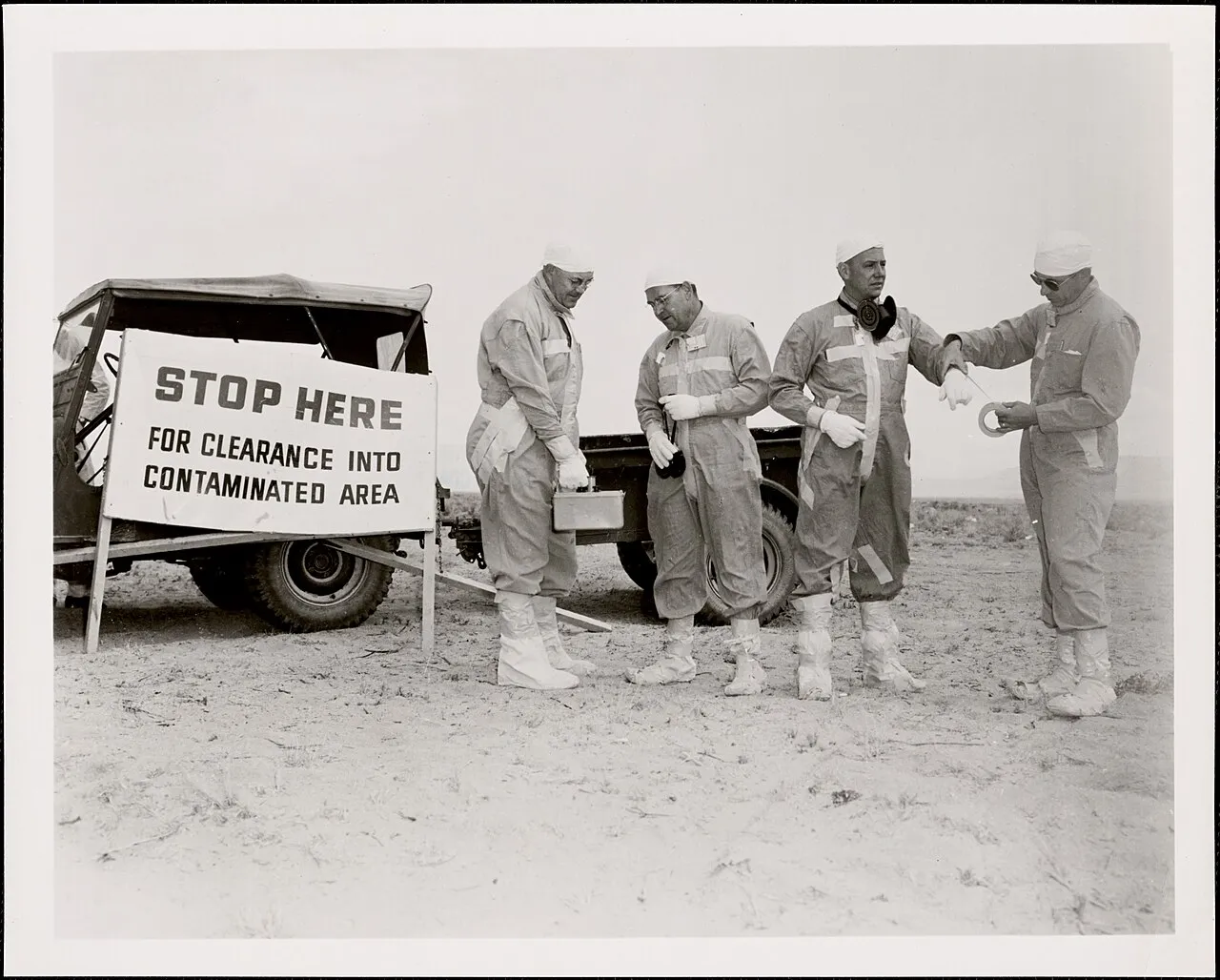
The people who were close felt the shock wave. Melba Scott, a civil defence official from Lincoln, Nebraska, was one of the observers. Assigned to the medical corps, which would have treated the wounded after a real attack, she wore goggles, a helmet and coveralls and stood about six miles from the blast. She later recalled that “the shock wave almost knocked us over”. What she remembered afterwards was the silence, which she described as so awesome that people withdrew into themselves. She added a line that has often been quoted:
You just can’t look into the bowels of Hell and not be changed.
Melba Scott, Lincoln, Nebraska civil defence official, recalling Operation Cue
Peterson, the FCDA chief, said he “felt like I was on top of a tremendous pile of jelly”, and called the result “our cue for a renewed effort”. An observer named Dewey Swicegood lost a shoe to the blast at seven miles. A woman in the crowd said afterwards that she had expected something more violent, and was surprised that she did not mind it. Violet Keppers, a 21-year-old Missouri housewife, said she saw “a stairway to hell” and cried.
Peterson, Scott and the steel building
Several of the people who were there came from Nebraska, and their stories show how the test spread into business and into private lives. Val Peterson, the former Nebraska governor, told the observers that civil defence work would begin once the media had left.
Three brothers from Columbus, Walter, Mike and Gilbert Behlen, came to see how their buildings would stand up. None of the buildings was designed to resist an atomic blast. The one at 6,800 feet, about 1.3 miles from the tower, survived. After the test Behlen Manufacturing began to market family and community blast and fallout shelters, hired Peterson as its shelter products adviser, and rebuilt the surviving building for display at state fairs, including the 1955 Nebraska State Fair. It shows how closely the test was tied to commerce.
Melba Scott, for her part, was never tested for radiation. She said that officials still could not tell her how much she would have received, but added, “I’m still here”. The experience left her committed to helping civilians survive a nuclear war.
What the bomb did
The results came house by house.
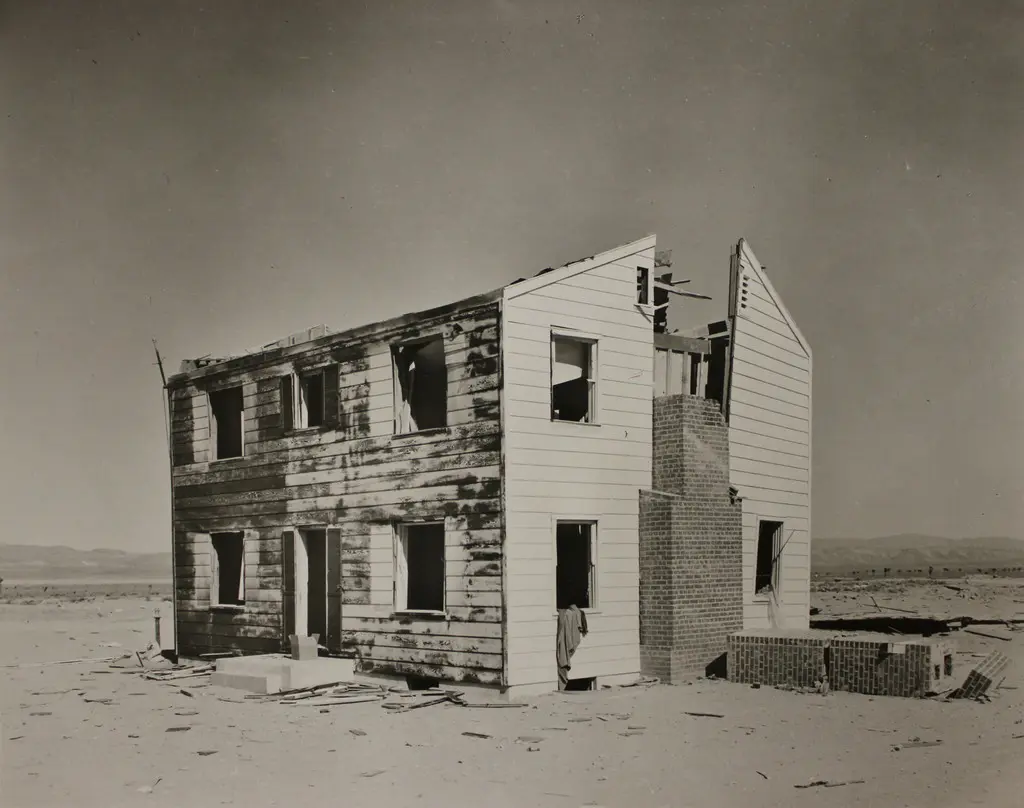
The brick house nearest the tower was reduced to rubble. A reinforced concrete house fared fairly well, although its windows were blown in. The two-storey frame house was damaged but still standing, and the brick house at the greater distance also stood. Blast pressure at the two-storey houses that survive today was about 1.7 psi. The wood-frame house stood about 6,600 feet from ground zero, and the brick house about 8,000. A basement shelter and a reinforced bathroom shelter both survived beneath ruined buildings, and two dogs that had been put in a bathroom shelter came out alive.
The infrastructure did better than might have been expected. The town lost power but kept its gas and telephone service. The radio towers, which stood about two miles out, were back on the air within a day or two. The Behlen building at 6,800 feet (a plaque in Nebraska gives 15,000) survived. Its roof bent by about two feet and the windows on the blast side shattered, but its pieces stayed bolted together, while other metal buildings at the same distance were destroyed. Melba Scott, looking at the brick house that stood at a distance, said, “That brick house survived great.”
The Albuquerque Journal reported that the explosion “cut a swathe of destruction” through the town “like a monstrous fiery scythe”, with no survivors and dummies left in distorted and unnatural poses. Media and military teams were allowed into the town about 24 hours later. They found what one newspaper described as “Dummies lay dead and dying in basements, living rooms, kitchens, bedrooms.” The Los Angeles Times’ Marvin Miles described what he called a “Terror Town”, with a headless mannequin soldier. Archie Teague, who had written an optimistic article in April under the headline “Doom Town to Show Way to Survival”, wrote a much grimmer piece in May headed “Dust Piles Over ‘Dead’ in Nevada’s Doom Town”.
A circus, or a lesson?
The FCDA praised the results.
Other voices were less sure. The Illinois civil defence director, Robert Woodward, called the whole thing “a lot of big ballyhoo” and “a waste of energy”. The press labelled it the “6-million-dollar atomic circus”.
John Cahlan, writing in the Las Vegas Review-Journal, called the television broadcast “one of the greatest horror programs ever produced” and described Doom Town II as a city “built to live for but one day”. Elton Fay of the same paper wrote about “death” and destruction in the atom-blasted town and celebrated the dogs that had survived. A Las Vegas resident, Cable B. Jones, took a more practical view and designed what he called “atomic resistant” walls after seeing the damage.
The historian John Wills reads the whole affair as a failure of imagery. The FCDA hoped to reassure, and it showed instead a family in a ruined living room. It had wanted the public to see a lesson in survival and what they saw was a nightmare. In Wills’s reading, Cue made the nation share in the fear that the government had meant to relieve. It was a “fallout” of a different kind, he says, shifting the mood of the country toward fatalism and helping to turn Americans against atomic testing.
The film
The test produced more than a news story. The film company 20th Century Fox made a twenty-minute short called Survival City, directed by Anthony Muto and produced by Edmund Reek, about an atomic test on a small American town. It won the Academy Award for Best Short Subject (One-Reel) at the 28th Academy Awards in 1956. Wikipedia notes that the film does not mention Operation Cue by name. A British trade paper called it “operation Q” and said it had cost about a million dollars. Wills says it played in several hundred cinemas, somewhere between 300 and 500.
The FCDA also made its own film. It included a visit by Joan Collin and the mass-feeding experiment. In both films the message was supposed to be a hopeful one.
What is left
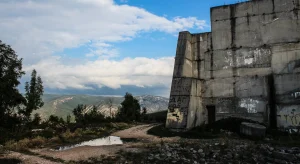
The 1955 town was not entirely destroyed, and that is the main reason it can be visited. Two two-storey houses, one brick and one wood frame, still stand in Area 1, along with some bungalows. Archaeology magazine counts three bungalows and a pair of two-storey houses, while the NNSS and Wills mention only the two big houses.
Inside there is not much to see. A team from the Desert Research Institute, led by Colleen Beck, examined and recorded the two houses. They found that the mannequins and most of the furniture were gone, though a table and some shelving remained. At the point where the tower stood, the steel anchors are still bolted into the ground. The Seattle Times reported in 1998 that the houses might be nominated for the National Register of Historic Places.
The houses are a highlight of the tours of the Nevada National Security Site, which are booked months ahead and do not allow cameras or phones. They are the only physical trace of the idea that a nuclear war could be survived with a basement and a stocked pantry.
Conclusion
Operation Cue was meant to be the proof. The FCDA built the most careful test it could, with houses of every construction, shops and services, food from half the country and seventy mannequins in their best clothes, and it set an atomic bomb off above them to show that civilian life would go on. The test did give real answers. Brick failed first. Concrete held. A basement or a reinforced room could shelter a person under a collapsed house.
The trouble was what the public saw. The FCDA’s own account was that these were successes, but the cameras showed a town in ruins, a mannequin thrown from its bed, glass in the rooms. The newspapers called the town “Doom Town” before the test and “Terror Town” after it. A woman who stood in the desert and said she had looked into the bowels of Hell did not sound like someone who had been reassured.
Two houses are all that is left, and they stand in the middle of a vast, empty range in a landscape built to be forgotten. The test that was designed to show that survival was possible is now a record of how afraid Americans were that it was not.
Did you know?
- Apple-2 was fired on 5 May 1955 and yielded about 29 kilotons according to the Nevada National Security Site.
- Operation Teapot had 14 tests, between 18 February and 15 May 1955.
- About 150 companies took part in the civil defence town, including Ford, Airstream and Kaiser Aluminum.
- The code name Cue was chosen partly to stop reporters calling the project "Doomtown".
- Delays gave the test the nickname Operation Mis-Cue.
- Showgirl Linda Lawson was crowned "Miss Cue" at the Sands hotel in a mushroom-cloud hat.
- The town had about ten houses, a radio station, a propane filling station and about 70 mannequins.
- NBC and ABC broadcast the blast live.
- The film Survival City won an Academy Award in 1956.
- Two of the houses still stand in Area 1 of the Nevada National Security Site.