A dam for the Ruhr
The Ruhr was the industrial centre of Germany, and by the start of the twentieth century it had a thirst that its rivers could not satisfy. Coal mines, steelworks, chemical plants and fast-growing towns all drew on the same water, and in dry summers the Ruhr ran low. In 1904, calculations of the area’s future needs led the Ruhrtalsperrenverein, the association responsible for the Ruhr’s reservoirs, to decide on 28 November to build new dams in the hills upstream.
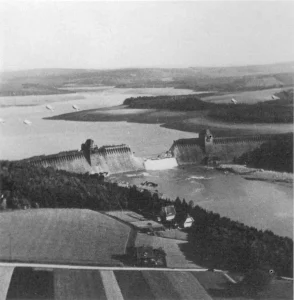
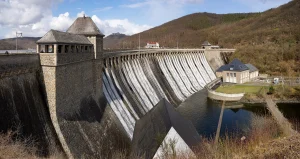
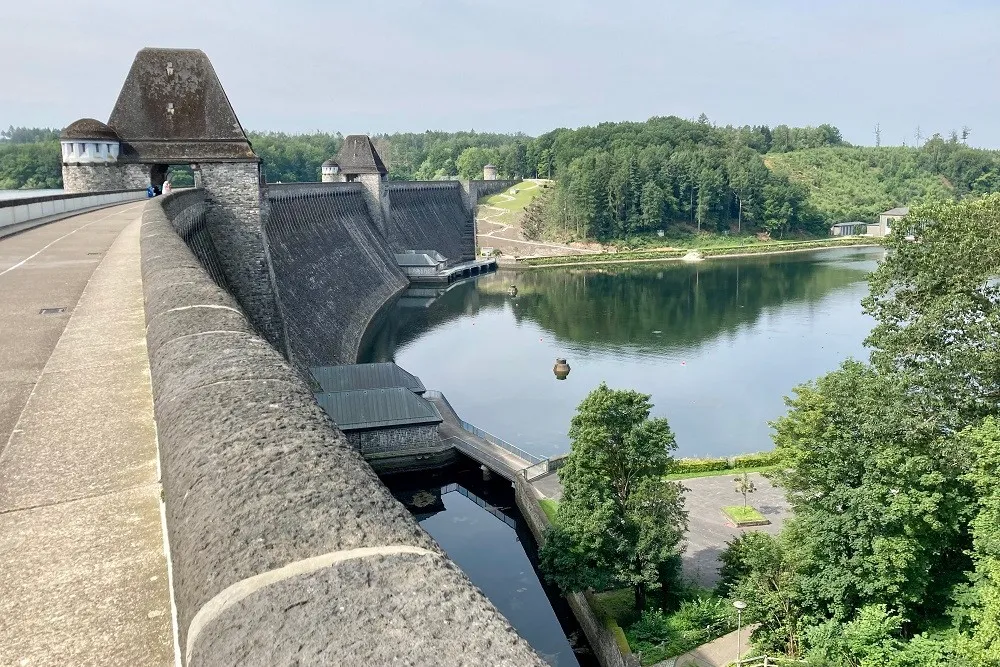
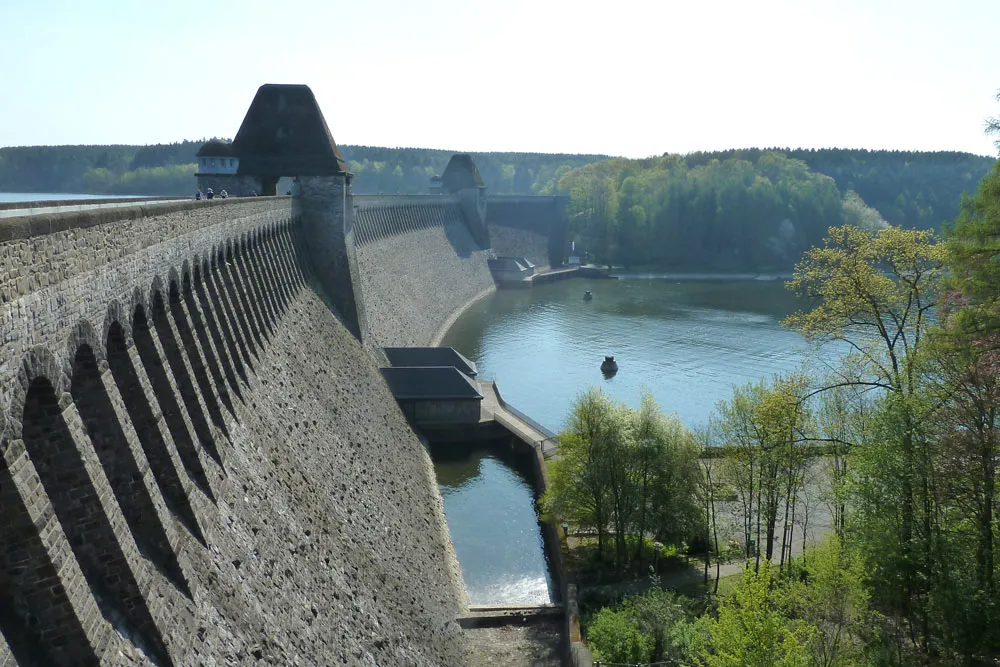
The Möhne Dam was the first large project of the association. Work began in 1908 on the edge of the Arnsberg Forest, in the valley where the Möhne river meets the Heve. The cost was around 25 million marks. The dam was designed with architectural care by Franz Brantzky, and its wall has distinctive arches along the top. It opened in 1913 and was described at the time as the largest dam in Europe.
Building it also meant moving people. About 140 homesteads, home to roughly 700 people, had to make way for the lake that would fill the valley.
The lake behind the wall
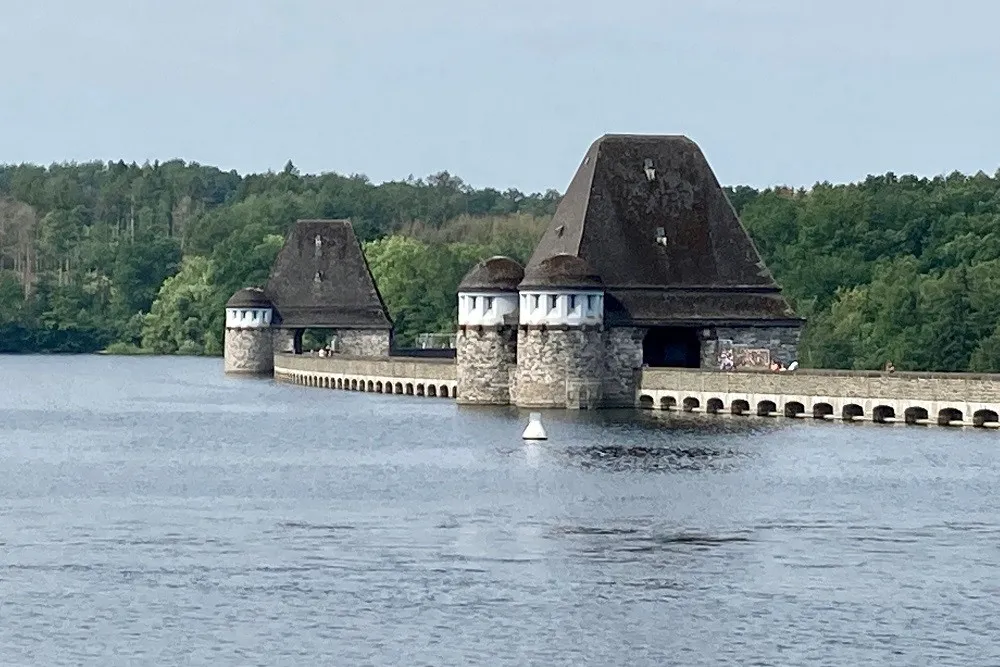
The Möhnesee is not one simple basin. It is formed by damming both the Möhne and the Heve, and its storage is spread across four basins, with a catchment area of about 432 square kilometres. The Heve arm is now a separate nature reserve, and the Heve forebay is a protected habitat in its own right. For the people who lived in the valley, the lake meant leaving their homesteads, and for the Ruhr’s towns downstream it meant a more reliable supply of water.
How the wall works
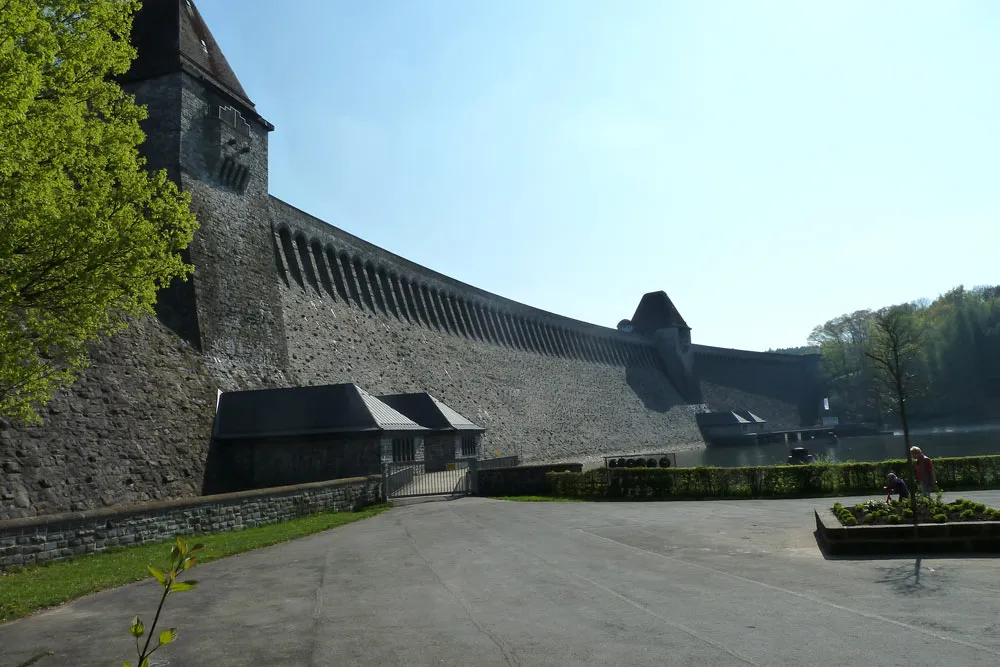
The Möhne is a gravity dam: it holds back the water simply through its own weight. The wall is built of quarry stone laid in masonry, following the Intze principle, a German design method of the time for masonry dams. At its highest it measures about 40 metres, and along the crest it is about 650 metres long. At the base it is 34 metres thick, and the crest is about 6 metres wide, which is why the dam looks so massive in photographs.
The reservoir behind it holds about 134 million cubic metres of water. It was designed to even out the flow of the Ruhr, storing the water of wet periods and releasing it in dry ones, to supply the towns and industry downstream, to help control floods and to produce hydroelectric power. At the foot of the wall, a power station took advantage of the drop. The Ruhrverband, which runs the system today, says that this one lake holds more than a quarter of the reservoir storage in the whole Ruhr catchment.
Marked for destruction
British planners had singled out the Ruhr’s dams long before 1943. Their reasoning was that the valley’s reservoirs supplied hydroelectric power, drinking water and process water to the steel and coal industries, and that a breach would cripple them. The weapon to do it arrived with Barnes Wallis’s Upkeep, a spinning cylindrical mine that could be skipped across the water and made to sink against the wall. The full story of the raid is told in Operation Chastise. The Möhne was its first and main target.
The Germans had not ignored the threat. The reservoir was protected by torpedo nets, and flak positions stood near the dam. The crews who approached it on the night of 16 to 17 May 1943 flew at about 60 feet, along a lake lying in a narrow valley, towards a wall defended by guns.
The night of 16 to 17 May 1943
Wing Commander Guy Gibson made the first attack. He released his mine at the right height, and it exploded against the wall without breaking it. Other aircraft followed. The second aircraft, flown by John Hopgood, was hit by flak and crashed. Gibson and others flew alongside the following aircraft to draw the German gunners’ attention. A mine dropped by Henry Young made a small breach, and then David Maltby’s mine exploded against the wall in the right place. The crack widened under the pressure of the water, and the wall gave way.
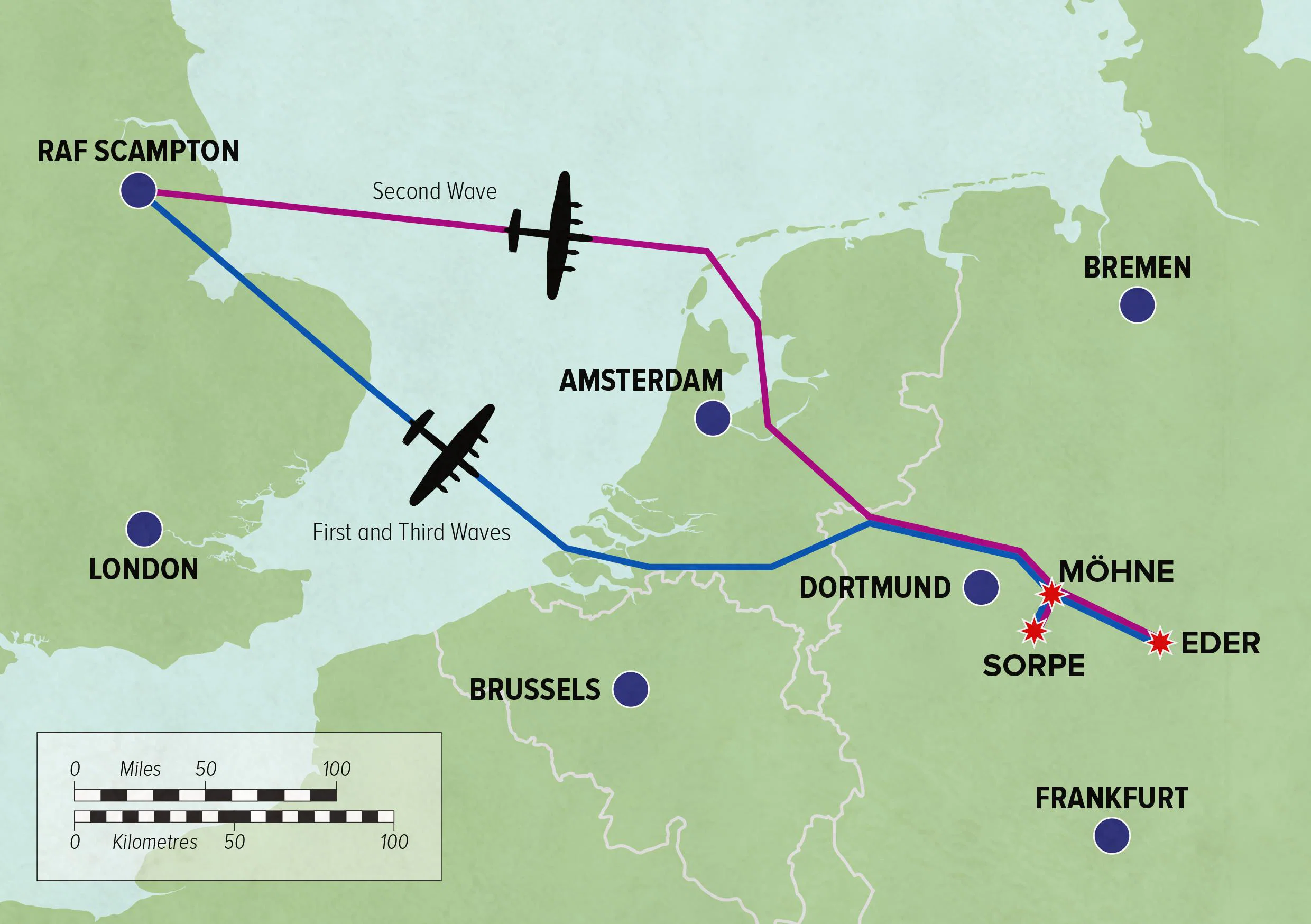
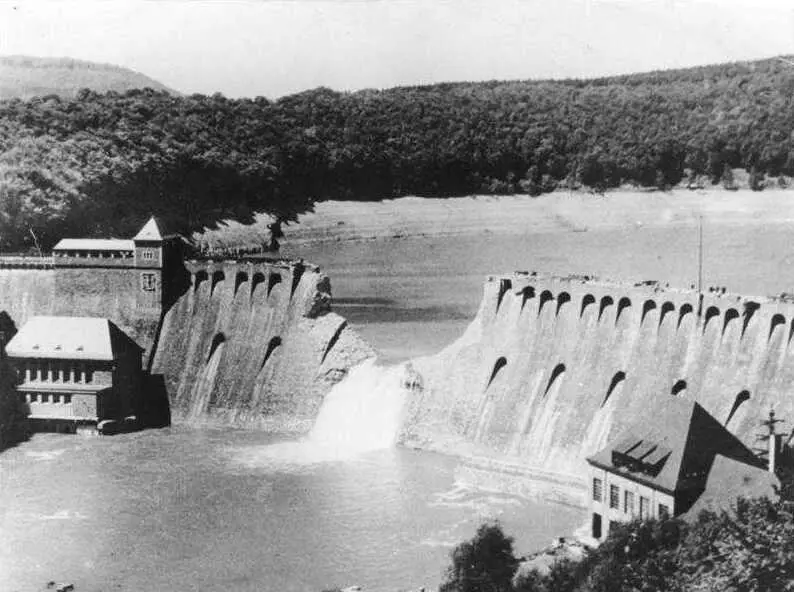
What followed was seen by the crews from the air. The breach, about 77 metres wide and 22 metres deep, released more than 100 million cubic metres of water into the valley below. A wall of water about ten metres high rushed down the Möhne towards the Ruhr, carrying away buildings, bridges and roads. Gibson then led the remaining aircraft on to the Eder Dam, further east.
Why it was the key target
The Möhne was among the largest of the Ruhr’s reservoirs, and it was the first named target of the raid. Planners expected that its loss would hit the region’s water supply and hydroelectric power. The raid was therefore built around it: the first and largest formation was sent to the Möhne, and only the aircraft that still had mines were to go on to the Eder.
The flood and its victims
The human cost of the breach was heavy. The most commonly cited figure is that at least 1,500 people were killed in the valley, with the minimum given elsewhere as 1,579. Most of the dead were not German civilians. A prisoner-of-war and forced labour camp stood about five kilometres below the dam, and its inmates were among the first to be hit by the water. More than 1,000 of the victims were foreign forced labourers and prisoners, many of them from the Soviet Union. In the town of Neheim-Hüsten, more than 800 people died.
The damage to industry was also real. Two power stations were destroyed, including the one at the foot of the dam, and water and electricity supplies were disrupted for weeks. Albert Speer, the armaments minister, later wrote that the power station at the foot of the shattered dam looked as if it had been wiped away, turbines and all.
Repair
The German response was quick. The Organisation Todt, the Nazi construction organisation, began repairs within days. It moved about 7,000 workers who had been building the Atlantic Wall, as well as prisoners of war and forced labourers, to the Möhne. The gap was closed and the lake was filling again by September 1943, and the repair is generally recorded as complete on 23 September, a little over four months after the raid. Industrial output in the Ruhr did not fully return to normal until that month.
The wall had been closed, but the dam had not been fully restored. The damaged bottom outlets were not rebuilt until 1950, when a new power station replaced the destroyed one. Further work followed in 1970, with a drainage and inspection tunnel, and again in the 1990s, when the drains and outlet pipes were renewed and about 20,000 square metres of the wall’s downstream face was renovated.
The dam today
The Möhne Dam is still working. It regulates the flow of the Ruhr, provides flood protection and contributes to the drinking water supply of the region. The power station below the wall produces electricity for roughly 3,000 households. The wall itself is a listed building, protected because of its architecture and its history, and its centenary in 2013 was marked by events around the lake.
The lake, the Möhnesee, covers about 1,040 hectares and is the largest reservoir by area run by the Ruhrverband. It lies about 45 kilometres east of Dortmund, and it is now primarily a place for leisure: sailing, rowing, diving, fishing and swimming in designated areas, with a footpath along the crest of the dam and views of the arches. It is also a protected habitat. The lake is a Natura 2000 bird sanctuary, home to between 4,000 and 6,000 waterfowl, mainly tufted duck, mallard and coot, and the Heve arm is a nature reserve.
Visiting and remembering
Visitors can walk along the top of the wall and look down on the power station and the valley that the water swept through in 1943. The dam has become a place of interest for people who know the story of the raid, which was made famous by the 1955 film The Dam Busters. The lake itself, with its beaches and paths, draws many more people who have come simply to enjoy the water.
Anyone visiting should stay on the public paths and observe any signs on and around the dam, which is a working industrial site. For the other targets of the same raid, see the Eder Dam, which was breached a short time later, and the Sorpe Dam, which survived. The raid also invites comparison with another famous operation against a single industrial target, the attack on Vemork.
Conclusion
The Möhne Dam is two things at once: a piece of early twentieth-century engineering that still does the job it was built for, and the site of one of the most famous bombing raids in history. The raid broke the wall in minutes, and the Germans mended it in months. What it could not undo was the loss of life in the valley below, most of it among people who had no say in the war. Today the dam is calm and well used, and a visit is a reminder that the same stone wall has served both purposes.
Did you know?
- When it opened in 1913 it was described as the largest dam in Europe.
- About 140 homesteads and 700 people had to move to make room for the lake.
- The wall is about 40 metres high, 650 metres long and 34 metres thick at the base.
- Its bottom outlets, damaged in 1943, were not rebuilt until 1950.
- The Möhnesee is a Natura 2000 bird sanctuary for between 4,000 and 6,000 waterfowl.
- The wall is a listed monument.