A dam for the Weser
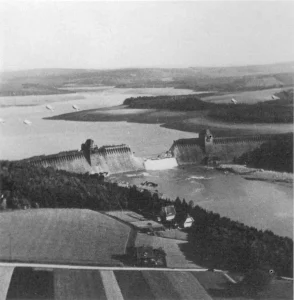
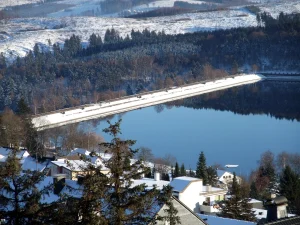
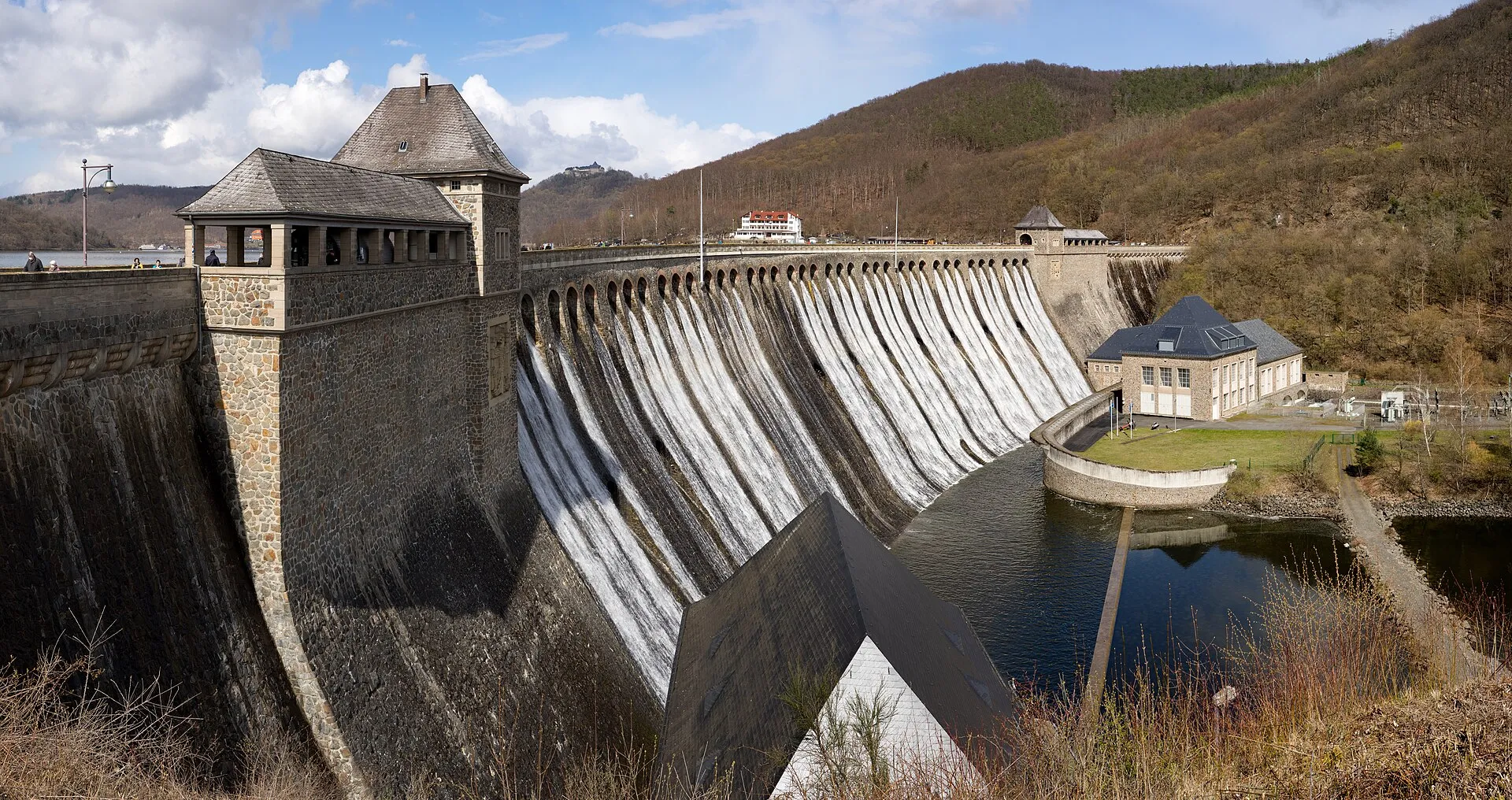
The Eder Dam is in Waldeck-Frankenberg in northern Hesse, close to the town of Waldeck on the northern edge of the Kellerwald hills. It was built to hold back the waters of the Eder river, a tributary of the Fulda. Its main purposes were practical and quite specific. Water released from the lake would keep the level of the Weser high enough for shipping through the dry months, and the fall of the water would drive turbines to produce electricity.
Work started in 1908, and about 900 workers began the job. The wall is a masonry gravity dam, built from about 300,000 cubic metres of stone. When it was finished in 1914, it stood 48 metres high and stretched 400 metres across the valley. The crest is 6 metres wide and the base is 36 metres thick. An inauguration ceremony for Kaiser Wilhelm II had been planned for 28 August 1914. The outbreak of the First World War cancelled it.
The lake and the lost villages
The lake that filled behind the wall, the Edersee, is large. It stretches for about 27 kilometres and holds about 199 million cubic metres of water, making it the third largest reservoir in Germany. At the foot of the dam it is about 42 metres deep.
The price of the lake was paid by the villages of the valley. Asel, Bringhausen and Berich were submerged when the reservoir filled in 1914. Their people had to leave, and the buildings went under the water. In very dry spells, when the lake falls low, the remains reappear: the remains of the villages and a bridge. Visitors call it the Edersee Atlantis, and descendants of the former residents sometimes come to visit the graves of their ancestors.
Power and the Weser
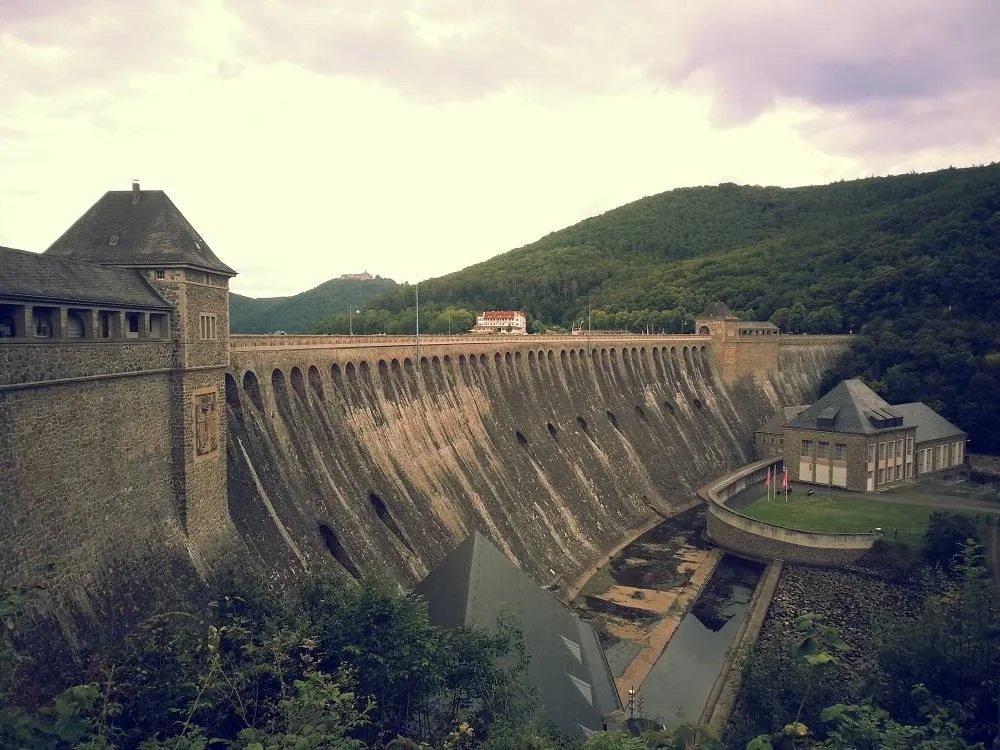
At the foot of the wall, the power station uses a drop of about 45 metres to generate electricity, with an installed capacity of 21 megawatts. The lake also serves a second purpose that is less obvious from the shore. In dry summers the water released from the Edersee raises the Weser far to the north, so ships can keep moving.
These functions made the dam an important part of the regional system, and they were part of the reason why British planners put it on the target list in 1943, although Albert Speer later argued that the Eder had nothing to do with the Ruhr’s water supply.
Three walls compared
The Eder and the Möhne were built within a few years of each other, and both are masonry gravity dams, but they are not alike. The Möhne is longer, at about 650 metres against the Eder’s 400, while the Eder is taller, at 48 metres against about 40. The Eder’s lake is also larger, holding about 199 million cubic metres against the Möhne’s 134 million. In 1943 the difference was more than numerical. The Möhne lay in a narrow valley close to the industrial Ruhr, and its flood hit densely used land and camps. The Eder lay further from the Ruhr, in the hills of Hesse, and the loss of life it caused was far lower.
The Eder’s main role was also different. The Möhne served the Ruhr directly, with water for industry and towns, while the Eder served the Weser and the power grid. Speer, writing after the war, claimed that the Eder had nothing to do with the Ruhr’s water supply, although British planners counted it among the three main dams. Even so, the raid showed that the second wall could be broken in the same way as the first.
Target number two
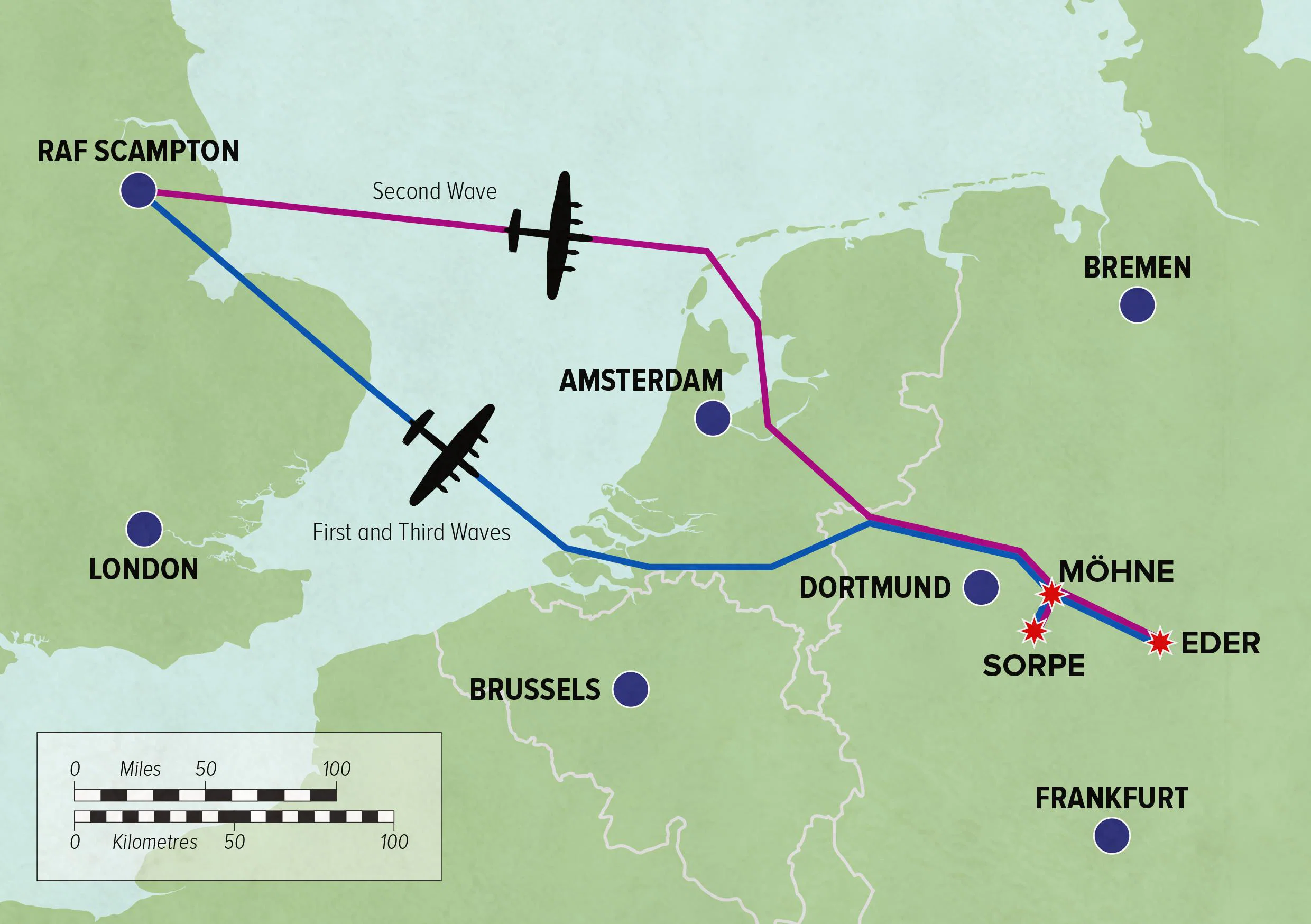
The Eder was the second target of Operation Chastise. After the Möhne had been breached, Wing Commander Guy Gibson led the remaining aircraft of the first formation east to the Eder. By then the force had already lost several aircraft, and only a few mines remained.
The Eder was different from the Möhne. It was not defended by anti-aircraft guns, but the geography was much worse for the pilots. The valley was filled with fog, and the approach meant dropping into the valley over a steep hillside and then lining up on the wall at the right height, with little room to correct. Flight Lieutenant Dave Shannon made six attempts before releasing his mine, which had no effect. Flight Lieutenant Henry Maudslay’s mine hit the top of the dam, and the explosion damaged his own aircraft. Flight Lieutenant Les Knight then dropped his mine, and this time it breached the wall.
According to the Edersee’s own history, it was 01:51 on 17 May 1943 when the bomb struck. The gap in the wall measured about 70 metres wide and 22 metres deep.
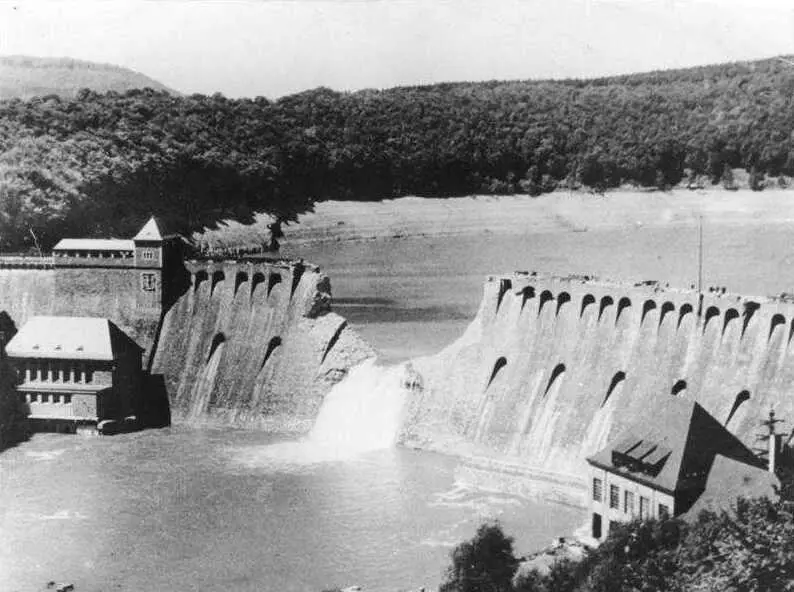
The flood
The lake began to empty at once. About 96 million cubic metres of water escaped in the first eight hours, and at the peak the discharge was about 8,000 cubic metres a second. A wave six to eight metres high ran down the valley, and its effects were felt up to about 30 kilometres downstream. The water stopped flowing through the breach on the third day.
The consequences were much less severe than at the Möhne. German research puts the number of dead at about 70. Some English-language sources cite a figure of 749, but that was a mistake: it refers to foreigners killed in the camps downstream of the Möhne, not the Eder. The wave had lost much of its force by the time it reached Kassel, about 35 kilometres from the dam.
Repair
As at the Möhne, the Germans acted quickly. The Organisation Todt took charge of the work, using prisoners of war and forced labourers brought from Atlantic Wall construction. The gap was closed by September 1943. The same organisation, using the same sources of forced labour, repaired the Möhne in the same summer, and both walls were holding water again by the autumn of that year.
The wall has been strengthened since then. Later checks showed that its stability could not be guaranteed in the case of an extreme flood, so 108 anchors were fixed into the rock below it, the base drains were upgraded and the stilling basin below the wall was enlarged.
Visiting the Eder
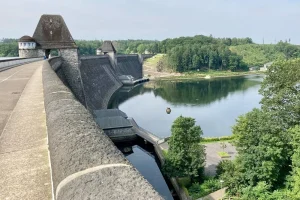
The dam is easy to reach. It stands near the village of Hemfurth and the town of Waldeck, and the Edersee Visitor Centre sits close to the wall. Visitors can walk across the top of the dam, look down at the stilling basin and the power station below, and see the lake from above. Between June and September, guided tours of the dam are held on set days. Booking is required, so it is best to check the Edersee tourist information in advance. Because the wall is being renovated, parts of it may be covered by scaffolding for the next few years.
The submerged villages are a different matter. They can only be seen when the water level has dropped, which depends on the weather and the demands on the lake, so there is no way to plan a visit around them with certainty. When the villages do reappear, visitors are asked to respect the graves and the remains.
The dam today
The Edersee is now one of the main leisure destinations in Hesse. It is a major summer recreation area, and many visitors come simply to see the dam itself. In 2014 the wall was fitted with 39 LED spotlights to illuminate it at night, and the tourist office describes it as the longest permanently colour-changing illuminated structure in the world. Guided tours of the dam are held in the summer months, from the visitor centre, and the footpath over the top is open to the public.
At the time of writing, renovation work on the wall was expected to continue until the end of 2027, and scaffolding may restrict the view in places, so it is worth checking before a visit. The dam also appears in popular culture. It features in the 1955 film The Dam Busters, and a level in the 2003 video game Call of Duty is set there.
The Eder is one of three dams in the story of the raid. Its sister dams are the Möhne Dam, the first target and the scene of most of the deaths, and the Sorpe Dam, which withstood the attack. The raid itself has a close parallel in the commando attack on Vemork, in Norway.
Conclusion
The Eder Dam shows how a single wall can have more than one story. For its builders it was a feat of engineering that served the Weser and the power grid. For three villages it was the reason they now lie under water, and for the crews of 617 Squadron it was a dark, foggy valley and a very hard target. The raid broke it in minutes, and it was repaired in months. Today it is a place where the lake, the villages and the wall are all part of the scenery, and where the history of 1943 is one layer among several.
Did you know?
- The Edersee is the third largest reservoir in Germany.
- Three villages, Asel, Bringhausen and Berich, lie beneath its waters.
- The inauguration planned for the Kaiser on 28 August 1914 was cancelled by the outbreak of war.
- About 96 million cubic metres of water escaped in the first eight hours after the 1943 breach.
- The 749 figure often quoted for the Eder flood is a mistake and belongs to the Möhne.
- The wall has been lit by 39 LED spotlights since 2014.