
A reactor in the sagebrush
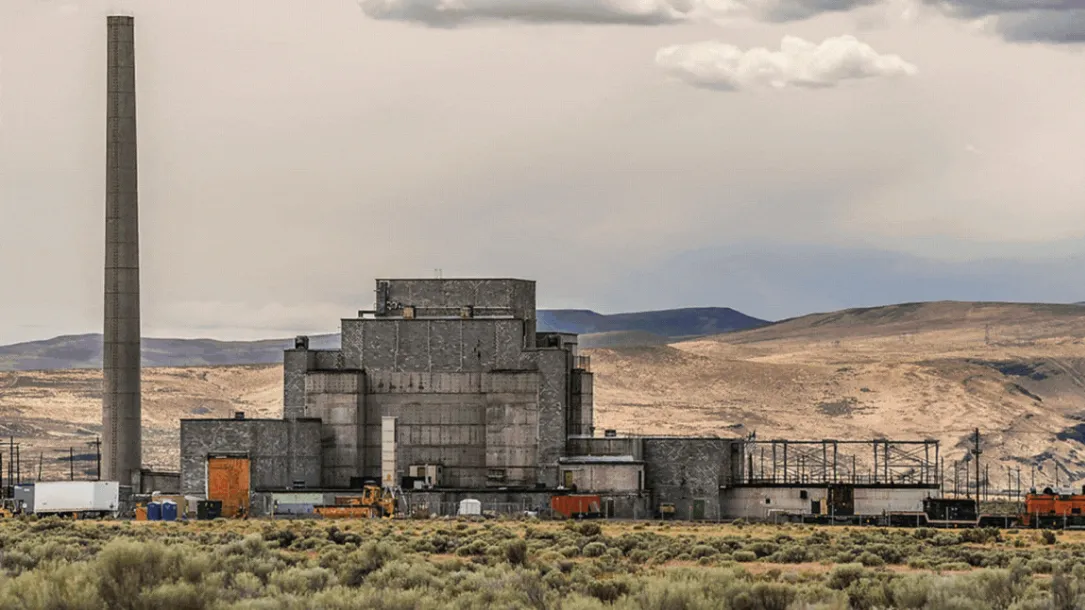
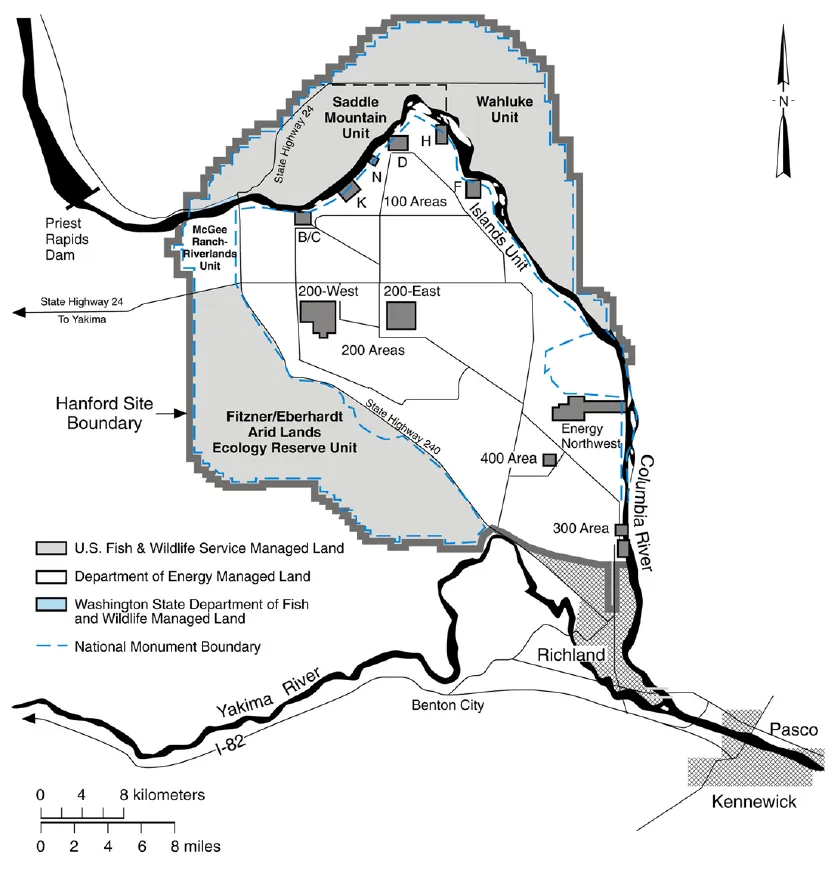
B Reactor stands on the south bank of the Columbia River in the 100-B Area of the Hanford Site, in Benton County, south-eastern Washington. The nearest city is Richland. It was the world’s first full-scale plutonium production reactor: a graphite-moderated, water-cooled machine designed to run at 250 megawatts of heat, built by the E. I. du Pont de Nemours company for the Manhattan Project.
Its job was narrow. Natural uranium goes in, neutrons turn a small part of it into plutonium-239, and the fuel is pulled out and sent to chemical plants where the plutonium is separated. The plutonium that came out of Hanford went into the device fired at the Trinity test on 16 July 1945 and into the Fat Man bomb dropped on Nagasaki on 9 August 1945. B Reactor kept running through the early Cold War, was shut down in 1968, and is now the only one of Hanford’s nine production reactors that was not entombed. It is open to visitors on guided tours.
The plutonium route was chosen partly because the alternative was so heavy. The uranium-enrichment plant at Y-12 in Tennessee drew on 14,700 tons of silver borrowed from the US Treasury and about 22,000 workers, according to Wikipedia. A reactor needed a great deal of graphite, cooling water and electricity, but far fewer people to keep it running.
Choosing the site
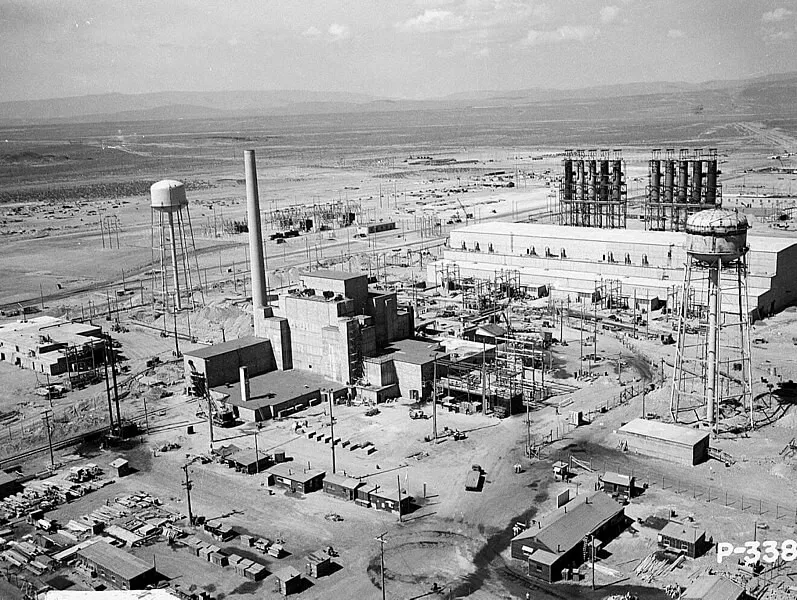
Brigadier General Leslie Groves took charge of the Manhattan Project on 23 September 1942. Oak Ridge in Tennessee was first considered for the production reactors, but DuPont’s Walter Carpenter objected because it lay only about 20 miles from Knoxville. Groves worried that even a small accident could disrupt aluminium production or the isotope separation plants nearby. Planning in December 1942 assumed six reactors and four separation plants.
The criteria for a new site were strict. It needed at least 25,000 gallons of water a minute and about 100,000 kilowatts of power. The hazardous area had to be at least 12 by 16 miles, the laboratories at least 8 miles from any reactor or separation plant, and the workers’ village at least 10 miles upwind. There could be no town of more than 1,000 people within 20 miles of the hazardous area, and no main highway, railway or village within 10 miles of it. The ground had to bear heavy loads. Electric power mattered most. The Tennessee Valley Authority was ruled out because Oak Ridge was expected to absorb its surplus.
Lieutenant Colonel Franklin Matthias, with DuPont engineers A. E. S. Hall and Gilbert Church, surveyed possible sites from 18 to 31 December 1942. The list included places near Coeur d’Alene in Idaho, Mansfield in Washington, several river valleys in Oregon, the Pit River in California, and Blythe and Needles on the Colorado River. On 1 January 1943 Matthias told Groves that the Hanford area was far more favourable than any other. It had abundant gravel for concrete, firm ground, and a high-voltage line from Grand Coulee to Bonneville running through it. Matthias later recalled his first sight of the land near Rattlesnake Mountain and said he knew at once it was the place. Groves approved the site on 16 January 1943. It became the Hanford Engineer Works, code-named Site W.
DuPont takes the job
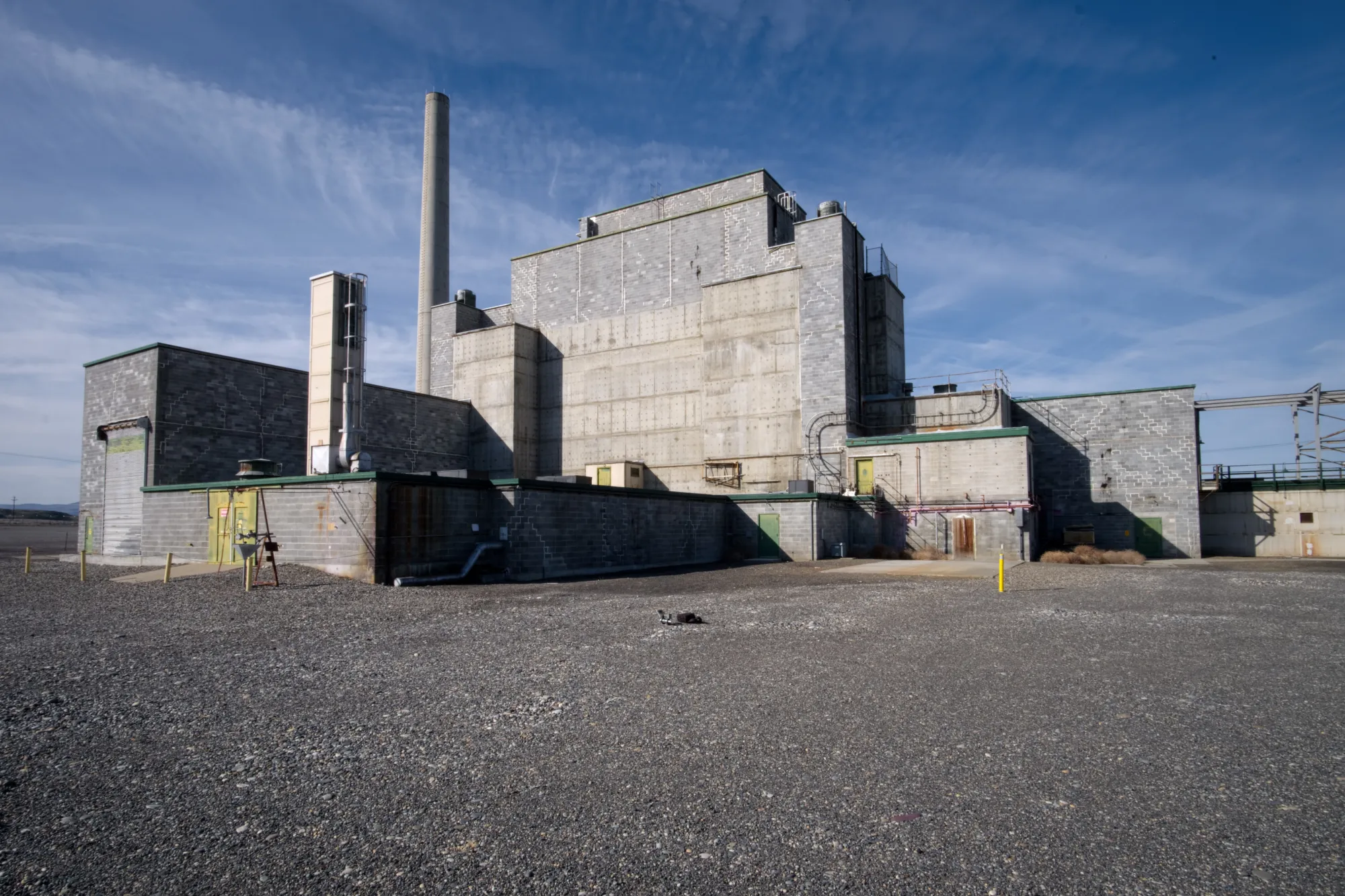
Groves chose DuPont as prime contractor because it designed and built its own plants, which cut down the number of firms he had to coordinate. DuPont protested that it had no expertise in nuclear physics. It first refused payment, then accepted a cost-plus contract with a fee of one dollar. At Carpenter’s request President Roosevelt initialled a letter stating that the government accepted responsibility for all the hazards of the project.
The work held the War Production Board’s AAA rating, the highest priority for materials. Matthias ran the site as area engineer with unusual independence, since the poor communications made daily reporting to the Manhattan District headquarters in Oak Ridge impractical. About 90 percent of DuPont’s engineering staff eventually worked on the project, and the physics came from the Metallurgical Laboratory in Chicago, where Enrico Fermi’s experimental piles had been tested, and from the X-10 Graphite Reactor at Oak Ridge, which reached about 4 megawatts by mid-1944. B Reactor was designed for a power level about a million times higher than Fermi’s first experimental piles.
Taking the land
Secretary of War Henry Stimson authorised the acquisition on 8 February 1943. A project office opened in Prosser on 22 February, and Judge Lewis Schwellenbach issued an order of possession the next day. The first tract was acquired on 10 March 1943.
The people who lived there were farmers, orchardists and townspeople in White Bluffs, Hanford and Richland. The numbers vary by source: Wikipedia’s article on the Hanford Engineer Works says about 1,500 people were displaced, while the Atomic Heritage Foundation puts the population of the towns and surrounding farms at about 2,000, with about 2,300 cited for early 1943. The Army moved 177 graves from the White Bluffs cemetery to Prosser. The area it set out to buy was 4,218 tracts covering 428,203.65 acres, about 670 square miles. The Atomic Heritage Foundation gives a larger figure of about 580,000 acres for the whole site, and the area has since been cut back to about 586 square miles.
Secrecy shaped everything. Officials said only that the land was needed for a wartime military project. Notice periods are recorded differently. One history says residents were ordered out on 5 July 1943 with two days’ notice, after Groves had postponed possession so that crops could be harvested. The Atomic Heritage Foundation records notice of between 28 and 90 days, and one family’s notice of exclusion, citing Public Proclamation No. 18 of 14 July 1943 and signed by Matthias, ordered the family to leave by 30 September 1943. The ordeal was real either way. Families had to sell livestock, machinery and goods quickly and at poor prices.
Compensation was the biggest grievance. Federal Land Bank appraisers visited in winter and valued farms low. Farmers also wanted payment for the crops in the ground. By 18 June 1943 only 19 checks had gone out for about 2,000 completed transactions. The irrigation districts organised opposition and hired lawyers, and a Senate committee led by Harry Truman looked into the matter. Truman agreed to drop the site from its inquiries on grounds of national security, and in July 1943 he privately described the land as being for a secret weapon.
Many farmers got their land reappraised and settled out of court for more. Matthias favoured settlements because they saved time, which mattered more than money in wartime. The first condemnation trial opened on 7 October 1943, and juries in Yakima, who distrusted the appraisals, awarded amounts well above them. When the Manhattan Project ended on 31 December 1946, 237 tracts were still unsettled. Land acquisition had cost $5,148,462.
Some families never felt the settlement was fair. Walt Grisham, whose family farm in the area grew grapes, apricots and peaches, said the appraisal left out buildings, irrigation systems and fences. He did not question the project’s importance. His complaint was about the way it was done.
The tribes of the river
The Columbia at Hanford had been used for centuries by Native peoples. The Wanapum lived there all year. The Yakama, Umatilla and Nez Perce wintered in the Columbia Basin and used the river for camping, hunting and fishing. The Atomic Heritage Foundation says the tribes received no payment for the land.
The Wanapum were forced to move to Priest Rapids. Chief Johnny Buck negotiated with Matthias for continued access to the river. Matthias promised to truck fishers to the island at White Bluffs each morning and bring them back at night, or let them stay. In the winter of 1943 Buck wrote to report that the Manhattan District was not keeping to the arrangement, and a meeting at the Wanapum spring festival on 2 April 1944 led to a series of passes being issued to the tribe. That article also records that Buck’s fishing passes at White Bluffs were revoked in 1944 and that the Yakama, who declined cash payments, were driven to Priest Rapids in fishing season but could not camp overnight. Beginning in 1997 tribal elders could bring young people to the site once a year to learn about sacred places.
Russell Jim, a Yakama leader, has said that his people lived in harmony with the river and that the project treated the area as expendable. Gabriel Bohnee of the Nez Perce environmental office summed up the longer view when he said the environment had been sacrificed in the name of global power.
Building in the desert
Construction of the Hanford camp began in March 1943. The reactor itself is dated differently: Wikipedia’s B Reactor article gives 7 June 1943 as the start of work, while the Hanford Site’s own B Reactor page says construction began in October 1943, which matches the arrival of the reactor plans on 4 October. The reactor was finished in September 1944.
The workforce was huge. The construction camp peaked at 45,096 workers on 21 June 1944. About 13 percent were women and 16.45 percent were not white. The camp was segregated. It had 195 barracks, of which 110 were for white men, 21 for Black men, 57 for white women and 7 for Black women. Another 1,092 prefabricated huts housed 7,120 white men and 2,714 Black men, and seven trailer camps held about 12,000 people. The camp had its own commissary, hospital, churches, library, bank, post office, school and airport. By the end of 1944 the Hanford Engineer Works had close to 50,000 residents, which made it the third largest city in Washington state, according to Richard Rhodes.
Pay was far above national rates. Unskilled labourers earned about $8 a day, and skilled pipefitters and electricians $15. Black workers were paid less and DuPont did not hire them as operating personnel, who were all white. About 4,000 women worked at the site in 1944, mostly in clerical and support jobs. Recruiters interviewed 262,040 people from 1943 to 1946 and hired 94,307. Turnover was a constant problem, driven by isolation, poor conditions and secrecy, and Matthias introduced longer weeks to cut absenteeism, which fell from 9.8 percent in November 1943 to 5.3 percent in September 1944. In August 1944 198 furloughed soldiers were brought in as civilian pipefitters because the trade was in short supply.
The permanent workers lived in Richland, about 25 miles from the reactors. It was first planned for 6,500 people, then enlarged to 16,000, and it reached about 17,000 in mid-1944. Unlike Oak Ridge and Los Alamos it was built without a surrounding fence. Its Cape Cod and ranch-style houses were laid out on curving streets, and housing was assigned by rank.
The non-construction workforce logged more than 28.9 million man-hours with 0.81 accidents per million hours and one fatality, according to the Hanford Engineer Works article. Workers wore film badges and pocket ionisation chambers. Seven workers died when a crane dropped a tank, and a meningitis outbreak killed two construction workers.
The machine
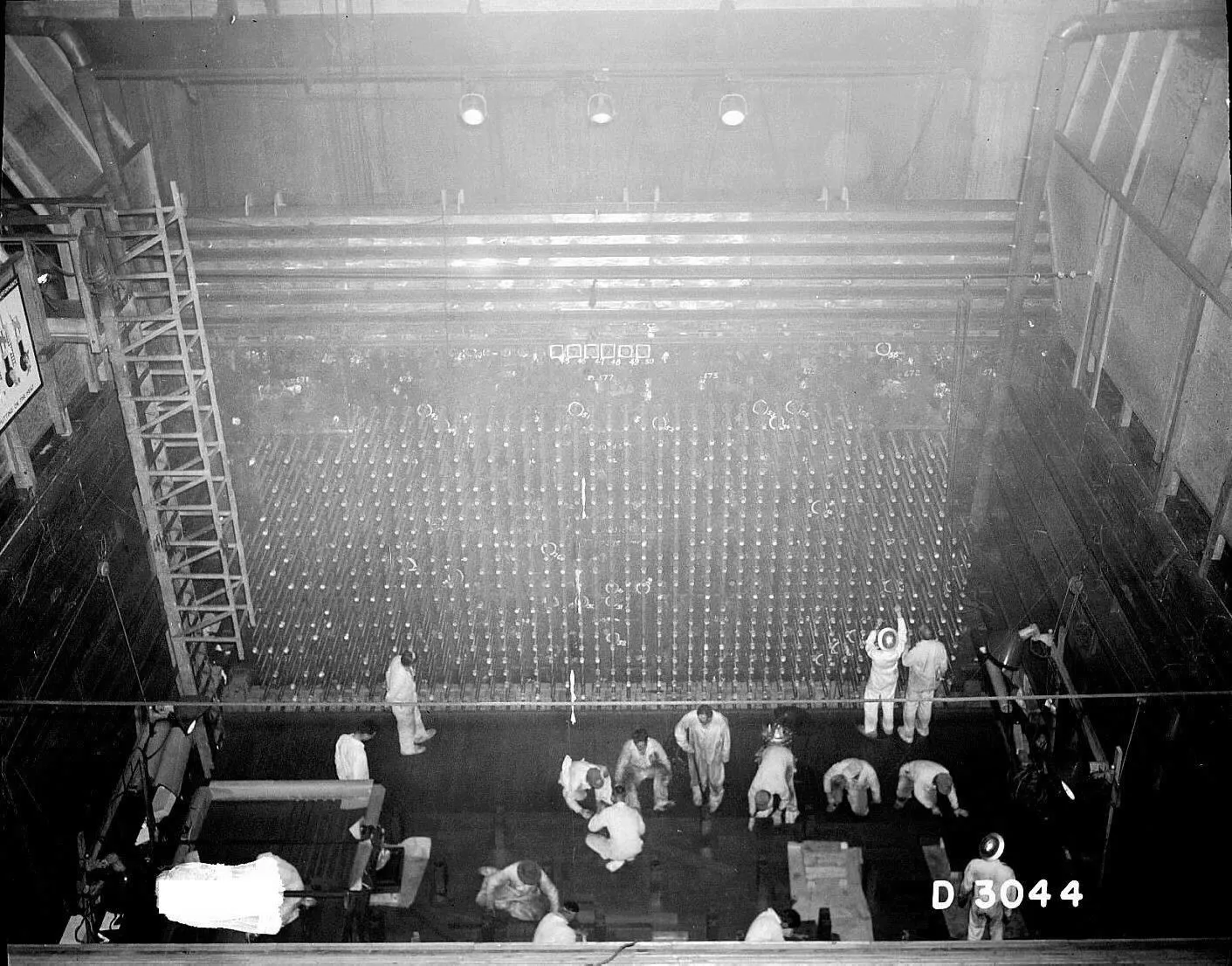
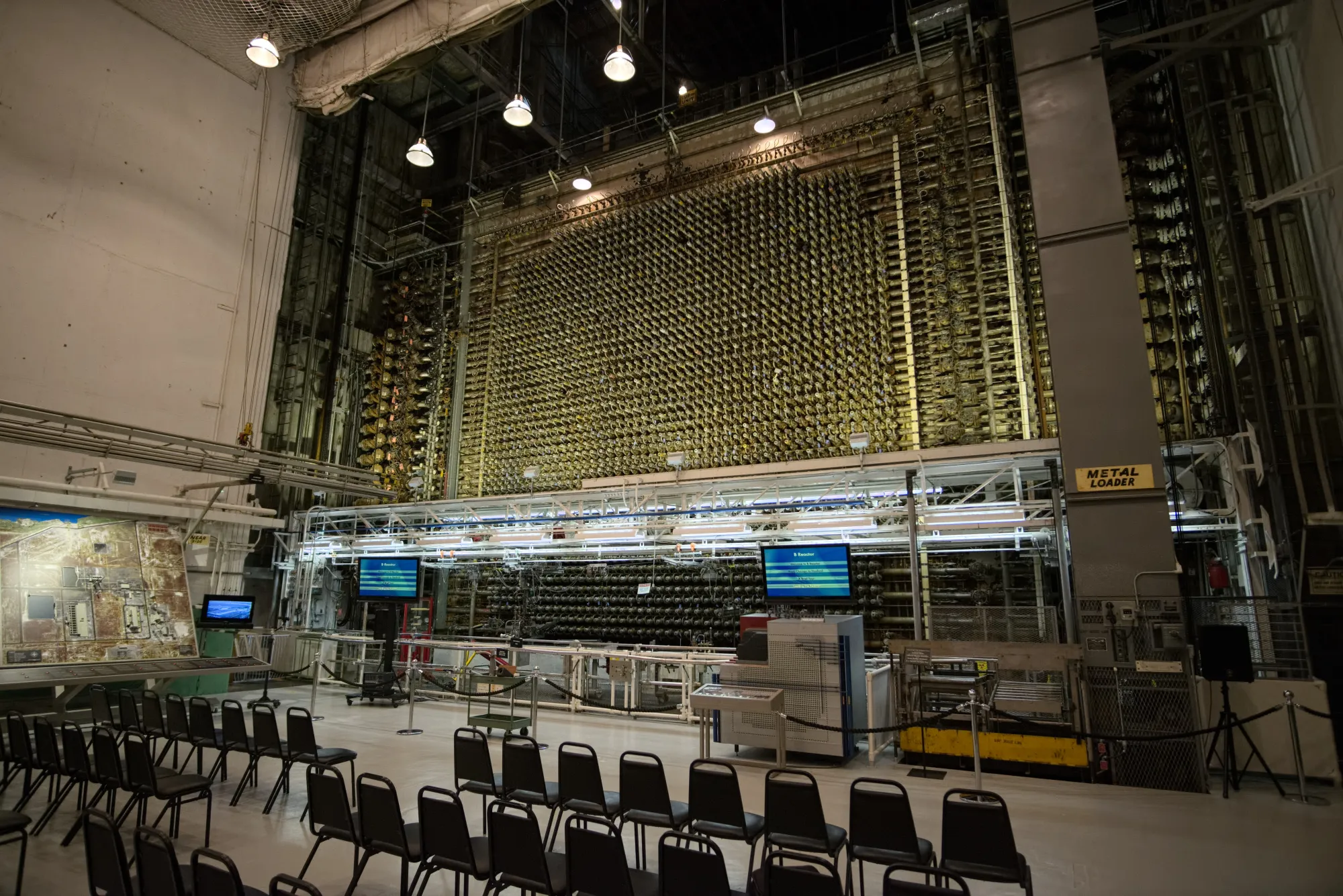
The core of B Reactor is a block of graphite about 36 feet tall and 36 feet wide. Its depth is given as 24 feet in the Hanford Engineer Works article and 28 feet elsewhere, and the weight of the graphite as about 1,200 short tons. Roughly 75,000 blocks were machined and laid. Graphite laying was finished in early June 1944, on 1 June or 11 June depending on the source. Dust control was strict. Work that could raise dust was suspended during the laying, every layer was vacuumed, and workers changed into special outer clothing before entering the building.
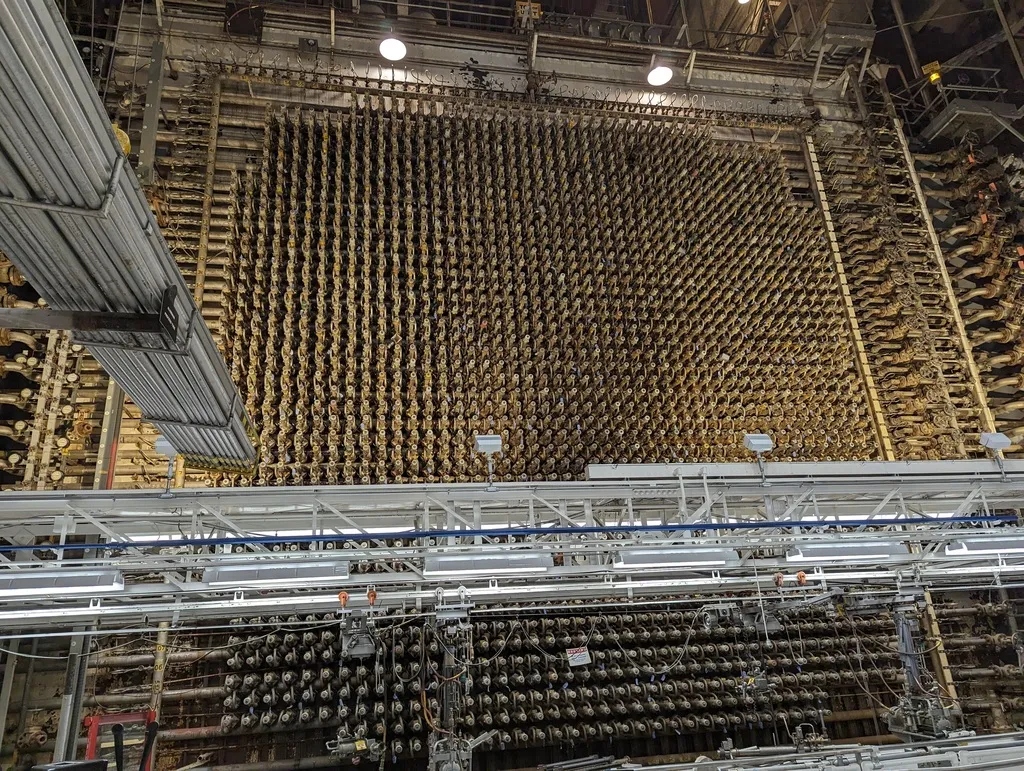
Through the block run 2,004 horizontal aluminium process tubes, spaced 8.375 inches apart. Each held 32 uranium slugs sealed in aluminium cans, so a full load was about 64,000 slugs and some 200 short tons of uranium. The slug dimensions vary by source, with the Hanford Engineer Works article giving about 1.5 inches across and 8 inches long. Canning was the hardest manufacturing problem. Raymond Grills and Ed Smith found that dipping the slugs in molten solder kept oxygen out, and the yield of good slugs rose from a few percent to over 90 percent by September 1944.
Water cooled the pile. Because water absorbs neutrons, the designers kept as little of it in the core as they could. The river water ran straight through the tubes and returned to the river after passing through settling basins that let short-lived radioactivity decay and brought it to within about 11 degrees Fahrenheit of the river temperature. The flow is given as about 30,000 gallons a minute in the Hanford Engineer Works article and the control-room account, and as 75,000 gallons a minute in Wikipedia. Forty pumps with a combined capacity of 355,000 gallons a minute served the site’s reactors, with steam backups in case the power failed.
The core was surrounded by a cast-iron thermal shield about 8 to 10 inches thick and weighing roughly 1,000 short tons. Outside it sat a biological shield of Masonite and steel plates. The Hanford Engineer Works article puts the steel for the biological shield at 20,000 short tons and the Masonite at 7.6 million square feet. The reactor sat on a concrete foundation 23 feet thick.
Wigner’s design called for about 1,500 tubes. The extra 500 were added as a margin. Accounts differ on why. One says Crawford Greenewalt of DuPont ordered them drilled to allow for possible corrosion of the fuel cladding. Another credits DuPont engineer George Graves with insisting on spare capacity. They would matter within weeks.
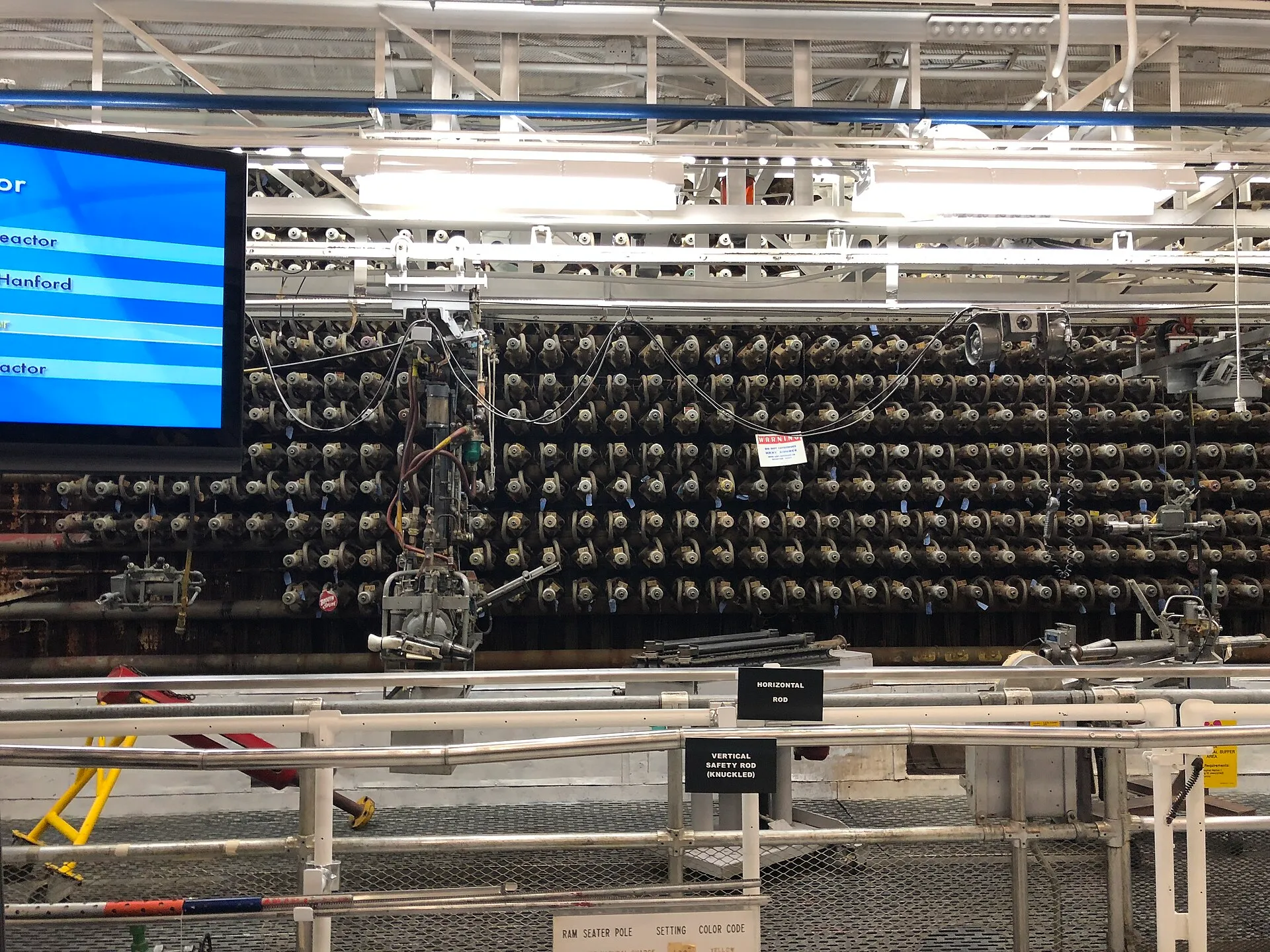
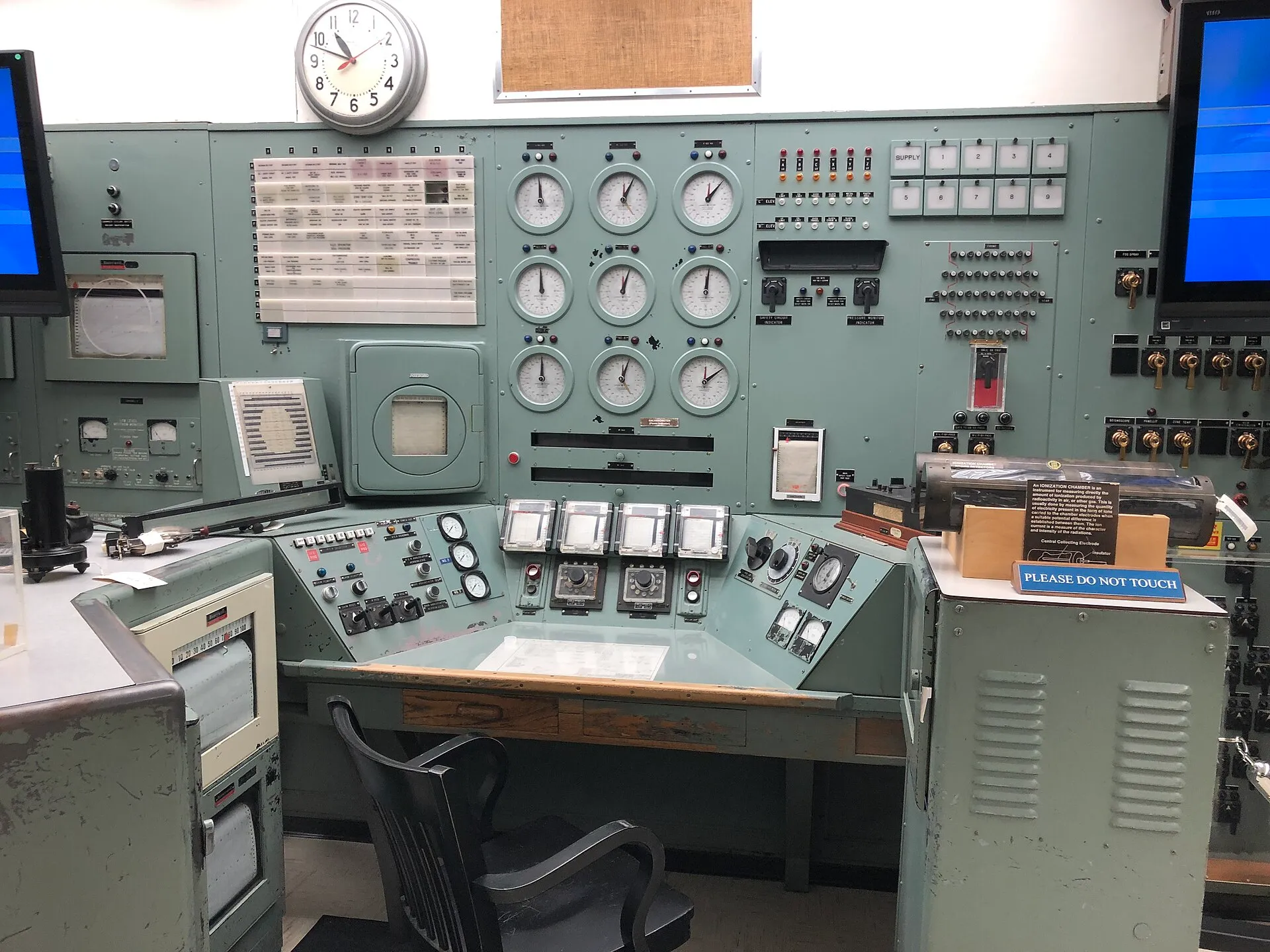
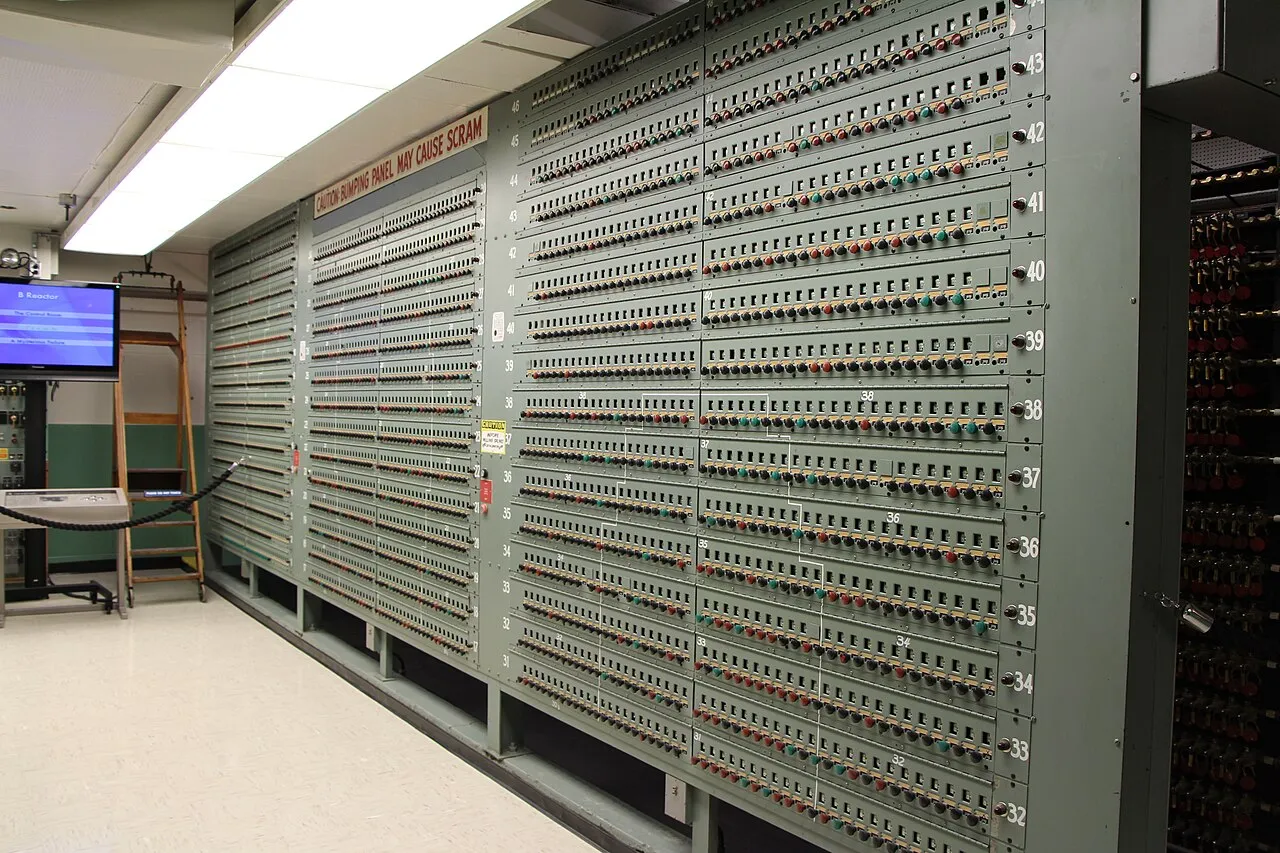
The control room held more than 5,000 instruments, all read by hand. A wall of pressure gauges on the right showed the water pressure in each of the 2,004 tubes, and a rise in any of them could trip a shutdown. Nine horizontal control rods, seven hydraulic and two electric, set the power. For emergencies there were 29 vertical safety rods above the core. Boric acid was rejected as a backup because it could make the reactor impossible to restart, and boron-bearing balls dropped through hoppers were used instead. The Atomic Heritage Foundation says cleanup after a ball drop could take three or four days, and that an earthquake detector could trigger it. Wikipedia adds that borated water was the original backup and that it was replaced in January 1952 by a ball system called Ball-3X. A typical operating crew had fewer than 20 people, and the only sound in operation was the river flowing through.
Loading the pile
Fermi was at Hanford for the start-up. Wikipedia’s Hanford Engineer Works article says he inserted the first uranium slug on 13 September 1944. The reactor went dry-critical on 15 September with 400 tubes loaded, and wet-critical on 18 September with 834. Operators then loaded more tubes and raised the power. B Reactor started up on 26 September, late in the day or around midnight depending on the account. The scientists who gathered for it included Fermi, Greenewalt and John Wheeler. One physicist recalled a betting pool, with a bottle of wine as the prize, on when the reactor would start on its own.
The reactor that went dead
Within hours the power began to fall. Operators raised it to about 9 megawatts, according to Rhodes, and the reactivity kept sinking until the reactor was close to stopping on the evening of 27 September. Operators suspected leaks in the cooling tubes. Then, around 1 a.m. on 28 September, it recovered on its own. When the power was raised again the same pattern repeated, which pointed to some poison building up and decaying away.
The reactor went dead, just plain dead!
Leona Woods Marshall, physicist
Greenewalt plotted the data on log paper and found the signature of a radioactive decay with a half-life of around 12 hours, but could not name the process. Fermi’s team worked through the night. On 29 September Wheeler worked out that iodine produced in fission was decaying into xenon-135, an isotope that swallows neutrons. Fermi confirmed the cause. The strength of the effect is given as about 30 times that of any isotope then known in one account and about 70 times in another. Wikipedia credits a paper by Chien-Shiung Wu, shared with Fermi, with the identification, while others give the credit to Wheeler, who had warned beforehand that fission products might poison the reaction.
The fix was already built into the reactor. Calculations showed how the power would climb as more tubes were loaded: about 14 megawatts with 1,000 tubes, 94 megawatts with 1,600, and 216 megawatts with all 2,004. Wheeler calculated that a reactivity gain of about 1.3 percent would overcome the poisoning, and loading the extra tubes supplied it. Greenewalt later said that margin was what saved the project. Rhodes argues that without it the programme might have stalled and only one bomb, the uranium weapon used at Hiroshima, would have been ready in time. By November B Reactor was running smoothly, and the first irradiated slugs were pushed into the cooling pool on 24 November 1944. Discharge rates rose from 10 to 50 tubes per eight-hour shift as the operators gained experience.
Wikipedia lists B Reactor among its claimed firsts as the first reactor to experience xenon poisoning.
From B to the bomb
The irradiated slugs were taken to the 200 Areas on the central plateau, about 10 miles from the reactors. Plutonium was chemically separated there. T Plant began processing on 26 December 1944, and B Plant followed on 13 April 1945. Roughly four tonnes of uranium were needed for each kilogram of plutonium.
D Reactor started in December 1944 and F Reactor in February 1945, and B Reactor reached full power in February 1945. The first plutonium reached Los Alamos in early February 1945. Wikipedia gives the date as 3 February, and Rhodes recalls Matthias carrying the container himself by train from Portland to Los Angeles, packed like an ordinary traveller’s box.
The war production was not free of risk. On 10 March 1945 a Japanese balloon bomb struck a high-tension power line serving the site and caused an outage. Plutonium from Hanford then went to Trinity on 16 July 1945, where a plutonium implosion device was fired for the first time, and to the bomb dropped on Nagasaki on 9 August 1945. The Hanford Engineer Works cost more than $348 million through December 1946.
The Cold War years
When the Manhattan Project ended on 31 December 1946, the Atomic Energy Commission took over Hanford. B Reactor was shut down for a time. Wikipedia says operations were suspended in March 1946, while the Hanford Site’s own B Reactor page says it was shut down at the end of 1946. Both agree it came back in 1948, when the Berlin crisis pushed the United States to raise plutonium output. Wikipedia dates the restart to June 1948.
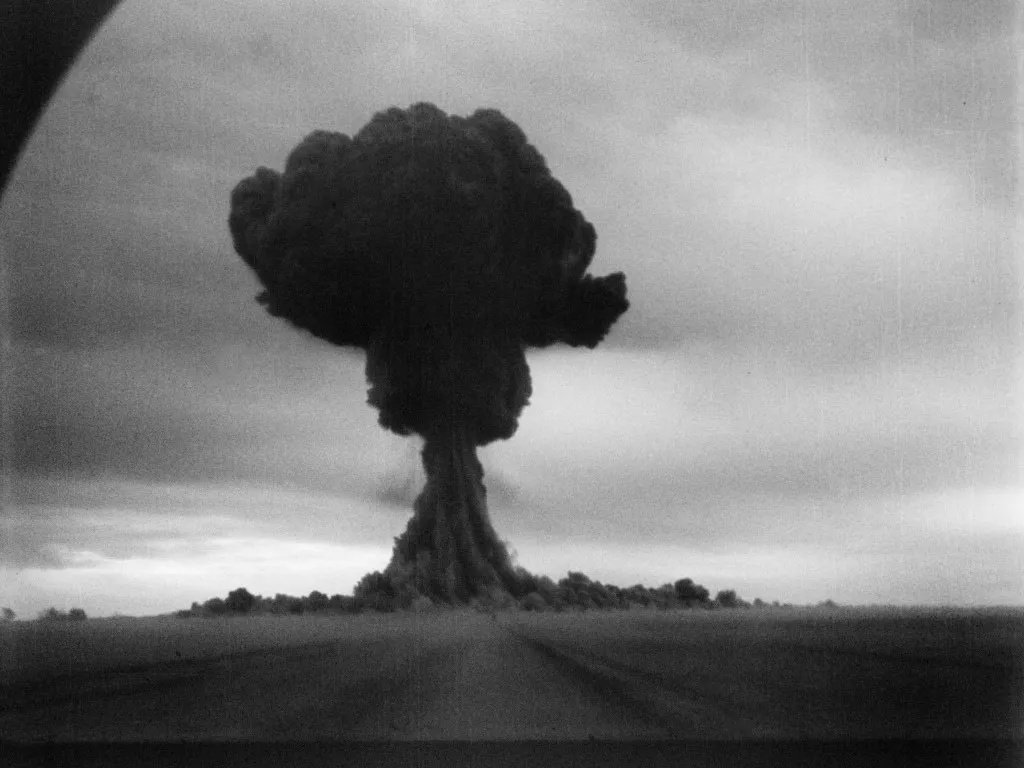
The Cold War then drove a building programme along the river. H Reactor was set aside for tritium after the first Soviet atomic test in 1949, C Reactor followed during the Korean War, and larger K reactors were authorised in 1952. B Reactor made tritium for the hydrogen bomb programme from March 1949, according to Wikipedia. The sources disagree about the test where its tritium was first used: the engineering society says the first hydrogen bomb test at Bikini in 1952, Wikipedia says 1 March 1954. Hanford’s peak production years were 1956 to 1965. Power levels rose well above the original rating, and Wikipedia gives 2,000 megawatts for the upgraded reactors in the early 1960s.
The end came when the Atomic Energy Commission judged its plutonium stockpile large enough. Reactors were shut down in stages from 1964 to 1971. B Reactor was ordered closed in early 1968, and the Hanford Site’s own page gives 12 February 1968 for the order, while Wikipedia’s timeline puts the Atomic Energy Commission directive on 29 January and says the reactor shut permanently that February. Across all its reactors Hanford made about 67.4 metric tons of plutonium over four decades, of which 54.5 tons was weapons grade, and that supplied most of the roughly 60,000 weapons in the American arsenal. N Reactor, the last, shut in January 1987.
The river and the waste
B Reactor ran on an open cycle, and the river carried the price. Daily discharges to the Columbia were about 400 curies in the 1940s, 7,000 curies in 1951 to 1953, and a peak of 20,000 curies in 1959. Early waste practice was inadequate and radioactive material also went into the air.
The most striking release was the Green Run, a deliberate experiment at T Plant. On 2 and 3 December 1949 the plant processed fuel from F Reactor after a decay period of only 16 days, instead of the usual 83 to 101, and the off-gas scrubbers were left off. The aim was to test whether aircraft and ground monitors could detect nuclear production at a distance, after the first Soviet nuclear test. Estimates of the iodine-131 released range from about 4,000 curies to about 11,000, and xenon-133 from about 20,000 to 29,000. The plume spread from the Hanford area to places as far as Kettle Falls in Washington and Klamath Falls in Oregon. The test stayed secret until references were declassified and the story broke in 1986, and a 1995 federal advisory committee concluded that it clearly did not conform to Hanford’s public-safety practices of 1949. Residents known as downwinders later filed up to 5,000 complaints, and the last lawsuit was settled in 2015.
The cleanup is the largest in the United States and is still going on. Hanford has 177 underground tanks holding about 56 million gallons of radioactive and chemical waste, according to the Washington Department of Ecology. The Waste Treatment and Immobilization Plant, whose first concrete was poured in June 2002, began vitrifying low-activity waste in October 2025, mixing it with glass-forming additives and heating it to about 2,100 degrees Fahrenheit. High-level waste vitrification is planned for the 2030s, with the high-level waste facility expected to start in 2033.
How B Reactor was saved
After shutdown the surroundings were stripped away. More than 30 buildings and 20 service facilities had supported the reactor. From 1969 to 2006 all were removed except the reactor building, the main exhaust stack and the river pump house, which still supplies water for site work. The other production reactors were cocooned: the buildings were demolished down to the 4-foot concrete shield around the core, the openings sealed and a new roof built. D Reactor was cocooned in 2004, and F Reactor in 2003.
B Reactor came close to being demolished. As late as 2008 the plan called for taking down the reactor and its stack as part of the cleanup. A campaign by local people had gone on since the B Reactor Museum Association was founded in 1990, and the site had been recognised along the way. The American Society of Mechanical Engineers named it a landmark in 1976, and it was listed on the National Register of Historic Places on 3 April 1992. In 1994 it became a civil engineering landmark, and on 19 August 2008 a National Historic Landmark. In 2008 the Department of Energy changed its policy to keep the reactor and open it to the public.
The first public tours ran in early 2009, and by 2012 about 10,000 people were visiting a year. The minimum age was lowered from 18 to 12 and the citizenship requirement was dropped. A 2004 congressional study had recommended a national park for the Manhattan Project, and Congress authorised the Manhattan Project National Historical Park in December 2014, with the president signing it on 19 December. The Department of Energy and the National Park Service agreed on joint management on 10 November 2015. The department owns and runs the historic facilities, and the Park Service interprets them. The park also takes in sites at Oak Ridge and Los Alamos. From 2009 to 2018 about 80,000 people visited, according to Wikipedia.
Visiting
B Reactor is on the Hanford Site, a secure Department of Energy facility, so it can only be seen on an official tour. According to the 2024 season details, tours are free, open to all ages and run from late March through October. They start at 8:30 a.m. or 11:45 a.m. depending on the date, from the visitor center at 2000 Logston Boulevard in Richland. The whole tour takes about four hours, with a bus ride of about 45 minutes to the reactor and about two hours there. Registration is online. Groups of at least 20 can book by email, and the visitor center number is (509) 376-1647.
Cameras and phones are allowed. Only bottled water is allowed inside the reactor building, and nothing is sold at the visitor center. The tour covers the people, events, science and engineering behind the reactor and the bombs of the Second World War, and visitors can see the control room. Season dates and rules change from year to year, so check the Hanford tours page before you go.
The same programme runs separate tours of pre-war sites that survive on the Hanford Site, including the Bruggemann ranch and the White Bluffs bank. Together they tell the story of the people who were moved out before the reactor was built.
Conclusion
B Reactor was built in a hurry from a design that had never been tested at this scale, in a place cleared of its farmers and fishing families, by tens of thousands of workers under strict secrecy. It stalled on its second day, recovered because of a margin someone had insisted on, and then supplied the plutonium for Trinity and Nagasaki.
It then spent two more decades feeding the arms race, and the river, the tanks and the old townsites are still paying for that. The reactor that was almost demolished in 2008 is now one of the few places where the whole chain, from displacement to plutonium to cleanup, can be walked through.
Did you know?
- B Reactor was designed for a power level about a million times higher than Fermi's first experimental piles.
- DuPont took the Hanford contract for a fee of one dollar.
- The Army moved 177 graves from the White Bluffs cemetery to Prosser to clear the Hanford site.
- Wigner's design needed about 1,500 fuel tubes, but B Reactor was built with 2,004, and the extra ones saved it from xenon poisoning.
- The reactor's graphite core was vacuumed layer by layer as it was laid, to keep dust out.
- On 10 March 1945 a Japanese balloon bomb hit a power line serving Hanford and caused an outage.
- The Hanford construction camp peaked at 45,096 workers on 21 June 1944.
- Richland was built without a security fence, unlike Oak Ridge and Los Alamos.
- A typical operating crew at B Reactor was fewer than 20 people.
- B Reactor is the only one of Hanford's nine production reactors that was not entombed.
- Hanford's tank farms hold about 56 million gallons of waste in 177 underground tanks.