A test that had failed before
The disaster began as a safety exercise. A nuclear plant needs electricity to run its cooling pumps, even when the reactor is shut down. If the grid failed, the diesel generators would take a minute or so to start, and the engineers wanted to know whether a spinning-down turbine could briefly power the pumps in the gap. The test had been tried and had failed in 1982, 1984 and 1985, so it was rescheduled for the planned shutdown of Reactor 4 in April 1986.
Preparations began on 25 April. The emergency core cooling system was disabled so that it would not interrupt the test. Then grid demand delayed the shutdown, and the test passed to the night shift, led by Aleksandr Akimov, with Leonid Toptunov operating the reactor. Deputy chief engineer Anatoly Dyatlov directed it. For many hours the reactor had run without that protection, and the people now in charge had not been part of the planning.
A reactor that was hard to control
As power was reduced, the reactor began to “poison” itself with xenon-135, a by-product that absorbs neutrons. Power fell far below the level the test required, to about 30 megawatts thermal or less. The reasons are disputed: most accounts blame an error by the operator at the controls, while Dyatlov blamed a fault in the regulator.
To bring power back up, the crew pulled out nearly all of the reactor’s 211 control rods. That left far fewer rods in the core than the safety rules allowed, a fact the operators could not see in real time. They also switched on extra cooling pumps, which lowered reactivity further. The reactor was now in a state that no operating procedure had described.
Two design weaknesses of the RBMK-1000 then turned an unusual situation into a disaster. The reactor had a positive void coefficient: as water boiled to steam, reactivity rose rather than fell. And the control rods had graphite tips that, as they first entered the core, briefly displaced water and increased reactivity. This “positive scram” effect had been identified in 1983 at the Ignalina plant, but nothing had been done about it.
01:23: two explosions
The test began at 01:23:04. About 36 seconds later an operator pressed AZ-5, the emergency shutdown button. Why exactly then is unknown. The rods started to drop into the core, the graphite tips added reactivity, and within about three seconds output exceeded 530 megawatts and kept climbing. The last instrument reading was roughly 30,000 megawatts thermal, around ten times normal output.
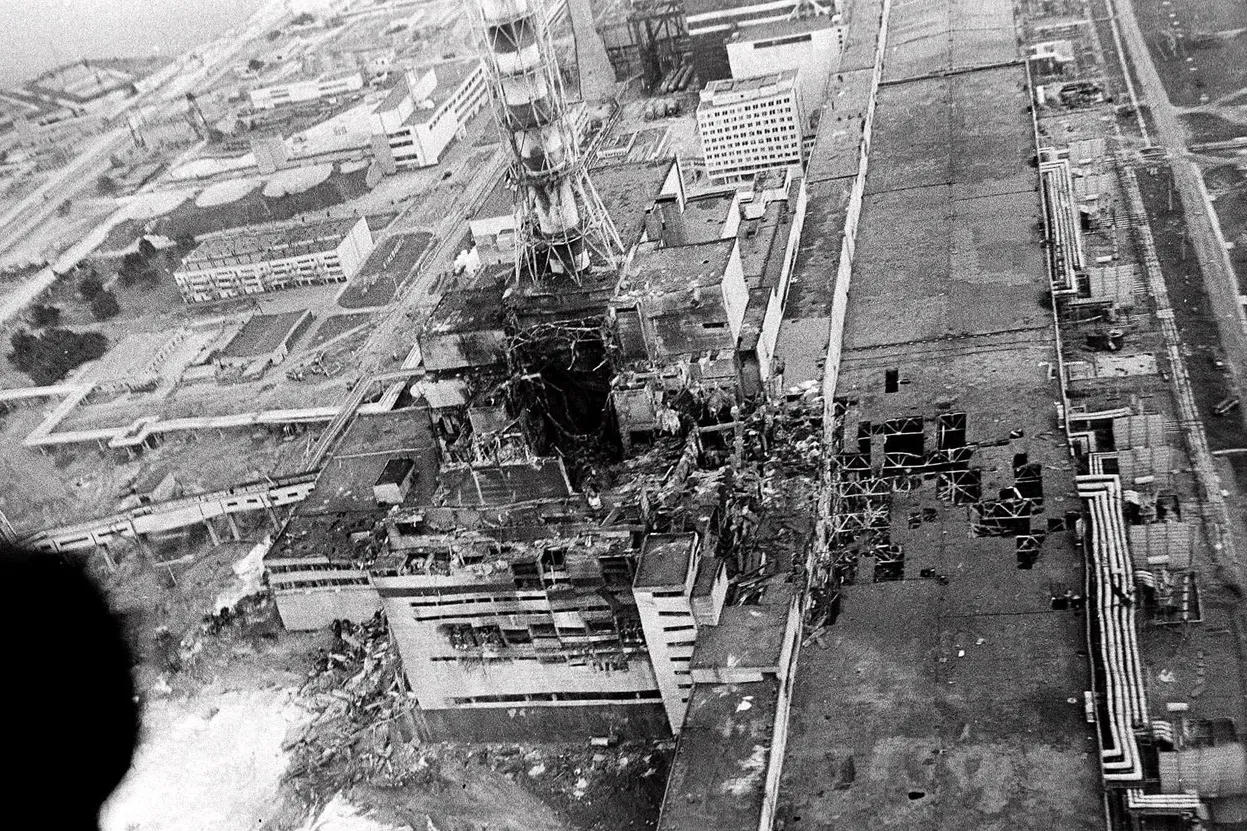
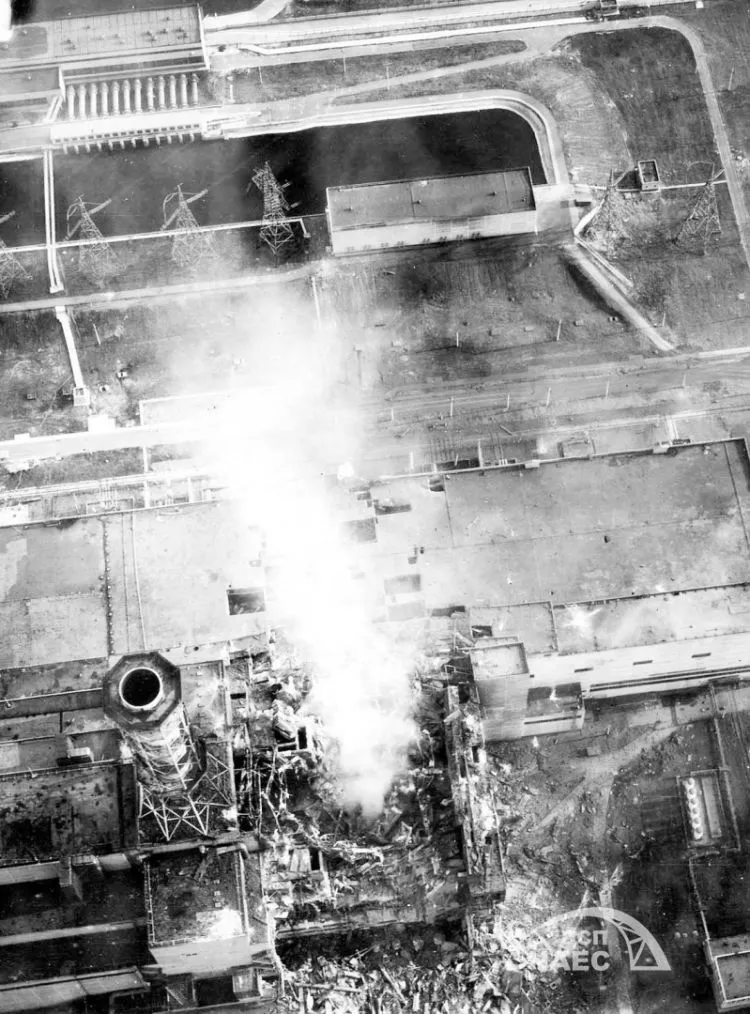
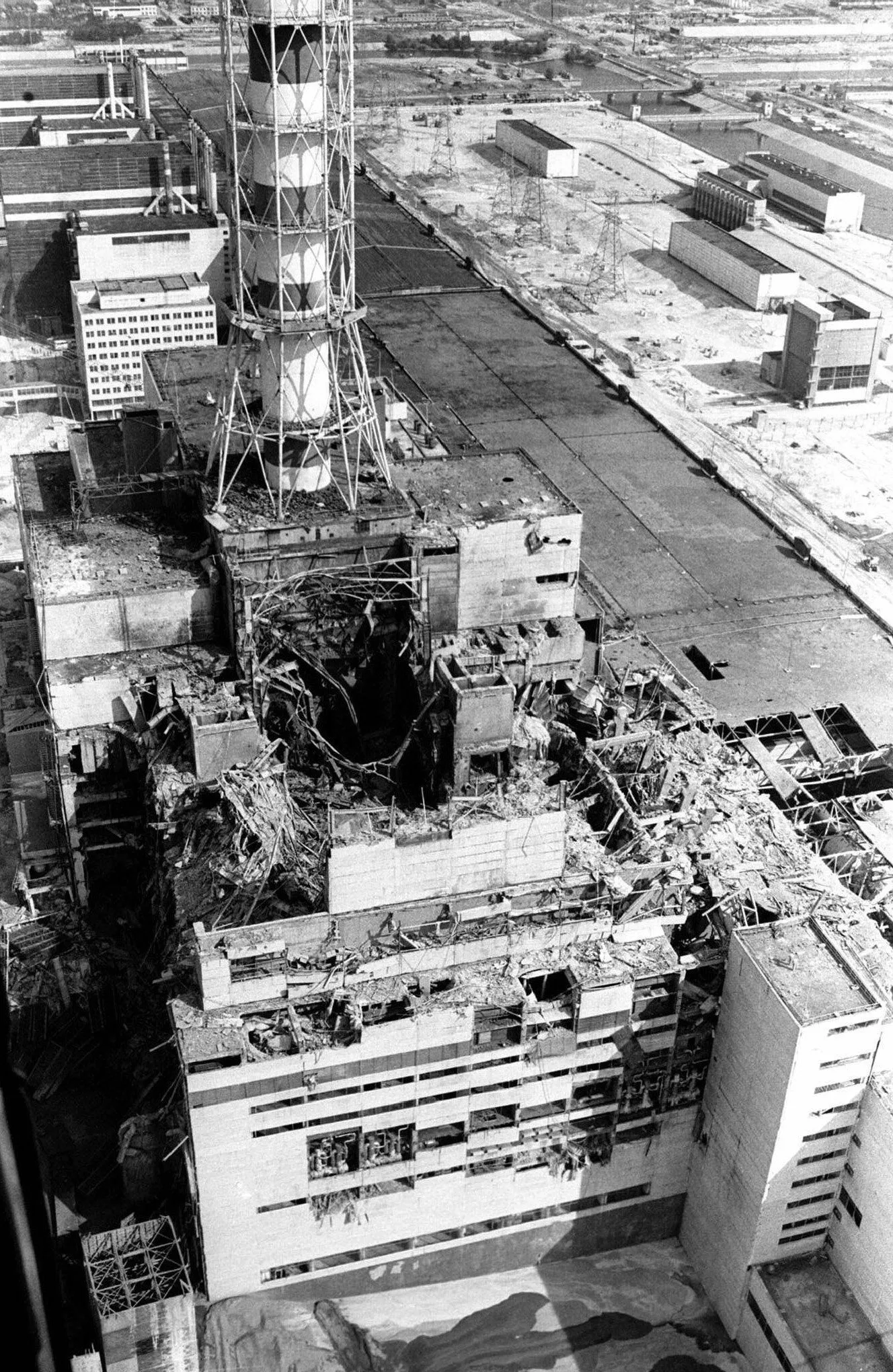
A steam explosion blew the reactor’s roughly 1,000-tonne upper shield off and wrecked the roof. A second, bigger explosion followed two or three seconds later. Its cause is still debated, and hydrogen is the most commonly cited explanation. Burning graphite and fuel fell across the turbine hall roof and on Reactor 3, and the graphite in Reactor 4 itself burned until 10 May. Most of the radioactivity escaped through those fires. The World Nuclear Association puts the total release at about 14 exabecquerels, more than half of it inert noble gases.
The firefighters
The plant’s fire brigade responded within minutes. The first crew, led by Lieutenant Volodymyr Pravyk, was sent onto the roof without being told how radioactive the debris and smoke were. Pravyk died about two weeks later of acute radiation sickness. The fires outside the reactor were out by about 05:00, but many of the firefighters had already taken very high doses.
Of 237 workers examined in hospital, 134 were diagnosed with acute radiation syndrome. 28 of them died by the end of July 1986, six of them firefighters. Two other people were killed directly by the explosions.
Evacuating Pripyat
A government commission, headed by Valery Legasov of the Kurchatov Institute, reached the plant on the evening of 26 April. It ordered the evacuation of Pripyat for the next day. Buses arrived from about 14:00 on 27 April, and residents were told to expect to be away for about three days. A 10 km zone was set about 36 hours after the accident, and about ten days after it the zone was widened to 30 km. By mid-May about 116,000 people had been moved out of the 30 km zone. In the years that followed, a further 220,000 were resettled, and the total evacuated or resettled grew to about 350,000. Many of the plant’s staff were rehoused in a new town, Slavutych, built for the purpose with a direct rail link to the plant.
Silence, then Sweden
The Soviet authorities said nothing. On the morning of 28 April, radiation alarms went off at the Forsmark nuclear plant in Sweden, more than 1,000 km away. Swedish authorities worked out that the radiation was coming from elsewhere. Sweden asked Moscow whether there had been an accident. Moscow denied it at first. Only after Sweden said it would alert the IAEA did the Soviet news programme Vremya read a 20-second statement at 21:02 that evening, the first official acknowledgement.
Even then the secrecy did not lift. Moscow said there was no reason to cancel the 1 May celebrations in Kyiv, about 100 km from the plant. The Politburo agreed only to shorten the festivities, and the parade went ahead while fallout was in the air.
Putting it out
Helicopters dropped around 5,000 tonnes of sand, clay, dolomite, lead and boron onto the burning reactor over about ten days, though little of it reached the core. Three plant workers, Alexei Ananenko, Valeri Bespalov and Boris Baranov, went into the flooded basement to open the valves of the bubbler pool so that it could be drained. All three survived, and were decorated with the Order for Courage in 2018.
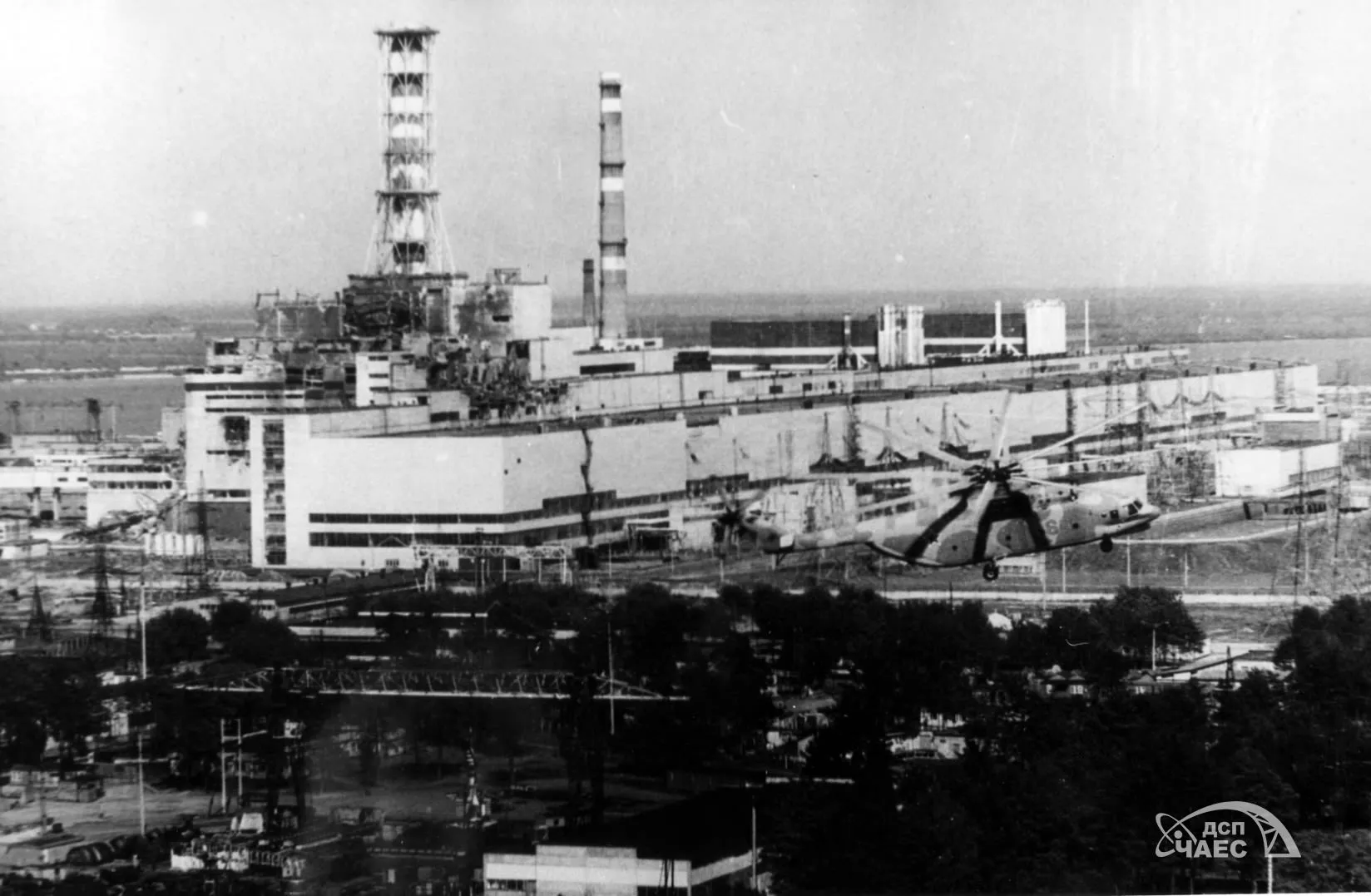
The clean-up workers, known as liquidators, eventually numbered more than 600,000, though most took low doses. About 200,000 of them worked in 1986 and 1987 and averaged about 100 millisieverts each, and about 1,000 emergency and onsite workers received the highest doses on the first day. Robots were tried, but their electronics failed in the radiation, and much of the roof debris was cleared by hand, in short shifts. A concrete shelter, the “sarcophagus”, was built over the ruin within about seven months and was designed to last only 20 to 30 years. In December 1986 inspectors found the “Elephant’s Foot”, a lava-like mass of melted fuel, concrete and sand in the basement. It was once so hard that a chunk could only be removed with an armour-piercing round.
The Red Forest and the exclusion zone
The pine forest immediately downwind of the plant took such a dose that it died, turning the colour that gave it the name Red Forest. Radioactive material spread much further. About 100,000 square kilometres were contaminated, mostly in Belarus, Ukraine and Russia, and about five million people lived in areas contaminated above the standard threshold. Traces were carried across Scandinavia and much of Europe. The exclusion zone around the plant was set at 30 km and later extended, and it now covers about 2,600 square kilometres of mostly regrown forest.
What the reviews concluded
The first Soviet report, presented in Vienna in 1986 and reflected in INSAG-1, put most of the blame on the operators, who had withdrawn most of the control rods in breach of the rules. The later INSAG-7 report in 1992 shifted the emphasis to the RBMK design: its control rod design, its instability at low power and the way safety information was presented to operators. It still called the operators’ actions ill judged. After the accident, RBMK reactors were modified: fuel enrichment was raised from 1.8 to 2.4 per cent uranium-235, control rods were changed and shutdown systems were made faster.
The human cost
The immediate toll is clear: two workers killed by the explosions and 28 dead of acute radiation syndrome within weeks. Among people exposed as children, about 20,000 cases of thyroid cancer were diagnosed between 1991 and 2015, and UNSCEAR judged that about a quarter of them were probably due to radiation. Thyroid cancers are mostly treatable, and 15 were fatal in the period to 2005.
The wider toll is contested. UNSCEAR and the 2005 Chernobyl Forum found no evidence of a major public-health impact from radiation other than thyroid cancer, and described mental health problems, smoking and alcohol as far larger issues than radiation. The Forum projected up to about 4,000 eventual deaths among the roughly 600,000 most exposed people. Estimates for Europe as a whole go as high as about 16,000, and the highest published figures are widely disputed. The financial cost was enormous too. The Soviet response alone is put at about 18 billion roubles, and estimates of the total run from hundreds of billions of dollars upwards.
Closing the plant
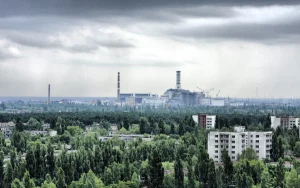
The other three reactors kept running. Reactor 2 was shut after a turbine hall fire in October 1991, Reactor 1 closed in 1996 under an agreement with Ukraine and international bodies, and Reactor 3 was switched off on 15 December 2000. The plant has been in decommissioning ever since. The sarcophagus was never designed to last: part of a turbine hall roof collapsed in February 2013, and the New Safe Confinement, a steel arch more than 100 metres high and about 260 metres wide, was slid into place on 29 November 2016. You can read more about the site itself on the Chernobyl Nuclear Power Plant page.
Politics and memory
Politically, the accident and the cover-up are widely seen as a catalyst for glasnost and as a drag on the Soviet economy in its last years. It slowed reactor building worldwide and led to new international safety agreements, including the Convention on Early Notification of a Nuclear Accident, which the IAEA helped to draft shortly after the accident. Valery Legasov, who headed the government commission, became the public face of the scientific response. The 2019 HBO series Chernobyl brought the story to a new audience, and visits to the exclusion zone peaked at almost 125,000 in 2019.
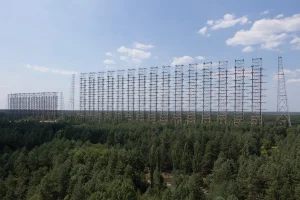
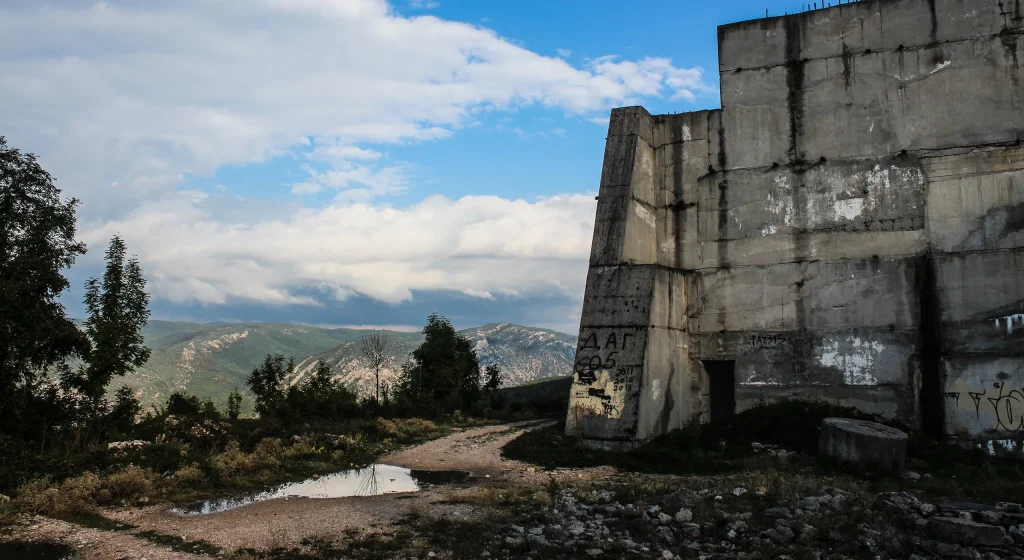
Nearby, the radar that stood in the same forest, the Duga Radar, remains one of the Zone’s other great ruins.
The site at war
The site was caught up in war again in February 2022, when Russian forces captured it, holding it until 31 March. The zone has been closed to tourists since then. In February 2025 a Russian drone struck the New Safe Confinement, started a fire and tore a hole about six metres across in the arch. The fire was put out in March. In December 2025 the IAEA concluded that the arch had lost its primary safety functions, including confinement, though its load-bearing structures were not permanently damaged. Repairs are expected to cost more than 100 million euros, with full restoration targeted for 2030.
Conclusion
Chernobyl is the benchmark every later nuclear accident is measured against, and the moment secrecy cost the Soviet state its credibility. It changed reactor design, international notification rules and public trust in nuclear power. Its lessons about hidden flaws, silenced warnings and what happens when people are not told the truth are why the story keeps being retold, and why the ruined reactor is still a live engineering problem nearly four decades later.
Did you know?
- The test that caused the disaster had failed three times before.
- A fault in the control rods had been found at Ignalina in 1983 and not fixed.
- Sweden, not Moscow, told the world: the alarm was a Swedish plant's own radiation detectors.
- The graphite in Reactor 4 burned for more than two weeks, until 10 May.
- The three men who opened the bubbler valves all survived and were decorated with the Order for Courage in 2018.
- The Kyiv May Day parade went ahead on 1 May 1986, although it was shortened.
- The pine forest next to the plant died from radiation and became known as the Red Forest.