



A monument that never left the rock
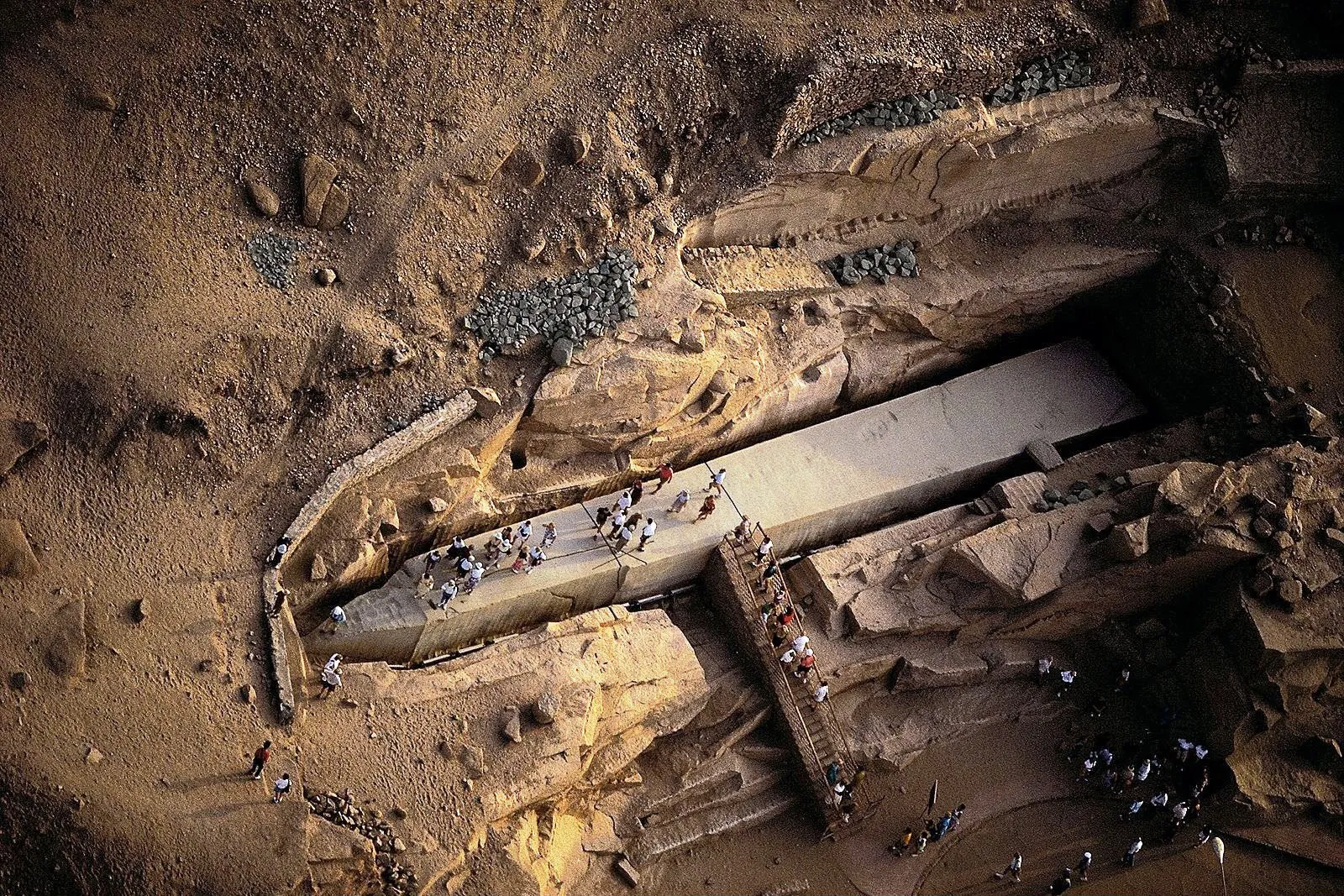
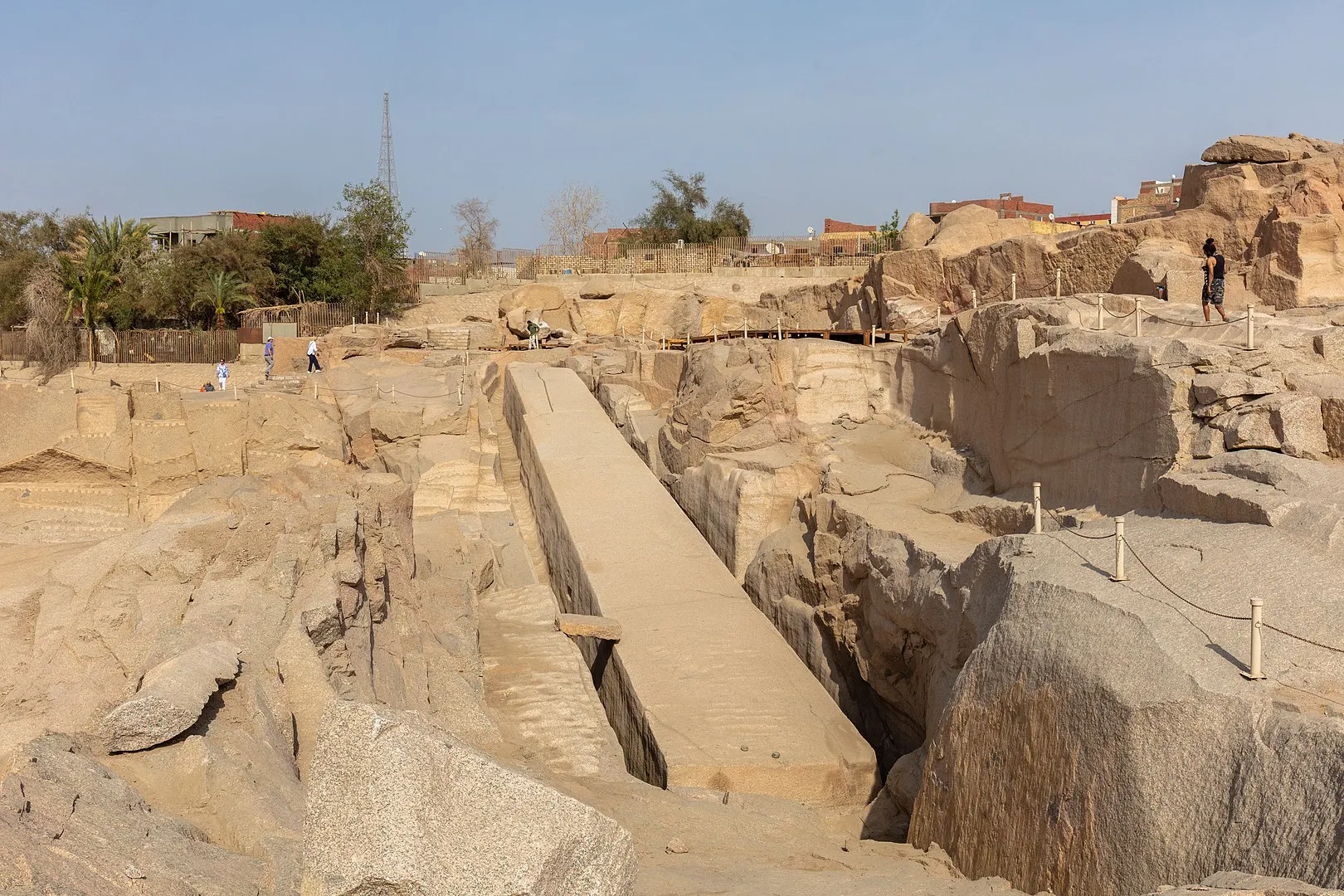
Most ancient monuments survive because they were finished. The Unfinished Obelisk survives because it was not. It sits in the granite quarries at Aswan, in southern Egypt, still joined to the bedrock it was being cut from, and it shows with unusual clarity how the Egyptians quarried their largest stones.
Had it been completed, it would have been a record breaker. Estimates of its height are about 41.75 metres, or 137 feet, and about 42 metres in other sources. Its weight is given as nearly 1,090 tonnes in one account, 1,168 tonnes by the Egyptian Ministry of Tourism and Antiquities and by the Egyptologist Reginald Engelbach, who gave it in English tons, and 1,200 tons in others. All of these put it about a third larger than any obelisk the Egyptians are known to have raised. For comparison, the tallest ancient Egyptian obelisk, the Lateran Obelisk in Rome, is about 32 metres tall and weighs over 400 tonnes.
What an obelisk was for
The Egyptians called these monuments tekhen. An obelisk was a tall, tapering shaft cut from a single piece of stone, with a rectangular section and a small pyramid-shaped top, which was often gilded so that it caught the sun. They were normally set up in pairs at temple entrances, and they were linked with the sun and with the benben, the first land said to have risen at the beginning of time. Kings had their names and dedications carved down the four sides.
The word obelisk itself comes from the Greek obeliskos. Egypt’s conquerors prized these monuments. After Rome took control of the country around 30 BC, temples were looted for them, and Rome ended up with many more than remain in Egypt. More than half of the surviving ancient obelisks now stand outside Egypt, and thirteen of them are in Italy.
Aswan and its granite
Aswan was famous in antiquity for hard, high-quality stone, and its quarries supplied granite for statues, columns and obelisks used across Egypt. The Unfinished Obelisk lies in the Northern Quarry, southeast of a medieval Arab cemetery, and it is still where its makers left it.
Who ordered it?
The obelisk is usually linked to Hatshepsut, the female pharaoh of the 18th Dynasty, though this is thought rather than proven. Her reign is dated to roughly 1479 to 1458 BC in some sources and a few years later in others, which places the work in the 15th century BC either way. Hatshepsut raised two pairs of obelisks at Karnak. Only one of them still stands, the second tallest ancient obelisk still upright, and one of the later pair is said to have broken during the work and been replaced by a third. Some accounts identify the unfinished giant with that broken one.
The sources disagree on this. The Egyptian Ministry says it was meant for the temple of Amun at Karnak. Another view is that it may have been planned to match the Lateran Obelisk, which was originally at Karnak and was later taken to Rome. Engelbach, who measured it in 1922, rejected several of the links that others had made and left the date unresolved, and that caution still fits. Nothing at the site gives the name of the king who ordered it.
How it was cut
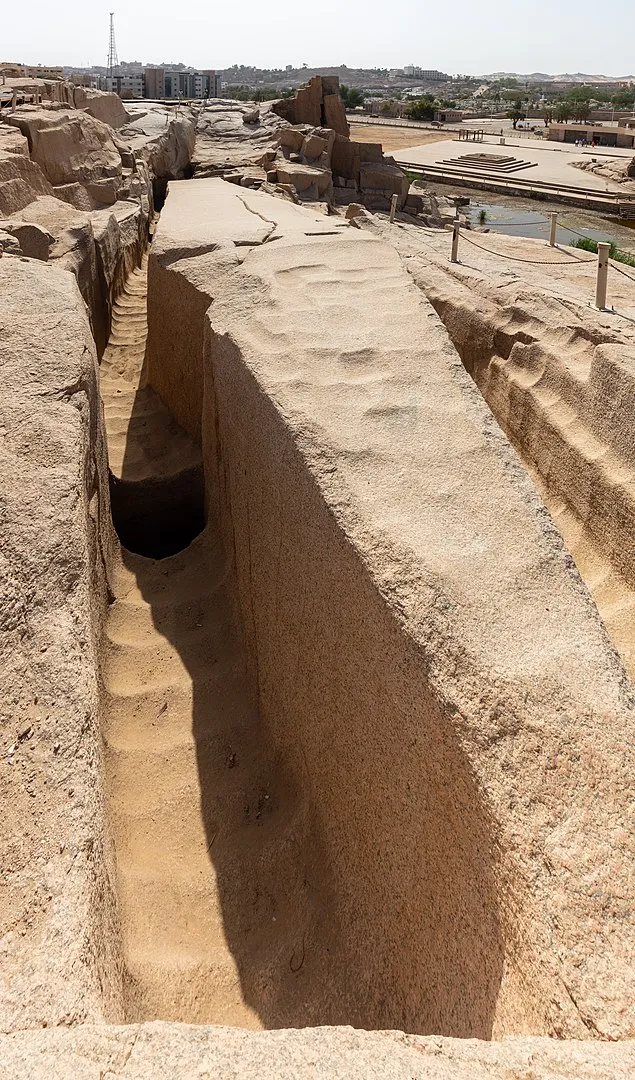
Granite is far too hard to work with simple metal tools, so the quarrymen used stone against stone. They pounded the rock with balls of dolerite, a stone harder than granite, and some of these hammerstones can still be seen at the site. Engelbach described them as nearly round, 8 to 13 inches across and weighing 9 to 15 pounds, and suggested they were swung on a pivoting rammer, like the tool used by modern Egyptian stoneworkers, with two men working from above and one below. He tried the method by hand and removed about 5 millimetres of granite in an hour from a small patch. Pounding along the outline cut a trench of about 75 centimetres wide around the shaft and slowly smoothed rough surfaces. Engelbach reckoned the trench alone would have taken more than seven months.
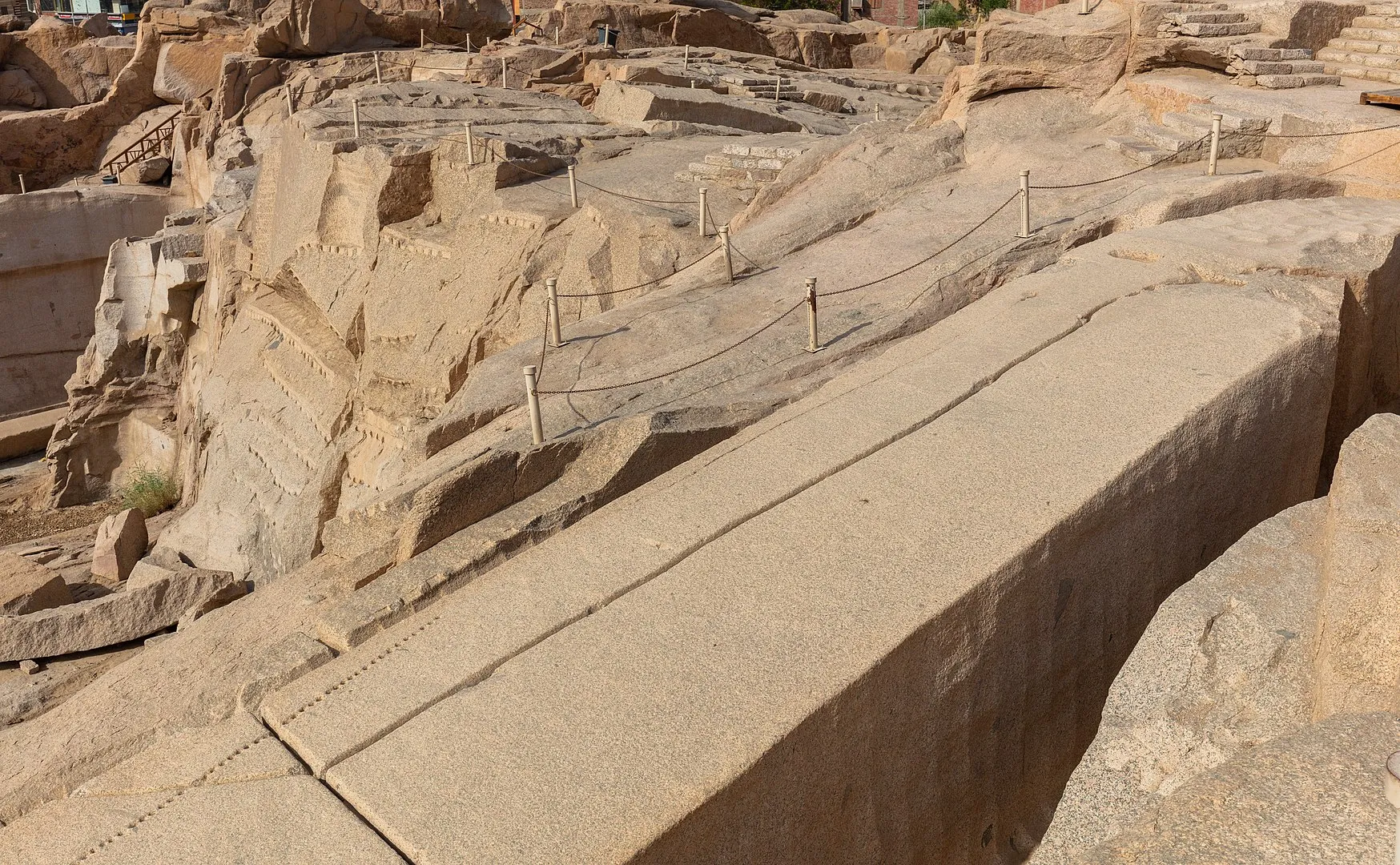
To free the shaft from the bedrock, popular accounts say the workers cut a line of small cavities, like the perforations on a sheet of paper, and set dried wooden wedges in them. The wedges were then soaked with water, and as the wood swelled it split the rock along the line. Engelbach’s findings were slightly different. He found no chisel or wedge marks in the trench itself, and no copper tool, but he did record tapering wedge slots on the surface and burnt chips and burnt mud brick, which suggest that fire was also used to break the rock. He thought the wedges were probably metal. How the Egyptians cut granite with chisels is still discussed, and one source also mentions copper tools for finishing work.
The crack
The project failed at the stage where the obelisk was being separated from the bedrock. A large crack appeared in the granite, and further fissures are described across the surface. One source puts the cause down to natural flaws in the stone or to the stress of the work. Engelbach found that fissures had caused constant trouble, and that the workers tested them by hammering shallow hollows and cutting narrow channels. Two of the fissures meet near the tip, so that the pyramidion would have had to be moved back by at least half a metre, and others would have required the shaft to be narrowed or shortened. A monument of this size could not have been repaired, so the quarrymen stopped.
They may have tried a second plan. Engelbach found guide lines for a smaller obelisk, set out on a new centre line along the north edge to avoid the worst cracks. It would have been about 32 metres long and weighed about 507 tons, which is close to the size of the Lateran Obelisk. That plan was also dropped, probably because the granite near one fissure looked unsound.
The abandoned obelisk was left with its base still attached to the bedrock. Tool marks and ochre working lines remain on the stone, which makes the quarry a record of an unfinished job rather than a ruin of a finished one.
Getting it out
Cutting the shaft was only the first problem. Engelbach worked out how it could have been lifted clear and moved, and he put the figures at several thousand men. He favoured undercutting the whole shaft and levering it up with about 30 levers, which he reckoned would need around 1,260 men, and he reckoned a pull on rollers for a stone of this size would need around 11,000. These are his estimates and not records. The Nile still had to be crossed, and a barge for the largest obelisks would have been roughly 61 metres long and 30 metres wide, based on a small-scale test. In 1999 a team in the NOVA television experiment moved a 25-ton obelisk on a sledge with over 130 people, only 10 to 20 feet a day, and raised it with a pit of sand that was slowly emptied. The Unfinished Obelisk was more than forty times heavier.
Rediscovery and study
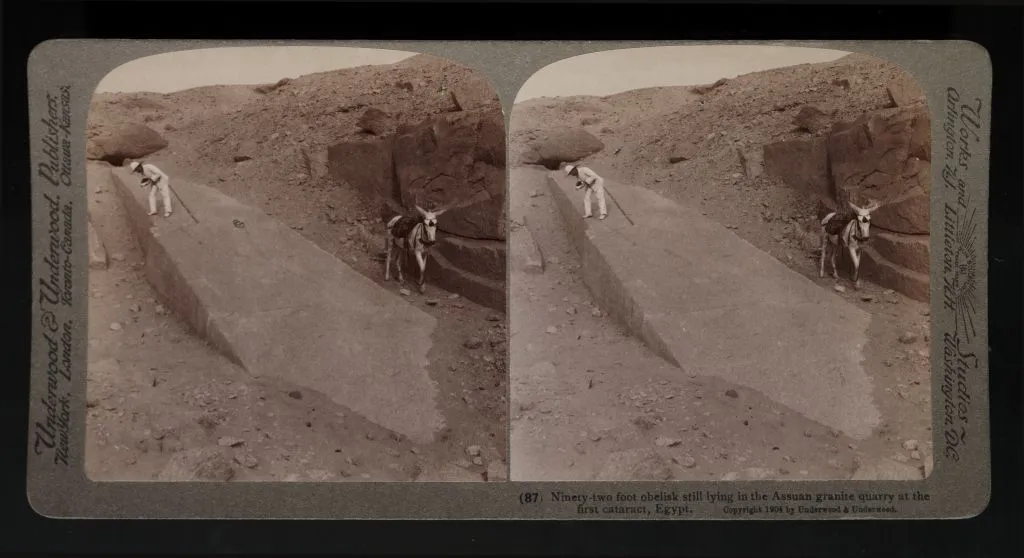
The Unfinished Obelisk was buried under sand and quarry chips for a very long time. Before Engelbach’s work only about 22 metres of it was visible, and the base was buried under roughly 7 metres of chips. His team cleared it in stages in 1921 and 1922, at a cost he gave as 75 Egyptian pounds, and a stereograph from 1904 shows it before the sand was fully removed. His measurements give it a length of 41.75 metres, a base 4.2 metres across and a pyramidion 4.5 metres high, tapering at a slope of about 1 in 24. He published the study in 1922 as The Aswan Obelisk. In 2005 another unfinished, partly worked obelisk base was found nearby, along with rock carvings and possible remains of a working site.
The site today
The quarry is protected and runs as an open-air museum. Walkways and viewing platforms let visitors see the obelisk, the tool marks and the surrounding quarry. In 1979 it was included in the UNESCO World Heritage listing for the Nubian Monuments from Abu Simbel to Philae, although the quarry is neither Nubian nor between those two sites.
Visiting
The Ministry of Tourism and Antiquities lists the site as open daily from 07:00 to 16:00. Ticket prices on that page were EGP 220 for a foreign adult and EGP 110 for a foreign student, and EGP 20 and EGP 10 for Egyptian adults and students. Prices and hours change, so check them before you go.
The ground is uneven granite, so wear comfortable shoes. There is no shade, so early morning or late afternoon is more pleasant in the warmer months. Guided tours with Egyptologist guides are available.
Conclusion
The Unfinished Obelisk is a failure that has lasted. A crack in the granite stopped one of ancient Egypt’s most ambitious projects, and the result is a monument that shows how the work was done, from the pounded channels to the working lines still on the stone.
Did you know?
- The Egyptians called obelisks tekhen.
- The Unfinished Obelisk would have been about one-third larger than any obelisk the Egyptians are known to have raised.
- Its planned height was about 42 metres (137 to 138 feet).
- It is thought to have been ordered by Hatshepsut in the 15th century BC.
- Workers pounded the granite with dolerite balls, a stone harder than granite.
- Guide lines on the stone show a smaller, second obelisk was planned after the cracks appeared.
- Its base is still attached to the bedrock.
- Reginald Engelbach measured it in 1921 and 1922.
- More than half of the surviving ancient obelisks stand outside Egypt.
- Thirteen ancient obelisks are in Italy.