

Six domes on a sandbar
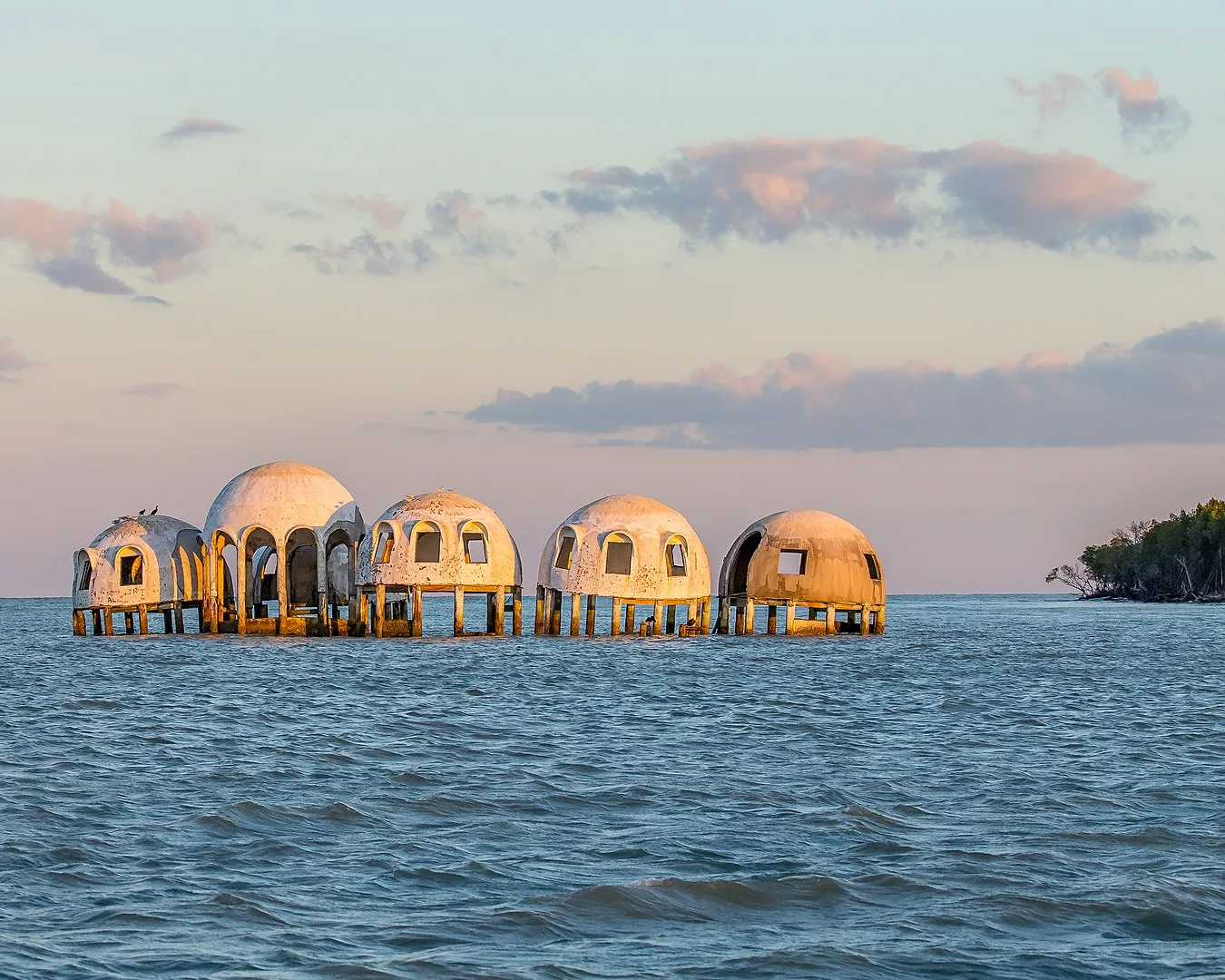
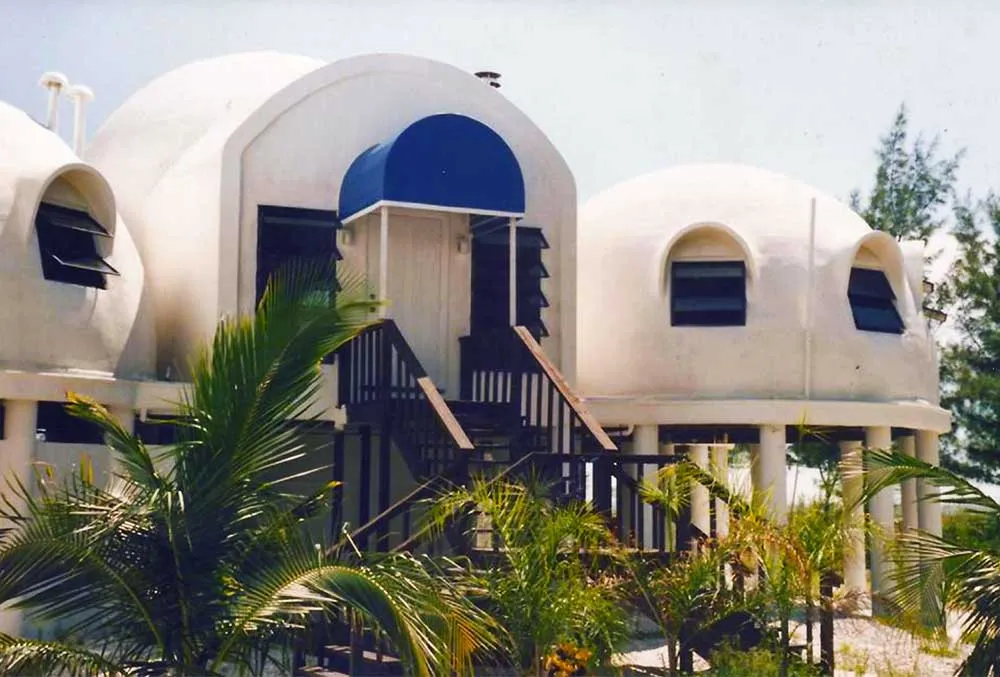
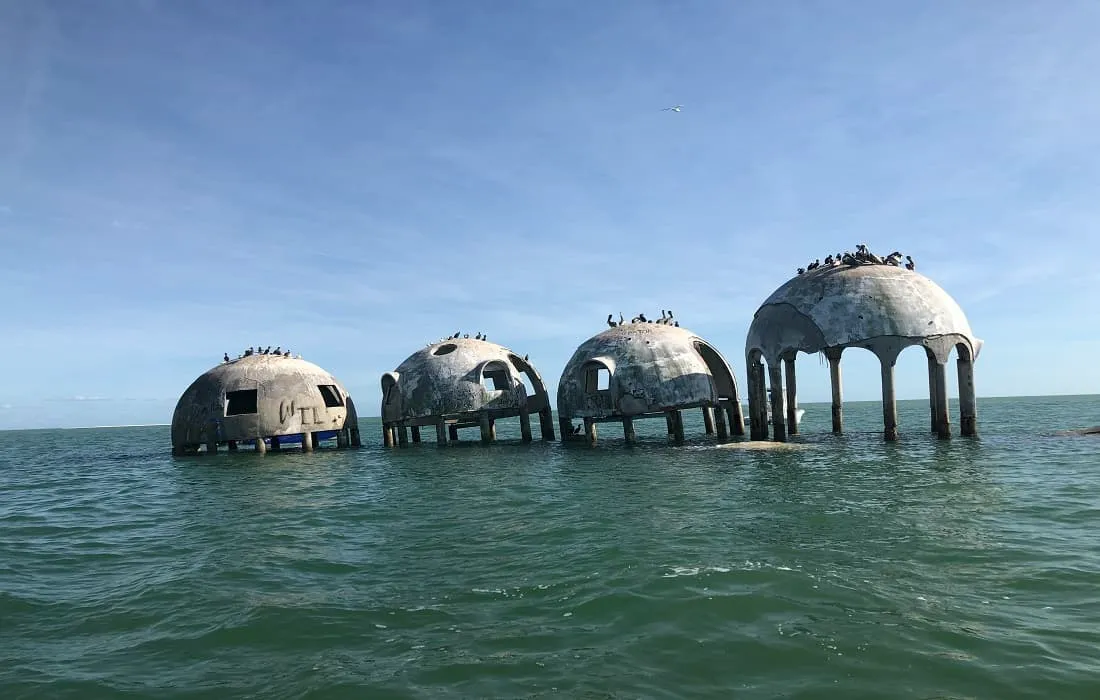
For about forty years a strange sight sat in the shallow Gulf of Mexico south of Marco Island. It looked like a cluster of white igloos, or a base from a science fiction film, standing on thin concrete legs in the water, some way from the shore. Boat captains slowed down for it, and kayakers paddled out to it. Anyone who saw it for the first time was likely to ask the same question: who lives there, and why?
The answer was a good deal stranger than the rumours. Nobody lived there any more. It had been built by a family from Tennessee, and the man who designed it was a retired oil producer with a taste for invention. He had built it as a holiday home on a stretch of beach. The sea took the beach away, and the house was left standing in the water. In 2017 and again in 2022, the Gulf took the house.
The Cape Romano Dome House was never famous for what it was. It was famous for what happened to it. It is also a rare example of a building whose whole story can be traced to one fact. It was built to resist the wind, and the wind never beat it. The water did.
The cape
To see why anyone built there, it helps to understand the place. Cape Romano lies on the Gulf coast of Florida in Collier County, south of Marco Island and separated from it by Caxambas Bay, at the edge of the Ten Thousand Islands. It is a low, shifting tangle of narrow barrier beaches backed by mangrove forest. Marjory Stoneman Douglas said the cape was named for Bernard Romans, who charted the Florida coasts in 1774, and his map labels it “Cape Roman or Punta Larga”. Another early writer, John Lee Williams, recorded several other names for it in 1837.
People have used the cape for a long time. A Calusa sub-chiefdom called Muspa may have lived on or near it, and one Spanish map labels the point “Punta de Muspa”. In 1838 a military expedition camped at the site of a former settlement there and found fresh water. A reliable freshwater well on the cape was used by local people for years afterwards, and from the 1930s to the 1960s a hermit named Joe Dickman lived there. The islands were narrow even then. The beach on Kice Island, next door, was only about two and a half miles long in 1976.
In the 1970s and 1980s several houses were built on or near the cape. Among them were a house on stilts and a pyramid-shaped house, which waves and erosion had destroyed before 2000. The domes outlasted them.
Bob Lee’s idea
The man behind the domes was Bob Lee, a retired independent oil producer from Tennessee. He had a geology background, and one account says he had been a Navy pilot. His family describe him as an inventor, a man who was always building something. His daughter, Jane Maples, who is given as Janet in some accounts, said he loved inventing things. His grandson, Mike Morgan, who lived in the domes as a child, called him an extremely intelligent and very adventurous person. He invented an under-floor heating system for the domes, and a device that dropped logs through a wall opening onto the fireplace.
Lee began buying land on the cape in 1978. By 1979 he had surveyed the site and acquired four adjacent plots. He wanted a home for his family that did not need the outside world: one that made its own power, collected its own water, and was shaped to survive the storms of southwest Florida. The rounded form was part of the answer. A dome has no corners and no flat walls, and the wind slides over it instead of pushing against it. As Morgan put it later, “there are no real edges for wind to catch”. Scientific American says the spherical walls were designed to deflect winds of 150 miles an hour.
Before he built it in Florida, Lee built it in Tennessee. He made a full-scale prototype on his own land in Gatlinburg, in the Smoky Mountains, to try out the design. It is said to be still standing, although Maples says it has a moisture problem.
Building on a barge
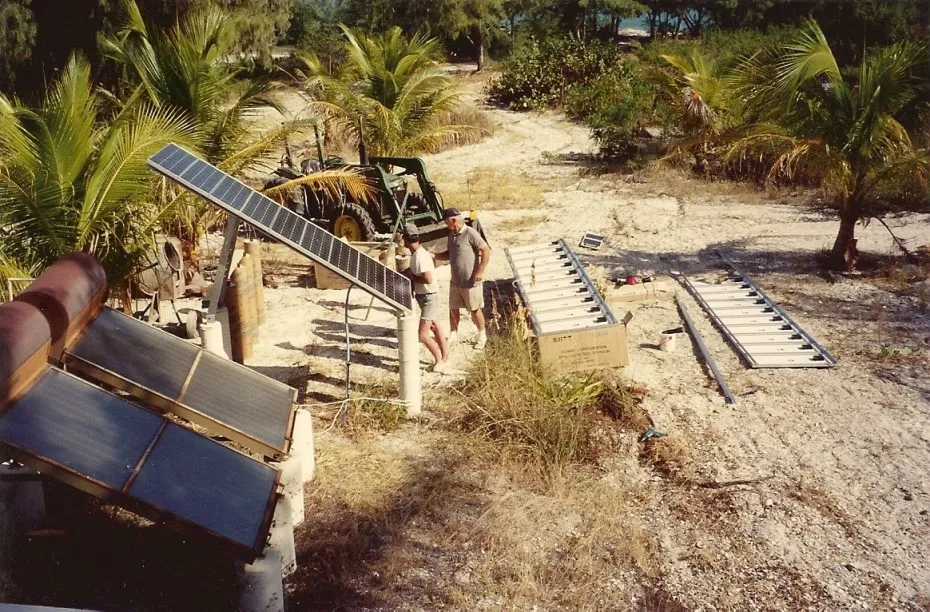
Construction started in 1980. The cape had no road, so everything had to come by water. Lee bought a barge to carry the steel forms, concrete mixers, fresh water, furniture and, eventually, the landscaping. The steel forms were large and were made by Lee himself. His daughter watched him build them as a child.
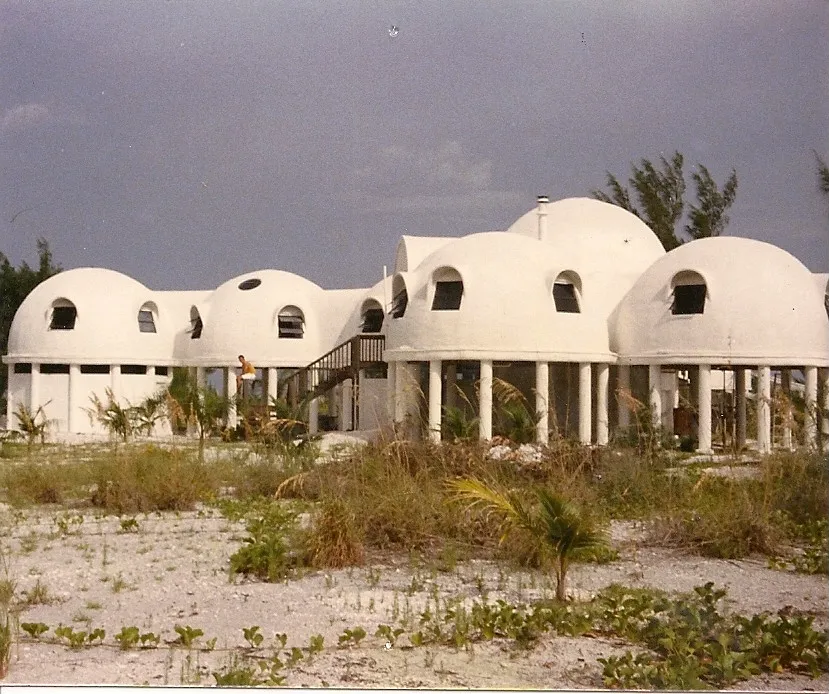
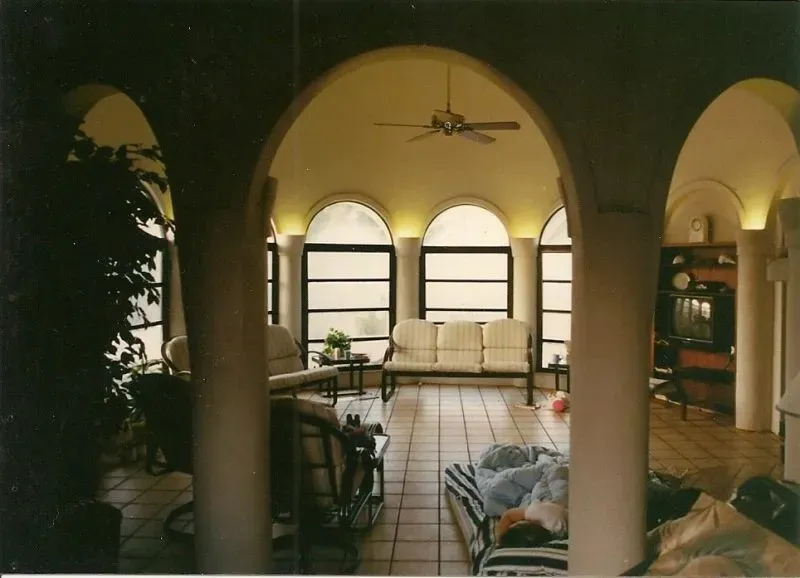
The domes were concrete, mixed with sand dug from the island itself, and they were built of rebar and cement, sprayed with gunite. One account puts the thickness of the shell at about four inches. The outside was coated with foam and painted white, which kept the inside cool. Six domes were joined into a single house, some of them two storeys high, with a total floor area of about 2,400 square feet. There were three bedrooms, three bathrooms, a living room, kitchen, den and sunroom. The curved ceilings took the place of corners, which Lee thought of as wasted space.
The whole building stood on concrete pilings, which lifted it above storm surge. Its designer did not leave anything to chance when it came to services. Rain ran down the domes into gutters and a cistern under the central dome, which held about 23,000 gallons, before being filtered for use. Solar panels fed a bank of batteries, with a generator for cloudy days. A solar contractor from Fort Myers, Dell Jones, installed the systems, which included a solar water heater, a refrigerator built for solar power and a hybrid photovoltaic system. The finished house had air conditioning, ceiling fans, a satellite dish, a telephone line, a hot tub, a gas barbecue and two lit wooden walkways, one to a lagoon and one to the ocean. Lee planted coconut palms around it. One account says it was named Seascape and appraised at $1.5 million.
It was an unusual machine for living in, and it worked. Jane Maples remembered the rooms as very large and open, and said of the family’s stays, “we were not roughing it”. Morgan said it was “totally self-sustaining”. On a sunny day, he said, you could do anything.
Life in the domes
The house was meant as a vacation home, and for the Lee family it was a place of solitude. Lee enjoyed the seclusion, the fishing, the shelling and the weather. The large arched windows looked out over the water, and the family watched manatees, porpoises and turtles go past. Maples remembers sitting on the front patio with her father watching the boats, and says it was “really beautiful”. The path to the beach was much longer than it is now, and a tiring walk.
The family sold the house in 1984. In 1987 the buyers ran into financial difficulties, and the Lees took it back. This time they moved in. Maples, her daughter and her son Mike moved in with Lee and his wife Margaret, and Maples and Mike lived there until 1993. A caretaker named Brian Slager also lived there for almost three years in the early 1990s, and he remembered that the house stood about 200 yards from the water.
The rumours began at about this time. Some locals decided the domes were a base for a secret cult. Others said that aliens had built them. Maples recalls being told that the site was guarded with machine guns, and that it “got a reputation of being a scary place”. None of it was true. The domes were a family house, with a family inside.
The sea comes for the house
The trouble was that the island under the house was moving. Cape Romano is made of loose sand, and sand moves. Over the 1980s and 1990s the shoreline was retreating, and the beach that had seemed so wide was getting narrower. The sea did not wait for the house to be finished before it began to eat the land.
Hurricane Andrew passed in August 1992. It did not hurt the domes’ walls or foundations, which is exactly what the design had promised. But the windows blew out, and the interior was flooded and destroyed. The Lees left the house that year. One account puts the end of the family’s use of it in 1993, and another says that it was abandoned in 1994.
Lee saw the erosion coming. He thought about a seawall, but the rules on coastal construction stood in the way. Later, when the house had been sold, he advised the new owner to build one, and that advice was ignored. Morgan summed up what the family felt: the house could withstand almost anything, he said, but “the only thing the house couldn’t withstand was beach erosion”.
What nobody calculated on was the fact that the water erosion would literally wash the sand out from underneath that place.
Brian Slager, who lived in the dome house as a caretaker in the early 1990s
By 2004 the water was lapping against the concrete pilings. By 2009 the foundations were permanently underwater, and the domes stood in the surf.
John Tosto’s fight
In 2005 Lee sold the house to John Tosto, a Naples man, for $300,000. Tosto had a plan. He would lift the domes by crane and move them inland, onto new concrete pillars on higher ground, and renovate them. He estimated it would take three or four months. He did not take Lee’s advice to build a seawall.
It did not go as planned. A few months after he bought the house, Hurricane Wilma arrived, making landfall near Cape Romano in October 2005, bringing a surge that eroded the shoreline further and left the foundation unstable. Tosto boarded up the windows. Then he found himself caught between three groups of regulators: the U.S. Army Corps of Engineers, the Florida Department of Environmental Protection and several Collier County departments, each with its own permits, and each with its own concerns, which included the nesting seasons of protected birds. He could not get the permissions he needed to move the house.
Wilma did lasting damage to the geography as well. It sent a storm surge of roughly ten feet over Kice Island and cut a new channel, Morgan Pass, which split the southern end of the island off as Morgan Island. In the decade that followed, much of Morgan Island’s beach wore away, and the sand moved south to form a spit and to settle on the Cape Romano shoals. That is one reason the sources disagree about which island the domes stood on. The ground itself had changed names, and then shape, within a few years.
In 2007 the Collier County Code Enforcement Board ordered him to demolish the structure within two years, even though an engineer had certified that the house could be repaired. In November 2009 he was fined $187,000 for missing the deadline. The county offered to waive it if he finished the demolition. Other accounts speak of a fine of $250 a day, and one gives a total of nearly $1 million. Tosto said he had already spent $500,000 and that finishing the job would cost another $900,000. He did not demolish the house.
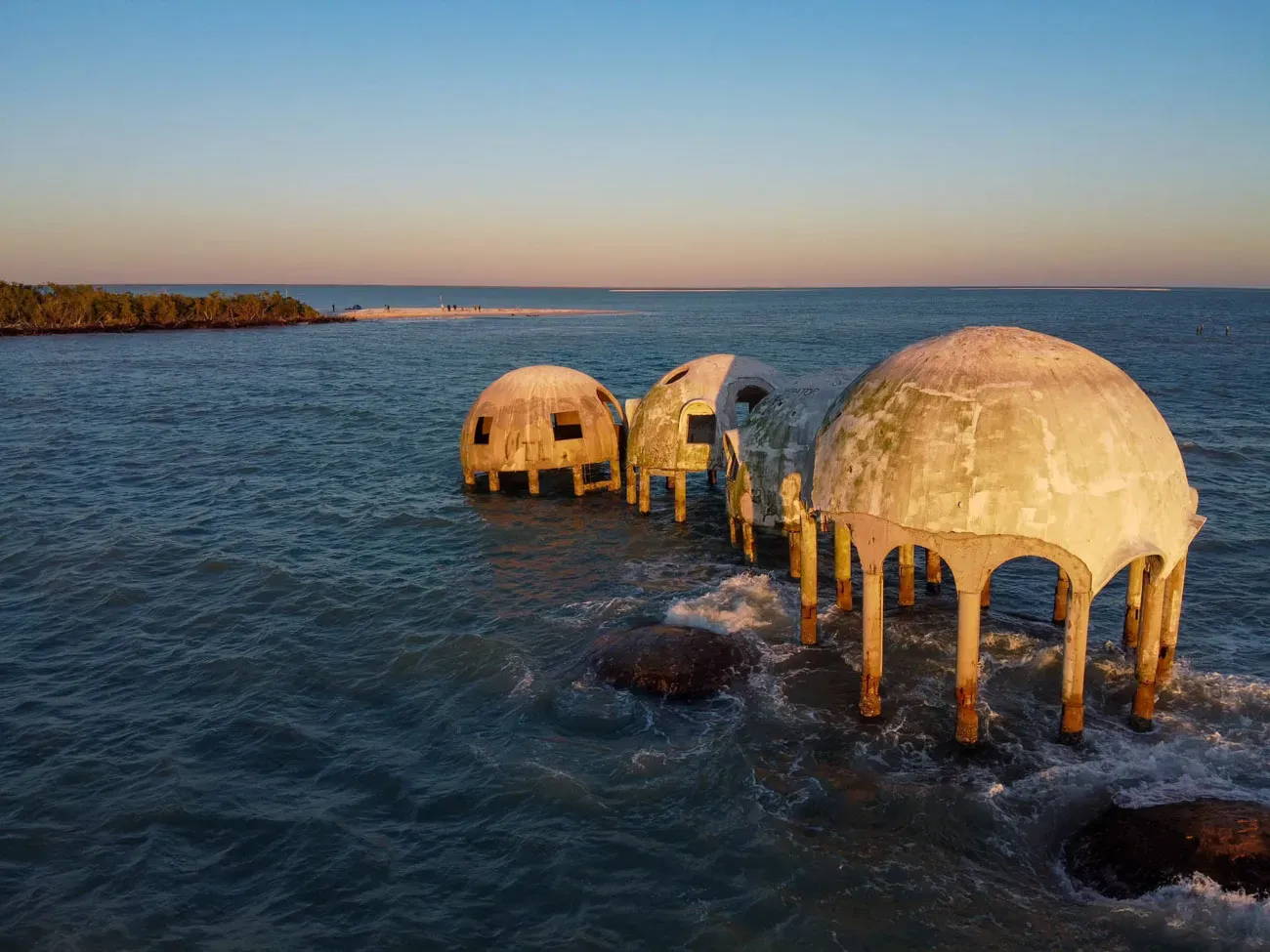
The domes stayed where they were, and the sea kept coming. By 2014 all six were standing in the water, with the beach eroding away behind them.
A ruin with a following
Something odd happened to the domes while their owner and the authorities were arguing about them. They became famous.
A photographer named Mila Bridger first saw them from a friend’s boat. She was struck by the architecture, she says, and “knew there had to be a story”. She later started a Facebook page called “Cape Romano” and swam around the domes, so often that people thought she was crazy. A local journalist, Natalie Storm, published the first history of the house in the Coastal Breeze News in 2012. In 2013 a reporter from Florida Weekly, Cynthia Mott, put on a snorkel and swam to the domes. She found that the ruins below the water had turned into a reef, and wrote that she had “never witnessed a more diverse, crowded concentration of undersea life”.
Photographs spread online, and so did the rumours. Local boat captains began to run trips. Tour customers compared the domes to Luke Skywalker’s house in Star Wars. Visitors left their markings on the concrete, and locals sometimes fished off the pilings. In 2015 and 2016 a Naples charity, Oceans for Youth, proposed to haul the domes out to deeper water and sink them as an artificial reef, and tried to raise $2.2 million. The fund fell short, and some of the public objected anyway, because they wanted to be able to see the domes.
The ownership question was settled, in a way, in 2018. A letter from the Florida Department of Environmental Protection, dated 11 May 2018, set out that the submerged land under the domes belonged to the state, within the Rookery Bay Aquatic Preserve. Wikipedia records that ownership passed to the state that year. The structures stayed privately owned while the land under them belonged to the state, and the state’s main concern was safety, since they could collapse at any moment.
Irma and Ian
In September 2017 Hurricane Irma came ashore at Marco Island. The two westernmost domes collapsed into the sea. Four were left, on their pilings, standing in open water.
They survived another five years. Photographers kept taking pictures of them, and visitors kept going out to see them. In August 2022 a writer who visited on a charter got close enough to touch the concrete and found other people’s markings on it. One tour operator, Alex Demooy of Breakwater Adventures, said the domes had been walkable at low tide about twelve years earlier, and that the furthest was some 250 feet from shore.
On 28 September 2022 Hurricane Ian made landfall in southwest Florida. The storm knocked the last four domes off their pilings and into the water. Some of the pilings still stand above the surface, and at low tide the top of one dome is said to break the surface. Demooy was among the first people to photograph the site afterwards. He told a reporter that everyone was pretty sad.
It was built to withstand hurricanes, but it wasn’t built to withstand this.
Alex Demooy, Naples charter operator, after Hurricane Ian
Online, thousands of people mourned. A photograph captioned “R.I.P. to the domes” drew almost 2,200 likes in a few days, and Facebook groups were set up for people to share their memories. The boat ramp that people used to reach the water had been destroyed by the same storm, and the marina where a local captain kept his boats was closed.
What it shows
It would be easy to treat the domes as a curiosity, but they are also a useful lesson. The house did what it was designed to do. Its walls and foundations came through Hurricane Andrew, with only the windows and interior lost. What it could not survive was the slow movement of the ground beneath it.
Jayantha Obeysekera, a research professor and director of the Sea Level Solutions Center at Florida International University, told E&E News in 2019 that the dome home was “a clear sign of things to come” for low-lying and unprotected coasts. Southwest Florida’s coast has risen by around six to eight inches since 1990, according to a report cited by Scientific American, and a NOAA projection suggests about another foot and a half by 2050 at the present rate of emissions. The domes were not a victim of climate change alone. They were built on a barrier beach, which is by nature a moving thing, and erosion would have reached them in any case. But they make the point rather well.
Lee himself saw it coming. He died some years before the last domes fell. Jane Maples has said that when she was asked about going back to the cape, “it would just be too sad”. She hopes that the remaining domes could sink and become a home for coastal sea life.
Seeing it now
There is no longer a building to look at. After Ian the domes lie in open Gulf water, half-submerged or fully underwater depending on the tide, and the remains are a scatter of broken concrete and some pilings. One tour operator describes them as eerie, beautiful and very much a ruin. Pelicans and cormorants perch on the exposed rebar, and barnacles have formed a white ring on the waterline.
The site is reached only by boat, from the south end of Marco Island, past Kice Island and around Cape Romano. Some local tour companies include the ruins on their trips, timed to the tide, and some private charters stop there depending on wind and swell. The operators ask visitors not to land on or climb the ruins, which are unstable, and to stay a boat-length or two away, because broken rebar and jagged concrete sit just below the surface on the down-current side. Visibility is not good. One captain describes the water around Marco Island as somewhere between chocolate milk and green tea, so diving on the wreck is not easy. The surrounding waters are a protected preserve.
Conclusion
The story of the Cape Romano domes could have gone another way. A clever man built a house that made its own power, caught its own rain and shrugged off the wind, and for some years it did all those things. His family lived in it, watched manatees from the windows and fished from the patio. If the beach had stayed where it was, the domes would probably be standing today.
The beach did not stay. Everything else about the house was right and the one thing nobody could control was wrong. Over forty years the sand left, a succession of owners and regulators argued over the building, and the sea came in. In the end the domes became a reef, and a reminder that the coast is not a fixed line on a map.
They are still out there, under the water, with fish living in the concrete. It is not the future their builder imagined, but it may be the one that lasts.
Did you know?
- The house had six connected domes and about 2,400 square feet of living space.
- Builder Bob Lee made a full-scale prototype in Gatlinburg, Tennessee, that is still said to stand.
- All the building materials had to come by barge.
- Rain ran into a cistern under the central dome that held about 23,000 gallons.
- The Lee family sold the house in 1984 and took it back in 1987.
- John Tosto bought it in 2005 for $300,000.
- A Naples charity tried to raise $2.2 million to sink the domes as a reef.
- Hurricane Irma toppled two domes in September 2017.
- Hurricane Ian destroyed the other four on 28 September 2022.
- A 2013 snorkeler found the underwater ruins had become a reef full of marine life.