A war the U-boats were losing
In the first years of the Second World War, German submarines came close to cutting Britain off from the rest of the world. By the spring of 1943 the picture had reversed. Allied aircraft with long-range radar, better escort groups, improved codebreaking and the sheer volume of new merchant ships and escort vessels meant that U-boats were being sunk faster than they could be replaced. The navy’s commander, Karl Dönitz, needed a boat that could outrun the escorts and survive under the water for long periods, and he needed it in numbers.
The answer was the Type XXI, nicknamed the “electric boat”. Its designers took the streamlined hull of an earlier experimental design and, instead of the hydrogen-peroxide turbine that had been planned for it, filled the space with much larger batteries, roughly three times the capacity of the standard Type VII. The result was a boat that could run fast while submerged. The figure usually quoted is a submerged speed of about 17 knots, which is more than twice what a Type IX could manage underwater. It also had a snorkel, quieter running, and a torpedo room with power-assisted reloading that could fire a long salvo in about twenty minutes. On paper it was the first true submarine, in the sense that it was designed to live below the surface and not merely to dive when threatened.
The navy ordered the design in June 1943, and Dönitz approved it as the successor to the Type VII within days. Series orders followed in November of that year. The planners wanted hundreds of them, and the programme set for mid-1944 called for as many as 580 boats. A postwar American assessment was less kind to the design. It judged the engines underpowered, the hydraulics vulnerable and the hull structurally weak in places, and the naval historian Clay Blair concluded that the Type XXI could not have made a big difference in the Battle of the Atlantic. That verdict was only possible after the fact. In 1943 the Germans believed they had a way back into the war at sea.
Building submarines like cars
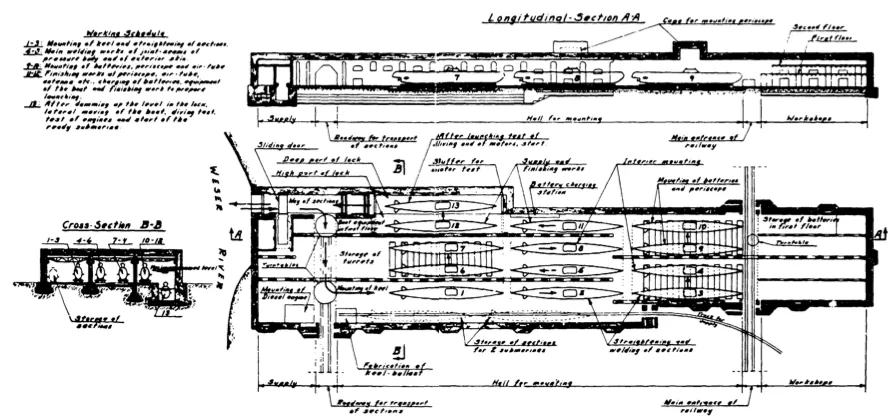
The Type XXI came with a new way of building it, and that method is the reason Valentin exists. A conventional submarine was built on a slipway, from the keel up, in a single shipyard. The XXI was divided into nine prefabricated sections: eight hull sections plus the conning tower superstructure. The sections were made at steel works and engineering firms across Germany, many of them far inland, and fitted out at specialist yards before being moved by barge and rail to a final assembly yard. Three yards were intended for this last step: Blohm and Voss in Hamburg, AG Weser in Bremen, and Schichau in Danzig. Albert Speer, the armaments minister, appointed Otto Merker to run the programme, and Merker’s idea was to treat submarine building like an industrial assembly line.
The weak point in that line was its last stage. A yard on a river is easy to find and easy to bomb, and the Allied bomber offensive had already shown what it could do to Hamburg and Bremen. If the final assembly was knocked out, the whole chain of prefabricated sections would be useless. The solution was to move that step under a roof of reinforced concrete too thick for any bomb then in service. The Germans already had experience of this idea. On the French Atlantic coast they had built massive pens for U-boats to shelter in, and the Allies had discovered that bombing them was almost pointless. Valentin applied the same thinking to production, not just to shelter.
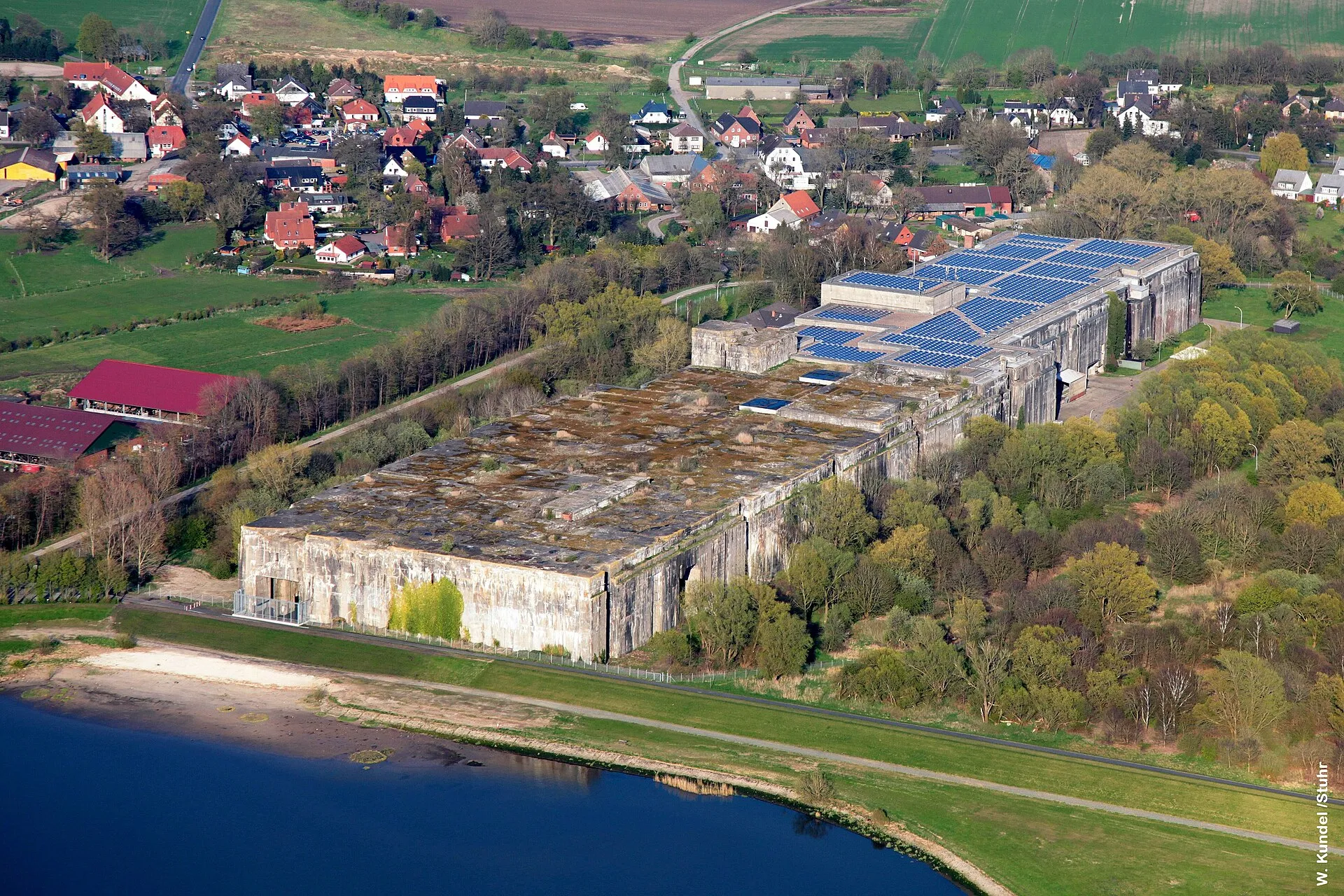
It was one of several such structures planned or begun in northern Germany in 1943 and 1944, among them the Hornisse bunker in Bremen for the AG Weser yard, and bunkers at Hamburg, Kiel and Wilhelmshaven. Valentin, on the Weser between the suburbs of Rekum and Farge in the north of Bremen, was the largest, and it is the one that survives as a place you can visit.
Farge before the bunker
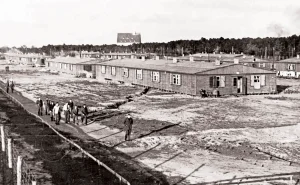
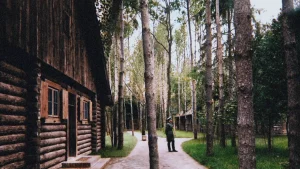
The land at Farge was not empty when work began. Since 1936 the area had been used for a large underground fuel depot, built for the Economic Research Foundation, known by its German initials as WiFo, which was a camouflage organisation of the Reich Ministry of Economic Affairs. The first barrack camp for forced labourers was built there in 1938 or 1939, and navy labour camps were added for a separate navy fuel depot. In 1940 the Gestapo opened a “labour education camp” in Farge, together with a camp for prisoners of war and workers brought from the east. Soviet prisoners of war were later held there.
That history matters for two reasons. First, it explains why the site was chosen: it already had road, rail and river connections, power, and a workforce that could be expanded. Second, it shows that the use of forced labour at Farge was not a feature of the bunker alone. By the time the U-boat shelter was started, the camp system around it was several years old.
Building Valentin
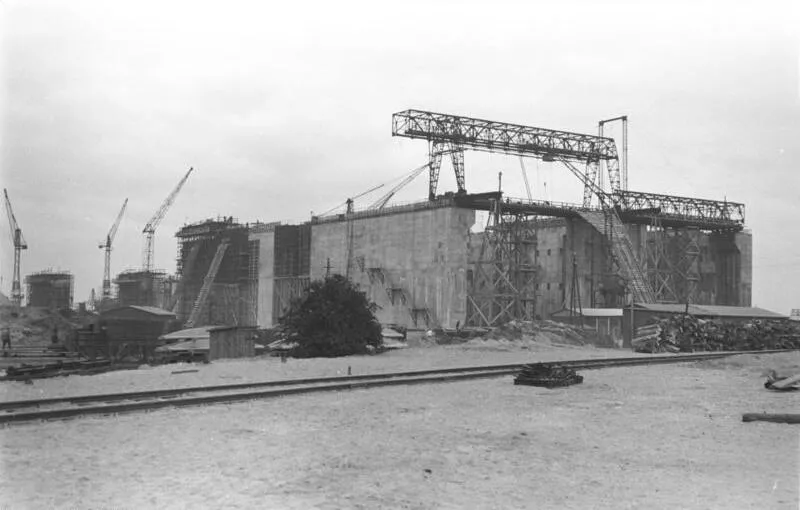
The Organisation Todt, the state construction agency, and regional firms began work on the bunker in 1943. The month is disputed: the memorial gives summer 1943, while Wikipedia gives February 1943, so the safest statement is that the main construction ran through 1943 and 1944 and into the first months of 1945. The overall charge was in the hands of a naval construction officer, Edo Meiners, and the site engineer, Erich Lackner, went on to a career in civil engineering after the war.
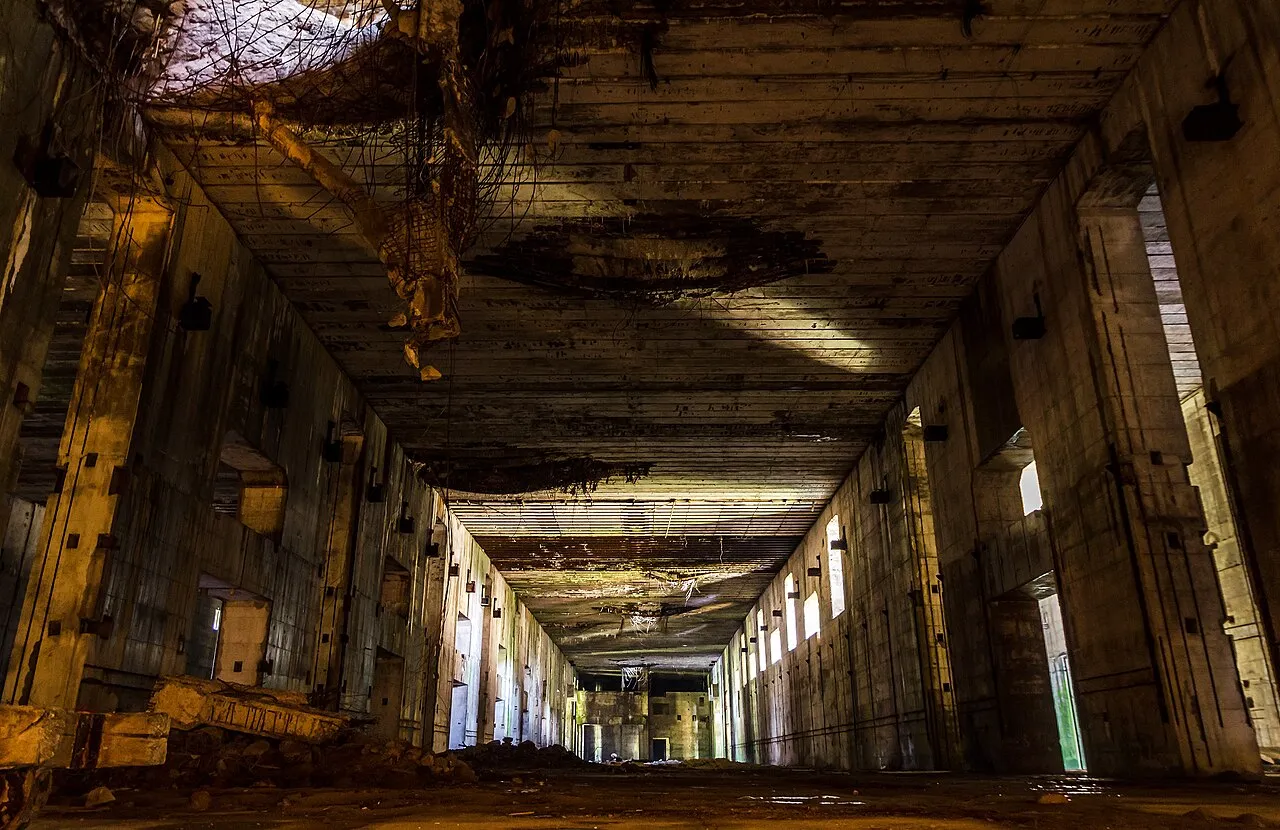
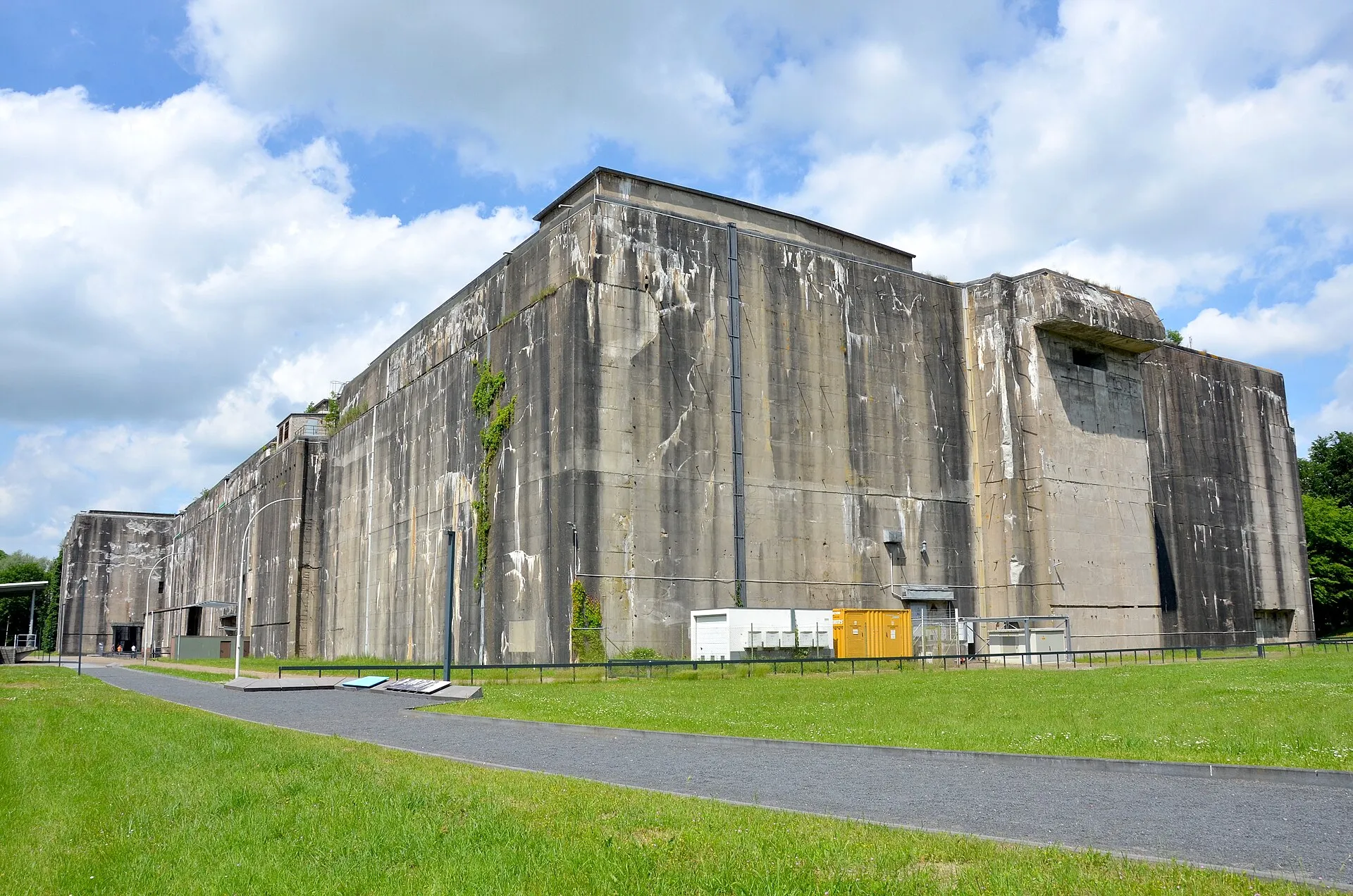
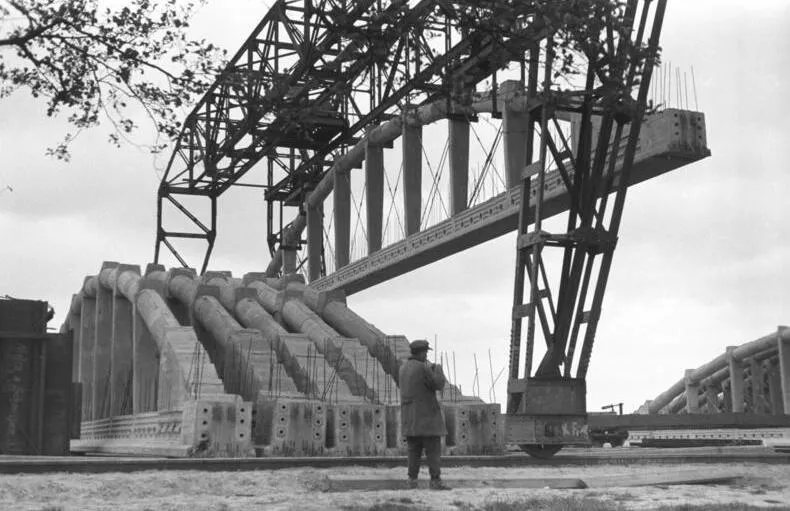
The scale is difficult to picture. The hall is about 426 metres long and up to about 97 metres wide, and between 22 and 27 metres high. The walls are about 4.5 metres thick. The roof is mostly around 4.5 metres thick, with a section on the eastern side that is about 7 metres. Building it took roughly half a million cubic metres of concrete. Other sources give somewhat different dimensions, partly because the structure has a western and an eastern half that were built to different specifications, and partly because the roof was still being thickened when the bombs arrived. The simplest summary that fits every source is a hall more than 400 metres long under a roof several metres thick.
The production plan was equally large. The first three boats were to be completed in April 1945, and from August 1945 the bunker was to turn out a minimum of 14 boats a month. Other accounts say the hall could hold 16 boats at once. By March 1945 it was about 90 per cent complete. None of those figures was ever tested, because no submarine was completed in the building.
The workforce
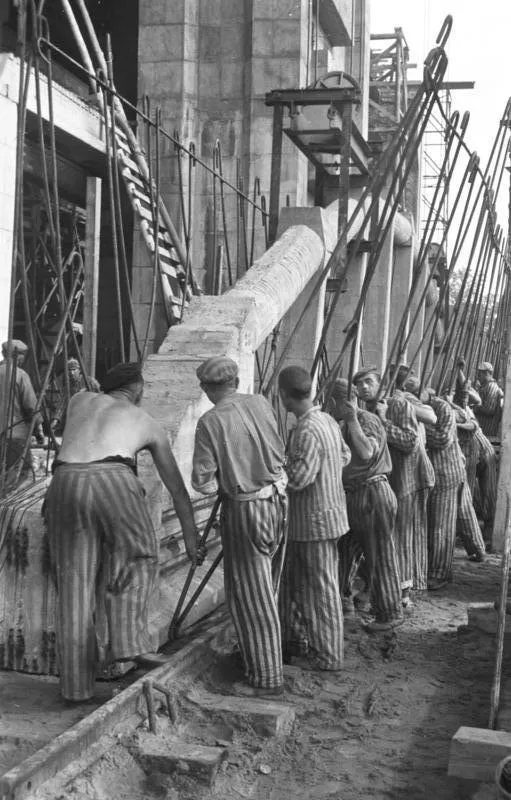
The concrete was poured by people who had no choice. Most of the 10,000 to 12,000 workers named in various accounts were forced labourers. They included Red Army soldiers taken prisoner, civilians brought from the occupied Soviet Union, French, Italian and Polish workers, and prisoners from concentration camps. The memorial counts at least seven forced labour camps in and around Bremen-Farge. In the autumn of 1943 a satellite camp of the Neuengamme concentration camp was opened in the Rekumer Feldmark. By March 1945 it held 2,092 prisoners according to one record, and the memorial describes more than 2,000 forced labourers there who worked at least ten hours a day. Other accounts describe shifts of 12 hours, from seven in the morning until seven in the evening.
The camps were between three and eight kilometres from the site, and the prisoners walked or were moved to the bunker every day. Food was poor and the work was heavy. Accounts describe people dying of hunger, exhaustion, disease and beatings, and the guards were not required to keep records of the deaths of the prisoners they regarded as expendable. The nationalities held at Farge reflect the reach of the German occupation: French prisoners of war, Poles, Russians and other Soviet citizens, and non-German concentration camp inmates, along with a smaller number of German criminals and political prisoners.
Counting the dead
The number of people who died building Valentin is not known, and the competing figures show why. The memorial states that at least 1,000 people died during the construction work, and it calls the total an estimate. Wikipedia confirms only 553 deaths by name, most of them French, and then says estimates reach 6,000 because the deaths of Polish and Russian workers were often not recorded. A visitor guide offers a range of 1,500 to 6,000, another website suggests about 4,000, and the article on the Type XXI says more than 4,000 of the builders died. Each figure answers a slightly different question. The lowest numbers count the dead who can be documented, and the highest estimate the dead who cannot.
It helps to read the memorial’s wording carefully. “At least 1,000” is a floor and not a total. If you see a website offering a single confident number, such as 4,000 or 6,000, it is repeating one estimate out of several. The honest position is that a death toll in the low thousands is probably right, and that the real figure will not be known, in part because the people who counted were also the people responsible.
27 March 1945
By the spring of 1945 the bunker was close to finished, and the Allies knew about it. Their problem was the roof. Ordinary bombs, even large ones, would simply detonate on its surface. The answer lay in a different kind of weapon, designed for exactly this purpose and built by the engineer who had designed the bouncing bomb used in Operation Chastise.
Barnes Wallis followed his dam-busting work with two very heavy bombs: the 12,000 lb Tallboy and the 22,000 lb Grand Slam. Both were streamlined, dropped from high altitude, and designed to reach a speed at which they could bury themselves deep in the ground or in concrete before exploding. The explosion then acted as an earthquake, shaking the structure from beneath. The weapons were carried by Lancasters of No. 617 Squadron, which had become the RAF’s specialist unit for precision attacks after the Dambusters raid. In 1944 a Tallboy dropped by the squadron, along with another squadron’s aircraft, had helped sink the battleship Tirpitz, and in the early months of 1945 the squadron was using both bombs against viaducts and U-boat shelters.
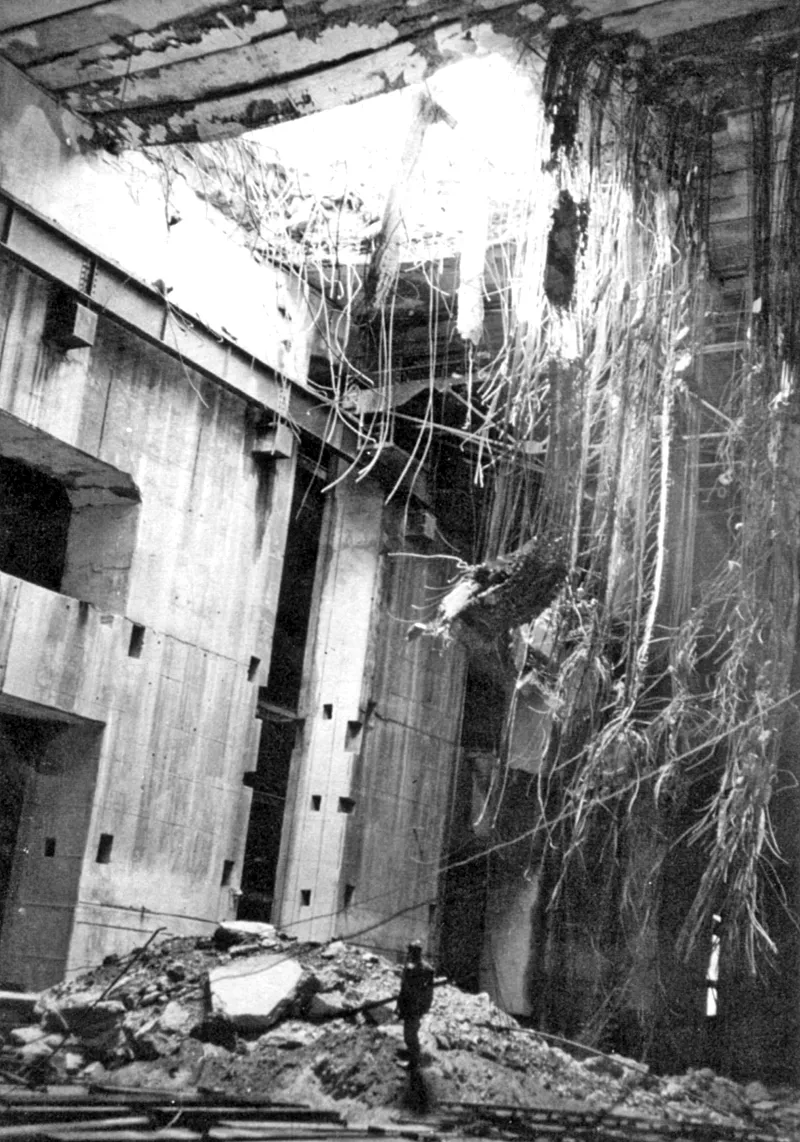
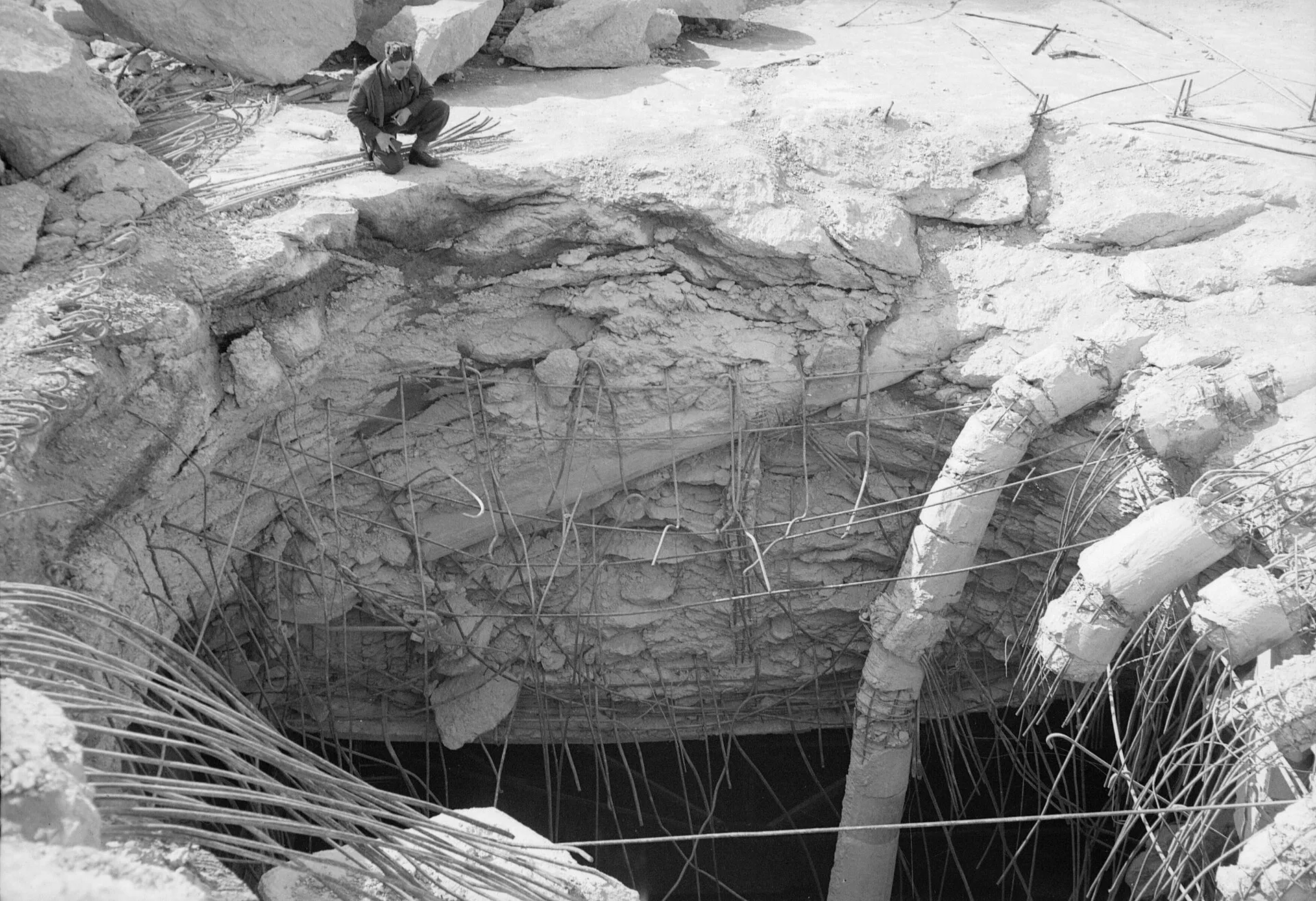
On 27 March 1945 the bunker at Farge was attacked. One published account says twenty Lancasters of 617 Squadron took part, seven carrying Tallboys and thirteen carrying Grand Slams. At the same time 115 Lancasters bombed a fuel depot at nearby Schwanewede, escorted by Mustang fighters. Two Grand Slams penetrated the roof of the western section and exploded inside, bringing down a great mass of concrete, which one source puts at about 1,000 tons. Another bomb damaged a power plant, workshops and a concrete mixing plant nearby. The memorial puts the result in its own words: an Allied air raid hit the bunker ceiling, construction stopped, and no U-boat was ever completed.
Accounts of the raid vary in detail, and some pages do not name the squadron, so the numbers of aircraft and bombs are best treated as the version in one published source and not as a definitive record. A later raid by the US Eighth Air Force on 30 March 1945, using rocket-assisted “Disney” bombs, is reported to have scored only a single hit and done minor damage to the bunker itself, though the surrounding installations suffered more.
The western roof was damaged beyond repair, but the eastern section stayed intact. That is the reason you can still see two different bunkers in one: a ruined half, open to the sky in places, and an intact half that was later used as a depot.
Evacuation and the ships
The raid ended the building work, but not the suffering of the people who had done it. On 10 April 1945 the SS evacuated the Farge satellite camp, and the prisoners were forced to march to Neuengamme, near Hamburg. As the front closed in, many of the prisoners from the northern camps were put on ships in the Baltic. The memorial records that concentration camp ships were sunk in an air raid in the bay of Neustadt, and that many of the prisoners died. It gives no figures, but the best-known loss in that bay was the Cap Arcona, which the RAF sank on 3 May 1945. About 5,000 prisoners were aboard, and only about 350 are said to have survived. We could not confirm how many of those people had come from Farge, so the link is best read as part of the same story and not as a direct count of Valentin’s victims.
The camps were liberated in early May 1945, when British forces reached the area. The Allies took over the WiFo premises and the unfinished bunker shell.
What could be done with it afterwards
The British considered what to do with a building that was too large to demolish. In 1946 the bunker was used for a series of penetration tests code-named Project Ruby, in which inert bombs were dropped on it to learn how different weapons behaved against thick concrete. The report concluded that none of the bombs tested was suitable against massive reinforced concrete of that kind, and the idea of blowing it up was abandoned, partly because the blast would have damaged nearby villages.
From 1957 the West German defence ministry administered the wider fuel depot, and in October 1966 the Bundeswehr opened a navy supply depot in a renovated part of the bunker. Visitor accounts say a partition wall separated the ruined western section from the intact eastern one. For decades the structure was a military warehouse, and the history of its construction was largely absent from public view.
That began to change in the 1980s. A monument to the victims, titled “Vernichtung durch Arbeit” (“extermination through labour”) by the Bremen artist Fritz Stein, was put up in 1983. Discussions about the history of forced labour at Farge and a possible memorial followed, and in the 1990s survivors and relatives gained access to the site. From 1990 visitors could book guided tours through the Bundeswehr, and in 1995 the Bundeswehr put up its own monument to the victims of the satellite camp. A private association, the “Geschichtslehrpfad Lagerstraße”, was founded in 1999 to preserve the traces of the camps.
The bunker was placed under monument protection in 2005. In 2008 the defence ministry offered it for sale, and in 2009 the city of Bremen began converting it into a memorial site. The Bundeswehr gave up its use on 31 December 2010, and on 8 May 2011 the Memorial Submarine Bunker “Valentin” opened in part of the building. It commemorates the victims of the Farge camp and of six other camps in the region.
The submarine that never came
It is worth asking what Valentin was meant to produce. Of the hundreds of Type XXI boats ordered, only a fraction were ever completed: 118 from an original plan of over a thousand, with quality problems, bombing and steel shortages disrupting production. Only one, U-2511, went on a war patrol, in the last week of the war, and by the time it was in position the war was ending. A second boat, U-3008, is sometimes credited with a patrol, but the evidence for that is not firm.
The design nonetheless influenced the submarines that followed it. After 1945 the Allies took over several of the surviving boats, and the Type XXI shaped the American GUPPY conversions, the Soviet Whiskey and Zulu classes, and a number of other postwar designs. One boat, U-2540, was raised in 1957 and served in the West German navy as a research vessel before becoming a museum ship in Bremerhaven, about 50 kilometres from Valentin. The submarine that Valentin was built to produce had a long afterlife. The building itself produced none of them.
How to read the numbers
Almost every figure attached to Valentin comes in more than one version, and it helps to know why. Dimensions come from different measurements of a structure with a western and an eastern half, one of which was bombed and one of which was not. Start dates differ because the project grew out of earlier works at Farge and was not begun on a single day. Death tolls come from camp records that were incomplete, from estimates made decades later, and from a workforce that included prisoners whose deaths were never written down. Even the account of the raid depends on which source you read, since some give the number of aircraft and the bombs they carried and others give only the result. Where a single confident number appears on a website, it is usually one estimate out of several, and this article gives the range wherever the sources allow it, so that you can see how much is firmly known and how much is argued over.
Visiting
The memorial is in the Rekum area of north Bremen, near the Weser. It offers an exhibition inside the bunker and guided tours of the structure and the remains of the former camps. The memorial’s own page says visits are by appointment and include guided tours, while another visitor guide says entry is free and an audio guide is available, with self-guided walking tours as well. These descriptions may reflect different periods, and opening arrangements change, so check the memorial’s official website before you travel. Public transport is possible, and one guide gives a bus line from Bremen-Farge or Bremen-Vegesack stations. The site is about 25 kilometres from the city centre.
Remember that this is a grave site as well as a ruin. Treat it with respect, keep to the marked routes, and do not enter closed or unsafe areas of the structure. The ruined western half in particular has fallen concrete.
Conclusion
Valentin is easy to describe as a failure of German industry. It was a vast investment that produced nothing, bombed before its first boat could be launched. That is true, but it leaves out what the building was made of. The concrete was poured by prisoners and forced labourers, many of whom died of hunger and exhaustion, in a camp system that stretched across Europe. The roof that two bombs went through was built with their labour, and the survivors of that labour were marched away within days of the raid.
The site is notable for another reason too. It links two parts of this site’s story: the Dambusters of Operation Chastise, and the weapons that Wallis designed afterwards, which finally made roofs like this vulnerable. In 1943 617 Squadron breached dams. In 1945 it was dropping the bombs that defeated the thickest concrete the Germans could build. The bunker is still there, because it was too big to take down, and the memorial inside it keeps the two facts together: that the building was a weapon of war, and that it was built by people who were killed by the work.
Did you know?
- The bunker is about 430 metres long.
- Type XXI submarines were to be assembled here from nine prefabricated sections built across Germany.
- Up to 12,000 people were held in the camps around Farge.
- Two bombs went through the roof of the western section on 27 March 1945.
- No U-boat was ever completed in the building.
- The West German navy used part of the bunker as a supply depot from 1966 until 2010.