A wooden giant in a desert bowl
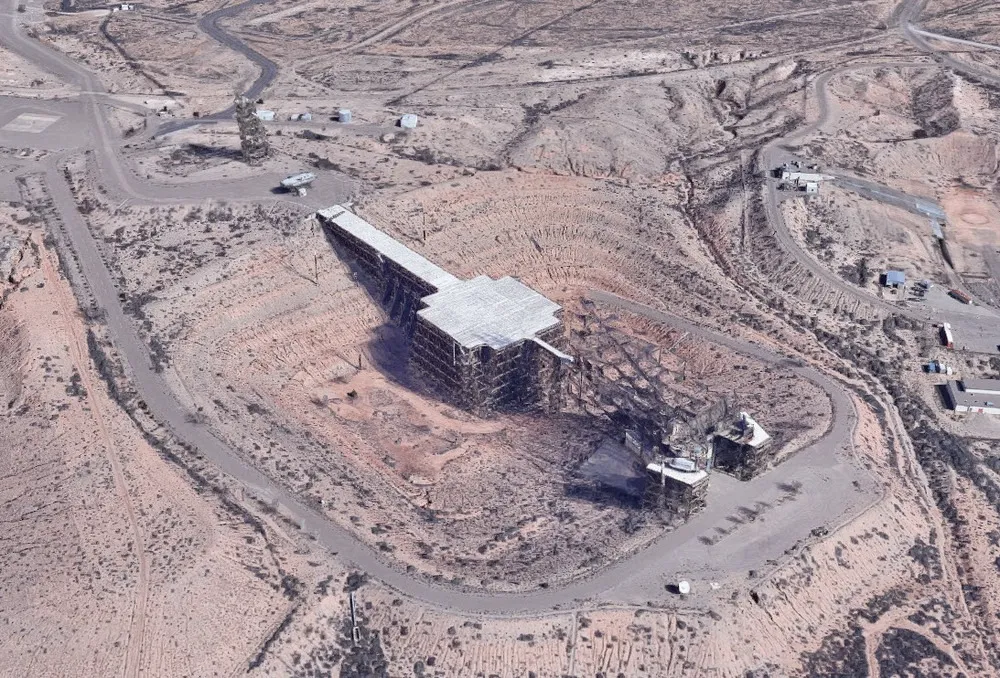
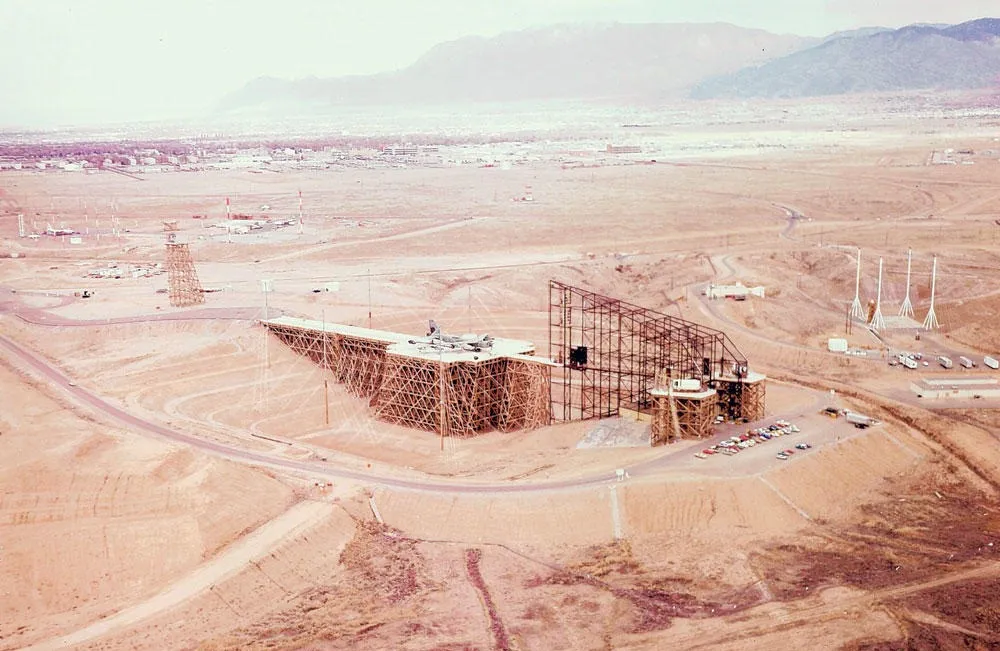
If you fly into Albuquerque, look out of the window on the approach to the Sunport and you may catch sight of something strange. Beyond the end of the runway, on the edge of Kirtland Air Force Base, there is a dry bowl in the ground about 600 feet across and 120 feet deep. In the bowl is a framework of pale timbers, climbing level upon level like a roller coaster that has never been given any track. A long wooden ramp slopes up from one side to a square platform standing high in the air. Beyond it rise towers, a tall steel wedge covered in wire mesh, and a wooden mast. It looks like a fairground built for giants, or a film set for a story that never got made.
It is neither. It is a machine. The Air Force called it ATLAS-I, the Air Force Weapons Lab Transmission-Line Aircraft Simulator, and almost everyone on the base called it the Trestle, because its designers had borrowed the idea from a railway bridge. For about a decade it was where the United States found out whether its nuclear bombers would still fly after a nuclear explosion had gone off in the sky above them. The answer had to be found without exploding a bomb, and the people who built the Trestle did it with timber and glue.
The problem: a bomb that kills electronics
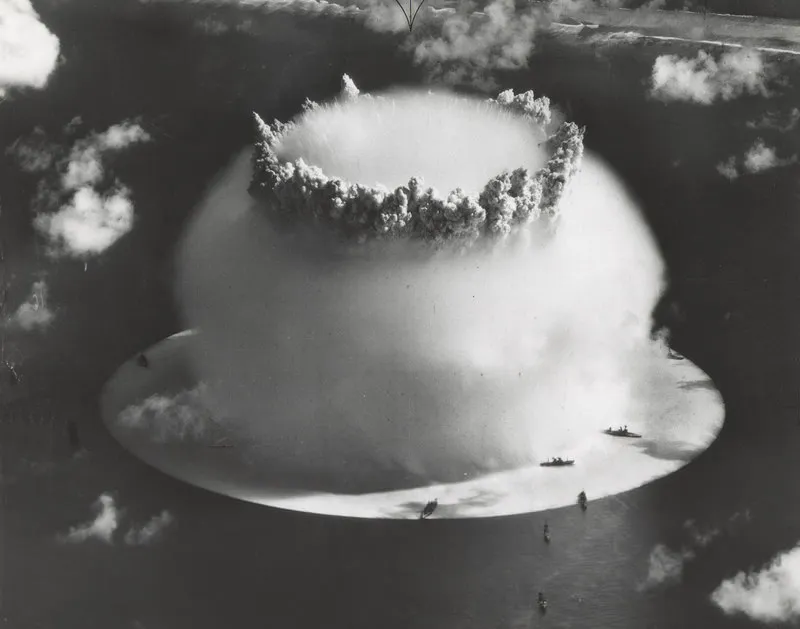
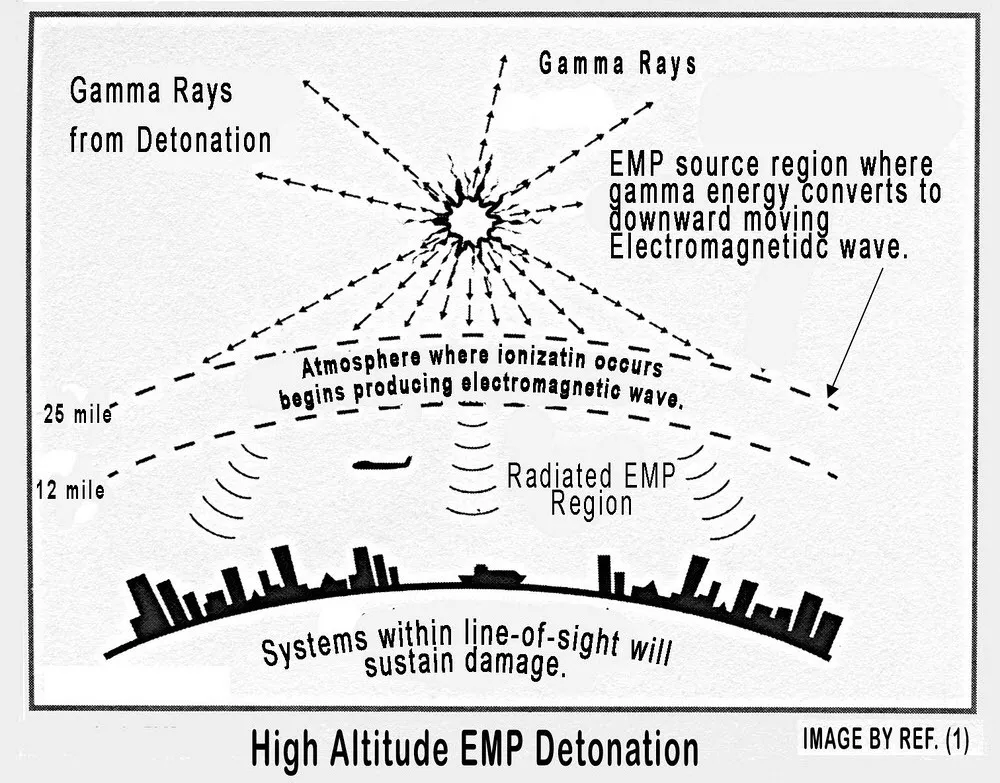
The worry behind the Trestle came from a discovery that was partly an accident. When the first atomic bombs were tested, scientists noticed that the explosion threw out a sharp burst of radio energy, which could upset electronic equipment nearby. At Trinity in 1945, the physicist Enrico Fermi is said to have advised the Army to shield its instrument cables, and even so many of the records were lost to stray pickup. But the full scale of the effect became clear only in the early 1960s.
On 9 July 1962 the United States set off a 1.4-megaton bomb at an altitude of about 400 kilometres above the Pacific. The test, called Starfish Prime, was planned as a study of radiation in space. It also produced an electromagnetic pulse far larger than anyone had expected, and it overwhelmed much of the instrumentation meant to measure it. In Hawaii, around 1,450 kilometres away, about 300 streetlights went out, burglar alarms began to ring and a telephone company microwave link was damaged. In the months that followed, radiation trapped in space killed at least half a dozen satellites, including Britain’s Ariel 1 and the Telstar 1 communications satellite.
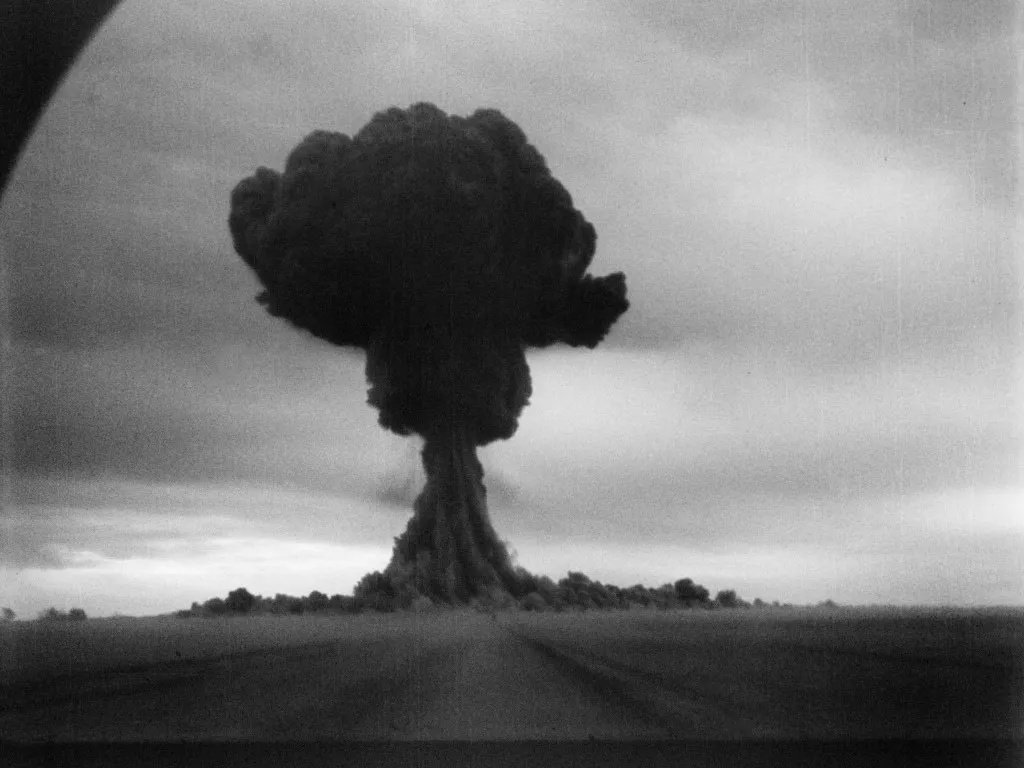
The Soviet Union carried out its own high-altitude tests that year. One account says that a 300-kiloton bomb exploded some 290 kilometres over Kazakhstan produced currents in a long buried power cable that set fire to a power station in Karaganda, and blew every fuse on a 570-kilometre overhead telephone line that scientists had set up to measure it. Whatever the exact details, the lesson for planners on both sides was the same. A single weapon exploded high above a country could knock out electrical equipment over a huge area without injuring a person on the ground.
That was a particular problem for the military. Aircraft, missiles and command posts had become packed with electronics, and many of them were meant to survive a nuclear war. A bomber that lost its navigation or its radios after the first weapon went off would be of no use. The Air Force needed to know how a real aircraft would behave, and it needed a way to find out without a nuclear explosion.
The idea: lift the aircraft off the ground
By the late 1960s there were already EMP test sites on air force bases, and one account counts at least eighteen built across the country. The usual method was to park an aircraft on the ground and fire a simulated pulse at it. This had a flaw that Captain Carl Baum, a scientist at the Air Force Weapons Laboratory at Kirtland, understood well. A real aircraft in the air is surrounded by empty sky. An aircraft on the ground sits above a conducting earth, which reflects the pulse back at it, so that the aircraft receives it twice, once directly and once from the ground. According to one account, that meant a parked aircraft was exposed to roughly twice the radiation it would meet in flight.
Baum’s answer, first proposed in April 1969, was to lift the aircraft high enough that the reflection could be ignored and to hold it up on a structure that was invisible to the pulse. In other words, the support had to be dielectric, or non-conducting. A steel gantry would have distorted the field. Wood does not. The Air Force’s own history says the facility was called TRESTLE from 1970, and a University of New Mexico profile of Baum says the design was inspired by a railway bridge. The structure would be so tall, and so empty of metal, that an aircraft towed onto it would be, as far as the electromagnetic pulse was concerned, floating in the sky.
That’s only a tiny percentage of a nuclear weapon but it’s a lot of energy for a short period of time in a limited space.
Dr. Carl Baum, on the energy delivered to an aircraft on the Trestle
Baum is the person most often credited with the concept, although one architectural source gives the original idea to John Malik of Los Alamos, and the Air Force’s history notes that Los Alamos declined to take part in the project. In any case it was Baum who went on to work at the base for some forty-two years, and who, in a profile published in 2012, was described working from an office two floors underground with a pencil and overhead transparencies rather than a computer. He drove a white 1962 Corvair.
Designing a bridge for a bomber
The project was approved in 1972 under the Air Force’s Project 1209. In April 1973 McDonnell Douglas won the main contract, worth $17.8 million, to design and build the simulator, with Maxwell Laboratories of San Diego responsible for the pulse generators. The architectural and engineering design was done by W.C. Kruger and Associates, and the structural design by R.D. Krause Engineering. Hunt Building Company handled the general construction and foundations, a firm called Koppers bid for the test stand and ramp, and the laminated timber came from companies including Standard Structures and Woodlam. Los Alamos stayed away.
The original plan was for two simulators, one in which the pulse travelled horizontally past the aircraft and one for a vertical field, with a budget of $25.5 million. Then the money started to move. The cost estimate rose to $39.4 million by April 1974 and $59.3 million by October. The Air Force’s own later review blamed inflation, a serious underestimate of the amount of lumber needed, an error of around 40 per cent between net and gross board feet, a design and construction schedule that overlapped, and weak control of the contractor. Among the lessons it recorded was that the project should have been finished in stages. The vertical simulator was shelved indefinitely in 1974, and the target date for the first tests was reset to 1980, with the new B-1 bomber in mind.
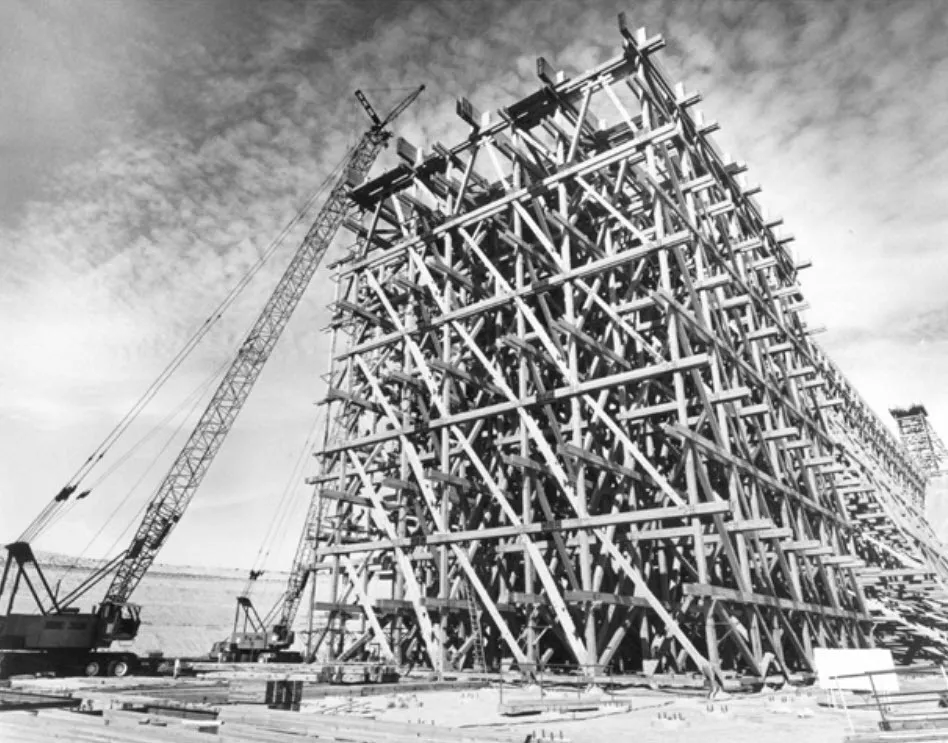
A young engineer who worked on the design later recalled the scale of the effort. Mark A. Miller, then a junior engineer at Krause Engineering in Santa Fe, designed most of the wooden structure and spent roughly his first two years in the profession on it. The bolts, made of resin-impregnated wood, were finished to furniture standard. No piece of metal in the structure was allowed to be longer than twelve inches. The columns were twelve-inch timbers with six-inch pieces bolted to each side, so that every bolt gripped at least twenty-four inches of wood. The design calculations filled dozens of ring binders. The environmental impact study, he said, concluded that some rabbits and a few horned toads might be displaced.
Building it out of wood
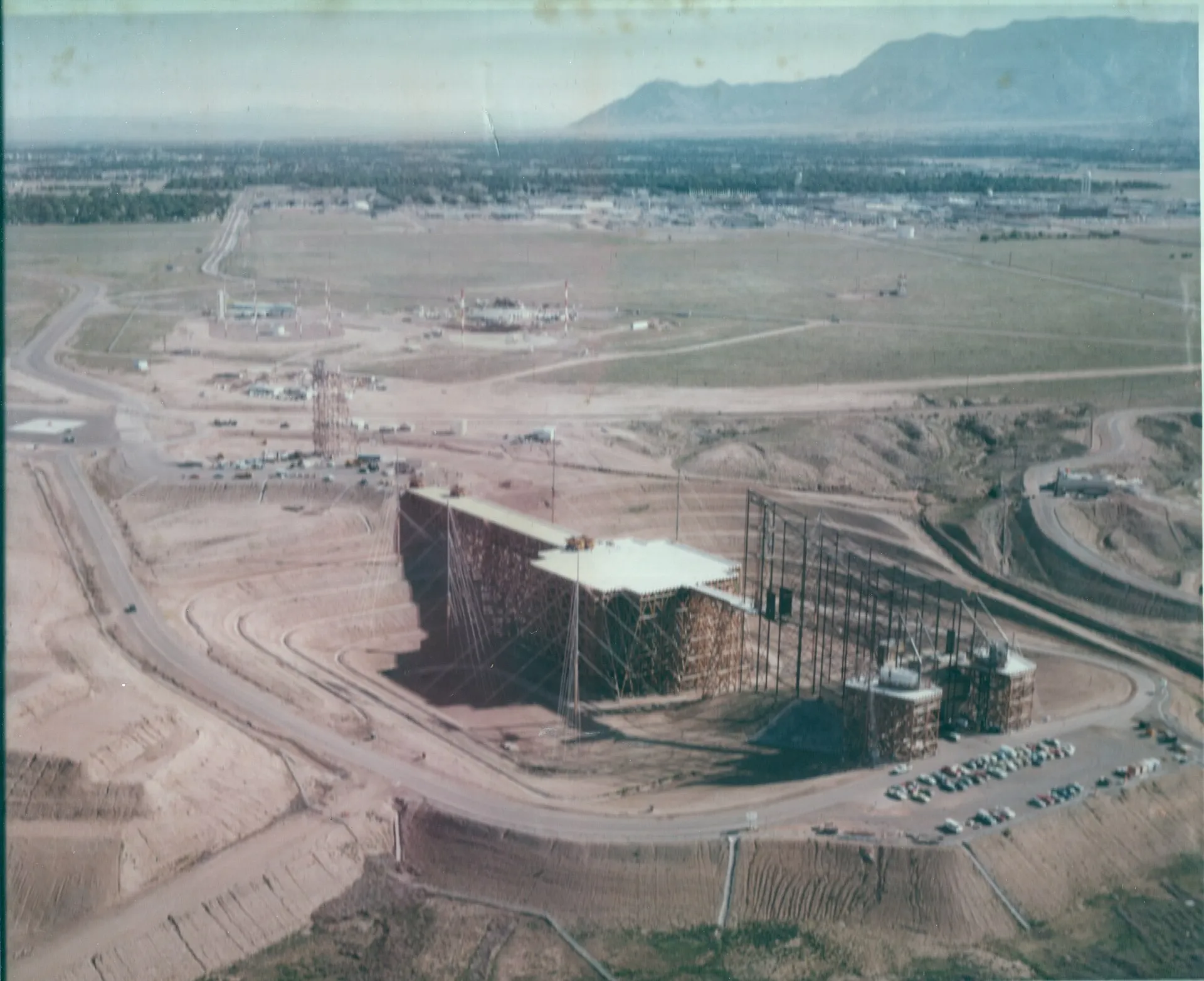
The Trestle stands in a natural depression in the Tijeras Arroyo, about 600 feet across and 120 feet deep. The base’s own history gives the construction period as September 1973 to April 1979 and the cost as $59.6 million, while most other sources say 1972 to 1980 and about $60 million.
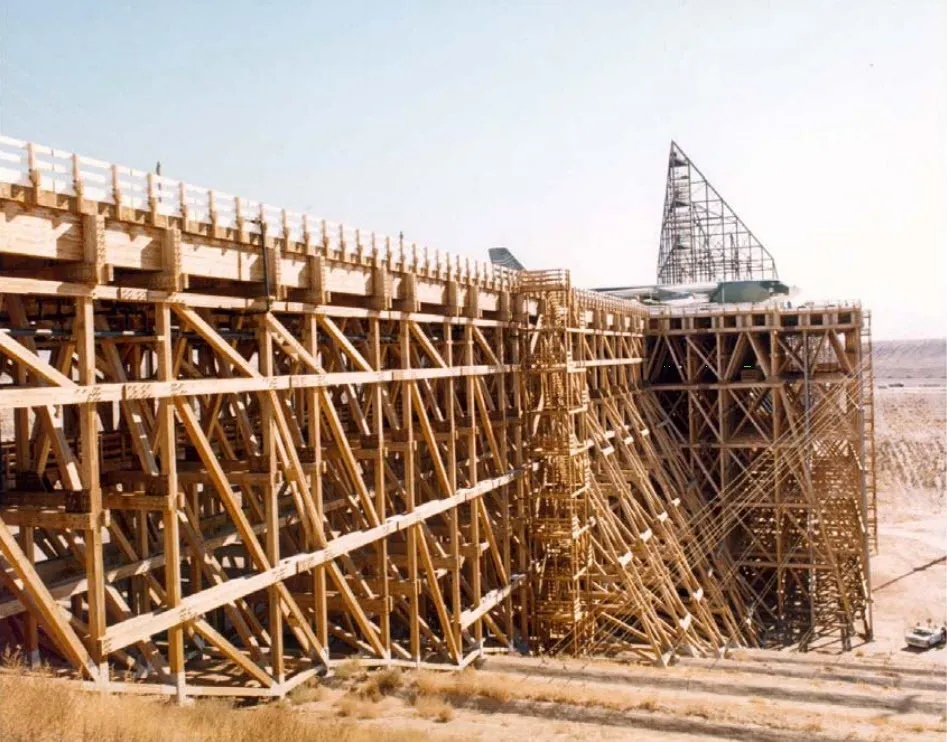
The numbers are hard to hold in the mind. The structure used about 6.5 million board feet of lumber, in more than 410,000 pieces, which were glued into over 15,000 laminated members. The wood was Douglas fir, chosen for its tensile strength, and southern yellow pine, chosen for its resistance to weather. It was chemically treated against rot and insects. Some of the timbers were up to 40 inches thick, and the biggest needed three railway wagons to carry them and cranes of 20 tons to lift them into place. The Air Force’s project history counts around 10,000 joints, held by 60,000 dielectric bolts of wood and fibreglass, some as much as 70 inches long, together with about 120,000 split rings and shear plates. The only metal in the load-bearing joints was steel rings around the bolts at the most heavily loaded points, and even the fire escape and the sprinkler pipes were made of fibreglass. A University of New Mexico account says it took one or two months’ worth of the lumber output of the Pacific north-west and Georgia.
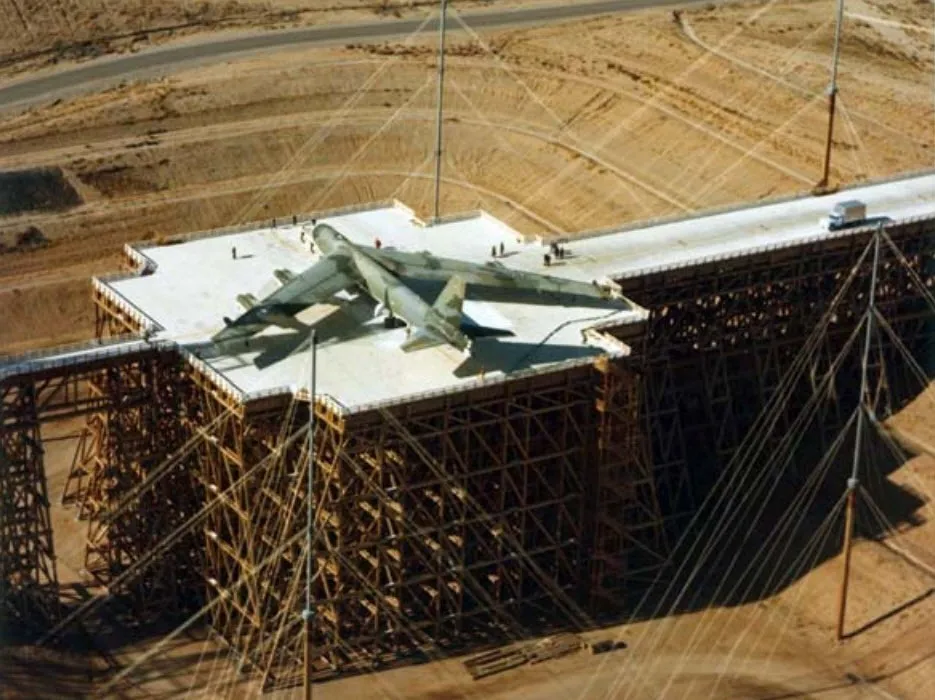
The shape of the thing follows from the job. A wooden ramp 400 feet long and 50 feet wide climbs from the edge of the arroyo to a test stand 200 feet square, with the corners trimmed off, standing about 115 feet above the floor of the bowl. It was designed to carry a fully loaded B-52, then the heaviest bomber in the American inventory, and could take up to 550,000 pounds. It was built to stand in winds of 40 miles an hour with an aircraft on it, and rather more without.
The test stand was only half the system. Beyond it, on the far side of the bowl, stood the sources of the pulse.
How the pulse was made
The pulse came from two Marx generators, a type of high-voltage machine that charges a bank of capacitors in parallel and then discharges them in series, so that their voltages add up. Each of the two generators, built by Maxwell Laboratories, was a stack of 50 trays, each tray holding two large capacitors and a switch, and each was enclosed in a fibreglass housing filled with sulphur hexafluoride gas to stop it arcing. Each could build up as much as 5 million volts. They stood on wooden towers on either side of the steel wedge, were charged to opposite polarities and fired at the same time into a pair of transmission lines, long arrays of wires that carried the pulse along the sides and over the top of the test stand and delivered it to the aircraft as a wave. The wave ended in a resistive load in a tall wooden tower about 127 feet high at the far end.
The combined result, according to the Air Force and most sources, was a pulse of around 10 million volts and about 200 gigawatts, lasting a fraction of a millionth of a second. For comparison, the whole of a large power station produces perhaps a gigawatt. It was a burst the size of a thunderbolt, delivered into a machine that the designers wanted to behave as if it were flying.
The only large piece of metal near the aircraft was the wedge, a steel structure 250 feet long and 240 feet high built from I-beams and covered with wire mesh like a vast cage. It served as the ground plane for the generators, and it also housed the people. Inside were offices, laboratories, a screened room where the generators were charged and fired, and the instruments that recorded the results. The data side was built from the equipment of the day: high-speed digitisers, minicomputers, and sensors on the outside of the wedge linked to oscilloscopes with instant cameras. The wedge was the tallest structure in Albuquerque when it was built, and its chief engineer, Jim Hands, was the man who designed it.
A day on the Trestle
The aircraft the platform was designed around was the B-52G, which has a wingspan of 185 feet. Its outrigger wheels, near the ends of the wings, hung out over the edge of the platform and over the arroyo, and one description of the work says that getting the aircraft into position was the most dangerous part of the whole operation. The aircraft was towed up the ramp and positioned so that it could be turned to meet the pulse at different angles. The same account says the stand was designed to hold a loaded plane for four hours after a fire started.
Instruments were fitted inside and under the aircraft and along its sides, to measure how much of the pulse got in through the skin, the wiring and the antennas. Then the generators were charged, the people cleared away and the pulse fired. The aim was not to destroy the aircraft. It was to find the weak points, and then to fix them in the aircraft’s design, or in the way it was shielded, wired and filtered.
Strategic Air Command bombers were the main subjects, because they were the aircraft most likely to be in the air carrying nuclear weapons when a pulse arrived. After the B-52, the B-1B was tested, and a photograph from 1989 shows one being prepared. The list of aircraft the Trestle was built to handle also included the E-4 (the airborne command post), the EC-135 and the E-3 AWACS, and fighters, transport aircraft and missiles were tested too. One account says hundreds of tests were run on dozens of aircraft, including everything from the F-14 to the F/A-18 and the presidential fleet, and that no one was seriously hurt in the whole of the programme. A Defense Science Board report in 1975 had recommended using the Trestle on complete aircraft with their on-board computers as soon as they were available, and on the B-1 and the airborne command post to see how ageing, maintenance and modification affected their resistance.
The Soviet visitor
The Trestle was built because of the Soviet threat, and one story, told by Baum himself, sums up how both sides came to see it. In 1996, when the Cold War was five years over, an international electromagnetics symposium was held in Albuquerque, and its delegates were taken to Kirtland to see the Trestle. Among them was a Russian general, Vladimir Loborev. Speaking through an interpreter, he told Baum:
You must realize that if it were not for us, you would have never built this.
Major General Vladimir Loborev, Russian electromagnetics specialist, to Dr. Carl Baum at Kirtland, 1996, as recalled by Baum
Baum, he says, answered politely and shook his hand. It is a remarkable moment, a Soviet officer taking credit for $60 million of American timber, and it shows what the Trestle was. It was not a weapon. It was a response to a threat, and the other side knew it as well as the Americans did.
The end of testing
The Trestle was used for about ten years. The base’s own history says EMP testing there ended in 1990, while most sources say 1991, and the reason is the same either way. The Cold War was ending. Testing a whole aircraft on the platform had become expensive, and computer modelling had become good enough to take over much of the work. Baum himself remained doubtful about this. He said that simulation could never fully replace testing, because real systems differ, even between two identical aircraft.
The people who ran the facility left, one visitor recorded, so abruptly that coffee and sandwiches were left behind. The funding stopped. The fire sprinkler system was turned off in 1991, and the structure has not been properly maintained since. What was left was a vast wooden structure, drying out in a desert.
The Trestle’s technology had a second life. Wikipedia credits advances made at Sandia National Laboratories for the Trestle with helping to lead, in the 1990s, to the Z Machine, a far more powerful pulsed-power device used for fusion and weapons research, although the Z Machine itself was never used to test aircraft.
What is left
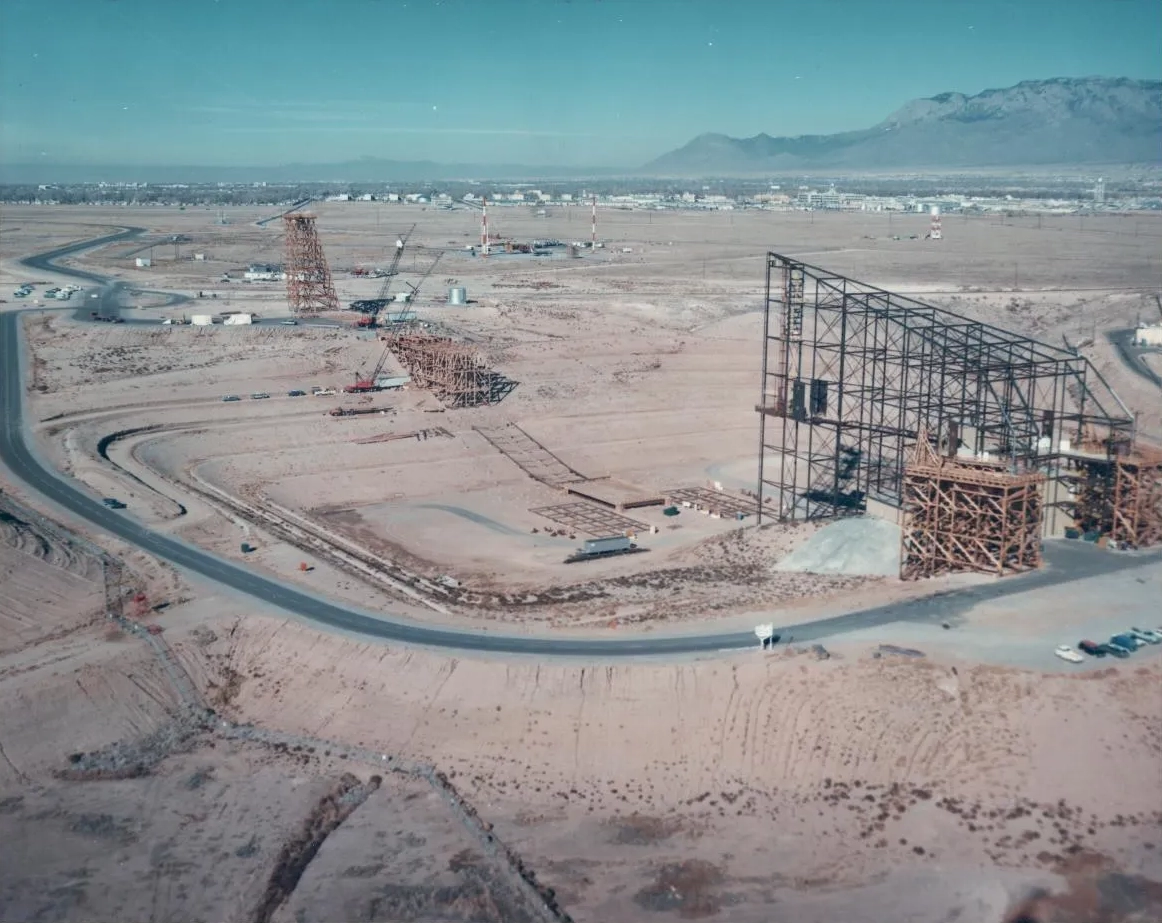
The Trestle is still there. A University of New Mexico writer who visited with a film crew around 2012 found it unmaintained for about twenty years but in good condition. Some parts of it are now used as offices. The U.S. Army’s Big Crow programme has offices in the wedge and acts as a kind of caretaker. Soldiers rappel from the wooden frame as training. And the wildlife has moved in: bobcats, crows, owls and red-tailed hawks live in the structure, and nature is reclaiming the ground around it.
The main danger is fire. The timber is old, chemically treated and bone dry, the sprinklers have been disconnected, and Baum has said that fire is the only way he can imagine the Trestle going. The base’s own 2021 history of its landmarks calls it the largest free-standing wooden structure in the world and one of Kirtland’s most distinctive landmarks, and notes that the instrumentation area is still in use.
Preservation has been talked about for years and has not got far. The Trestle was recorded for the Historic American Engineering Record in 2004, as HAER NM-9, but I found no sign that it has been listed on the National Register of Historic Places or given any other formal protection, and one source says the effort has stalled because it is on a secure military base. One account says the base’s plan to treat it as a historic site is held back by the cost of maintaining it.
A second obstacle is that nobody is sure what to do with it. A feature of the Trestle is that it was built for one single purpose, to hold a bomber still in the sky for a few seconds, and there is nothing else it is any use for. Selma Holo, the director of a university art gallery, is quoted as saying, “what a beautiful piece of art that trestle is”. It is, in that sense, an artwork nobody commissioned.
Seeing it
You cannot walk up to the Trestle. It is on Kirtland Air Force Base, southwest of the intersection of Wyoming and Pennsylvania Avenues, behind two fences, and entry needs the permission of the base commander and a background check. The best public view is from an aircraft approaching or leaving Albuquerque International Sunport, about a mile southeast of the Runway 26 threshold. Some writers say the structure can be viewed from the surrounding open area if you arrange it in advance with the base’s public affairs office. I would treat that as a possibility and not a promise.
If you only want to know what it looks like inside, the Summa Foundation at the University of New Mexico, which Baum heads, hosts a 44-minute film about the Trestle called TRESTLE: Landmark of the Cold War, and the Air Force’s project history is online.
Conclusion
The Trestle is an odd thing to find at the heart of the nuclear arms race. Most Cold War monuments are concrete, steel and earth, built to survive. This one is wood, designed so that it would disappear, electrically, the moment the pulse reached it. It was an enormous, carefully engineered way of not being there.
It also tells an honest story about how the Cold War was fought away from the headlines. The great fear of the early 1960s was not only the bomb that destroyed a city. It was the silent one, exploded high in the sky, that left the cities standing but blinded the machines that were supposed to defend them. The answer was an enormous amount of patient engineering, done by people like Baum and Miller, in desert light, with timber and glue. The Russian general’s remark in 1996 sums it up: it was there because of the other side.
Today the Trestle waits in its arroyo with the owls, a monument to a war that was never fought and to the question it asked. It is slowly drying out, and nobody has decided what should happen to it.
Did you know?
- ATLAS-I stands for Air Force Weapons Lab Transmission-Line Aircraft Simulator.
- The design was inspired by a railway bridge, which is why it was nicknamed the Trestle.
- It used about 6.5 million board feet of glue-laminated Douglas fir and southern yellow pine.
- The test stand was about 115 feet above the floor of the arroyo.
- Two Marx generators fired together to make about 10 million volts and 200 gigawatts.
- It was designed to carry a fully loaded B-52.
- The wedge that housed the control room was 250 feet long and 240 feet high.
- A design engineer remembered the environmental study concluding that a few rabbits and horned toads might be displaced.
- In 1996 a Russian general told its designer that the Trestle existed because of the Soviets.
- The sprinkler system was turned off in 1991, and the wood has been drying out since.