


A headland on the edge of Normandy
The Normandy coast between the Cotentin peninsula and the Bessin is not a gentle shore. West of Omaha Beach the long sands give way to cliffs, and the cliffs are steepest at a point that juts into the English Channel called Pointe du Hoc. The cliff there is usually given as about 30 metres high, or 100 feet. Wikipedia gives 35 metres, or 110 feet. The ABMC, which cares for the site, uses 100 feet. The difference is partly a matter of where you measure, and partly because the cliff has been retreating for decades.
The headland sits about 6.5 kilometres west of the centre of Omaha Beach. From the top, the view in both directions is wide. You can see the sweep of Omaha Beach to the east and the coast stretching away to the west. That view is the reason the Germans wanted the place, and the reason the Allies feared it.
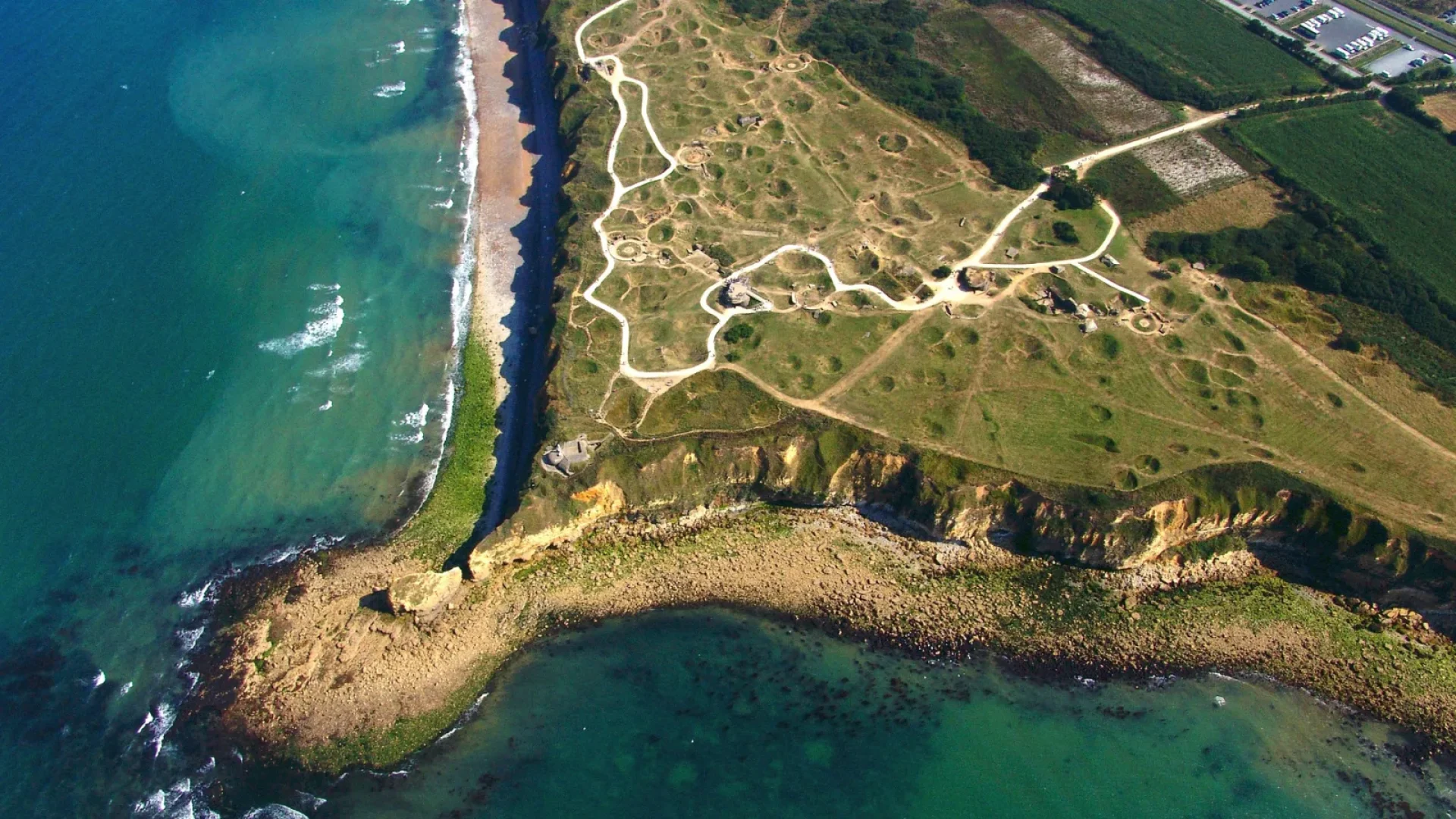
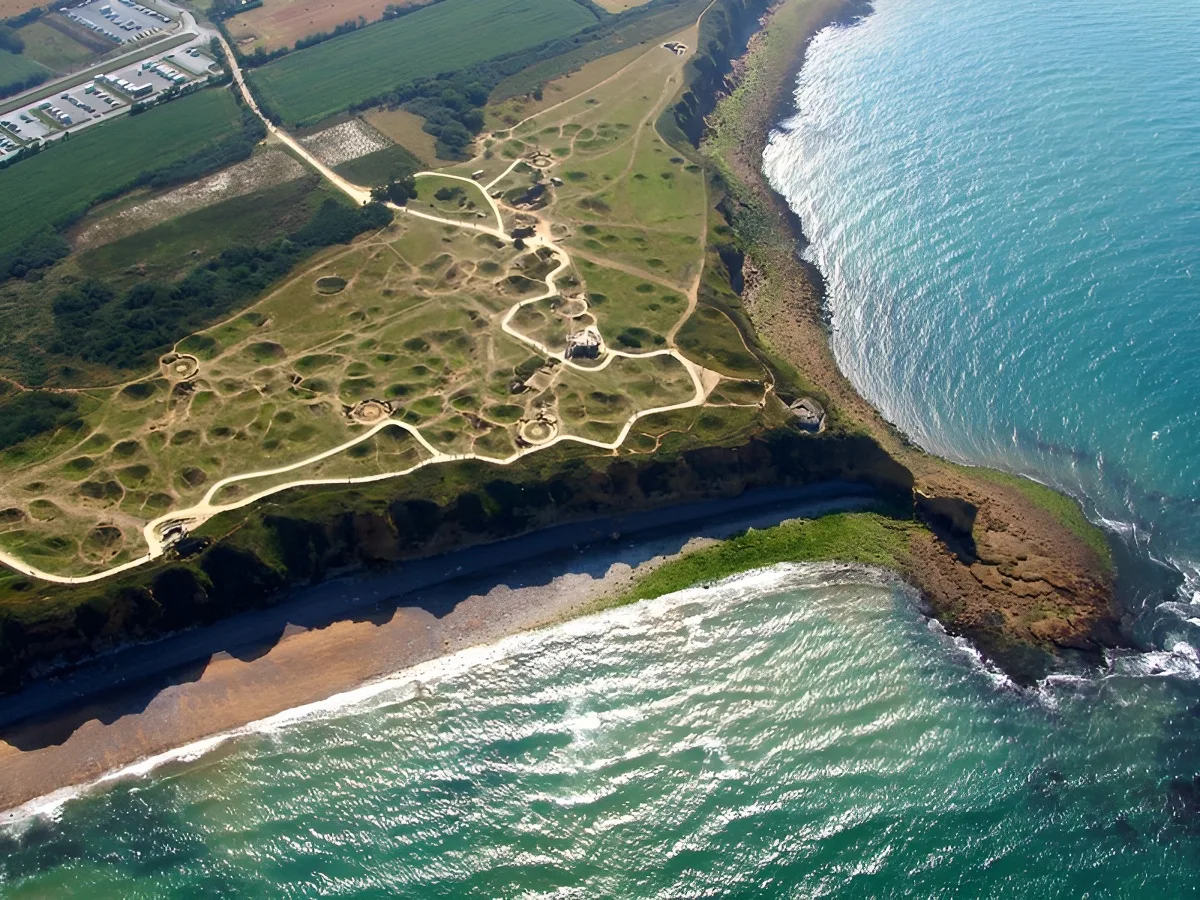
Today the site covers about 13 hectares. It is quiet, windswept grass with a surface that looks as though it has been punched. The craters are the first thing that visitors notice, and they are the work of bombs and naval shells from 1944. Behind the craters stand the broken remains of the German concrete bunkers. It is one of the few battlefields in France that has been deliberately kept as it was left.
The German battery
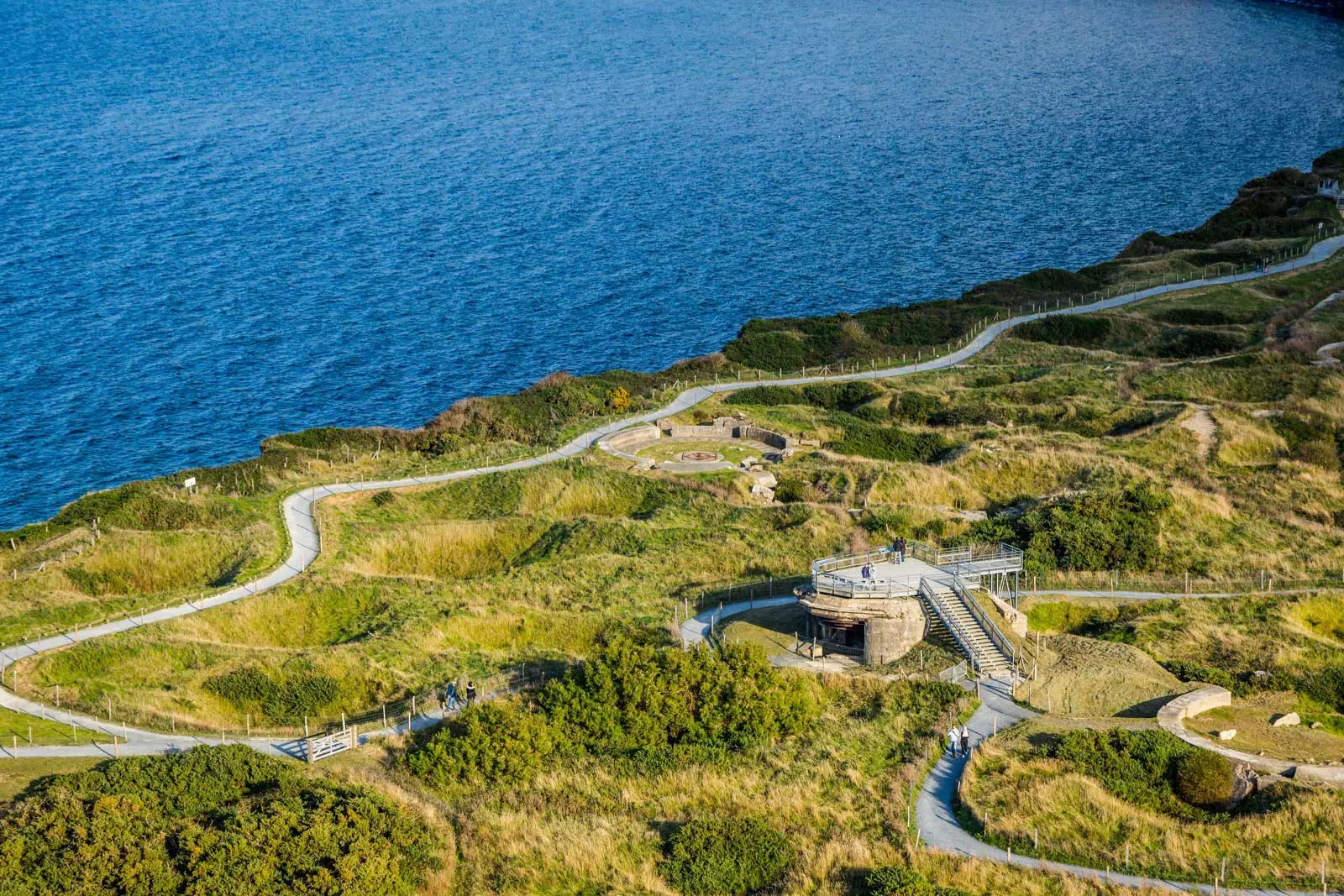
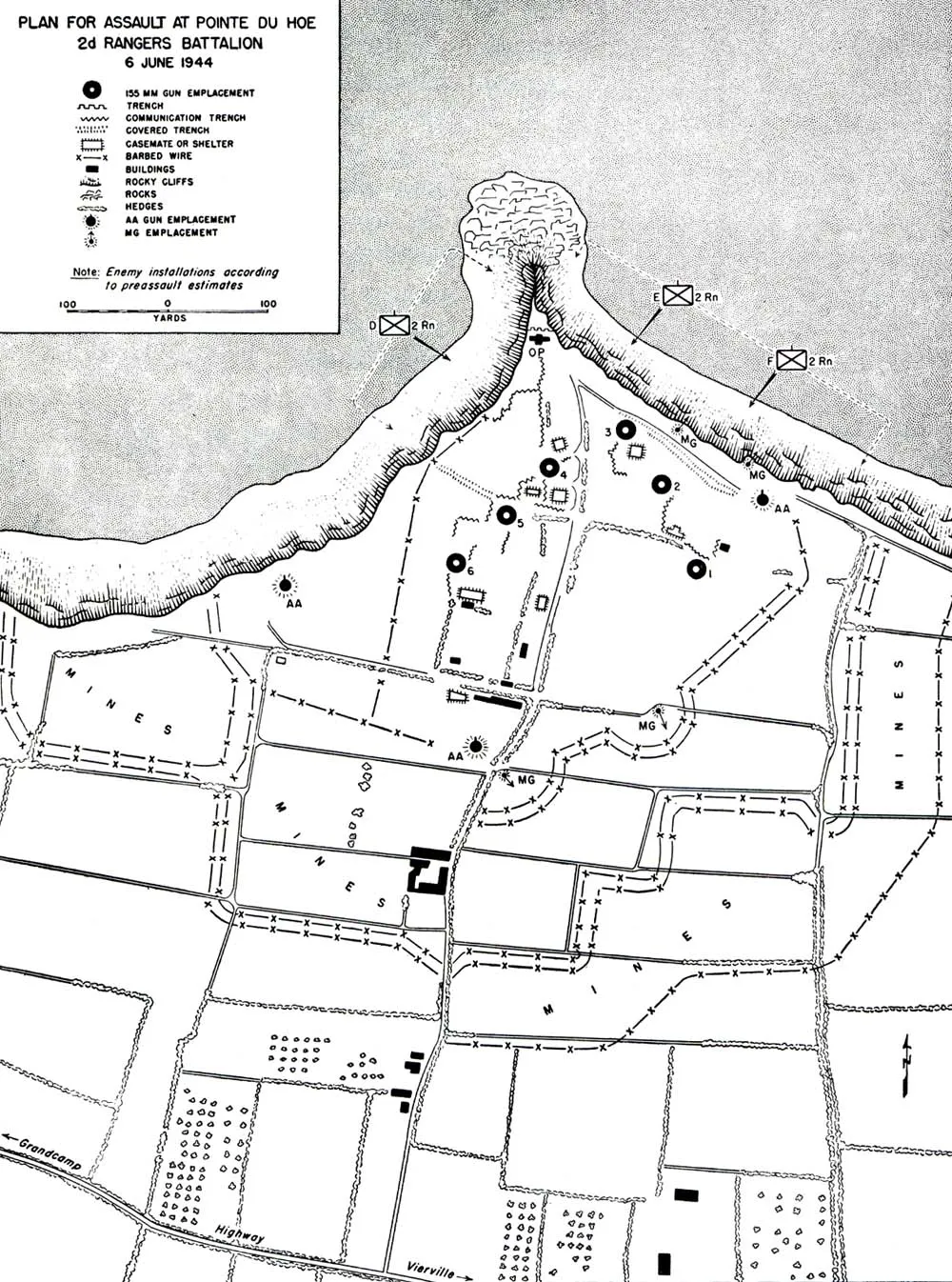
Pointe du Hoc became a fortified position in 1943, as part of the Atlantic Wall, the chain of coastal defences the Germans built from Norway to the Spanish border. The battery here was built around six captured French First World War guns, the 155 mm GPF, designated K 418(f) by the Germans. They were first placed in open concrete gun pits. The unit that garrisoned the point was the 2nd Battery of Army Coastal Artillery Battalion 1260, and elements of the 352nd Infantry Division were stationed there to defend the promontory.
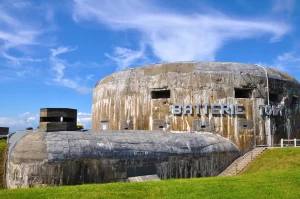
In the spring of 1944 the Germans began upgrading the position with enclosed casemates, the H671 type. Six were planned, and two were not finished by the time of the assault. They also built an H636 observation bunker and mounts for 20 mm Flak 30 anti-aircraft guns.
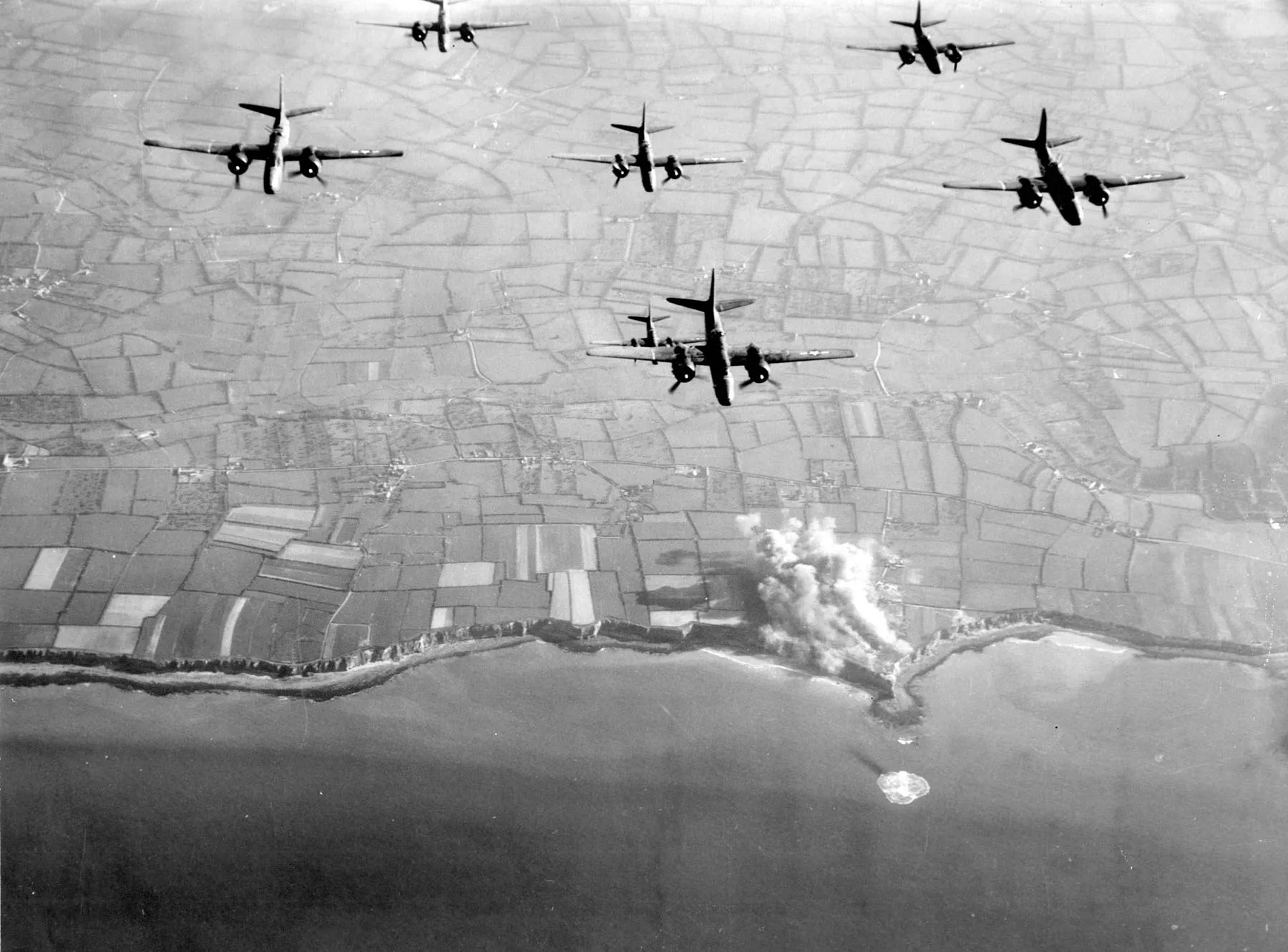
The Allied command knew about the battery, and it worried them. The guns, according to the ABMC, were in a position to fire at the troops landing on both Omaha and Utah beaches. That made them one of the more dangerous pieces of the whole coastal defence for the planners. In the weeks before D-Day, A-20 Havoc bombers of the U.S. 9th Air Force attacked the site. Allied intelligence also noticed something that would matter later: in the months before the invasion, the Germans were removing the guns one by one. The final plan, according to the record, was four casemates facing Utah Beach and possibly two 155 mm guns in open emplacements. The Allied planners did not know, on the morning of the landing, whether the guns were still there.
Rudder’s Rangers
The job of dealing with the battery was given to the Rangers. Two Ranger battalions were assigned, the 2nd and the 5th, with Lt. Col. James Earl Rudder in command. They were part of the Provisional Ranger Group, and for the assault on Pointe du Hoc they came under the 116th Infantry Regiment, which had been attached from the 29th Division, and in turn to the 1st Infantry Division and V Corps.
The plan was direct and risky. Three companies of the 2nd Ranger Battalion, D, E and F, called Force A, would land at the foot of the cliff at H-Hour, about 06:30, climb it using ropes, grapnels and ladders, destroy the guns, and hold the position until they were reached by forces coming off Omaha Beach. A second wave, made up of the 5th Rangers and the 2nd Battalion’s A and B Companies, was to follow if a flare signal showed the first wave had got up the cliff. If no signal was seen, they were to land at Omaha Beach and fight their way west.
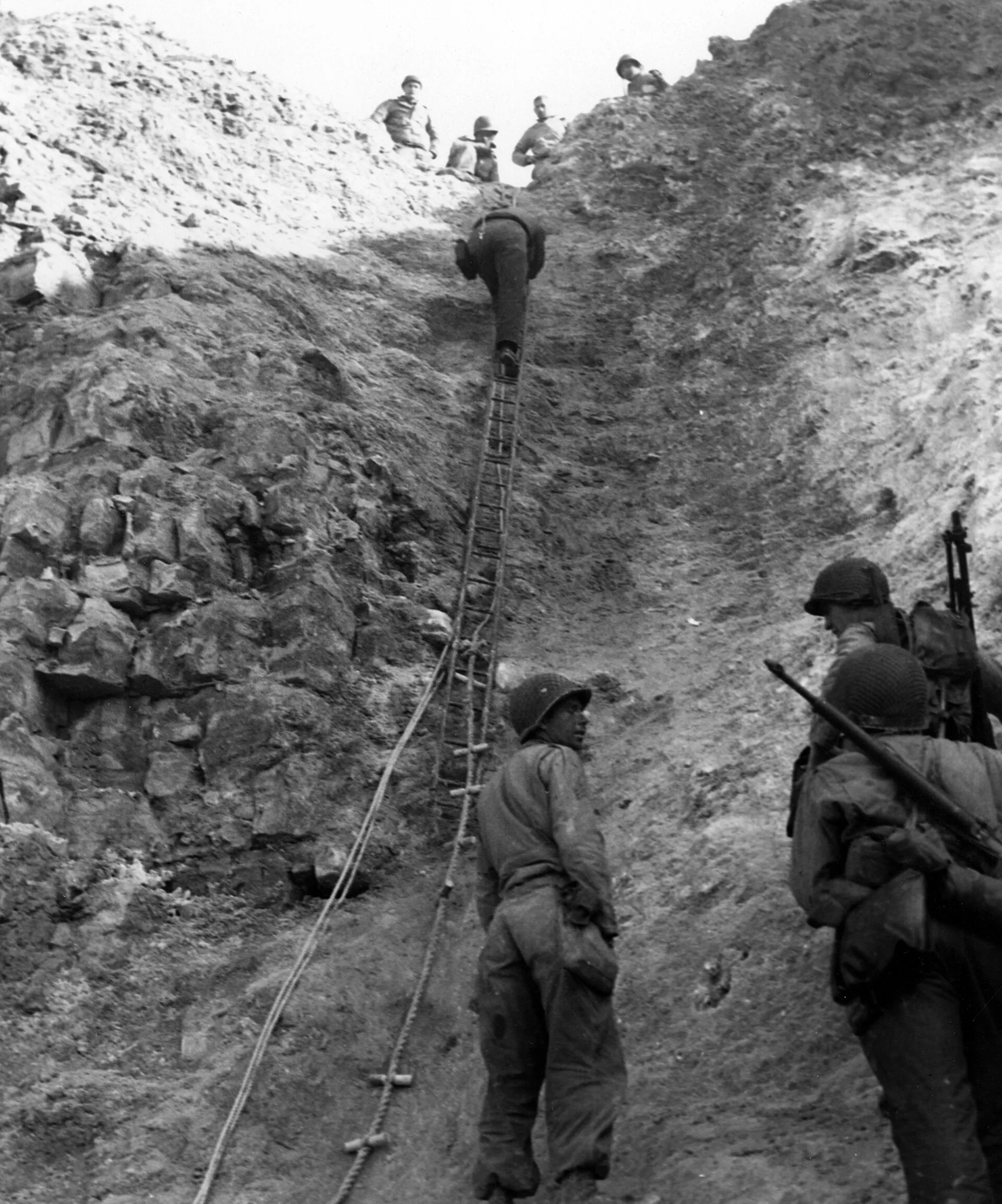
The Rangers trained for the climb on the Isle of Wight, under British Commandos. The equipment included rocket launchers mounted on the landing craft to fire grapnels and ropes up the face of the cliff, and four DUKW amphibious trucks carrying 100-foot ladders borrowed from the London Fire Brigade. The assault force used ten landing craft, two supply craft and four DUKWs. Naval fire support was to come from the battleship USS Texas, the destroyers USS Satterlee and USS Ellyson, and the British destroyer HMS Talybont.
One incident before the landing is recorded in the sources. Major Cleveland A. Lytle, who commanded Force A, argued in the briefing aboard the TSS Ben My Chree that the assault was unnecessary, because French Resistance reports said the guns had been removed. Rudder relieved him at the last minute. Lytle later went to the 90th Infantry Division and was awarded the Distinguished Service Cross.
The run-in
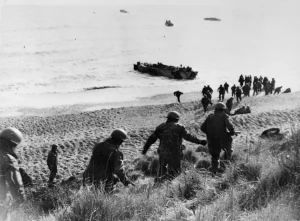
The landing went wrong before the Rangers reached the beach. One troop-carrying craft sank, drowning all but one of the people aboard. Another was swamped. One of the supply craft sank and the other threw its stores overboard to stay afloat. German fire sank one of the DUKWs. Strong tides and navigation errors pushed the force off course and delayed it.
The record gives the timings. The flotilla was approaching the coast at about 06:39. The Rangers reached the base of the cliff at about 07:10, 40 minutes late, with roughly half the force they had started with. The delay mattered. The plan’s timing fell apart. The second wave, which was meant to follow on a flare signal, did not get the signal in time. The 5th Rangers and A and B Companies of the 2nd Battalion landed at Omaha Beach instead, as the fallback plan said. Radios were ineffective.
Up the cliff
The Rangers came ashore on a narrow strip of shingle and rubble at the foot of the cliff, under fire from the top. Rocket launchers on the landing craft fired grapnels and ropes up the face. The cliffs proved higher than the ladders could reach, so the Rangers had to climb the rest by rope.
The Germans on the cliff top fired on the climbers, while the naval ships gave covering fire. About 15 casualties were recorded in the landing and climb. By about 07:30 the first Rangers were over the top and were engaging the Germans in the craters and trenches. The battalion had done what the planners asked of it, but only just, and with about half the strength it had meant to use.
The empty casemates
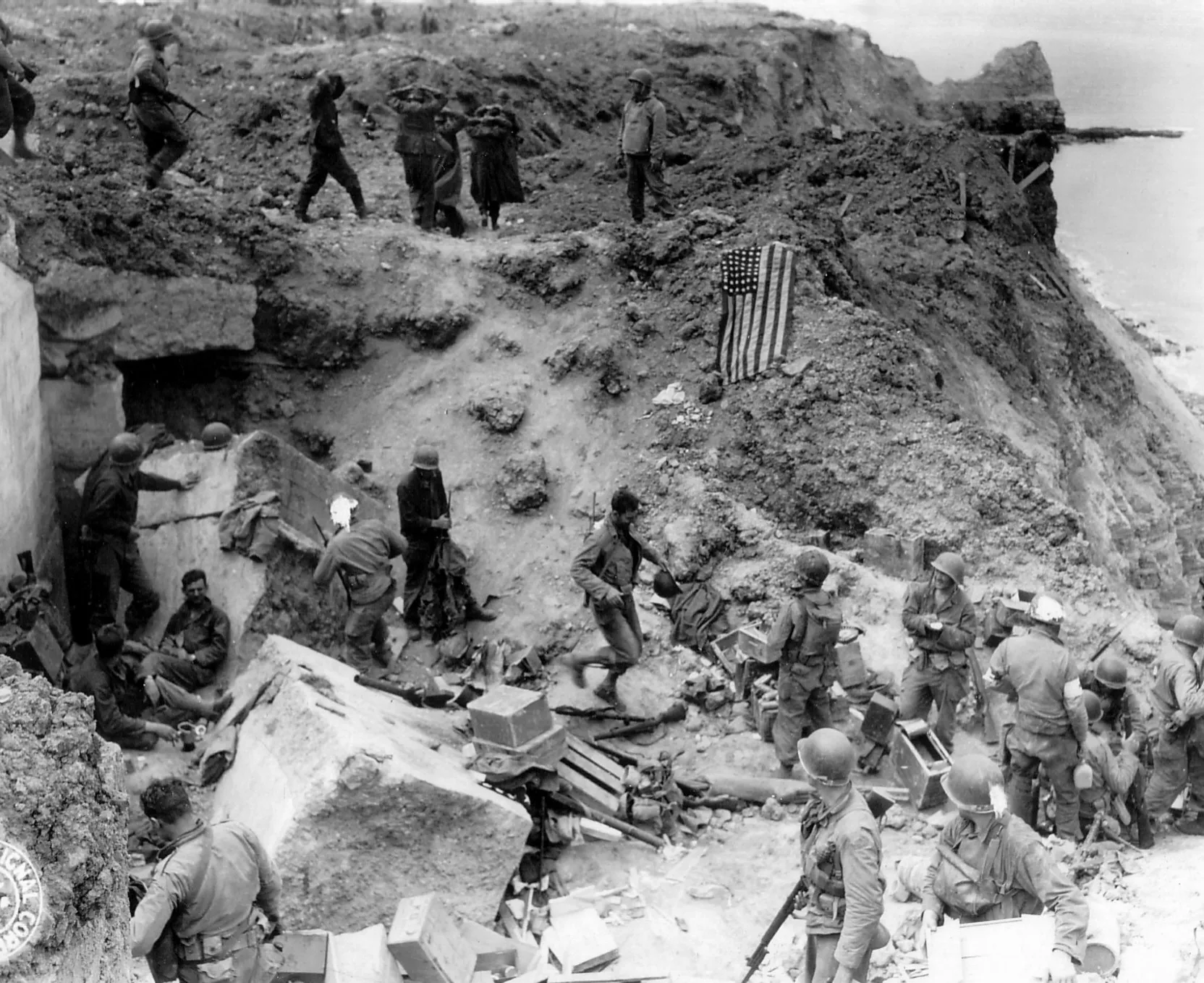
What the first Rangers found was not what they had expected. The casemates were empty. The guns that the whole operation was designed to capture were not in them. For some hours after the initial fighting, the Rangers reportedly saw no German troops on the point.
What happened next is the best-known part of the story. A patrol went inland to look for the guns. First Sergeant Leonard Lomell, who was acting commander of D Company at the age of 24, and Staff Sergeant Jack Kuhn led a patrol several hundred yards to a coastal road. They saw heavy tracks leading away, followed them, and found the guns. There were five of them in an orchard, hidden under camouflage, pointing towards Utah Beach, with ammunition stacked beside them. The gun crews were not with them. Lomell later called the discovery pure luck.
With Kuhn covering him, Lomell placed thermite grenades in the elevating mechanisms of two guns and smashed the sights of a third. He went back for more grenades and dealt with the remaining guns. The heat of the thermite fused the gears. Members of E Company then blew up the ammunition. The sixth gun was not there. According to one source it was being repaired. By around 09:00 the battery was out of action. The Army’s official account credits E Company with finishing the job, and more recent accounts give Lomell credit for disabling the guns.
Lomell was wounded in the side during the landing. He received the Distinguished Service Cross and the British Military Medal for Pointe du Hoc, and later served in the Hürtgen Forest and the Battle of the Bulge, where he was wounded again. He died in New Jersey in 2011, aged 91.
Holding the point
Destroying the guns did not end the fight. The Rangers had taken the high ground, but they were cut off from the rest of the invasion force. Around 08:15, about 35 Rangers reached the road and set up a roadblock to stop German movement along it. The rest held the perimeter around the point.
The Germans counterattacked throughout the day with troops of the 914th Grenadier Regiment. The Rangers beat off the attacks, but the cost mounted. The ground gave them cover, since the craters were already dug, but the position could not be reinforced. On the evening of 6 June, 23 Rangers of the 5th Battalion fought their way through to join the 2nd Battalion. That night the Germans pushed the Rangers into a smaller enclave along the cliff, and some were captured.
On 7 June the Rangers defended an even smaller area. In the afternoon, an LST platoon arrived and evacuated wounded men. A detachment of 84 Marines from the USS Texas had been prepared to land to reinforce the Rangers, but at the last minute no Marines were allowed ashore. The relief came on the morning of 8 June, when the 2nd and 5th Rangers, the 1st Battalion of the 116th Infantry and tanks of the 743rd Tank Battalion reached the point.
The cost
The 225 men who landed on 6 June were reduced to about 90 fit for duty by the end of the fighting. Over the two days, 77 were killed and 152 were wounded. German losses are less well documented. The sources give more than 25 killed during the landing and more than 50 killed and 40 captured in the counterattacks. These are estimates. The figures vary between accounts, and the German side kept few reliable records of the fighting.
The Rangers’ battalion was the first American unit to complete its D-Day mission, by about 09:00. Their landing is also thought to have helped the stalled landing at Omaha Beach.
The sources record a grim footnote. After the battle, some Rangers believed that French civilians had fought for the Germans or acted as artillery observers. A number of civilians were executed. The number is unknown.
Did Rudder know?
The fact that the casemates were empty has produced a long argument. If the guns had been moved, it asks, did the Allied command know? And if it did, why send the Rangers up the cliff?
The record shows that Allied intelligence noticed the guns being removed in the months before D-Day, and that Major Lytle raised the question in the briefing, citing French Resistance reports. Some writers have concluded that Rudder knew the assault was pointless and went anyway. Historian Thomas M. Hatfield, of the University of Texas, called that allegation entirely false. He pointed out that Rudder reviewed the operations order with Major General Clarence Huebner shortly before the crossing, and that no records show anyone questioning the guns’ presence. A different suggestion, from the amateur historian Gary Sterne, is that Rudder could have moved inland during a lull. The source notes that this would have needed the rest of the 2nd Rangers as reinforcements, which could have cost Omaha Beach.
The empty casemates do not make the assault pointless. The guns were found, in the orchard, about where a mobile battery would have been moved to, with ammunition ready. If they had been left, they would have been able to fire on the beaches. The Rangers did what they were sent to do, even though the target was not where the maps placed it. A separate battery nearby, at Maisy, kept shelling Allied positions until 9 June, when the 2nd and 5th Rangers attacked it.
From battlefield to memorial
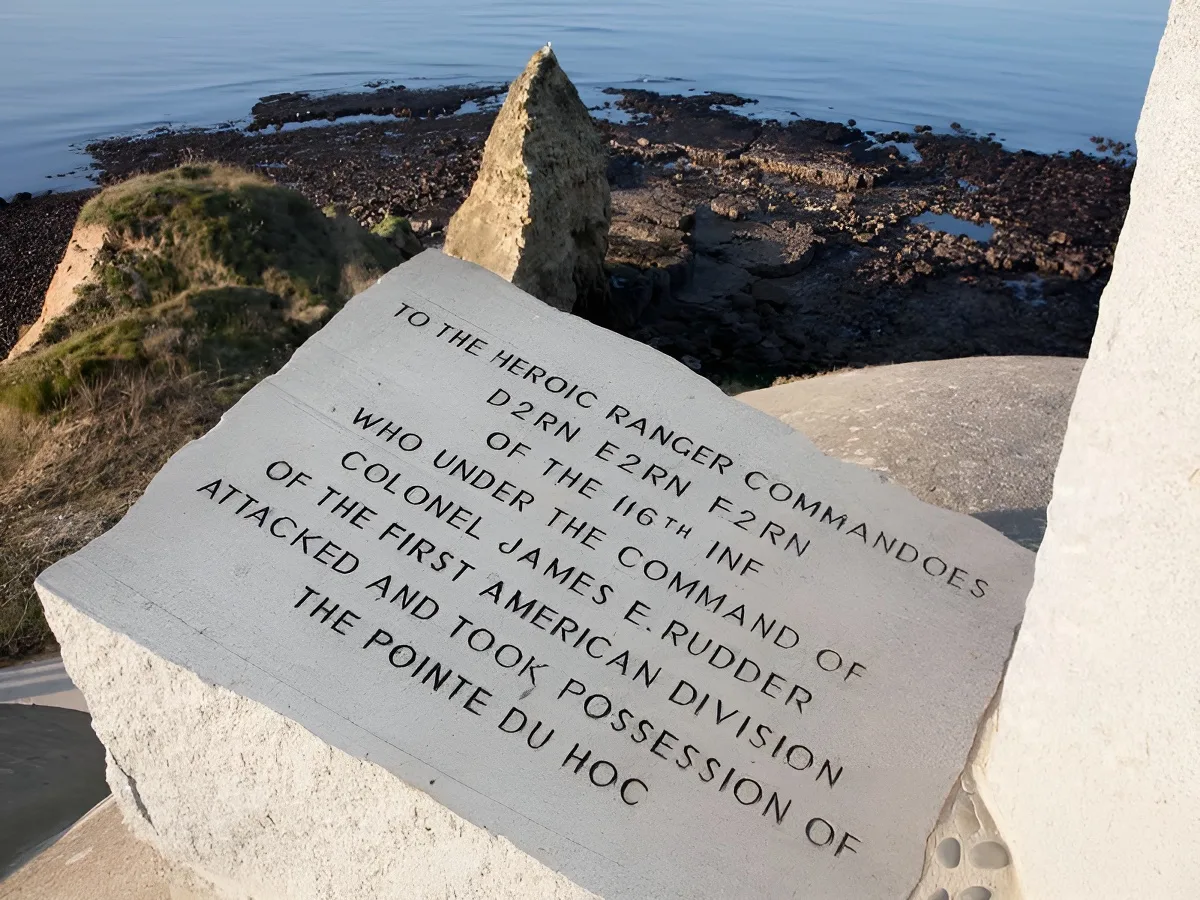
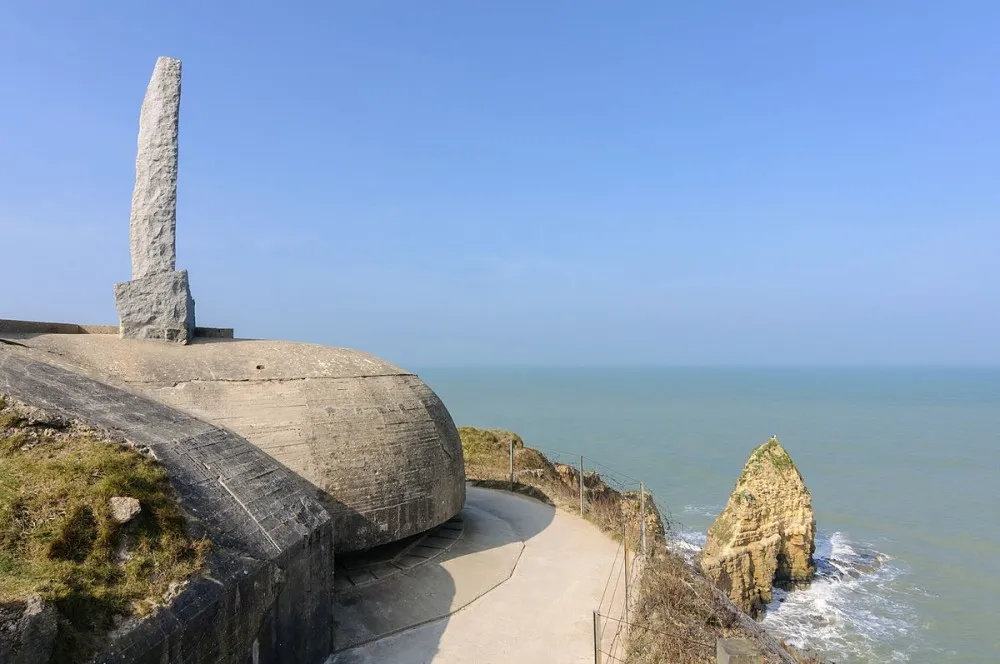
After the war, the French government left the point in the state the battle had made it. The French Committee of the Pointe du Hoc preserved the site and put up a granite monument at the cliff edge. It is a simple pylon on top of a German concrete bunker, with tablets at its base carrying inscriptions in French and English.
On 11 January 1979, in Paris, the two governments signed an agreement transferring the 13-hectare site to American control. U.S. Ambassador Arthur A. Hartman and the French secretary of state for veterans affairs, Maurice Plantier, signed it. The American Battle Monuments Commission took responsibility for its perpetual care. It is popularly described as a gift, but the sources describe it as a transfer, and it is worth using the more careful word.
On 6 June 1984, for the 40th anniversary of D-Day, President Ronald Reagan spoke at Pointe du Hoc, and that speech made the place familiar to millions who had never heard of it. For the 75th anniversary in 2019, members of the 75th Ranger Regiment re-enacted the climb. Visitor numbers are large. According to the ABMC, about 730,000 people visited in 2024 and about 640,000 in 2025.
A cliff that is falling away
The problem with a memorial on a cliff is that the cliff is not permanent. The headland has been eroding for as long as it has existed, and the rate has increased. The ABMC has said it has known since 2011 that cliff erosion threatens the cultural landscape.
On 5 May 2022, part of the outcrop overlooking the Channel collapsed into the sea. No one was injured, and the ABMC said there was no risk to visitors at the time. Its press release described the cliff base as increasingly fragile. The site stayed open, and the ABMC said it was continuing to study ways to reduce the risk and preserve the site. Access has also been restricted in some years around the D-Day anniversary, for crowd control.
On 17 February 2026, the ABMC held a groundbreaking ceremony at the site for a large renovation project. According to the ABMC, the work covers the parking lot, the welcome plaza, the visitor center and the memorial plaza, and it modernises existing paths for visitor safety. One report puts the cost at roughly 10 million dollars. The project is expected to take about 18 months, with construction finishing in mid-2027. The ABMC chairman, Michael X. Garrett, said, “We cannot stop the forces of nature.” The monument’s historic character is not to be altered. The site is to remain open during the work, though visitors should expect some closed areas and changed routes, and the visitor center is currently closed.
Visiting Pointe du Hoc
Pointe du Hoc is near the village of Cricqueville-en-Bessin, close to Omaha Beach and to the Normandy American Cemetery at Colleville-sur-Mer. Entry is free. The Normandy tourism board reports free parking, toilets, a baby-changing area and bicycle parking, and a visit takes about an hour.
What there is to see is mostly outdoors. You can walk among the craters, which are the result of the air and naval bombardment, and look at the remains of the battery: the command post, the casemates and shelters, and the observation bunker. The granite monument stands on the cliff-edge bunker. At the cliff itself you can look down to the narrow shore where the Rangers landed. Information panels are placed along the route. Guided tours are available, and during the renovation the ABMC says its interpretive guides will rove the site without a fixed meeting point.
During the 2026 to 2027 works, the routes have been adapted and some paths have been moved further from the cliff edge. Some areas may be closed temporarily for safety. The introductory film is shown outdoors while the visitor center is shut. Visitors should keep to the marked paths and respect restricted areas, and children should stay on the designated paths. Do not climb on the bunkers or go near the cliff edge, since the ground there is unstable. Opening times change with the season and with the works, so check the ABMC site before travelling.
What is uncertain
The numbers for Pointe du Hoc vary between sources, and it helps to know where. The cliff height is given as 30 metres in some places and 35 in others. The number of Rangers who landed is given as 225 or “more than 225”. The casualty split between killed and wounded, 77 and 152, comes from a summary of the two-day action, and some accounts give lower or higher figures depending on whether the men who reached the point by other routes are counted. The German casualty figures are estimates. The number of guns destroyed is five found and disabled, with one that was being repaired, but accounts differ on who finished which gun.
The role of individuals is also argued over. Official accounts give E Company the credit for finishing the destruction of the guns, and more recent ones give Lomell and Kuhn the credit for finding them. Whether Rudder knew the casemates were empty is disputed, and the evidence favours Hatfield’s view that he did not. The number of French civilians executed afterwards has never been established.
Conclusion
Pointe du Hoc is often described as a failure that turned into a success. The guns were not in their casemates, the landing was late and costly, and the force that reached the top was half the size planned. But the Rangers found the guns, destroyed them, and held the headland for two days without relief, at a cost of most of their number. The battery never fired on the landing beaches.
The site itself is unusual among Normandy memorials in that it does not interpret much. It has a monument and information panels, but mostly it leaves the ground as it is. The craters are still there, the bunkers are still broken, and the cliff is still where the Rangers climbed it, though less of it each year. The restoration now under way is about keeping that in place against the sea. What visitors see in 2027 and after will be a repaired version of a site that has always been disappearing slowly, and the effort to save it is a reminder of how much of the history of D-Day is written on land that nobody owns for ever.
Did you know?
- The Rangers' DUKWs carried 100-foot ladders borrowed from the London Fire Brigade, but the cliff turned out to be higher than the ladders could reach.
- The Rangers fired grapnels and ropes up the cliff from rocket launchers on their landing craft.
- The casemates were empty when the Rangers got to the top. Five of the six guns were found hidden in an orchard inland, with ammunition stacked beside them.
- First Sergeant Leonard Lomell, who found the guns, was 24 years old and acting commander of D Company.
- Of the 225 Rangers who landed, 77 were killed and 152 wounded in two days, leaving about 90 fit to fight.
- The site was transferred to American control on 11 January 1979 and is run by the American Battle Monuments Commission.
- President Ronald Reagan spoke at Pointe du Hoc on the 40th anniversary of D-Day in 1984.
- A landslide took part of the cliff on 5 May 2022, and a restoration project began in February 2026.