A gypsum hill at the edge of the Harz
The Kohnstein is a modest hill, about 330 metres high, on the northern edge of the town of Nordhausen in Thuringia. It sits where the flat country of the Goldene Aue meets the first wooded slopes of the Harz mountains in central Germany. Its core is gypsum and anhydrite, a soft rock that is easy to dig and stays dry and stable once the roof is cut. That made it useful long before the Second World War. Gypsum was quarried here for plaster and building materials, and the miners left behind galleries that later owners were glad to inherit.
In 1917, during the First World War, a mine was opened inside the hill to extract anhydrite, and a railway ran in through a tunnel. After the war the workings were left largely idle. In 1936 the German state took an interest in them. A state-owned company called Wifo, short for Wirtschaftliche Forschungsgesellschaft, began turning the mine into an underground depot where strategic fuel and chemical stocks could be kept safe from air attack. By the summer of 1943 the Kohnstein had been developed into one of the largest underground fuel stores in the country, and the work was almost finished.
So when the German leadership needed a place to hide a weapons factory, the hole already existed. It had rail access, power, a dry interior, and a cover of rock thick enough to shrug off the bombs of the time. All it needed was more tunnelling, a great deal more machinery, and a workforce that could be compelled to do the work. The SS supplied the last of these.
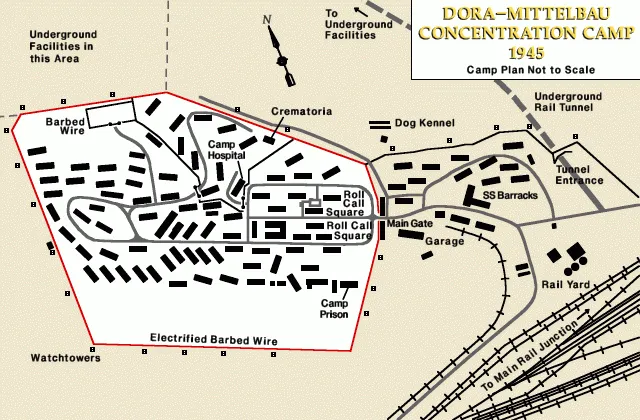
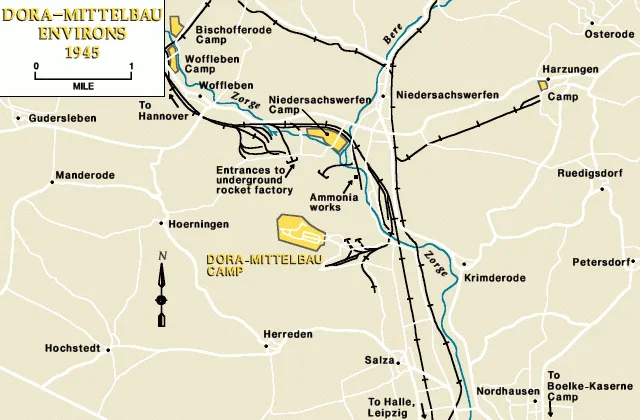
The order to go underground
The story begins at Peenemünde, the Baltic rocket research centre. On the night of 17 to 18 August 1943 the RAF raided it in Operation Hydra. The raid did not end the rocket programme, but it showed the German leadership that rocket development and production above ground, within reach of British bombers, was too exposed. Within days, on 22 August 1943, Hitler ordered Heinrich Himmler to supply concentration camp labour for V-2 production, and the manufacture of the missile was to be moved to a protected underground site. The Kohnstein was chosen.
The organisation behind it was Hans Kammler, an SS general in charge of the SS construction programmes. A state-owned firm, Mittelwerk GmbH, was set up in September 1943 to run the factory. Its board brought together officials from Albert Speer’s armaments ministry and from the SS. The man put in charge of operations was Albin Sawatzki, who had previously been involved in tank production. A contract was drawn up for 12,000 A-4 missiles, a staggering number for a weapon that had barely begun to work in tests. The plan was that the factory would make the weapon, and the SS would make the workforce.
The first group of prisoners reached the Kohnstein on 28 August 1943. It was 107 men from Buchenwald concentration camp, sent to work on the tunnels. About 1,200 more followed on 2 September. The camp they formed was first known as Arbeitslager Dora, a sub-camp of Buchenwald. The name “Dora” was an SS code name, and it stuck.
Two tunnels and forty-six galleries
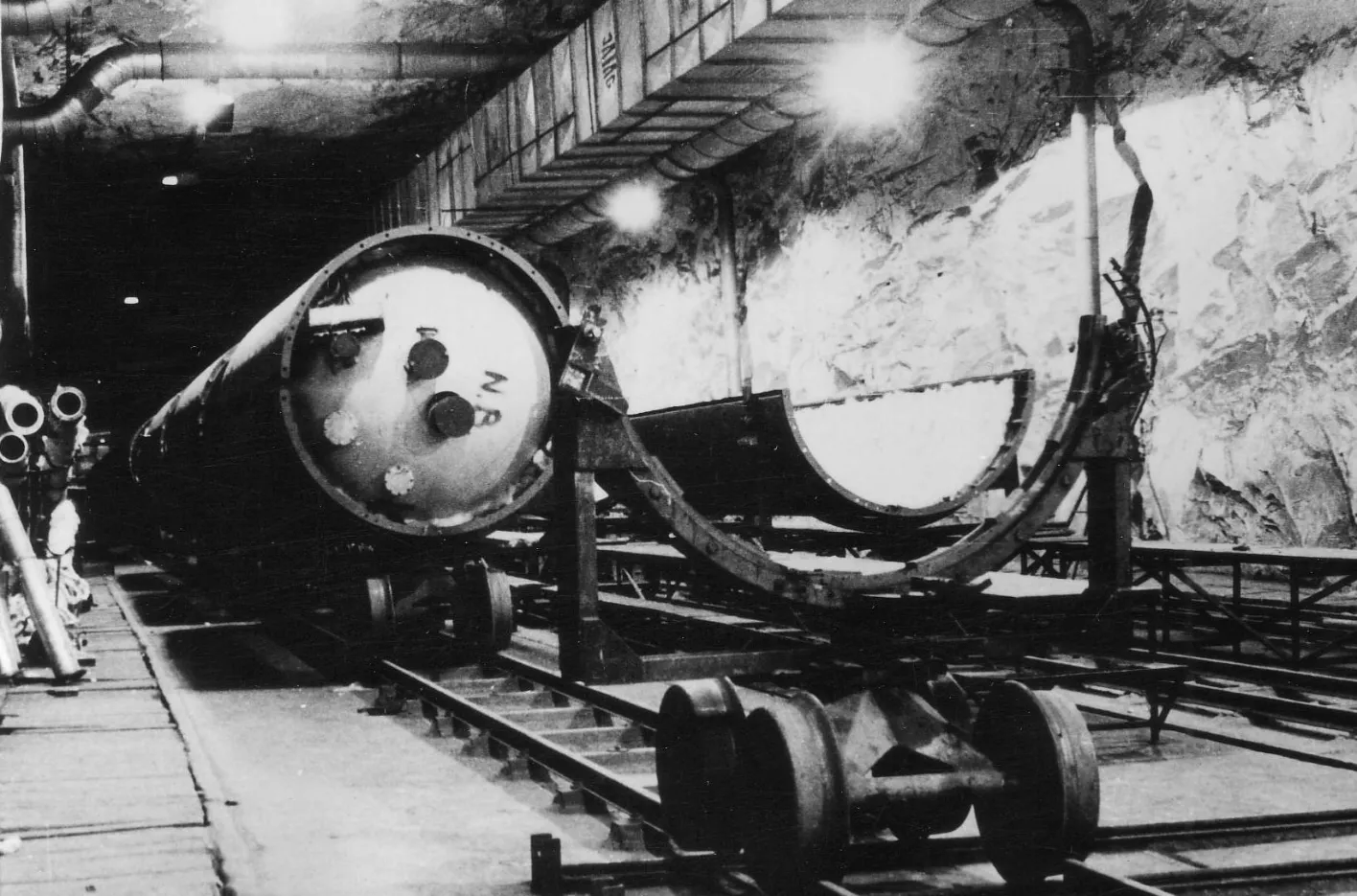
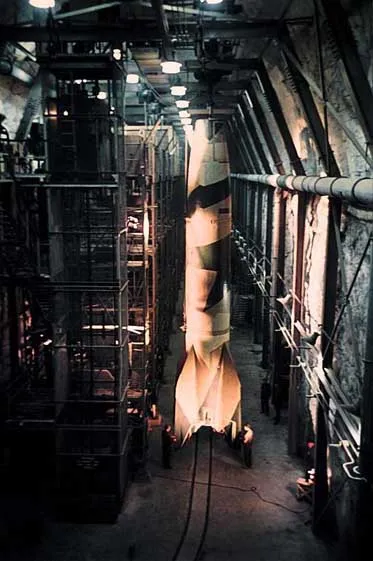
The layout of the underground factory was simple and enormous. Two main tunnels, designated A and B, ran roughly north to south through the hill. Each was about 1.8 to 1.9 kilometres long, and the sources give heights of about 7 metres and widths of roughly 9 to 11 metres. They were connected by 46 cross galleries, numbered from the north, so that a plan of the complex looks like a ladder lying across the hill. Each cross gallery was about 150 metres long. Tunnel A carried the incoming parts and storage. Tunnel B was the main assembly line, with rockets moving through it on rails.
The cross galleries were divided up by purpose. Galleries 21 to 46 were given to Mittelwerk for V-2 assembly. The first few galleries at the southern end of Tunnel A were used for V-1 flying bomb production from late 1944. Galleries 1 to 20, in the northern part, were handed to the Junkers company in 1944 for an aircraft engine plant known as the Nordwerk, which took up roughly 40 per cent of the underground space. Gallery 41, at the southern end, was excavated below floor level to make a hall more than 15 metres high, with an overhead crane for lifting finished rockets upright for testing.
The total floor area of the complex was more than 100,000 square metres. Standard-gauge railway lines ran along both main tunnels. Machinery was shipped in from Peenemünde and reassembled inside, often by the prisoners themselves. To reach those dimensions the tunnels had to be enlarged, and that was the work the first prisoners did. They drilled and blasted rock, hauled it out in wagons by hand, and installed rails, ventilation and power, in tunnels that were still being filled with dust and exhaust fumes from the blasting.
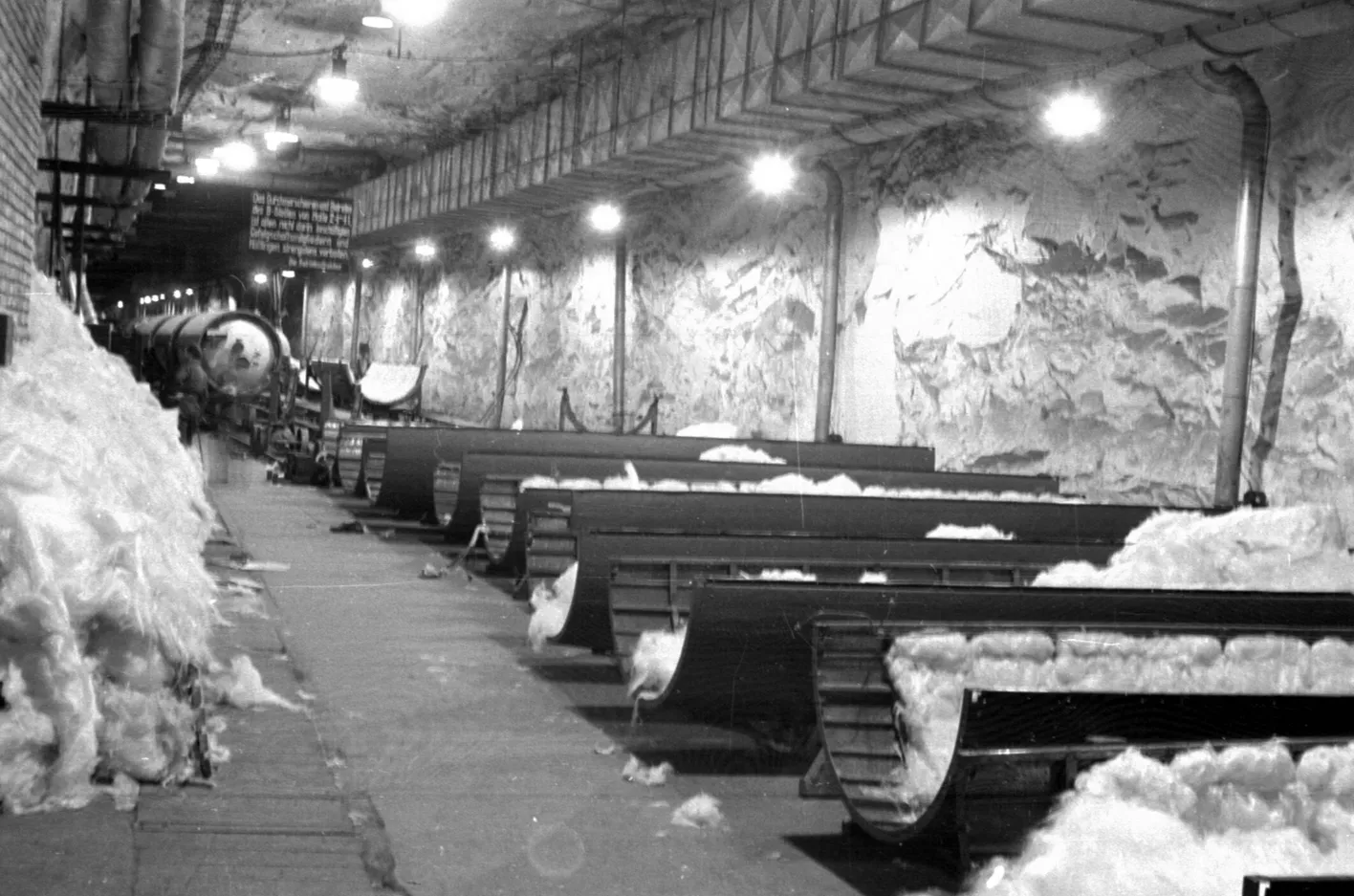
Sleeping underground
For the first months there was no camp on the surface. The prisoners lived in the tunnels. The earliest arrivals slept in tents near Tunnel B, and then on straw laid on bare rock in cross gallery 39. By the end of 1943 the SS had installed four-tier wooden bunks in the dead-end galleries 43 to 46, which became known as the “sleeping tunnels”. Thousands of men were packed into them.
The conditions are described consistently across the sources. There was almost no daylight, and some prisoners did not see the sun for weeks or months. Blasting, drilling and the movement of rock-hauling trains went on around the clock, filling the air with dust and fumes. Water was scarce. The toilets were oil drums cut in half, far too few for the numbers, and so the prisoners relieved themselves in the galleries. Lice, damp and cold spread disease. Typhus, dysentery, pneumonia and tuberculosis moved through the bunks. Shifts were twelve hours long, in two shifts a day, and men who could no longer stand were beaten or left to die.
The death rate in these months was extreme. According to the camp’s own registers, five prisoners died in September 1943 and 669 in January 1944. At the end of January 1944, more than 12,000 prisoners were registered, and between 8,000 and 10,000 of them still lived underground. When Albert Speer visited the tunnels on 10 December 1943, the sources say he found them littered with corpses.
The SS did not respond by improving conditions so much as by removing the people who could no longer work. In the first months of 1944, transports of around a thousand critically ill prisoners were sent away to Majdanek and to Bergen-Belsen, where most died. Over the winter of 1943 to 1944 almost 2,900 of 17,500 prisoners died at Dora itself, according to one count, and by April 1944 the de facto death toll was close to 6,000 once the transports are included. The monthly death rate peaked in March 1944.
Making the rocket
V-2 assembly began in late 1943. The first three missiles were delivered on 1 January 1944, and all had serious defects. Output grew to 56 rockets by the end of January, and around 400 a month by May, with a target of 900 to 1,000. Engineers from Peenemünde, including Wernher von Braun, visited the tunnels. Von Braun’s visits are recorded on 25 January and 6 May 1944. The detail of what the engineers knew about the conditions has been argued over for decades, and the surviving evidence points to their having seen the prisoners and the dead at close quarters.
The workforce was mixed. German civilian engineers, foremen and skilled workers, around 2,000 to 3,000 of them, supervised the workshops, and the SS prisoners did most of the labour, around 5,000 to 6,000 in the production areas at a time. Mittelwerk and the SS had an uneasy relationship. The company wanted rockets, and the SS wanted control of the prisoners. When rockets failed in testing, the SS blamed sabotage, and prisoners were hanged. About 350 prisoners were executed by hanging at Dora during its existence, including around 200 accused of sabotage, often with very little evidence. In February and March 1945 the SS sometimes hanged 30 prisoners in a day, and on one occasion 50. In March 1945 a breakout attempt by about 20 Soviet prisoners was followed by the hanging of 57 Soviet prisoners two days later.
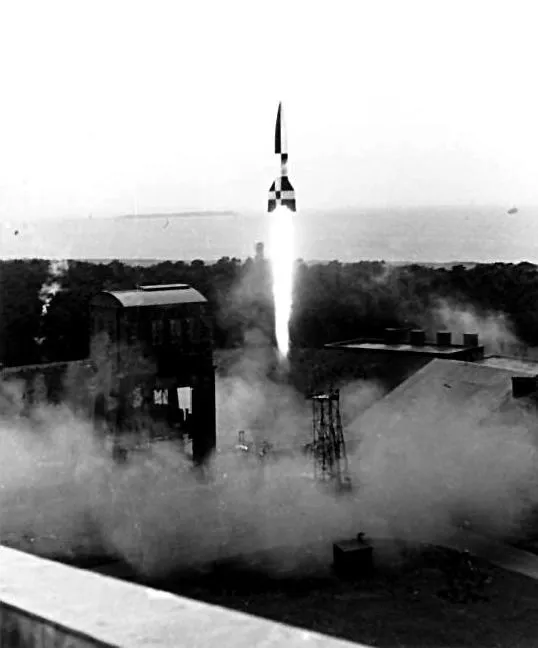
The first Mittelwerk-built V-2 was fired at London on 8 September 1944. From then until February 1945 output held at around 600 to 700 rockets a month. The total built in the tunnels is given differently by different sources. One count gives 4,575 completed between August 1944 and March 1945. Others put the overall figure at around 5,000 to 6,000 or higher. The fair way to put it is that several thousand V-2s came out of the Kohnstein, which makes it the main production site of the weapon. In late 1944 the factory also began building V-1 flying bombs, and about 6,000 were built by the end of the war according to the memorial’s figures.
A camp above ground
The surface camp was finally ready by the end of 1943 and expanded in the spring of 1944. In May 1944 the sleeping tunnels were dismantled and the prisoners moved to barracks near the southern entrance. The new accommodation was less deadly than the galleries but was far from safe. The prisoners still marched into the tunnel to work, in twelve-hour shifts.
Dora also became the hub of a growing network. Sub-camps were opened to supply labour for tunnelling projects, factories and construction across the southern Harz: Rottleberode in March 1944, Harzungen in April, and Ellrich-Juliushütte in May. Ellrich, in particular, had a reputation as one of the worst camps in the system, with up to 8,000 prisoners. At its largest the network had close to 40 sub-camps. In late September 1944 Dora was separated from Buchenwald, and the SS formally created the Mittelbau concentration camp on 1 November 1944. It was the last main camp the SS created, and the only one not named after a place. On that date the SS counted 32,471 prisoners across the system, 13,738 of them in the main camp.
The prisoners came from across occupied Europe. In the early months the largest national groups were Soviet, Polish, French, German, Belgian and Italian, and the early prisoners were all men and mostly non-Jewish. The first commandant of the independent camp was Otto Förschner, who served until the start of 1945. He was replaced on 1 February 1945 by Richard Baer, the former commandant of Auschwitz. Helmut Bischoff, head of security for Mittelwerk and the V-weapons programme, is held responsible for much of the surge in executions in the last months.
The last winter
As the Red Army advanced from the east, the SS began to empty its camps in Poland and eastern Germany. From February 1945, trains brought more than 16,000 prisoners from Auschwitz and Gross-Rosen to Mittelbau-Dora, among them women and children, and a large share of them were Jewish. In February the camp’s population rose from around 14,000 to 21,000. There was no room for them and no food for them.
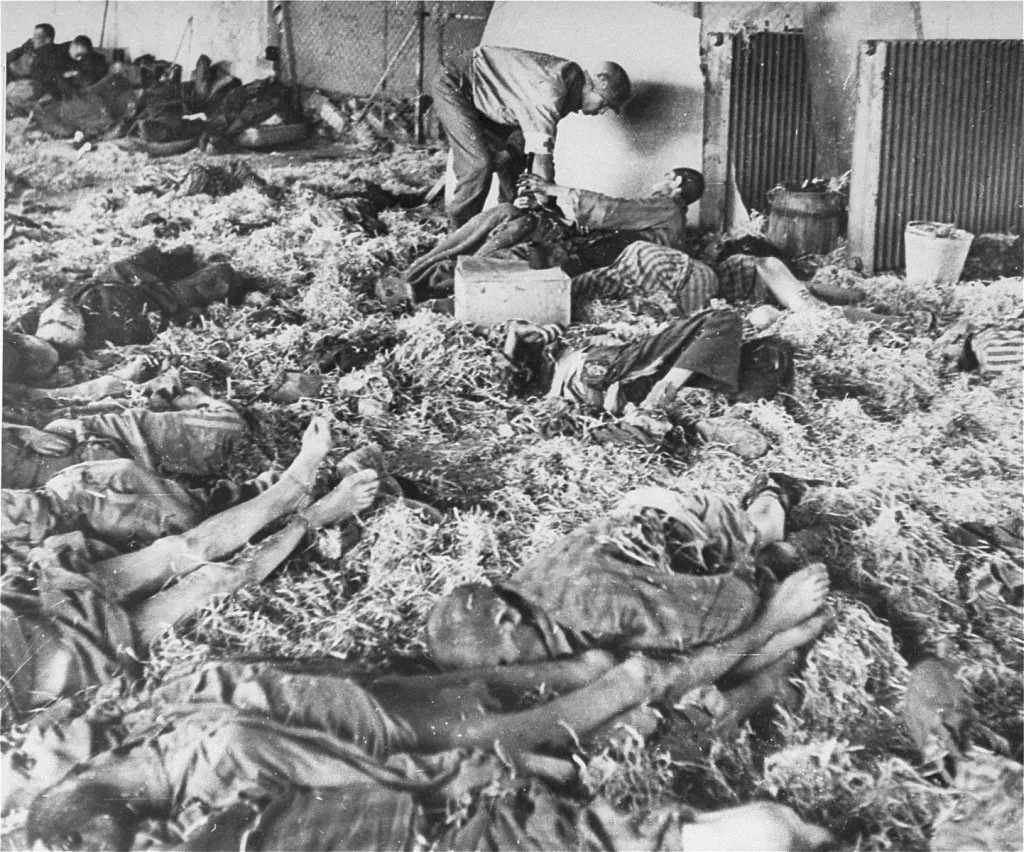
The result was a catastrophe on top of the existing one. In January 1945, the SS had converted the Boelcke-Kaserne, a former Luftwaffe barracks in the south-east of Nordhausen, into a dumping ground for the sick. Prisoners too ill to work were taken there and left on straw in aircraft hangars with little food and almost no care. The numbers rose from a few hundred to more than 6,000 and up to 100 people died a day. From January to early April 1945, about 6,000 inmates died in the Nordhausen area, around 3,000 of them at the Boelcke barracks.
Production continued as long as it could. Mittelwerk stopped work on 1 April 1945, though some accounts give 10 April. The power and ventilation systems were left running, and parts of V-2s lay in rows through the galleries.
April 1945
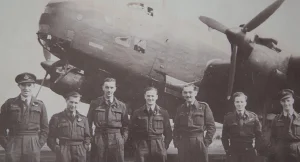
On 3 and 4 April 1945, hundreds of RAF Lancaster and Mosquito bombers attacked Nordhausen in two waves. The target was the town and the barracks, and the damage was catastrophic. Around three-quarters of the town was destroyed. Some 8,800 of the 40,000 inhabitants were killed and about 20,000 lost their homes. At the Boelcke barracks, an estimated 1,300 to 1,500 prisoners died in the bombing. The Kohnstein tunnels themselves, deep inside the hill, were not harmed.
The SS began to evacuate what remained of the camp on 4 April, by train and on foot. Trains took prisoners to Bergen-Belsen, Sachsenhausen and Ravensbrück. Others were marched into the Harz. Many died on the roads. Historian Jens-Christian Wagner estimates that more than 8,000 prisoners died in the evacuations. One of the worst incidents took place at Gardelegen, where more than 1,000 marchers from Mittelbau and Neuengamme sub-camps were locked into a barn that was set on fire. Those who tried to escape were shot, and only 20 to 25 survived.
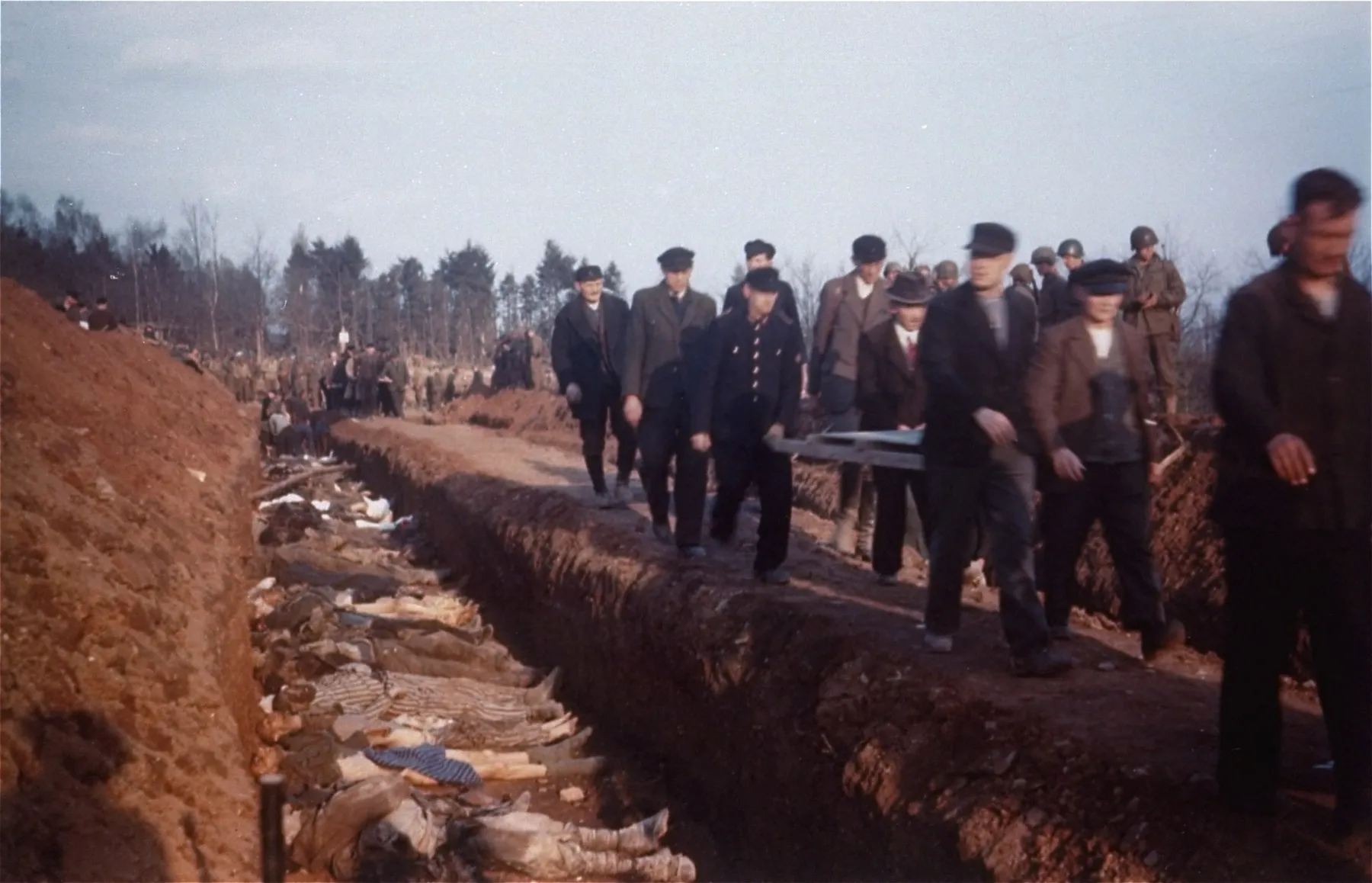
On 11 April 1945 elements of the US 3rd Armored Division and the 104th Infantry Division reached Nordhausen. At the Boelcke barracks they found several hundred sick and dying survivors lying among corpses. Counts of the dead found there range from 1,300 to 2,500, which probably reflects different ways of counting those who died in the bombing and before it. Soon afterwards they found the Mittelwerk tunnels and the Dora camp. War correspondents and army film units documented what they found. The footage was widely published and gave the world one of its first looks at the camp system’s last days.
The rocket men
The Americans, however, were also looking for something else. US Army specialists inspected the tunnels, which were full of rocket parts and assembly equipment, and they recognised the value of what they had found. Through May 1945 a special mission shipped trainloads of V-2 components out of the Kohnstein to the United States. About 100 V-2s’ worth of parts are recorded as going to New Mexico. The British, who had been promised a share, took part in the inspections, and the Soviets toured the plant on 26 May 1945.
The Americans left the area in June 1945 under the zonal agreements, and the Red Army moved in on 5 July. Before they left, the Americans evacuated rocket engineers and their families from the area. Several dozen of the people who had run the Mittelwerk and the V-2 programme were hired by the United States under what became Operation Paperclip. The best known is Wernher von Braun, who later led the Saturn V programme. Arthur Rudolph, a senior production manager at the Mittelwerk, also went to the US, worked on the Pershing missile and the Apollo programme, and in 1984 agreed to leave the country and renounce his citizenship after an investigation into his role at Mittelwerk. He was never charged with a crime.
The Soviets, for their part, stripped what they could. They briefly used parts of the tunnels for rocket work and took equipment and engineers east. The Red Army also ran a repatriation camp at Dora, from which some former forced labourers were sent on to the Gulag. From late 1945, the old camp held expelled Germans from Czechoslovakia for about a year.
Justice was partial. The British tried Franz Hössler, who had served at Dora in early 1945, in the Belsen trial, and he was executed in December 1945. The US trial of Dora personnel (United States v. Andrae et al.) began at Dachau in August 1947 with 19 defendants. Fifteen were convicted, and one death sentence was carried out. Georg Rickhey, the Mittelwerk’s general director, was tried separately and acquitted. Arthur Rudolph was not tried. West German trials followed in Essen from 1967 to 1970, and these ended with modest sentences for the defendants, who were released on health grounds. The sources differ in details, so check any specific figure against the memorial’s own materials.
Sealed, forgotten, reopened
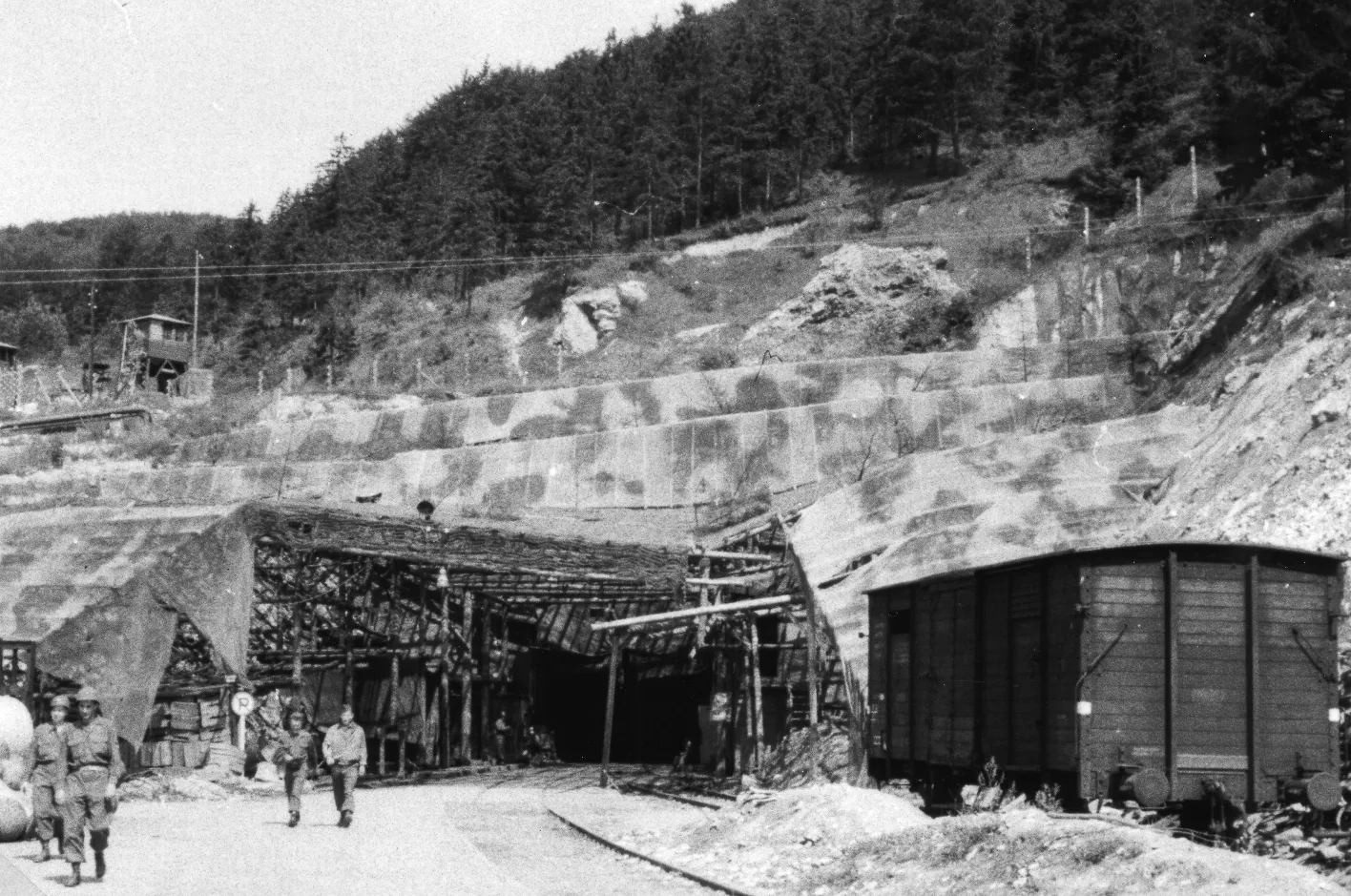
The Soviets tried to destroy the tunnels’ interior. They failed, but in 1947 and 1948 they blew up the entrances and sections inside, sealing the complex. The tunnels were left to the groundwater. Large sections flooded and others collapsed. Above ground, the camp barracks were taken down. By the time the memorial was founded, only the crematorium, the fire station and the former camp prison stood, and the prison was demolished in 1952.
In East Germany the camp was remembered in a particular way. The crematorium was declared a site of honour in 1954, and the local party organisation opened a memorial in 1964, which was formalised in 1966. The exhibition concentrated on the communist resistance and gave less attention to other prisoner groups. It also pointed at West Germany, since the engineers had gone west. The tunnels remained closed. An attempt in 1988 to open one of the Kohnstein tunnels was abandoned for lack of money.
After reunification the memorial was reorganised. A new access tunnel to Tunnel A was driven in 1995, so that visitors could finally go inside. Looting by treasure hunters also occurred in the years after 1989, and access through the old entrances was not secured until 2004. In 2000 the Stiftung Gedenkstätten Buchenwald und Mittelbau-Dora took over the site, and a new museum and permanent exhibition opened in 2006. The memorial now presents the camp as a model case of concentration camp forced labour for the arms industry.
Visiting the memorial and the tunnel
The KZ-Gedenkstätte Mittelbau-Dora is at Kohnsteinweg 20, on the north-western edge of Nordhausen, at the foot of the Kohnstein. The grounds are open daily until dusk, and entry to the grounds and the exhibitions is free. The exhibitions are open Tuesday to Sunday and on public holidays, from 10:00 to 18:00 from April to October, and from 10:00 to 16:00 from November to March. They are closed on Mondays and on 24 to 26 December, 31 December and 1 January. These details can change, so check the memorial’s website before you travel.
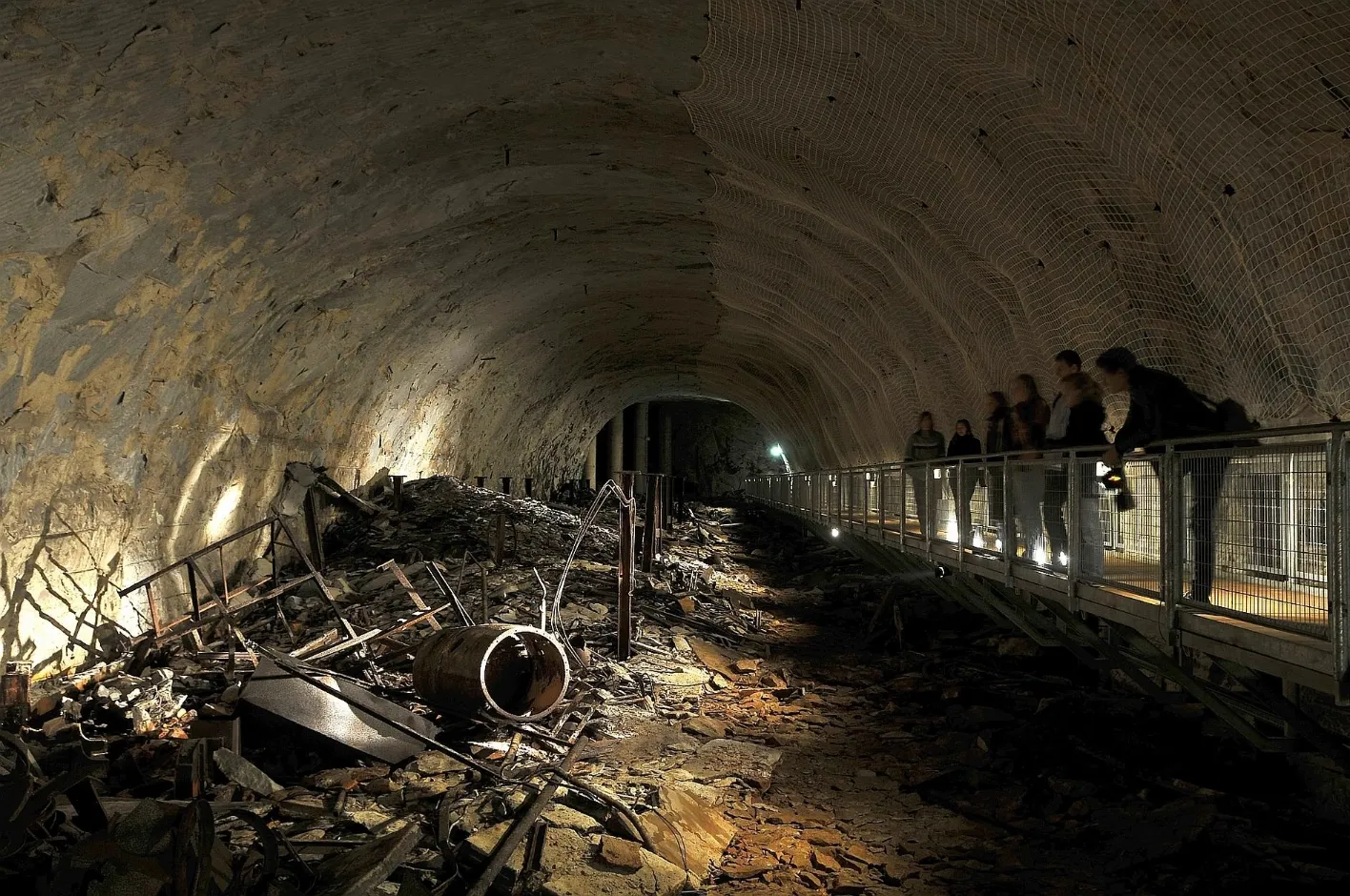
The underground part of the site can be visited only on a guided tour, which currently costs a small fee. Tours generally run at 11:00 and 14:00, with fewer on weekdays in winter, and some are cancelled, so it is worth checking in advance. The visit follows the raised walkway along Tunnel A, where the memorial shows V-2 components, fuel tanks and the remains of the assembly line. About 710 metres of the tunnel system is open. The remainder is flooded, unstable, or unsafe because of continuing gypsum extraction in the hill, and it is closed. The tunnel stays at around 8°C all year, so bring warm clothes and sturdy shoes. The memorial recommends the tunnel tour only for visitors in the ninth school year and above.
Treat the place as what it is. The tunnels are a grave as well as a factory, and the memorial asks visitors to behave accordingly. Do not climb on or remove anything, and do not try to enter the closed sections of the hill or its old entrances.
Counting the dead, and what is uncertain
The figures for Mittelbau-Dora are among the more carefully researched for any camp, and they still come with caveats. About 60,000 people were deported to the Mittelbau camps between August 1943 and April 1945. The SS’s own records show about 12,000 deaths, but those records stop being reliable towards the end, and they do not count the sick sent away to die elsewhere or the people who died on the evacuation routes. Conservative estimates put the total at more than 20,000, around one in three prisoners. One older figure gives 26,500 dead, which counts differently. The reader should treat all of these as estimates.
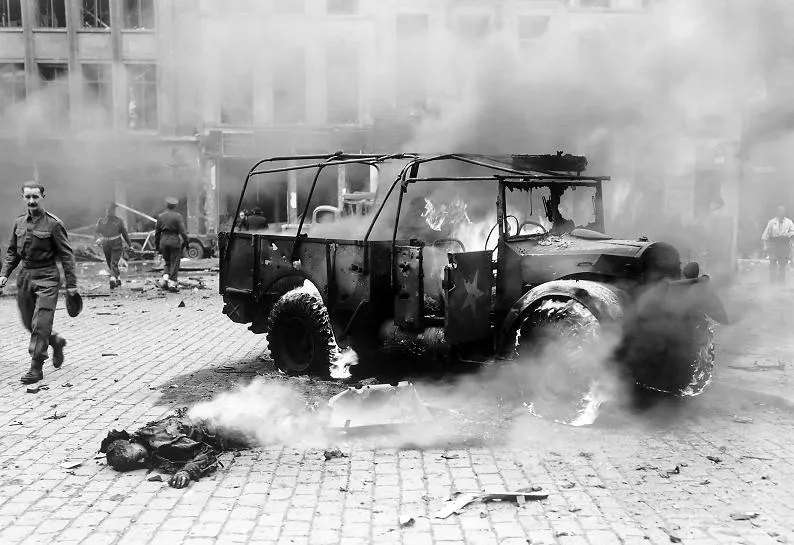
The comparison with the weapon’s victims is often quoted. Estimates of the people killed by V-2 attacks on Britain, Belgium and elsewhere run into the thousands, with one count giving 2,541 killed and 5,923 injured in Britain, while the death toll among the Mittelbau-Dora prisoners is several times higher. The comparison is a fair one, but the exact ratio depends on which estimates you use for both sides.
Other questions are still disputed or incompletely documented. How much the engineers knew, and how much responsibility individual managers carry, is argued in the literature. Total V-2 output varies by source. And claims that appear in many popular accounts, such as the figure of 250 slave workers dying every day, come from a 1945 mission report and have not been verified. Where this article gives a range, that is the reason.
Conclusion
The Mittelwerk was one of the most efficient pieces of industrial engineering the Third Reich built, and one of the most deliberate uses of human beings as material. The tunnels were not an accident or a late desperate measure. They were planned, financed and run by an alliance of the SS, the armaments ministry and German industry, with the aim of making a weapon at a price that included the lives of the people who built it. The system worked, in its own terms, until the war ended.
Today the Kohnstein is quiet. The barracks are gone, the entrances were blown up and reopened, and a walkway leads visitors into a cold gallery where rusted rocket parts still lie. It is one of the few places where the technology of the space age and the conditions that produced it can be seen in the same room. The memorial does not let a visitor treat the rocket as a separate subject from the prisoners, and that is the point of going.
Did you know?
- The Kohnstein tunnels were first dug as a gypsum and anhydrite mine in 1917, and by 1943 they were one of Germany's largest underground fuel depots.
- Mittelbau-Dora was the last main concentration camp the SS created, and the only one not named after a place.
- For the first months, prisoners at Dora lived inside the tunnels in four-tier bunks, and some did not see daylight for weeks.
- About 60,000 people were deported to the Mittelbau camps, and at least a third did not survive.
- The Mittelwerk tunnel system had two main tunnels linked by 46 cross galleries, which on a plan look like a ladder.
- The first V-2 built in the Mittelwerk was fired at London on 8 September 1944.
- The Soviets blew up the tunnel entrances in 1947 and 1948, and a new access tunnel was not dug until 1995.
- The tunnel temperature is around 8°C all year round.