An island made of rivers
Brest sits where the Mukhavets river meets the Western Bug, on the border between Belarus and Poland. The crossings here controlled the Warsaw-Moscow railway and highway, and an old Lithuanian castle once stood on the site. In the 1830s the Russian Empire replaced it with something far larger.
The engineers did not build on the high ground. They used the rivers. The Mukhavets and the Bug split the land into four islands, and the Russians set the central one, with its branches of water on every side, as the core of a fortress. The star-shaped outline from the first plans has been preserved, and it is still easy to read on a map nearly two centuries later.
Most abandoned military sites slowly vanish. Brest Fortress did not vanish, but it was not left as it was either. After the Second World War it was turned into a monument, and what visitors see is partly the 19th-century ruin and partly a Soviet memorial built over and around it. Both layers matter to the story.
Building the fortress
Construction began in the 1830s under Tsar Nicholas I, as part of a plan to defend the western edge of the empire. The start date is not settled: 1830 in one source, 1833 in Wikipedia, which links it to a draft by the military engineer Karl Opperman, and 1836 in UNESCO’s tentative-list text, which gives the building period as 1836 to 1842. All agree that the work was finished in 1842. One account names Generals Oppermann and Maletsky as the engineers in charge and says that the national revolt of 1831 delayed the work. The fortress was ready by the end of April 1842.
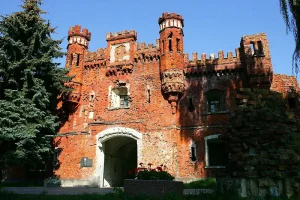
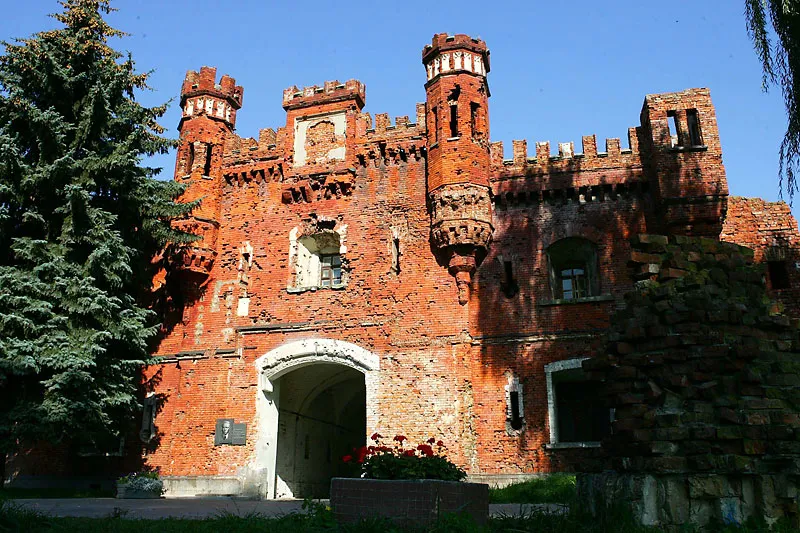
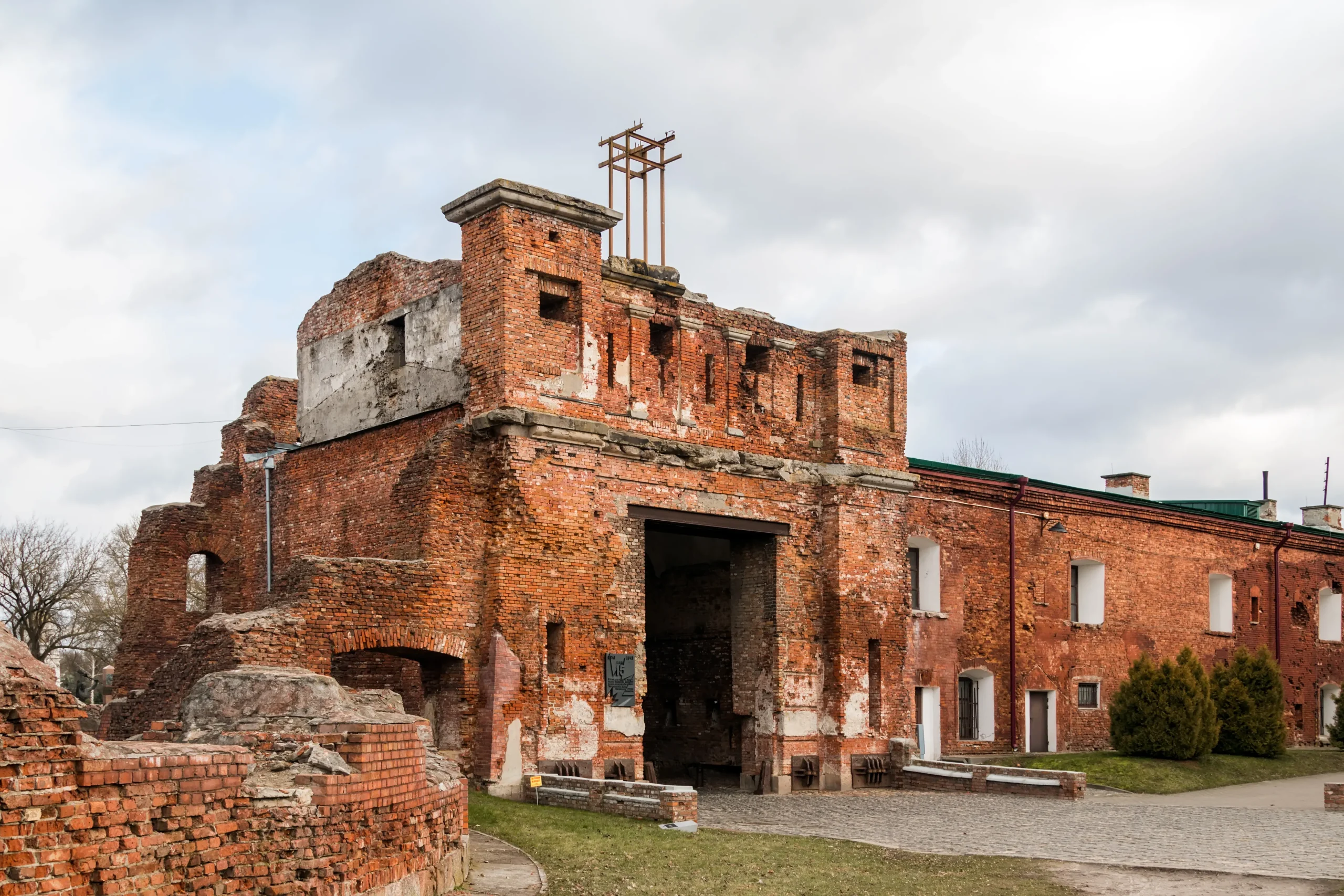
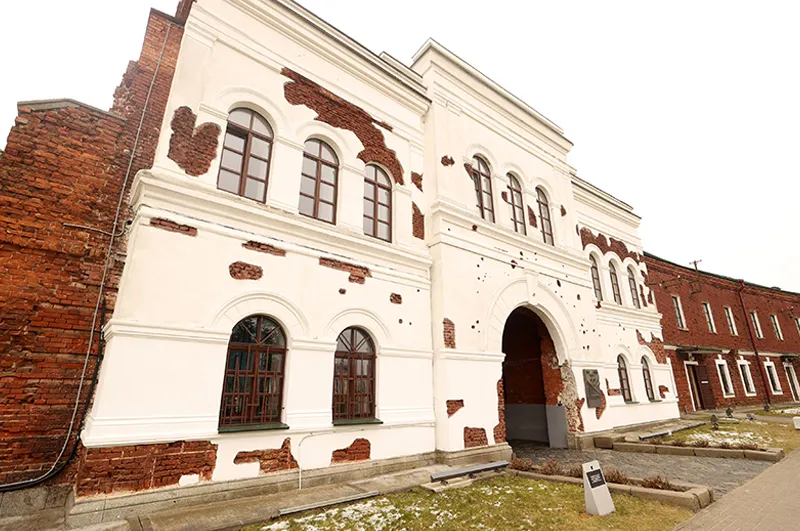
The central island held the Citadel. Around it ran a two-storey ring barracks of red brick, about 1.8 kilometres long, with 500 rooms for 12,000 soldiers, four semi-towers and walls roughly two metres thick. The citadel originally had four gates. Only two survive, the Kholm Gate and the Terespol Gate, and most of the barracks is now in ruins. Inside the ring stood storehouses, a church and an officers’ building called the White Palace.
The Citadel was not the whole fortress. Three outer fortifications, each on its own island, guarded the approaches. The Kobrin fortification to the north-east was the largest, horseshoe-shaped, with curtain walls, three detached ravelins and two forts, an East Fort and a West Fort. The Terespol fortification to the west was the bridgehead on the Polish side, and the Volyn fortification to the south-east covered the third approach. They were protected by river branches and moats, with earthworks about ten metres high and red-brick casemates built into them.
Modernised, then lost
Artillery changed quickly in the 19th century, and the fortress changed with it. The main rampart was renovated in 1864 to take heavier guns. Between 1869 and 1872 the Russians built the Graf Berg fort about a kilometre south-west of the Citadel, and there were plans for dozens of new outposts six or seven kilometres from the centre. By the time the final works were completed, in 1914 according to one source, the fortress was surrounded by a ring of outer forts as well.
It never fought as a besieged fortress in the First World War. When the Russian armies fell back in 1915, after the loss of the fortresses at Kaunas and Modlin, they abandoned Brest and took most of the stockpiled munitions with them. German troops entered the fortress on 26 August 1915.
The treaty of March 1918
The fortress entered world history in the winter of 1917 to 1918. After the Bolshevik revolution, the new Russian government opened peace talks with the Central Powers, Germany, Austria-Hungary, Bulgaria and the Ottoman Empire, in Brest-Litovsk. The delegates met in the fortress and were housed in temporary wooden buildings in its courtyards. The treaty was signed on 3 March 1918 at 17:50, with Grigori Sokolnikov signing for Soviet Russia.
The terms were severe. Russia gave up control of Ukraine, Poland, Belarus, Lithuania, Latvia, Estonia and the Caucasian districts of Kars and Batum, and renounced its claims to Finland. The lands that Russia lost held about 34 per cent of the former empire’s population, 54 per cent of its industrial land, 89 per cent of its coalfields and 26 per cent of its railways. A supplementary agreement in August 1918 added a payment of six billion marks to Germany, and 25 per cent of the output of the Baku oil fields.
The treaty was short-lived. The Armistice of 11 November 1918 annulled it, and the Bolshevik central executive committee formally cancelled it on 13 November. The place where it was signed went on to become something else.
Polish Brześć
After the First World War and the Polish-Soviet War, the Treaty of Riga of 1921 placed the fortress inside Poland, where the town was known as Brześć Litewski. In the early 1930s the fortress held the leaders of the Polish opposition.
The best-known prisoners were opposition politicians from the Centrolew alliance, arrested on the orders of Józef Piłsudski and Felicjan Sławoj Składkowski. Poland’s Institute of National Remembrance says all the arrested opposition leaders were held in Brest Fortress and treated as criminals. They were charged with preparing an attack aimed at removing the members of the government by force. The trial that followed is known as the Brest trials, although it was held at the Warsaw Regional Court, from 26 October 1931 to 13 January 1932.
The verdicts were announced on 13 January 1932. Adolf Sawicki was acquitted. The others received sentences of between a year and a half and three years, among them Herman Lieberman, Norbert Barlicki, Stanisław Dubois, Mieczysław Mastek, Adam Pragier and Adam Ciołkosz of the PPS, and Wincenty Witos, Władysław Kiernik, Kazimierz Bagiński and Józef Putek of the peasant parties. The government offered the convicted men the chance to emigrate. Five did, and five stayed to serve their terms. Witos chose exile in Czechoslovakia and returned shortly before the Second World War. After 31 October 1939 the Polish president in exile, Władysław Raczkiewicz, issued a decree granting an amnesty to the Centrolew activists.
September 1939
The Second World War reached Brest in the second week of September 1939. The Battle of Brześć Litewski ran from 14 to 17 September between German and Polish forces. On 14 September a German armoured probe was beaten off by Polish infantry and by the 113th light tank company, which had twelve obsolete Renault FT tanks. All of the Polish tanks were destroyed, but the Germans fell back to their start lines. German artillery came up that day, and by dawn about half the town was in German hands.
The main assault came on 16 September. The German 20th Motorised and 10th Armoured Divisions took the northern part of the Citadel, and a second armoured corps came up behind them. Under General Konstanty Plisowski the Polish troops evacuated on 17 September, and the last unit blew up the bridge behind it. The same day the Red Army crossed the Polish eastern border.
The German and Soviet advance guards met in the fortress area a few days later. On 22 September 1939 the German general Heinz Guderian, whose XIX Corps had taken the town, and the Soviet brigade commander Semyon Krivoshein, whose 29th Tank Brigade had arrived to take it over, held a joint parade in Brest-Litovsk. The Germans had advanced beyond the demarcation line agreed in the Molotov-Ribbentrop Pact and were ordered back behind the Bug by that date. Krivoshein supplied a band and a few battalions, and the two generals reviewed the troops together. Historians who have looked at the claim that similar joint parades took place in other occupied cities, such as Grodno, Pinsk, Białystok and Lwów, regard those as a myth. The Brest parade is the documented one. Afterwards the Germans withdrew west of the Bug, and the Soviets took over Brest and the fortress, which now stood on the border between the two occupiers.
The border garrison
For the next 21 months the fortress was a Soviet barracks on the frontier. In June 1941 it held elements of two rifle divisions, the 6th under Colonel Mikhail Popsuy-Shapko and the 42nd under Major-General Ivan Lazarenko, together with the 17th Frontier Guards Detachment of the NKVD Border Troops, the 132nd Separate NKVD Convoy Battalion, and hospital and support units. About 300 families of servicemen lived inside. The total strength is disputed: about 9,000 men on some accounts and fewer than 8,000 on another.
It was an obvious target. It controlled the Bug crossings and the Warsaw-Moscow railway and highway in the path of Army Group Centre. German planners gave the job of taking Brest to the Austrian 45th Infantry Division, about 17,000 strong, under Generalmajor Fritz Schlieper. The plan was to take Brest on the first day of Operation Barbarossa using infantry and artillery only. For the context of the whole invasion, see our article on Operation Barbarossa. The Soviet defensive belt that lay behind the frontier is described in the article on the Molotov Line.
Twenty-two June 1941
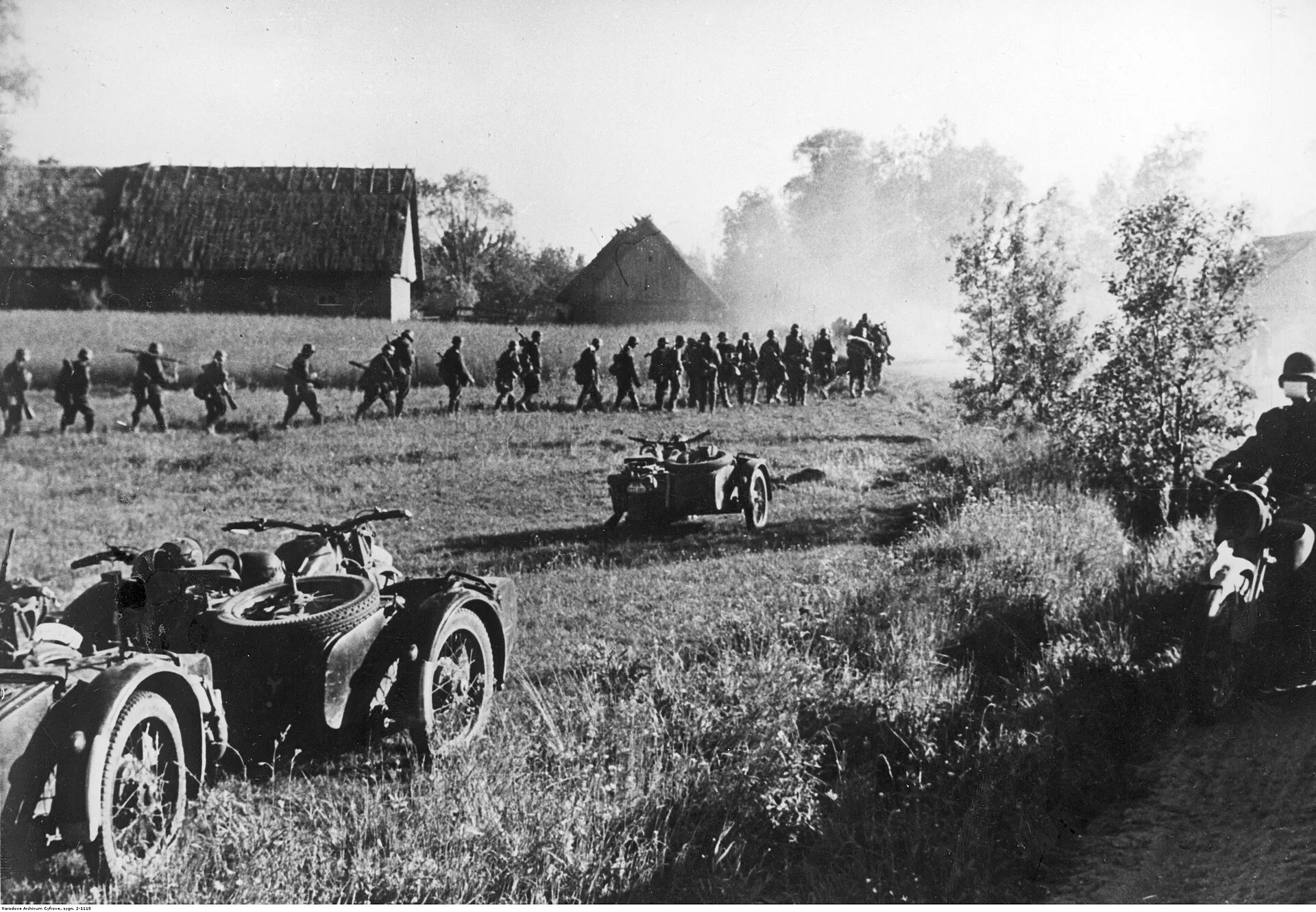
At 04:15 Moscow time on 22 June 1941 the German bombardment began without warning. It lasted 29 minutes and included artillery and rocket mortars, among them the 60-centimetre mortars of Heavy Artillery Battalion 833. German assault groups crossed the Bug about four minutes after the barrage began. The defenders were surprised, and the garrison was soon divided into groups holding isolated strongpoints.
The Germans expected to finish quickly. They thought the siege would last no more than 12 hours. Instead the defenders held isolated strongpoints in the thick brick of the barracks and the casemates, and the fighting turned into a slow, costly struggle for individual buildings. Around 281 Germans died on the first day. By 09:00 the fortress was surrounded.
Inside the walls
The defence had no overall commander at first. On 24 June Captain Ivan Zubachyov of the 44th Regiment gathered the survivors in the Citadel, with Regimental Commissar Yefim Fomin as his deputy. The regimental commander, Major Pyotr Gavrilov, was cut off in the Kobrin fortification and fought on separately. Zubachyov argued against a breakout, expecting the Red Army to counter-attack and relieve the fortress, but a night attempt went ahead and failed. By that evening 4,000 to 5,000 Red Army soldiers had been captured.
The Germans used heavy artillery, rocket mortars and flamethrowers to clear the buildings, and they cut off the water. Schlieper later described the choice that was open to him: “There was only one solution – to force the Soviets to capitulate through hunger and thirst.” On the evening of 26 June most of the northern Kobrin fortification had been taken, except for the East Fort. The same day Zubachyov and Fomin were captured. Fomin was executed on the spot under the Commissar Order, and Zubachyov died in German captivity on 21 July 1944, in a prisoner-of-war camp whose name sources give differently.
The East Fort lasted longest. On 29 June the Luftwaffe bombed it twice, and about 360 defenders surrendered. Schlieper reported the fortress fallen on 30 June, and the main German units left Brest on 2 July.
Isolated fighters did hide in the cellars and casemates afterwards. The only documented resistance after 29 June is a shoot-out on 23 July, followed by the capture of a Soviet lieutenant the next day. Major Gavrilov is usually reported captured around 23 July. Inscriptions scratched on the walls of the Citadel became famous after the war. One reads “I’m dying, but I won’t surrender. Farewell, Motherland. 20.VII.41.”
What the numbers show
The figures differ so much between sources that they are best shown as ranges. German losses were about 430 killed and 670 wounded on one count, and 482 killed and more than 1,000 wounded on another. The fighting accounted for more than 5 per cent of all German deaths on the Eastern Front up to 30 June 1941, which is given as 8,886. On the Soviet side the dead are put at about 2,000 and the prisoners at about 6,800; the Russia’s Periphery project at William and Mary gives about 7,000 prisoners, including 100 officers.
The date of the end of the fight is also contested. Soviet accounts said the fortress held out until 20 July with no surrender, and a popular version spoke of 32 days. Historians describe the 32-day claim as a myth that grew from the mid-1950s, and the UNESCO tentative-list text says only that the defenders held out for nearly a month. What the evidence supports is a hard fight of about a week, a few weeks of scattered resistance, and a very small number of fighters still alive in late July.
Learning what happened
The story was not told at once. The Soviet authorities learned the details only in 1942, when German documents were captured. One of them was a copy of the report by Schlieper that the German High Command had asked for on 8 July 1941, found near Livny in winter 1941 to 1942.
That changed in the 1950s. The writer Sergei Smirnov published a book, Brest Fortress, which was revised after a ten-year effort and won the Lenin Prize in 1965. Major Gavrilov, who had survived German captivity in the camps at Hammelburg and Ravensbrück and was released in May 1945, was made a Hero of the Soviet Union in 1957. The film Immortal Garrison appeared the same year. More than 200 other defenders were decorated. In 1965 the fortress was given the title Hero Fortress, the equivalent for a place of the Hero City title that twelve Soviet cities received, and it was awarded the Order of Lenin. The Belarusian party official Pyotr Masherov argued for making the fortress a national war monument and tourist destination.
Building the memorial
The fortress was not restored to its 19th-century form. The memorial complex built there between 1969 and 1971 was designed under the direction of the sculptor Alexander Kibalnikov and covers more than 70 hectares. It opened on 25 September 1971. More than 1,000 defenders, including soldiers, their wives and children, are said to be buried on the site; the William and Mary page counts 962 tombstones, more than two-thirds of them marked “Unknown”.
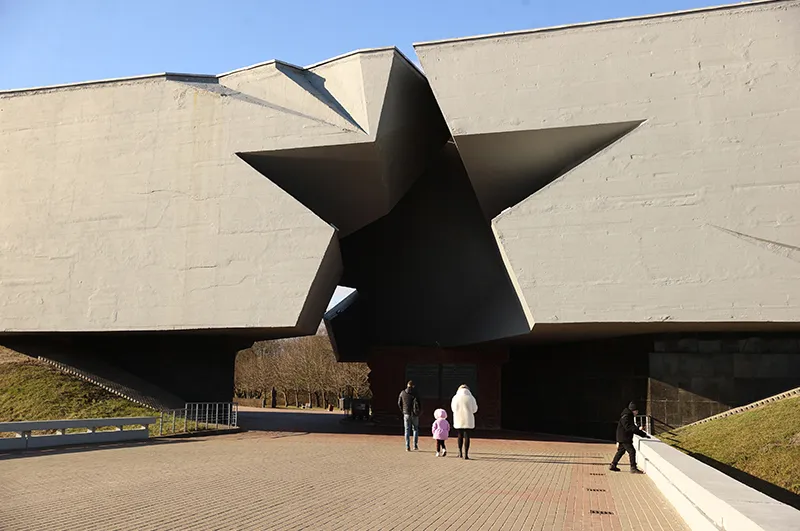
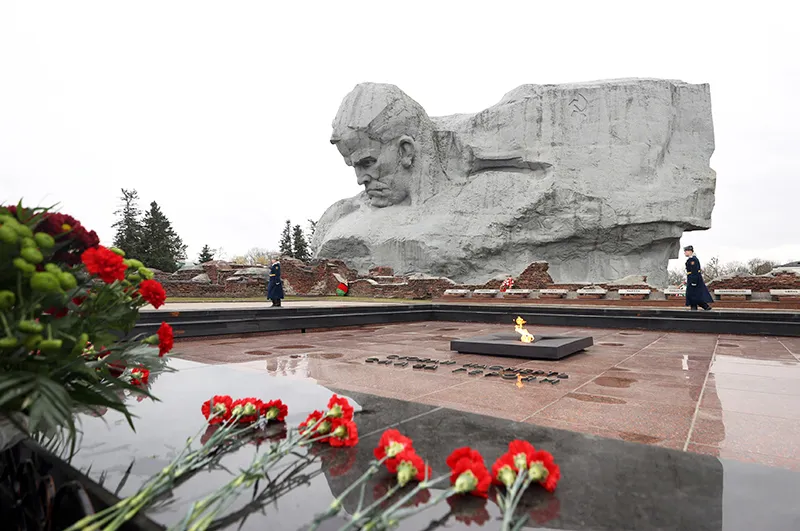
The memorial is arranged as a route. The main entrance is built in the form of a star. The centre of the complex is the Ceremonial Square, and between the square and the Museum of the Defence of Brest Fortress lie the surviving sections of the White Palace. The main monument is a huge concrete head of a soldier, over 30 metres tall (32 metres on one count), set into a block carved with scenes titled “The Counterattack”, “The Meeting of the Commanding Officers” and “The Last Grenade”. An obelisk in the form of a bayonet stands nearby, and an eternal flame burns at the top of a flight of stone steps, next to the rows of tombstones.
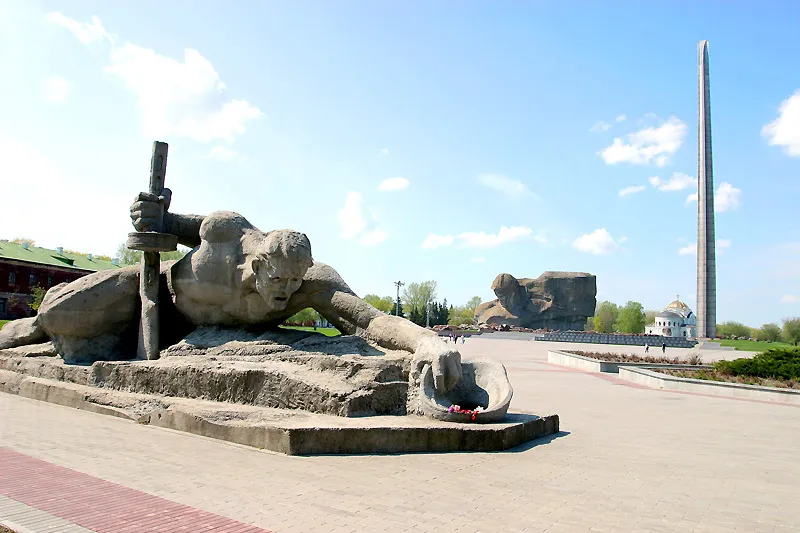
The sculpture called “Thirst” is perhaps the most affecting. It was completed in 1971 by Kibalnikov, Andrei Bembel and Vladimir Bobyl, and it shows a soldier crawling towards the river with a helmet in his hand. It recalls the destruction of the fortress’s water supply in the first hours of the attack. The Bug and the Mukhavets were within a few metres of the defenders and out of reach.
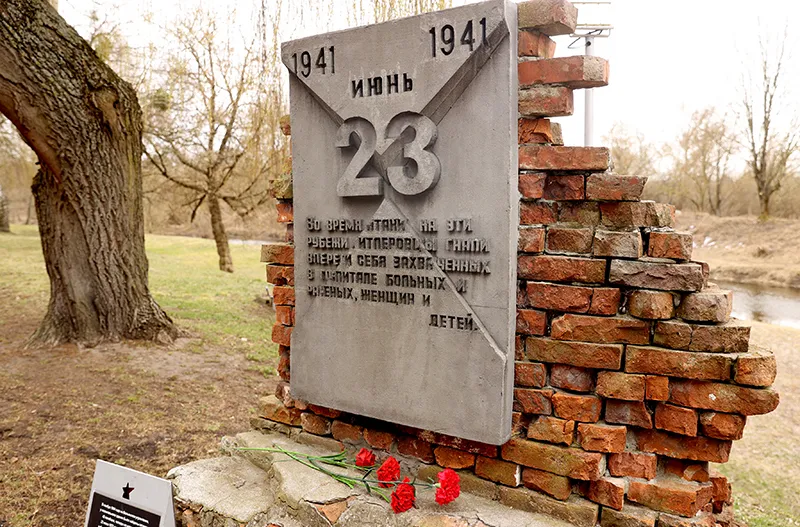
The old structures were kept as ruins, not restored. The barracks, gunpowder bunkers, forts and the museum are all part of the complex, and the Kholm Gate and Terespol Gate still stand. This mix of a monument and a real battlefield is what makes the site unusual.
The argument about the monument
The memorial is heavily political, and anyone writing about it has to say so. It was built to serve a Soviet narrative of heroic resistance, and for decades Soviet writers avoided academic study of the battle. The first semi-academic Russian monograph appeared only in 2008. The 32-day claim, the focus on a few named commanders, and the emphasis on victory in defeat belong to that narrative.
The monument has had critics for other reasons. In 2014 CNN published a list that called the concrete head the “world’s ugliest monument”, and CNN later apologised. The film Fortress of War, directed by Alexander Kott and released on 22 June 2010, brought the story to a new audience. Its producers claimed the plot was as close as possible to historical fact, and the Brest Fortress Museum supervised it.
None of this changes what happened in the fortress. Thousands of men fought against a larger force that had planned for the attack, many died, and most of the survivors were taken prisoner. The disputes are about numbers, dates and the story built on top of the facts.
World Heritage ambitions
Belarus first put the fortress on UNESCO’s tentative list on 30 January 2004 as a 19th-century cross-border fortification. The listing was dropped in 2016. On 23 February 2024 Belarus’s Prosecutor General’s Office proposed adding it again, this time as a war memorial, saying it would symbolise “the protection of the world from Nazism”. A joint nomination with Russia, titled “Memorials to the Heroes of the Great Patriotic War: Brest Fortress and Mamayev Kurgan”, was submitted on 30 May 2024 under criteria (ii), (iv) and (vi). Until 2021 UNESCO had a moratorium on sites tied to military history, with Auschwitz as the exception. The preservation of the site is managed by the Brest Fortress Development Foundation.
Visiting
The memorial complex is at 60 Heroes of the Brest Fortress Defence Street, Brest. The complex’s own website lists the opening hours of its parts. The Museum of the Defence of Brest Fortress, its 5th Fort branch and the “Defence of the Eastern Fort” exhibition are open from 9:00 to 18:00, with the ticket office closing at 17:30, and are closed on Mondays. The “Museum of War – Territory of Peace” and the “Chronicle of the Brest Fortress” exhibition are open from 10:00 to 19:00 and closed on Tuesdays. The Eastern Fort exhibition includes a display called “We Remember…”, on the genocide of the Belarusian people in the Second World War. A thematic tour of the Terespol fortification and the Pogranichny island runs on weekdays by advance booking only.
The site says that only its own staff may lead guided tours on the grounds and in the museums, and it warns against unofficial guides. Tours are booked by phone, Viber or WhatsApp on +375 29 542 42 74, or by email at [email protected]. The official site is in Russian and Belarusian, it did not list ticket prices on the page we checked, and opening hours and exhibits change, so check them before travelling. Entry rules for foreign visitors to Belarus are set by the state and are not covered here.
Conclusion
Brest Fortress was built to hold a frontier, and it did the job it was given only once, in a way its builders did not expect. In 1918 it was a place where a government signed away much of an empire. In the 1930s it held men whose crime was opposing their government. In 1939 and again in 1941 it was a battlefield, and in the second battle it was surrounded, bombed and cut off from water within a day.
What survives is a layered site: the star-shaped island of the 1840s, the ruined barracks, the graffiti, and the vast concrete monument of 1971 around them. It deserves to be read with all those layers in mind. The facts of the defence are grim enough without the later legend, and the later legend is a part of the history of the place too.
Did you know?
- The fortress sits on an island formed by the Bug and two branches of the Mukhavets, and its barracks ring was about 1.8 kilometres long.
- The Treaty of Brest-Litovsk was signed on 3 March 1918 at 17:50, and the delegates were housed in temporary wooden buildings in the fortress courtyards.
- On 22 September 1939 the German general Heinz Guderian and the Soviet brigade commander Semyon Krivoshein reviewed a joint parade in Brest-Litovsk.
- The German attack on 22 June 1941 began with a 29-minute bombardment, and assault groups crossed the Bug about four minutes after it started.
- A scratched wall inscription found after the war reads: "I'm dying, but I won't surrender. Farewell, Motherland. 20.VII.41."
- The "Thirst" sculpture shows a soldier crawling to the river with a helmet, recalling the loss of the fortress's water supply.
- The memorial complex opened on 25 September 1971, and the fortress was named a Hero Fortress in 1965.
- Wikipedia describes the "32 days" figure for the defence as a myth that grew from the mid-1950s.
- Wikipedia says that Hitler and Mussolini visited the fortress on 26 August 1941.