A ring of reef in the Marshalls
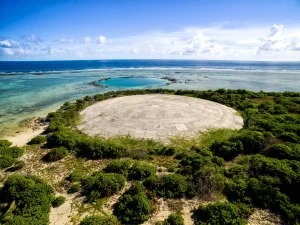
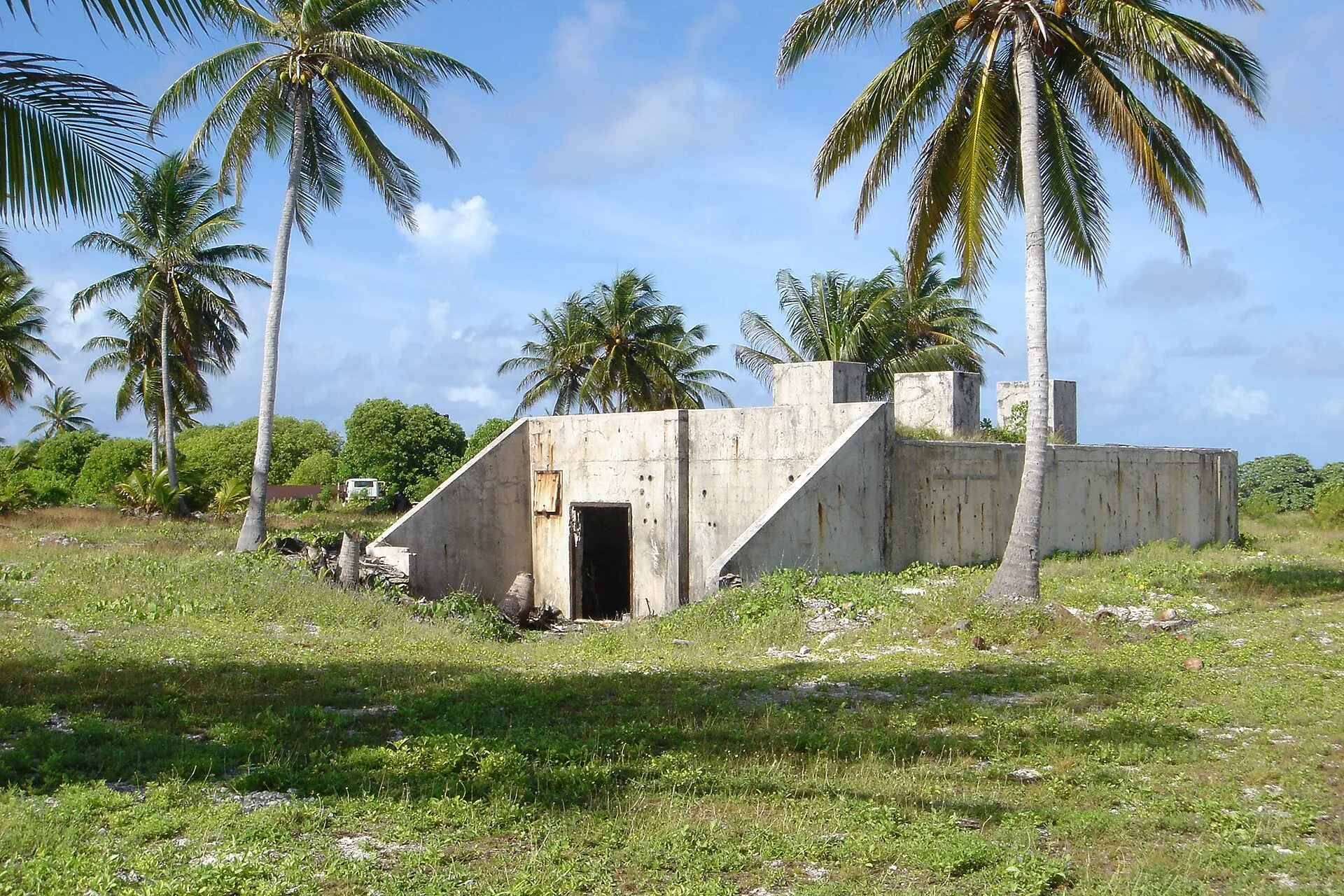
Bikini Atoll lies at the northern end of the Ralik Chain, the western of the two island chains that make up the Marshall Islands. It is a coral reef with 23 small islands set around a central lagoon of 594.1 square kilometres. The land area is only about six square kilometres, and the average height above the sea is about two metres. Majuro, the capital, is about 850 kilometres to the south-east.
The largest island, Bikini Island, covers about 237 hectares and is about four kilometres long. It was the main home of the islanders. A probable shield volcano, Wōdejebato, lies about 74 kilometres to the north-west and is joined to the atoll by a submarine ridge. Some of the islands were lost in the weapons tests that followed: Bokonijien and Aerokojlol were destroyed, along with part of Namu.
The name is a later arrival. The Marshallese name is Pikinni, and “Bikini” is the form that Germans gave the atoll when they ran the islands as a colony. The first westerner to see it without dispute was the explorer Otto von Kotzebue in 1816 and 1817, who named it Eschscholtz Atoll. Germany annexed the Marshall Islands in 1885 and used the atoll for copra. Japan took the islands in 1914 and held them under a League of Nations mandate from 1920. After the Second World War the islands came under US control.
The people of Pikinni
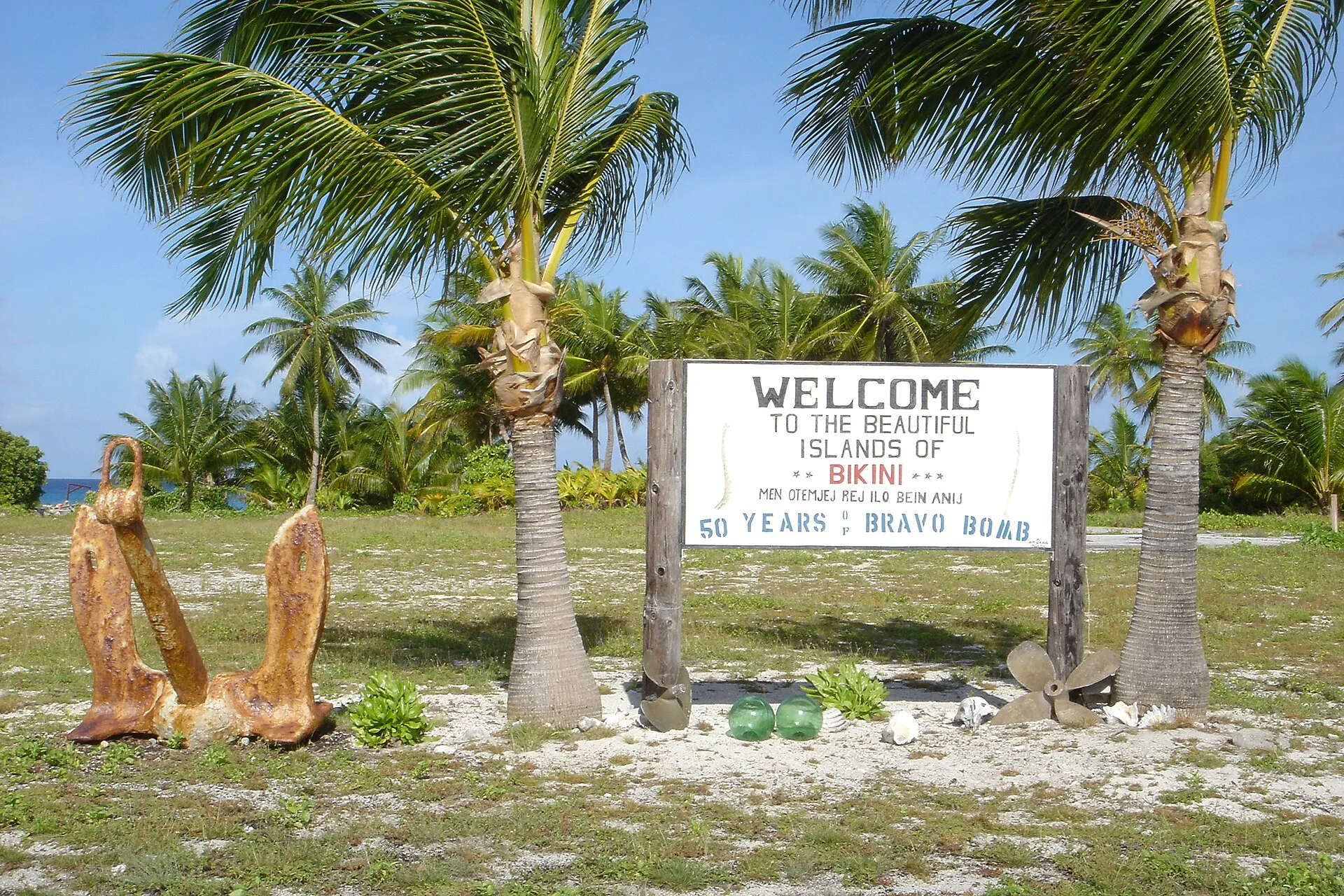
When the Americans came to Bikini in 1946, 167 people lived on the atoll, in 11 family lineages. Their leader, Juda, was an alap, the head of a lineage. The Bikini Project, a descendants’ history site, says the community saw itself as communal and reciprocal, and it gives two sayings that express this: “Kan drikdrik kon yokwe”, sharing what little one has with love, and “Jiban don”, helping each other. It also makes a point that matters for what followed. Marshallese had no words for nuclear weapons, radiation or fallout, and the islanders had no legal representation and no written documents when they were asked to leave.
The deep history of settlement is less certain than it looks in some summaries. The claim that people lived on the atoll for about 3,600 years rests on early dates that most researchers reject. Work on nearby Ujae Atoll puts permanent habitation around the first century CE, with the oldest confirmed date there between AD 256 and 542.
The request of March 1946
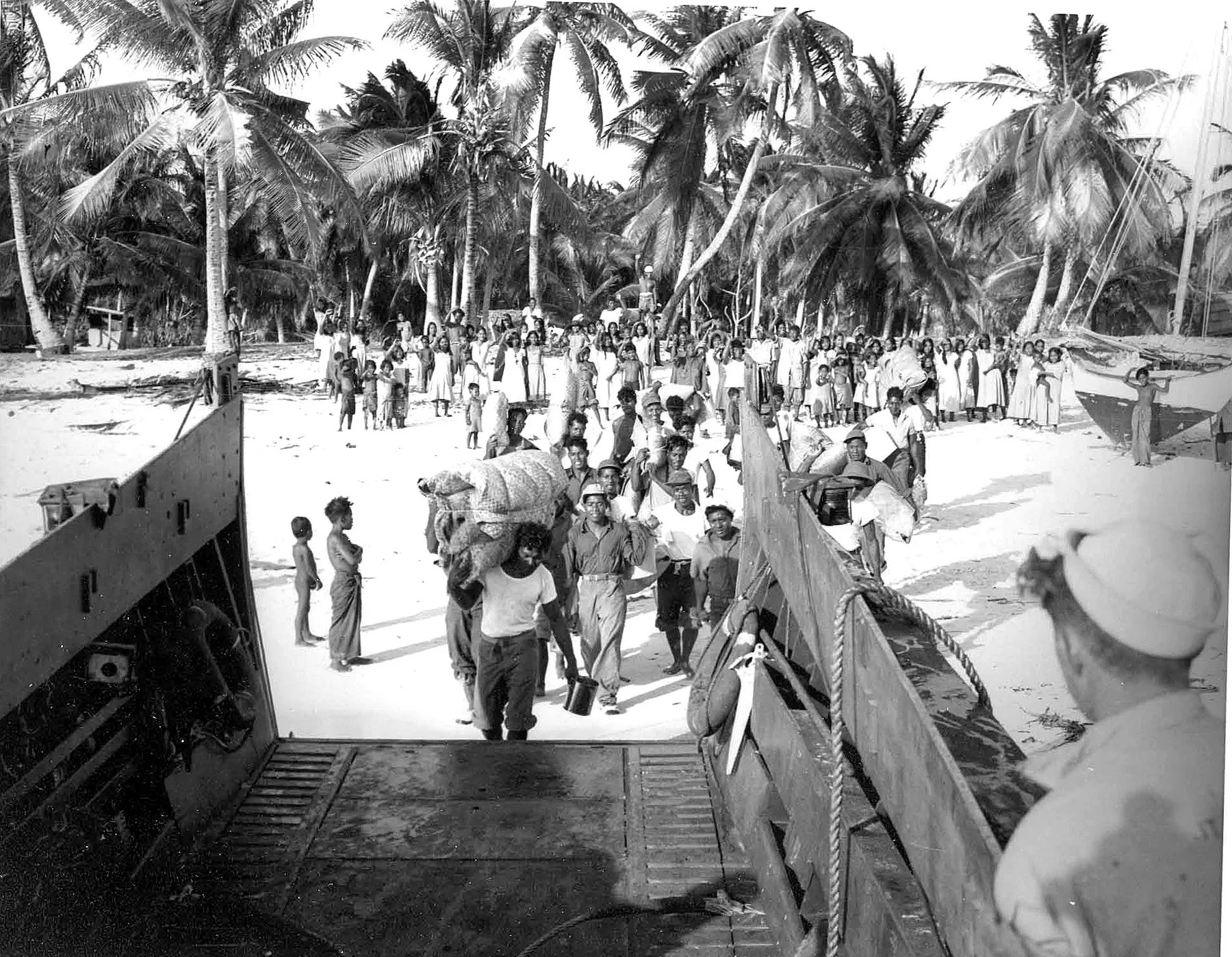
In February 1946 the US Navy’s Commodore Ben H. Wyatt asked the Bikinians to leave their atoll. One account has him saying that the land was needed for “the good of mankind and to end all world wars”. The islanders were told it was temporary, and Juda agreed. The move took place on 7 March 1946, when the 167 people were taken about 200 kilometres east on the landing ship LST 1108 to Rongerik Atoll.
The atoll was needed for Operation Crossroads, a test of what nuclear weapons would do to a fleet of warships.
Operation Crossroads
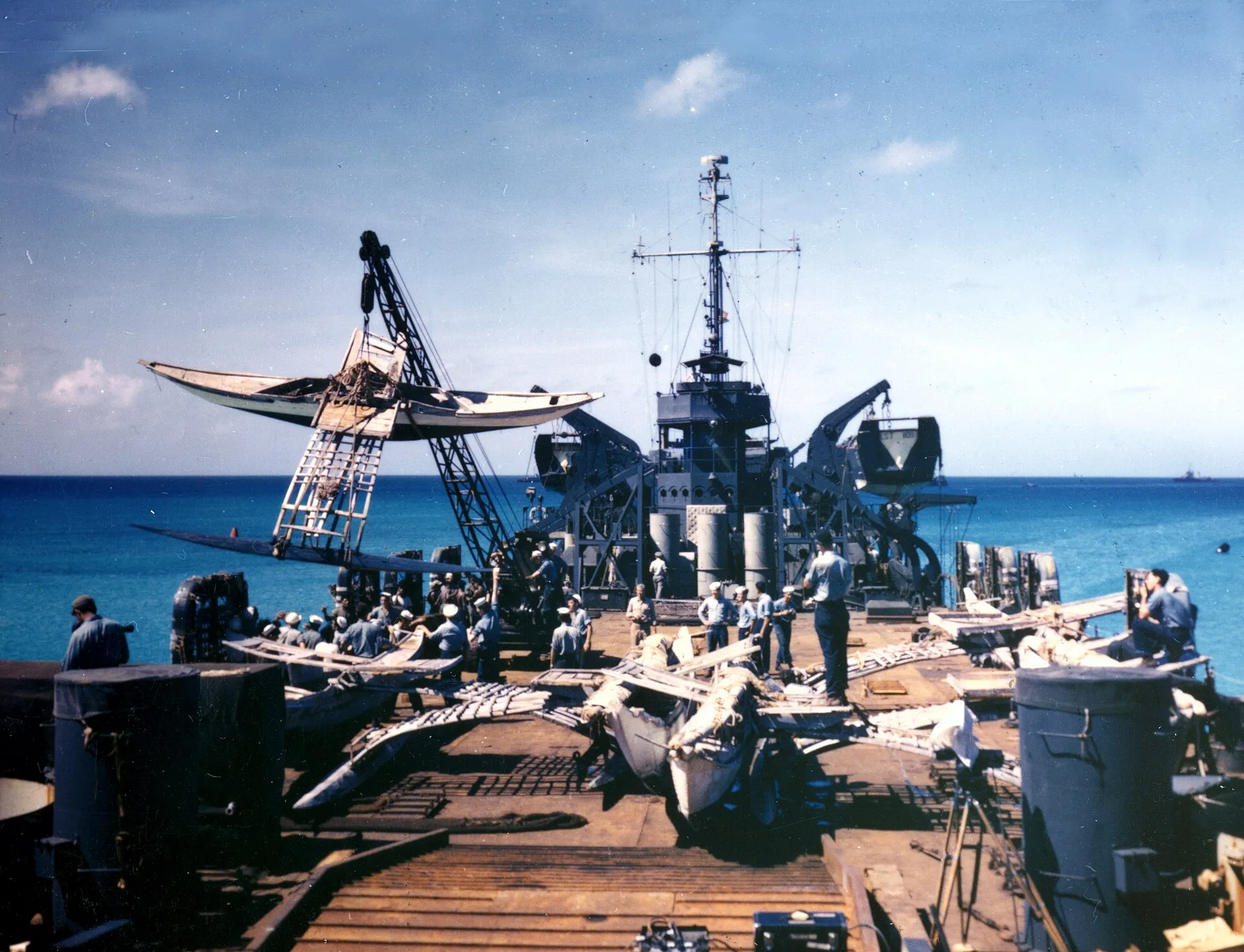
Operation Crossroads began in July 1946. The Navy assembled 93 target vessels in the lagoon: four obsolete American battleships, two carriers, two cruisers, twelve destroyers, eight submarines, forty-one landing ships, and three surrendered Axis ships, the Japanese cruiser Sakawa, the Japanese battleship Nagato and the German cruiser Prinz Eugen. About 42,000 men took part, and 114 reporters came to watch. The fleet also carried animals to test the effects of radiation. For Able, 22 target ships carried 57 guinea pigs, 109 mice, 146 pigs, 176 goats and 3,030 rats, and about 35 per cent died or were euthanised within three months. For Baker only pigs, goats and rats were used, and all the pigs and most of the rats died.
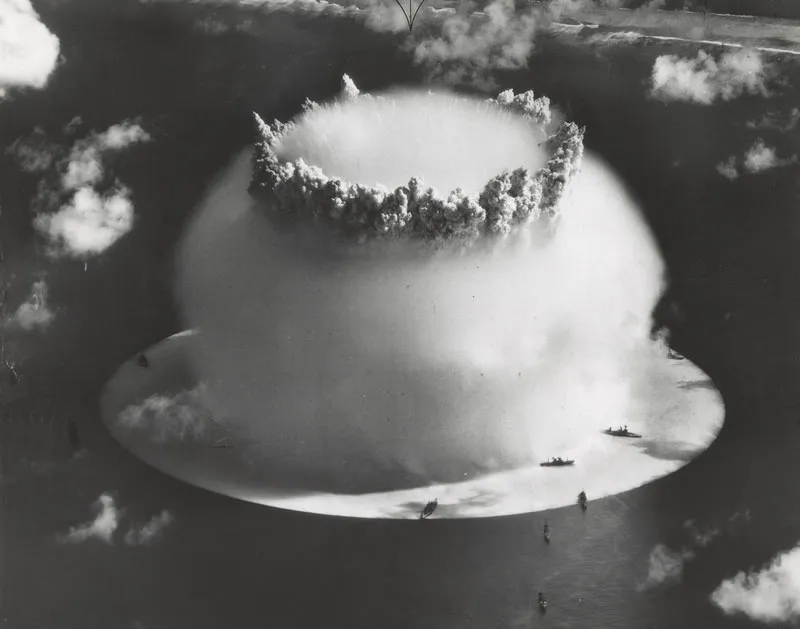
The first shot, Able, was dropped from the B-29 Dave’s Dream on 1 July 1946 (local time) at 23 kilotons, and it missed its aiming point, the battleship Nevada, by about 650 metres. It sank five ships. The second shot, Baker, was fired underwater on 25 July in 55 metres of water, also at 23 kilotons, from a device called “Helen of Bikini”. It sank ten ships. The nuclear chemist Glenn Seaborg later called it “the world’s first nuclear disaster”: it contaminated the fleet heavily, and decontamination failed. Stafford Warren halted the decontamination work on 10 August 1946 after plutonium was found in samples. Only nine ships were eventually scrapped, and the rest were scuttled. Film badges recorded 67 overdoses of radiation among those working on the ships between 6 and 9 August. The third test, Charlie, a deep underwater shot planned for early 1947, was cancelled. Contamination from Baker had delayed the support crews and left no clean target ships, and planners also judged the test less urgent, since the United States had only a handful of nuclear weapons. Deep-water effects were tested later, in Operation Wigwam in 1955.
The health of the men who took part has been studied. A 1996 mortality study found that veterans of the operation had a death rate 4.6 per cent higher than non-veterans by 1992, equivalent to a loss of about three months of life expectancy, although cancer rates were not significantly higher and the cause of the difference remains unexplained.
Where the name came from
Four days after the first Crossroads shot, a French designer named Louis Réard launched a two-piece swimsuit in Paris. He introduced it on 5 July 1946 at a swimsuit review at the Piscine Molitor, using the 18-year-old Casino de Paris dancer Micheline Bernardini as his model after no other model would wear it. He called it the “Bikini”. Réard never explained his choice of name, and the usual guesses are that he wanted an explosive commercial reaction, that he wanted to link the suit to the tropical Pacific, or that he was making a joke about the atom, since his design “split the atome” of his rival Jacques Heim’s earlier suit. Heim’s suit sold more at first, but Réard’s name is the one that stuck, and for most of the world it is now what the word “bikini” means.
Hunger on Rongerik
While the fleet was sinking in their lagoon, the Bikinians were struggling on Rongerik. The island was about one-sixth the size of Bikini, it was considered a “bad place” in traditional belief, and its food resources had been overstated. The provisions were meant to last a few weeks. Juda began asking for a return after about two months. A fire in May 1947 destroyed about one-fifth of the island.
The anthropologist Leonard Mason visited on 31 January 1948 and found the community living on a flour-and-water gruel, with failing crops, scarce fish and rainwater rationed at one bucket per family per day. He recommended immediate relocation. The columnist Harold Ickes wrote that “the natives are actually and literally starving to death”. The islanders were moved to Kwajalein Atoll in March 1948 and lived for about eight months in a tent camp beside a military airstrip.
In June 1948 they chose Kili, a 200-acre island in the southern Marshalls with no lagoon, and they moved there on 2 November 1948, a group of 184. Kili had one great defect: it had no sheltered water. Waves reached the island, supply ships could not land for about four months of each year, and typhoons in 1957 and 1958 destroyed most of the crops. The community came to depend on imported canned food. A 40-foot ship donated in 1949 to carry copra was washed onto the reef and lost in 1951.
Castle Bravo and the other tests
The Bikini tests did not stop with Crossroads. In all, 23 devices were fired at the atoll between 1946 and 1958 from seven sites, with a combined yield of about 77 megatons. The Marshall Islands as a whole saw 66 or 67 tests, depending on how they are counted, and UNESCO’s own text gives both the 23 and the 67 figures without reconciling them.
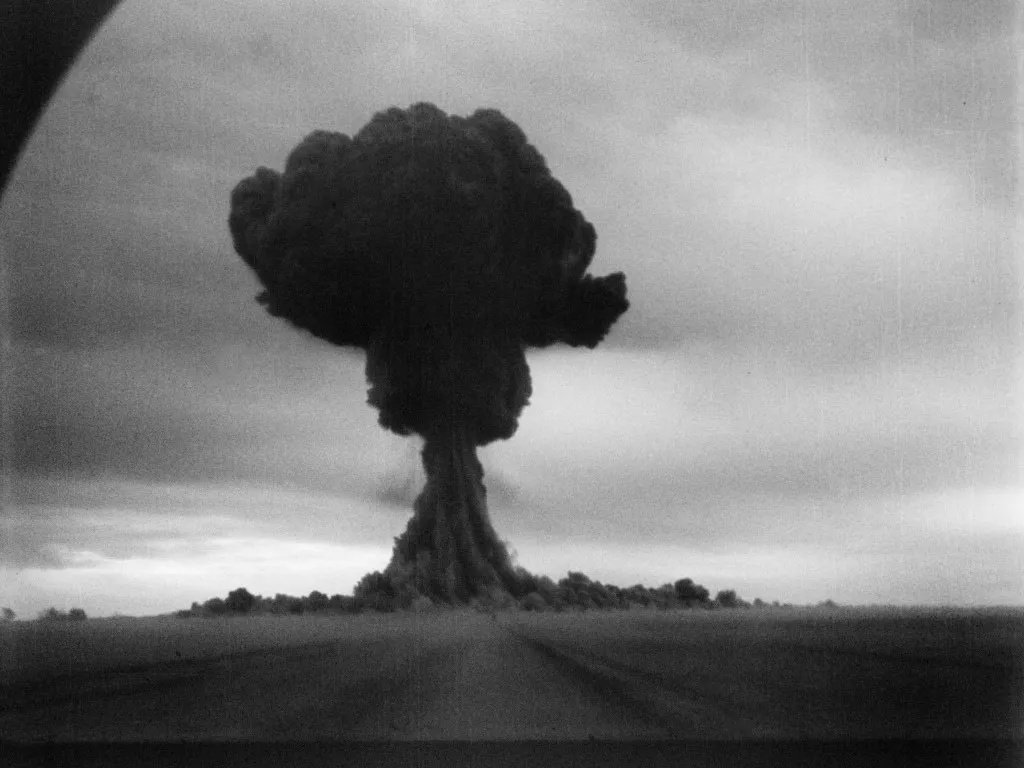
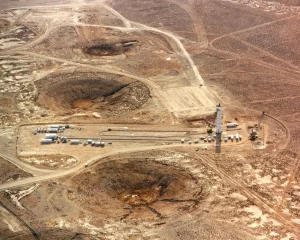
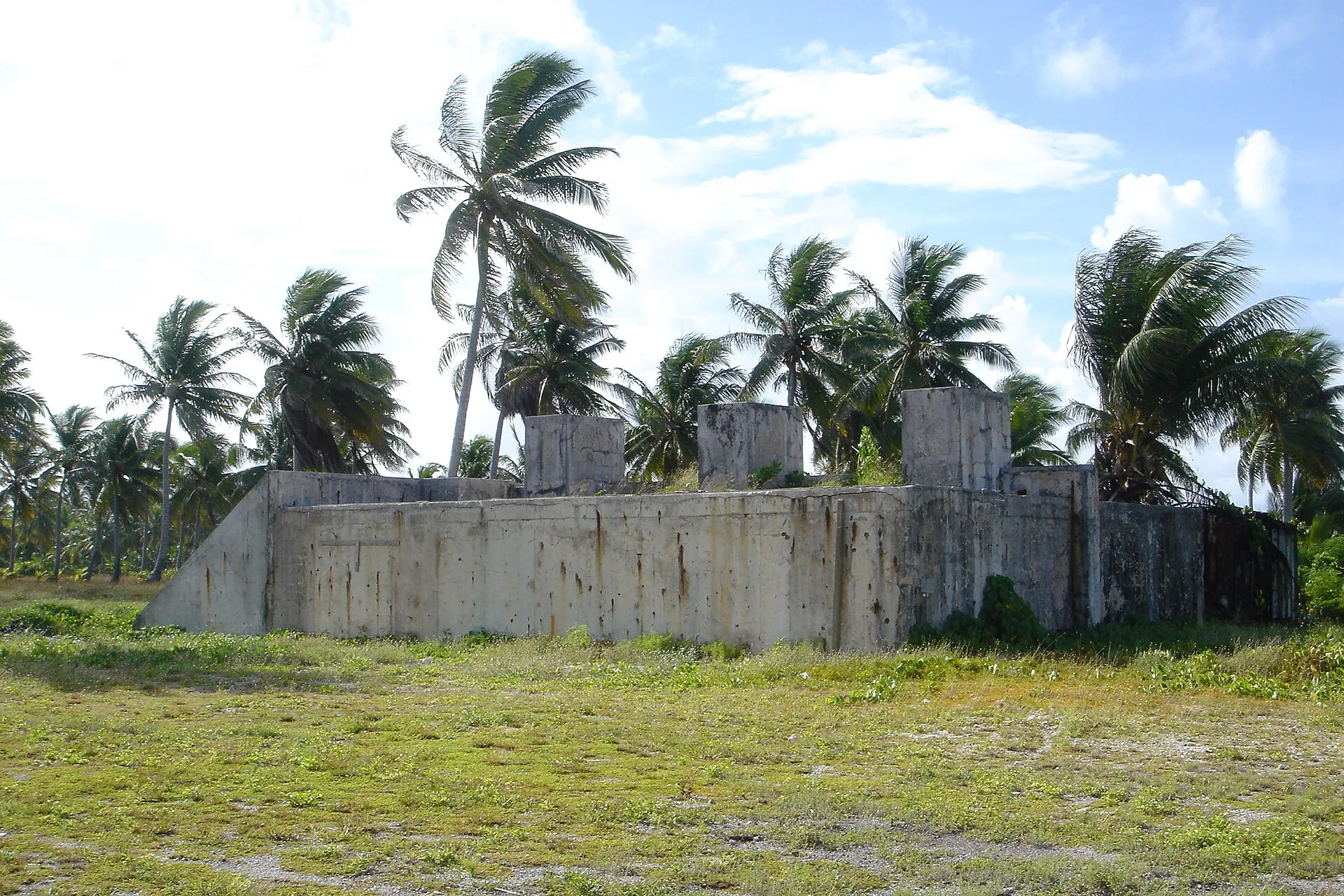
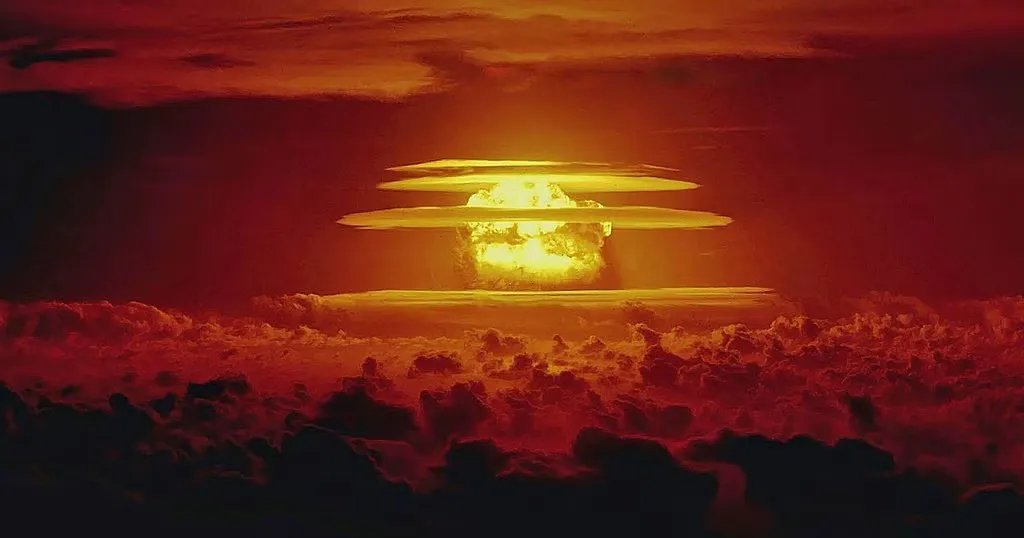
The largest was Castle Bravo, fired on 1 March 1954 local time (28 February in US records) from a site on Namu islet. The device, nicknamed Shrimp, was a lithium deuteride design. The designers had assumed that one isotope of lithium, lithium-7, would not react in the explosion. It did: fast neutrons made it produce extra tritium and neutrons, and the yield rose to about 15 megatons, well above the prediction, which Wikipedia gives as six megatons in one place and five in another. The fireball was about 7.2 kilometres across, and it left a crater about 2,000 metres wide and 76 metres deep. The mushroom cloud reached about 47,000 feet within a minute and about 130,000 feet within ten minutes, and the thermal flash started a fire 37 kilometres away. The task force could not approach the atoll for 24 hours.
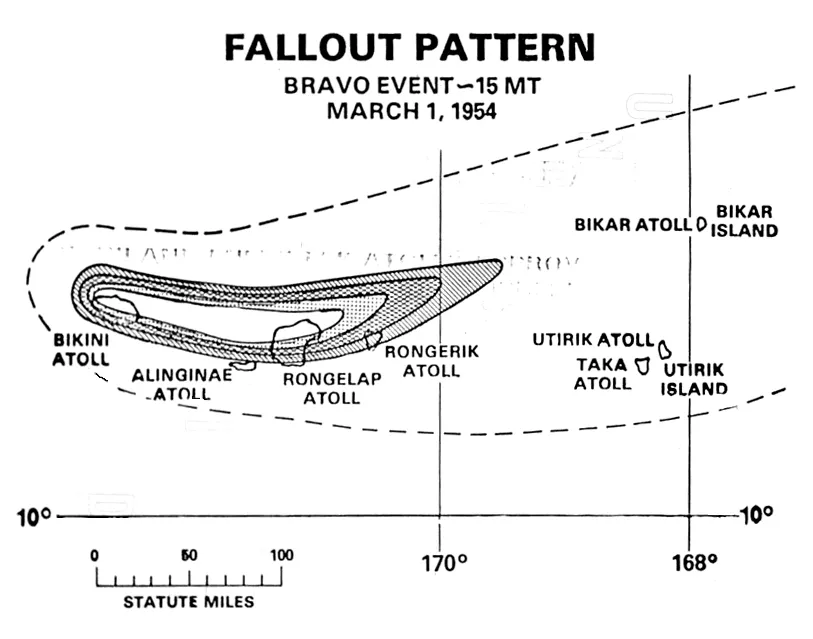
The fallout was not what the planners had expected either. It contaminated more than 7,000 square miles of the Pacific and fell on Rongelap, Utirik and Ailinginae atolls and on American personnel on Rongerik. In all, 239 Marshallese and 28 Americans were exposed. The people of Rongelap (86 by one count) and Utirik (167) were evacuated about two days later and taken to Kwajalein for care. Those exposed suffered radiation sickness, and later had thyroid tumours; many birth defects were also reported. Japanese fishermen were hit too: the 23 crew of the Japanese fishing boat Daigo Fukuryu Maru, or Lucky Dragon No. 5, were contaminated and suffered acute radiation sickness. Their chief radioman, Kuboyama Aikichi, died that September. Japan called the incident a “second Hiroshima”, and it received $15.3 million in compensation. The test led the United States to adopt an unwritten limit of 15 megatons on single tests.
The series continued. Operation Castle fired six shots in 1954, five of them at Bikini. Redwing in 1956 had six detonations totalling 18.2 megatons, and Hardtack I in 1958 had eleven totalling 21 megatons, according to the Bikini article on Wikipedia.
Coming home, twice
The Bikinians never stopped hoping to return. In June 1968 President Lyndon B. Johnson announced that they could. A study by the Atomic Energy Commission found that radiation posed no significant threat, and cleanup began in 1969. The Bravo shot had vaporised three islands, and most of the coconut palms were gone, so the Commission removed debris and replanted trees. Accounts of the return differ: one gives about 100 residents returning in 1972, another says that 160 islanders were allowed back in 1970. They agree on what happened next. Later monitoring found high radioactivity. Coconut crabs were too contaminated to eat, and well water and local pandanus and breadfruit were unusable. In May 1977 scientists found dangerous strontium-90 levels in the well water, and later that year caesium-137 in the islanders’ bodies had risen 11-fold. In September 1978 the residents were evacuated again, to Majuro according to one source.
The question of how clean is clean enough has never been settled. In 1995 the Environmental Protection Agency’s standard of 15 millirem a year was found to be far stricter than the Department of Energy’s 100 millirem standard, and the dispute stalled the cleanup. A 1998 IAEA advisory group recommended against permanent resettlement. A 2012 assessment by Lawrence Livermore found caesium-137 levels falling faster than expected. Officials still advise against eating local plants and wildlife, and coconut crabs were found to retain high radioactivity.
Compensation and the trust funds
The Bikinians took the United States to court. They filed a class action in 1975, and the settlements that followed set up trust funds: a Hawaiian trust fund began in 1975 with $3 million, and a resettlement trust fund began in 1982 with $20 million, to which the United States later added $90 million. A US pledge made in 1946 said that the Bikinians would be taken care of as if they were American children. In 2018 the mayor, Anderson Jibas, told Congress that his people did not want to be treated “like children who do not know what they are doing”. The 1986 Compact of Free Association brought $75 million, and a 1988 payment of $90 million was earmarked for radiological cleanup. On 5 March 2001 the Nuclear Claims Tribunal awarded $278 million for loss of land use and $251.5 million for rehabilitation of the atoll. Congress has not funded the award, and the US Supreme Court declined to hear the islanders’ appeal.
The funds themselves have since run down. In 2017 the Bikini council rejected US oversight of the resettlement fund, and the Interior Department released about $59 million to it. The fund held $71 million in 2016 and only $100,041 by March 2023, and its spending included aircraft, cargo ships, an apartment building in Majuro and 283 acres in Hawaii; salaries and subsistence payments stopped, and a state of emergency was declared on Kili. A separate account in the Pacific Island Times (21 August 2024) describes a lawsuit brought in Delaware’s Court of Chancery by the Kili/Bikini/Ejit Local Government Council and four individuals against Arden Trust Company, the trustee from 2018. It says the resettlement trust fell from about $60 million to $89,002 and the claims trust from $59.1 million to about $28.7 million during that time. These are allegations, and Arden had not responded to the paper.
Kili today
About 4,880 Bikinians were counted in February 2013, spread between Kili (1,250), Majuro (2,150), Ejit (280), other Marshall Islands (350) and the United States and elsewhere (850). A figure for March 2016 puts the total at about 5,400. Kili’s own population is given as 415 in 2021, with a much higher figure for 2015, so the numbers are not reliable.
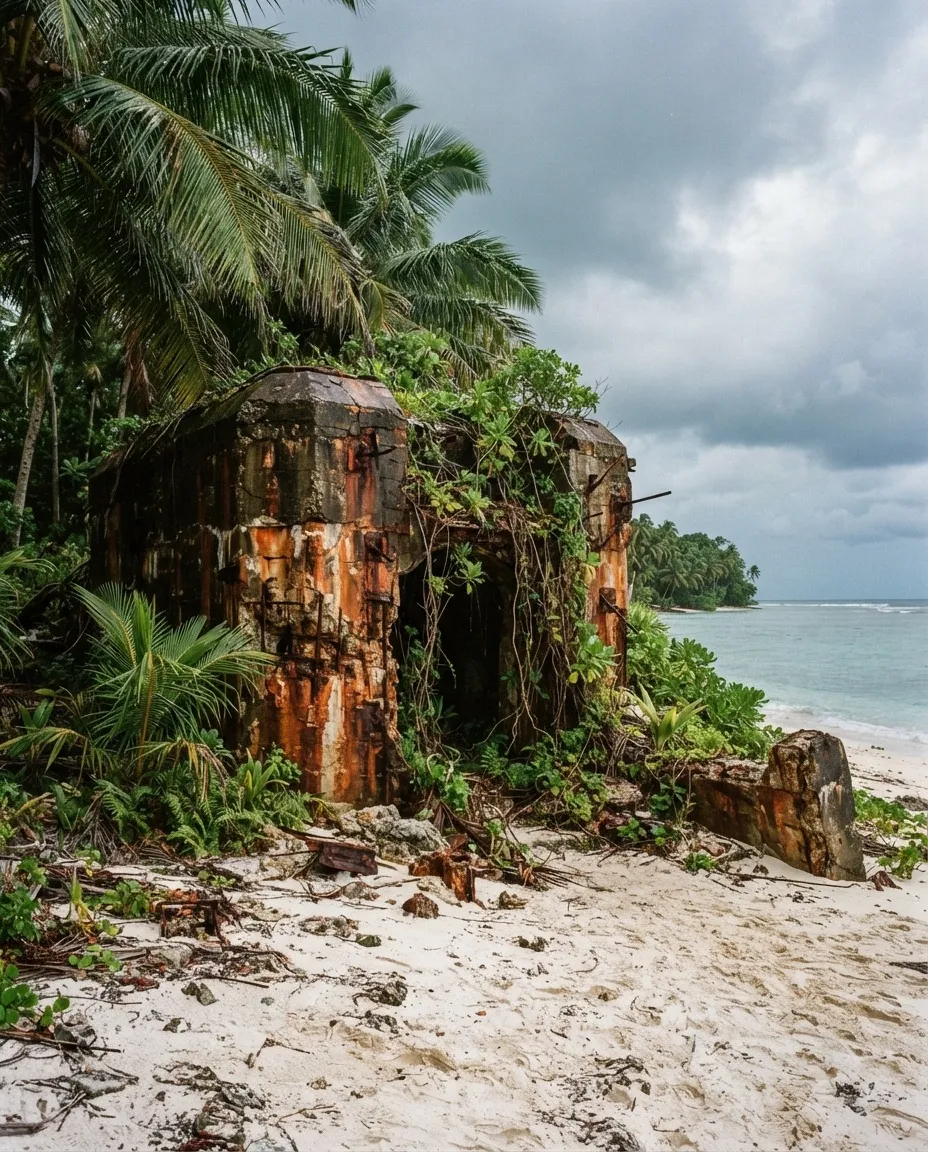
The island is a hard place to live. At about 3 metres above sea level at its highest point, it was covered by ocean waves at least five times between 2011 and 2015, and those floods contaminated all its wells. The grass airstrip turns to mud after rain. In August 2015 the Bikini council asked the US to change the resettlement fund so it could pay for relocating the population outside the Marshall Islands. A 2018 report in Grist quoted a council plan to add seawalls, plant vegetation, raise houses 3 to 4 feet and install solar pumps, and said that another relocation might be needed if those measures failed.
A World Heritage site
UNESCO inscribed “Bikini Atoll Nuclear Test Site” on 3 August 2010, at the 34th session of the World Heritage Committee, under criteria (iv) and (vi). It was the first World Heritage site in the Marshall Islands. The property covers 73,500 hectares, with a buffer zone of 130,425 hectares. UNESCO’s text describes the site as “tangible testimony of the birth of the Cold War” under criterion (iv), and under criterion (vi) as a source of the nuclear disarmament movement and a symbol of the nuclear era. It also states that the tests carried out 7,000 times the force of the Hiroshima bomb. Human presence on the atoll has stayed very limited because of the radionuclides left by the tests. UNESCO’s own review says the management system needs strengthening in areas including visitor reception and interpretation, the Peace Museum and the documentation centre.
Under the lagoon
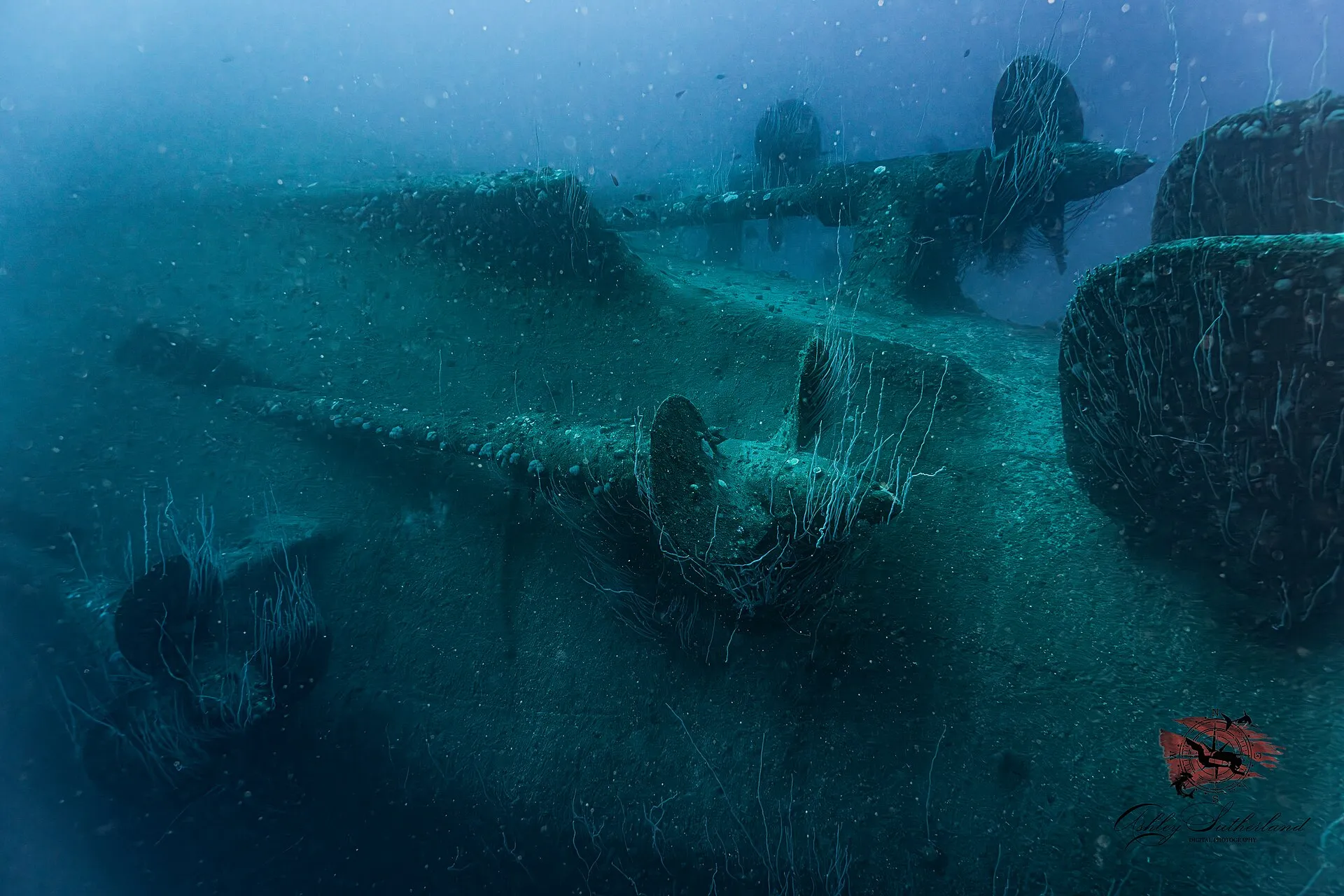
Many of the Crossroads ships are still there. The wrecks include the aircraft carrier Saratoga, the battleship Arkansas, the Japanese battleship Nagato, the Japanese cruiser Sakawa, and destroyers, transports and submarines. Some of the details differ from what is usually said. Saratoga sank after the Baker shock wave opened leaks. Nagato sank five days after Baker. Arkansas capsized because of structural failure of the hull, not because the explosion lifted it vertically, as popular accounts say. Prinz Eugen was too radioactive to repair and sank in December 1946 at Kwajalein, not in the Bikini lagoon.
The wrecks have made Bikini a destination for experienced divers. A liveaboard trip advertised by Master Liveaboards for 14 September 2026, from Kwajalein, runs 11 days with two dives a day, at a price of $5,850 a place plus about $950 in fees, and it lists the Saratoga, Nagato, Arkansas, Lamson, Anderson, Apogon, Carlisle and Pilotfish among the dives. It reports water temperatures of 27 to 29 degrees Celsius and visibility of 30 to 60 metres, and it requires technical diving certification (TDI Advanced Nitrox and Decompression Procedures, PADI Tec 45 or equivalent). Other sources say that tours cost more than US$5,000 and require a diver and two council representatives.
Visiting
There is no public access to Bikini in the normal sense. Four to six caretakers live on the atoll, and the 2020 population was recorded as five. Visits are made on arranged tours, mostly dive trips by liveaboard boat. The sources we checked do not give a permit procedure or the council’s contact details. A visitor would need to book through an operator that has the agreement of the Bikini local government. Officials advise against eating local plants and wildlife, so follow the guides’ instructions.
Conclusion
Bikini Atoll was a home before it was a test site. Its inhabitants were asked to leave for the good of mankind, as they were told, and what they received was a series of moves to places that could not feed them, a return that had to be reversed and a fund that was meant to last. The tests that were fired there shaped the nuclear age, and the name of the atoll became the name of a swimsuit.
What remains is a lagoon full of ships, a crater and a community of about five thousand people who live elsewhere. The disputes in the sources are about numbers, dates and money. What they do not dispute is who bore the cost. Set the figures side by side and the scale is plain: 167 people moved in 1946, 23 devices fired over twelve years, about 77 megatons in total, and roughly 4,880 Bikinians counted in 2013, most of them living on Kili, Majuro and Ejit. UNESCO has now recognised the atoll as a place of global significance, but the people whose home it was are still waiting for the questions about its future to be settled.
Did you know?
- Bikini Atoll has 23 islands, but only about 6 square kilometres of land around a lagoon of about 594 square kilometres.
- The Bikini swimsuit was launched in Paris on 5 July 1946, four days after the first Operation Crossroads shot.
- Castle Bravo yielded about 15 megatons, and the fireball was about 7.2 kilometres across.
- The Bravo crater is about 2,000 metres wide and 76 metres deep.
- The 23 crew of the Japanese fishing boat Lucky Dragon No. 5 were contaminated by Bravo fallout, and Japan received $15.3 million in compensation.
- Wikipedia says the Bikini resettlement fund held $71 million in 2016 and $100,041 in March 2023.
- UNESCO inscribed the atoll as a World Heritage site on 3 August 2010, the first in the Marshall Islands.
- The Crossroads target fleet had 93 ships, and Baker, fired on 25 July 1946, was called "the world's first nuclear disaster" by Glenn Seaborg.
- The battleship Arkansas capsized because of a structural failure of the hull, not because it was lifted by the blast.