A fleet built to be destroyed
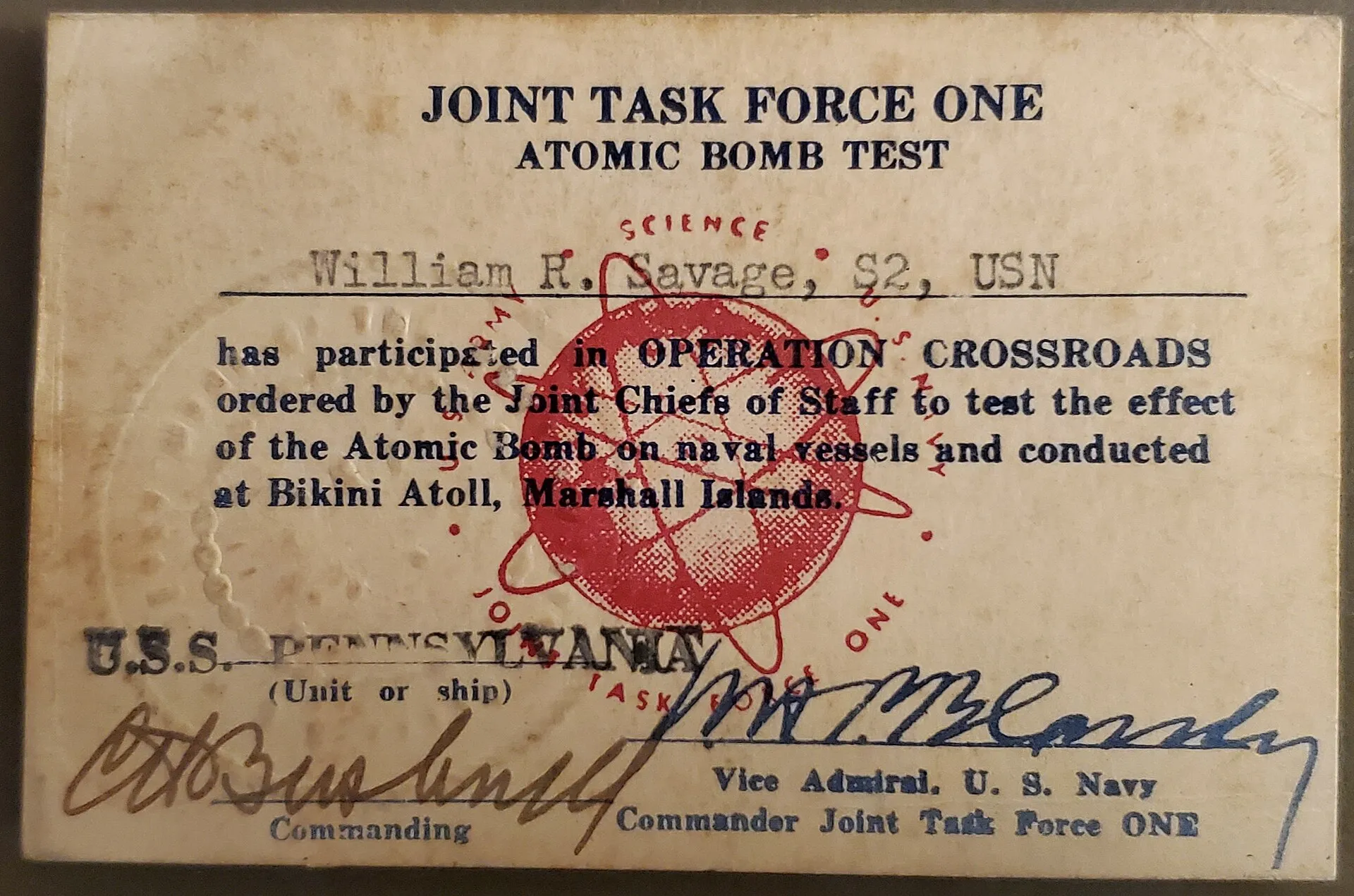
In the summer of 1946, less than a year after Hiroshima and Nagasaki, the United States gathered a fleet in a coral lagoon in the Marshall Islands and set off two atomic bombs over it. The target was not a city. It was more than 90 old, captured and surplus ships, packed together so tightly that a single bomb could be tested against all of them at once.
The operation was called Crossroads. It brought together roughly 42,000 people, a support fleet of more than 150 ships, hundreds of reporters and observers, and thousands of animals, and it was meant to answer a simple question that had split the American military: could a navy survive an atomic bomb?
The answer was messier than anyone wanted. The first bomb missed. The second, exploded underwater, threw a mountain of radioactive water onto the ships and turned the lagoon into a place the Navy could not clean. And on the atoll of Bikini, 167 people who had lived there for generations were told they had to leave.
Why the Navy wanted a test
The idea came early. Lewis Strauss, who later served on the Atomic Energy Commission, proposed a naval test of the new weapon on 16 August 1945, a week after Nagasaki. Senator Brien McMahon backed a test aimed at showing how vulnerable ships were. For the Navy the stakes were institutional as well as technical. If one bomb could sink a fleet, the case for large warships looked weak, and the argument over control of the tests between the Army and the Navy was real.
President Truman set up a civilian review panel to give the tests a look of objectivity. Not everyone was convinced the tests were needed. Scientists and diplomats opposed them, J. Robert Oppenheimer declined to attend, and Secretary of State James Byrnes argued for postponing them. The first date, 15 May, slipped to 1 July. Joint Task Force One ran the operation under Vice Admiral William H. P. Blandy.
The scientific side was uneasy too. A number of nuclear scientists doubted that the second test, with its underwater bomb, had much scientific value, according to Atlas Obscura. The Navy wanted to show that its ships could survive a nuclear attack and that the fleet remained relevant.
Choosing Bikini
Bikini Atoll was picked on 24 January 1946, nine days after the United States took trusteeship of the Pacific islands. It was remote, it had a large sheltered lagoon, and it lay about 4,500 miles west of San Francisco. It also had people living on it.
Bikini was one of 29 atolls and five islands in the Marshalls. Its northern, dry position meant it had seen little of the copra trade that tied the southern atolls to Spanish and German traders, and Bikinian society was close-knit, bound by extended families, with ownership of land measuring wealth. In 1946, 167 people from 11 family lineages lived there under Juda, an alap, or lineage head, whom Americans called King Juda.
“Everything is in the hands of God”
In February 1946 Commodore Ben H. Wyatt, the military governor of the Marshall Islands, met the islanders, according to one account after church, and asked them to leave temporarily so that atomic bombs could be tested, for the good of mankind. The Marshallese language had no words for nuclear weapons, radiation or fallout, and the islanders had no lawyer and no written agreement protecting their rights. They were told they could come home after the tests.
After a confused and sorrowful discussion, Juda announced the decision.
We will go believing that everything is in the hands of God.
King Juda, leader of the Bikini people, 1946
On 7 March 1946 a landing ship carried them about 125 miles east to Rongerik Atoll. Sources give the distance as 125 or 128 miles and name the ship as LST 1108 or LST 861. Rongerik was one-sixth the size of Bikini, uninhabited, and in local belief a bad place linked to an evil spirit. The Navy left supplies for only a few weeks. Within two months Juda was asking to go home.
The target fleet
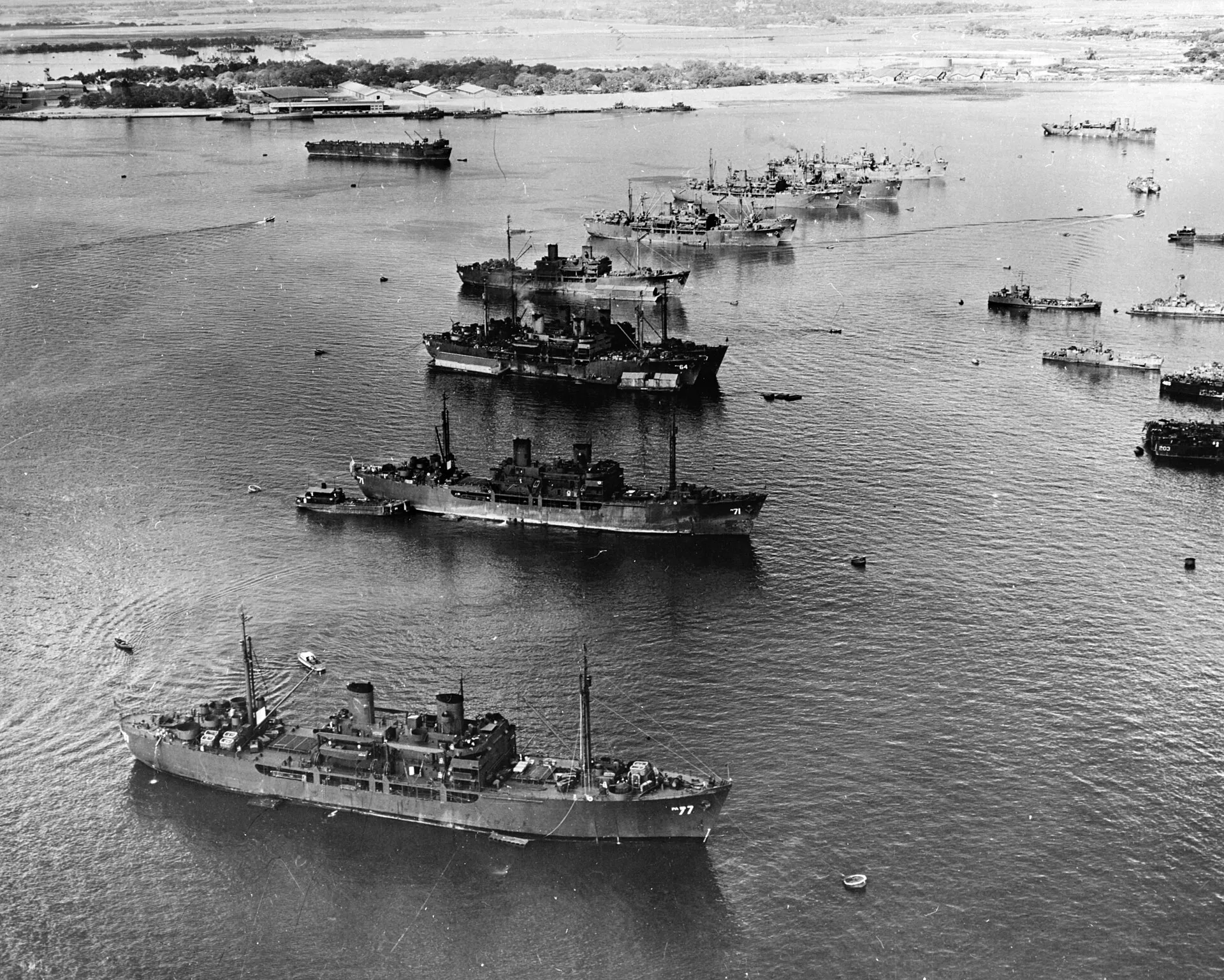
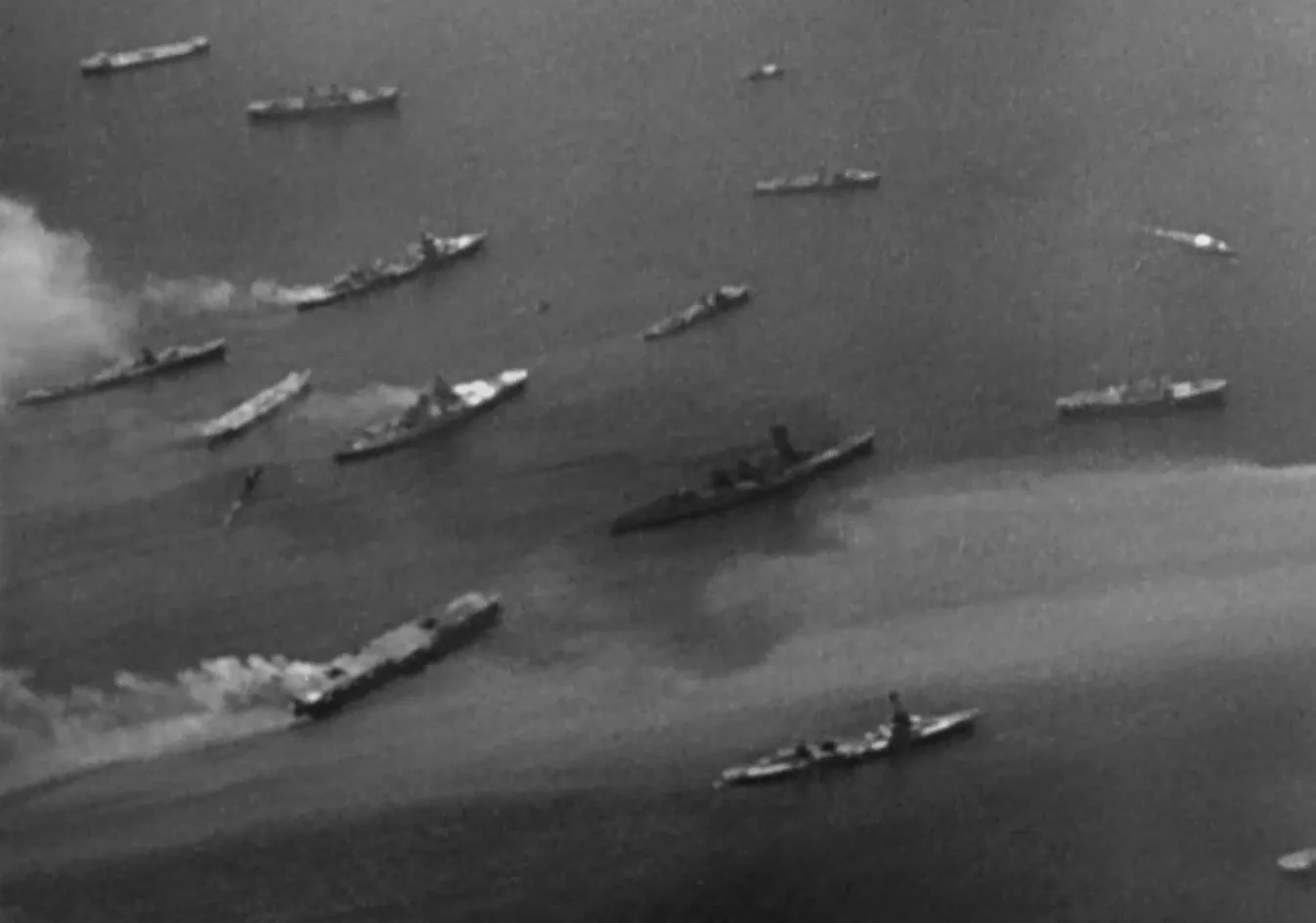
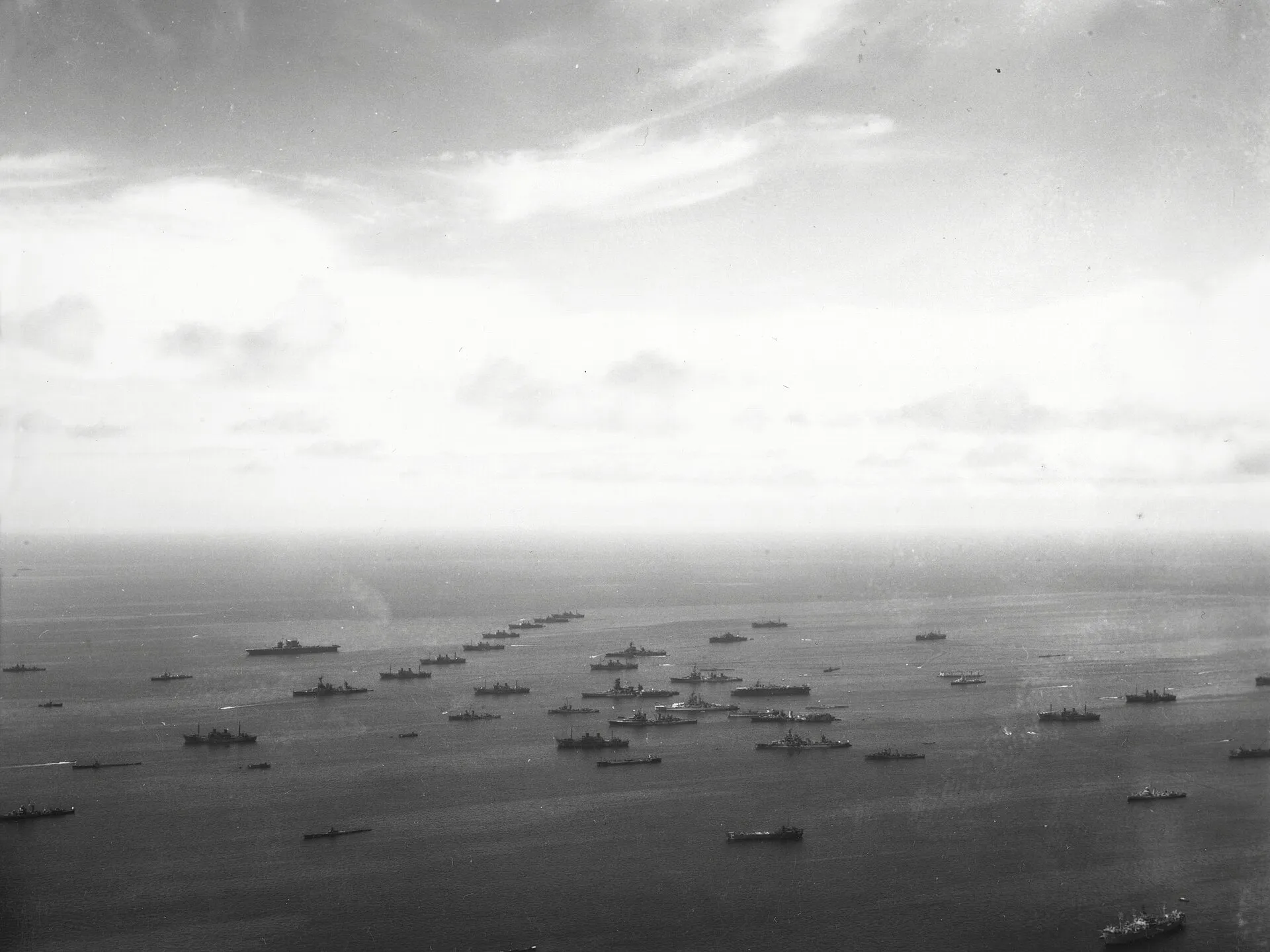
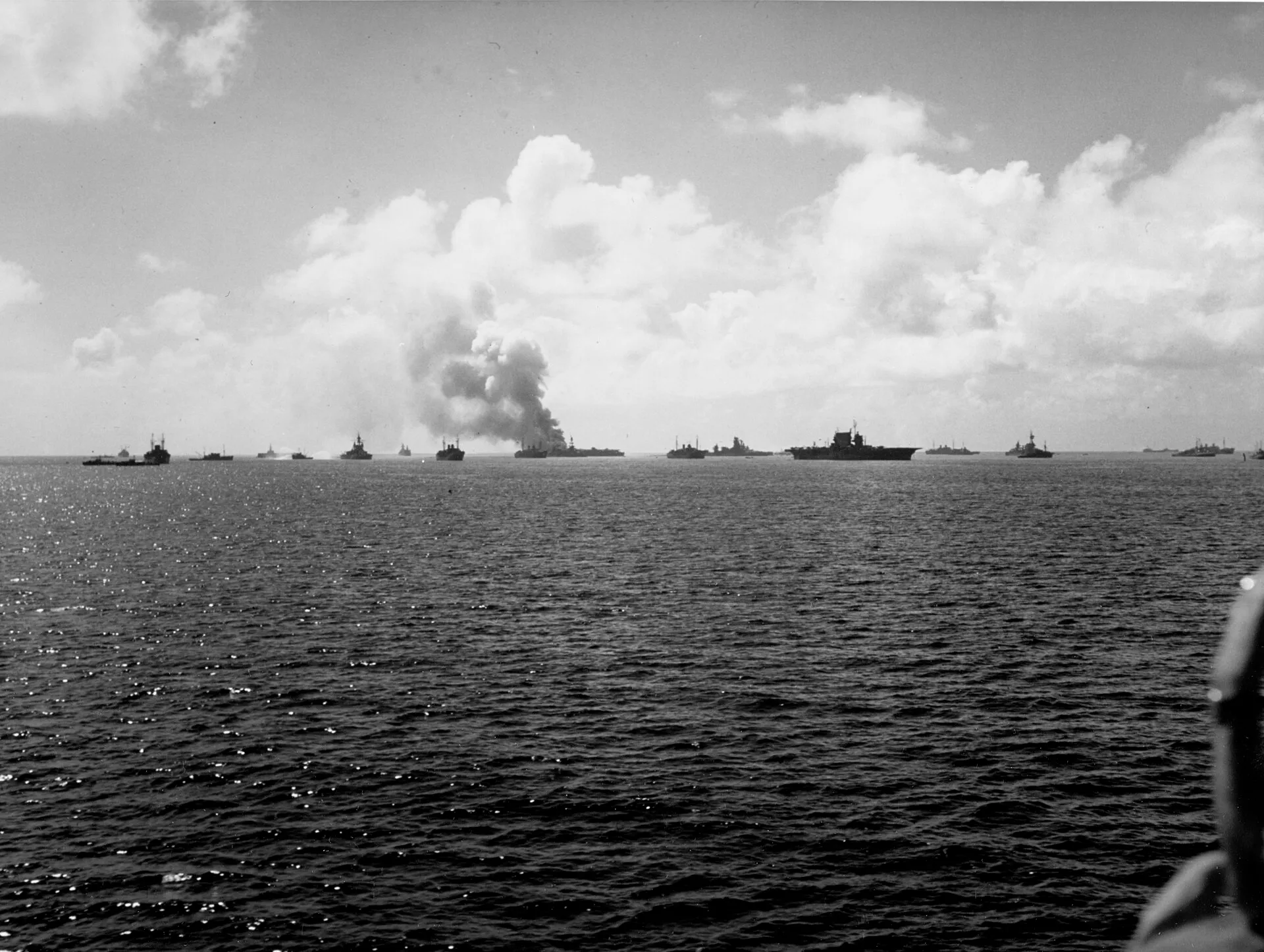
The ships came from many places. The list included four obsolete American battleships, two aircraft carriers, two cruisers, twelve destroyers, eight submarines, dozens of landing ships and transports, and three captured Axis ships: the Japanese battleship Nagato, the Japanese cruiser Sakawa and the German cruiser Prinz Eugen. The count of target ships is given as 71, more than 90, 93 and 95 in different sources, and depends on what is counted as a target. The Navy’s old battleships Nevada, Arkansas, New York and Pennsylvania, and carriers Saratoga and Independence, were among the best known.
The Nagato had a history. The Imperial Japanese Navy’s Pearl Harbor planning had been carried out aboard her, and an article on the 1989 and 1990 archaeological survey describes the captured ships as symbols of American dominance.
The fleet was arranged on purpose. At the centre, the ships lay about 20 to the square mile, three to five times denser than naval doctrine would allow. Crews cleared coral heads from the lagoon with about 100 short tons of dynamite. Congressmen quoted a value of $450 million for the ships, while the Navy’s own estimate of their scrap value was $3.7 million.
People, animals and cameras
About 42,000 people were on the task force, over 37,000 of them Navy, including 37 nurses. Navy personnel could extend their service by a year to take part. There were 114 press observers at the first test, and other accounts count hundreds of reporters, politicians and international observers across the operation.
Animals were placed aboard 22 ships for Able: 57 guinea pigs, 109 mice, 146 pigs, 176 goats and 3,030 rats, according to Wikipedia. About 35 percent died or were put down within three months. For Baker only pigs, goats and rats were used, and all the pigs and most of the rats died.
The test was also a film shoot. Eight B-17 bombers were converted into remote-controlled drones to fly through the cloud. The cameras on and around Bikini took 50,000 still pictures and about 1.5 million feet of motion-picture film, and one camera ran at 1,000 frames a second. One history of the Bikini people says the filming involved 18 tons of equipment and more than half the world’s motion-picture film.
The scale of the operation is given differently by different writers. The US Naval Institute article counts 242 ships, 95 of them atomic targets, 220 tons of test equipment, several thousand test animals and 43,000 military personnel and scientists, at a cost of hundreds of millions of dollars. Wikipedia and the Navy’s fact sheet give about 42,000 people and a support fleet of more than 150 ships, with others based on Eniwetok and Kwajalein.
Able: 1 July 1946
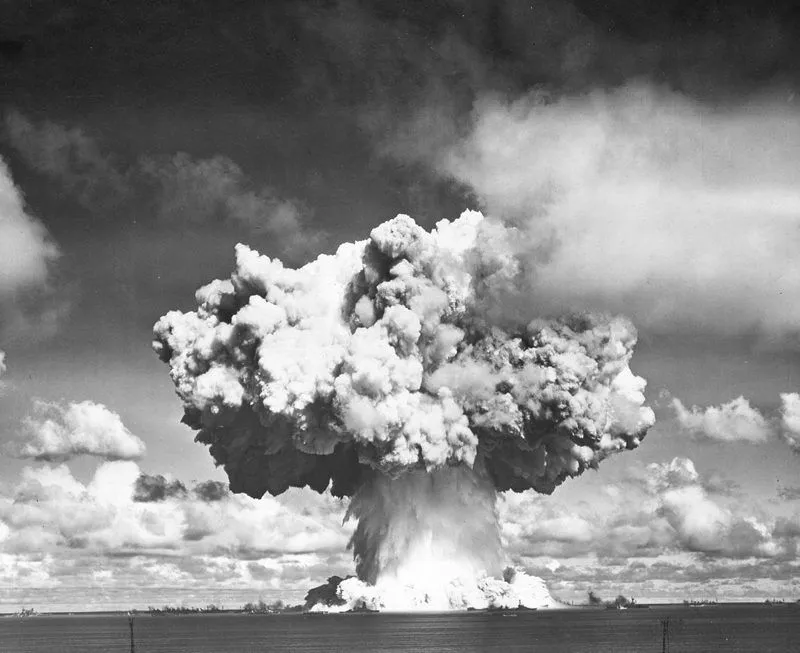
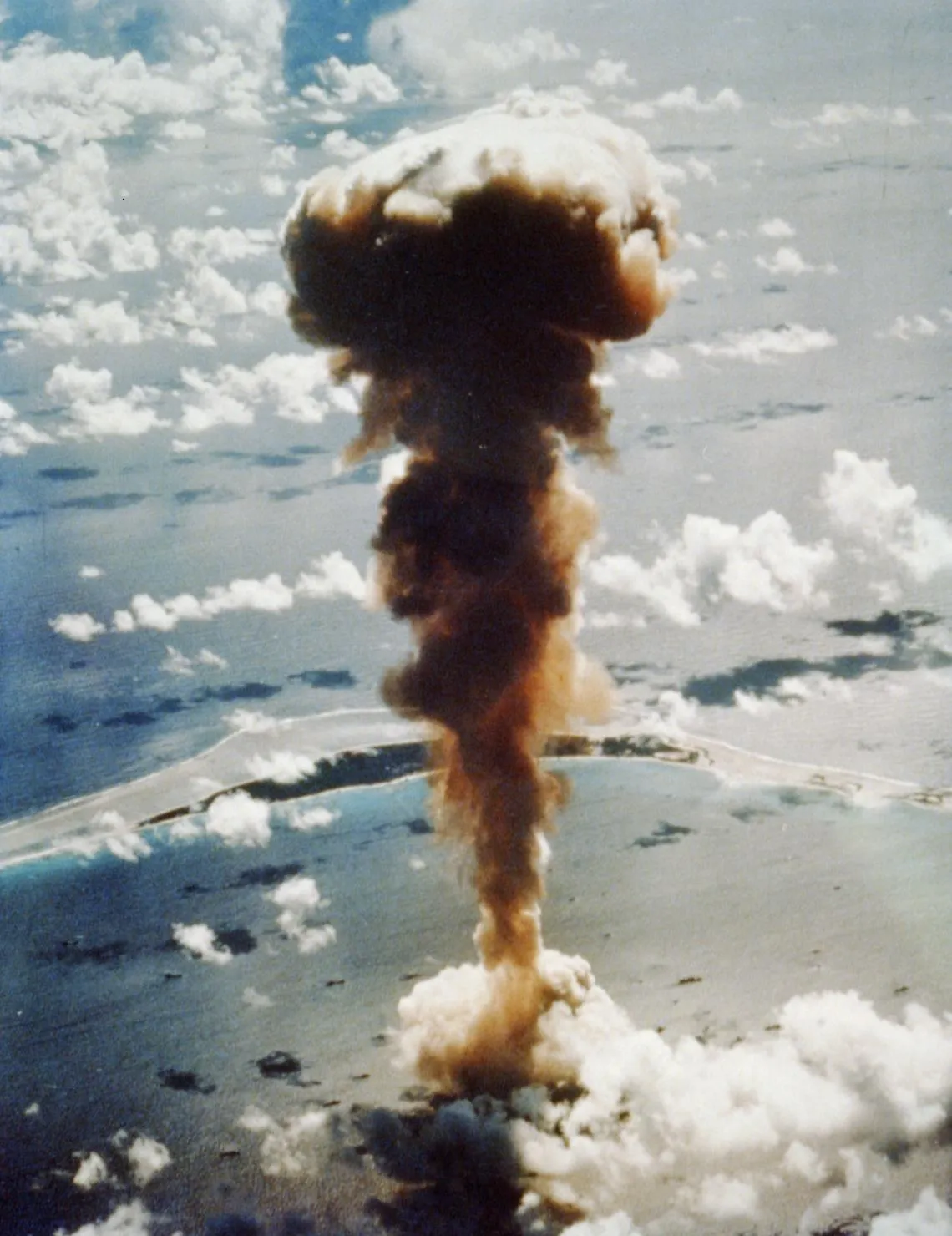
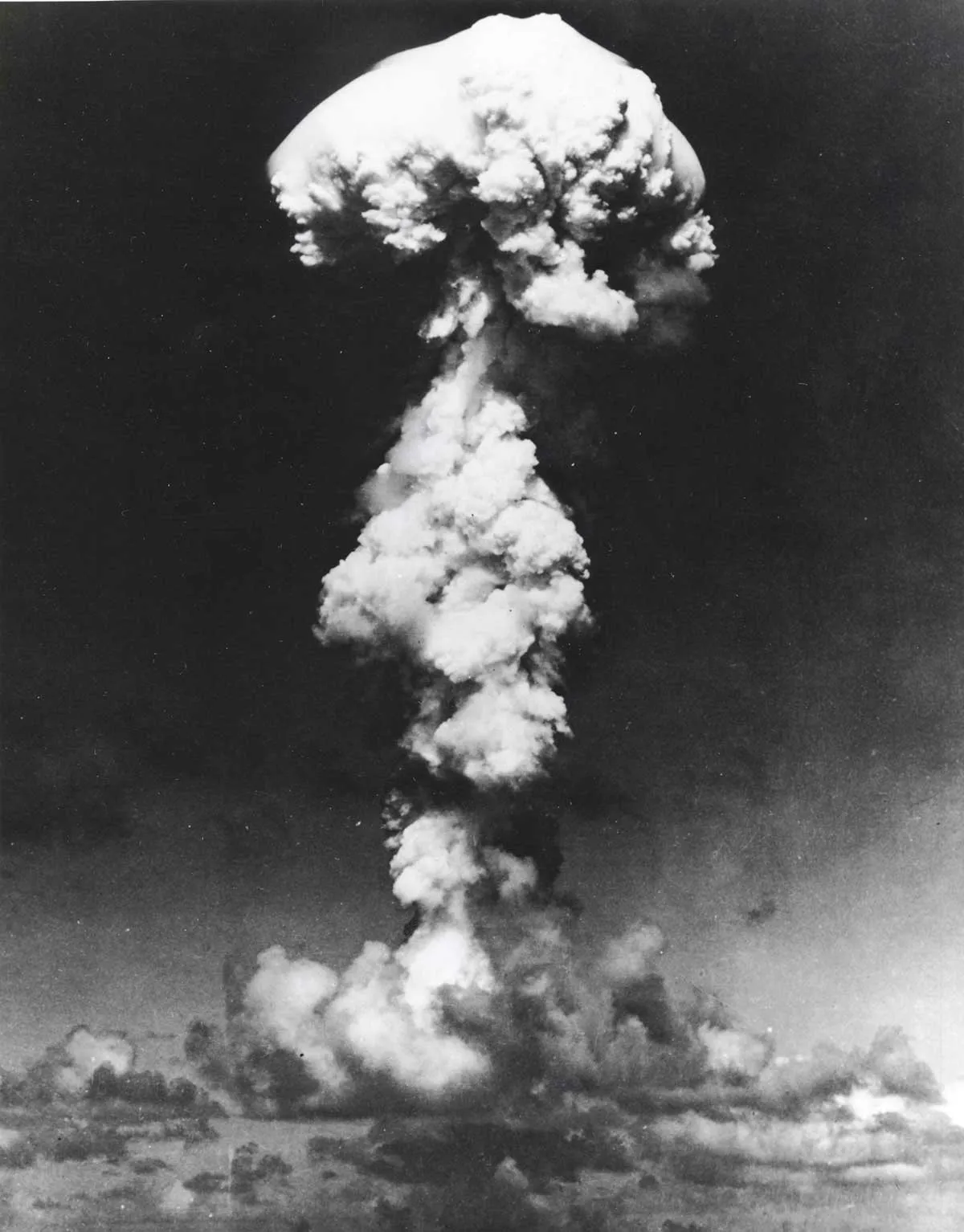
The first bomb was dropped at 9:00 a.m. local time on 1 July, which was 21:00 or 22:00 on 30 June in UTC. It fell from a B-29 named Dave’s Dream, flown by Major Woodrow Swancutt, and it was a Fat Man-type plutonium implosion bomb that crews called Gilda, decorated with a photograph of Rita Hayworth cut from Esquire.
It burst at about 520 feet, with a yield of about 23 kilotons, and the aim was the battleship Nevada, painted bright orange. The bomb missed. The distance is given as 710 yards in one account, as 1,500 to 2,000 feet in the Navy’s own summary, and as 980 feet short and 1,870 feet to the left in another. The cause was never settled. One possible explanation is a collapsed tail fin, and the flight crew was investigated by the government.
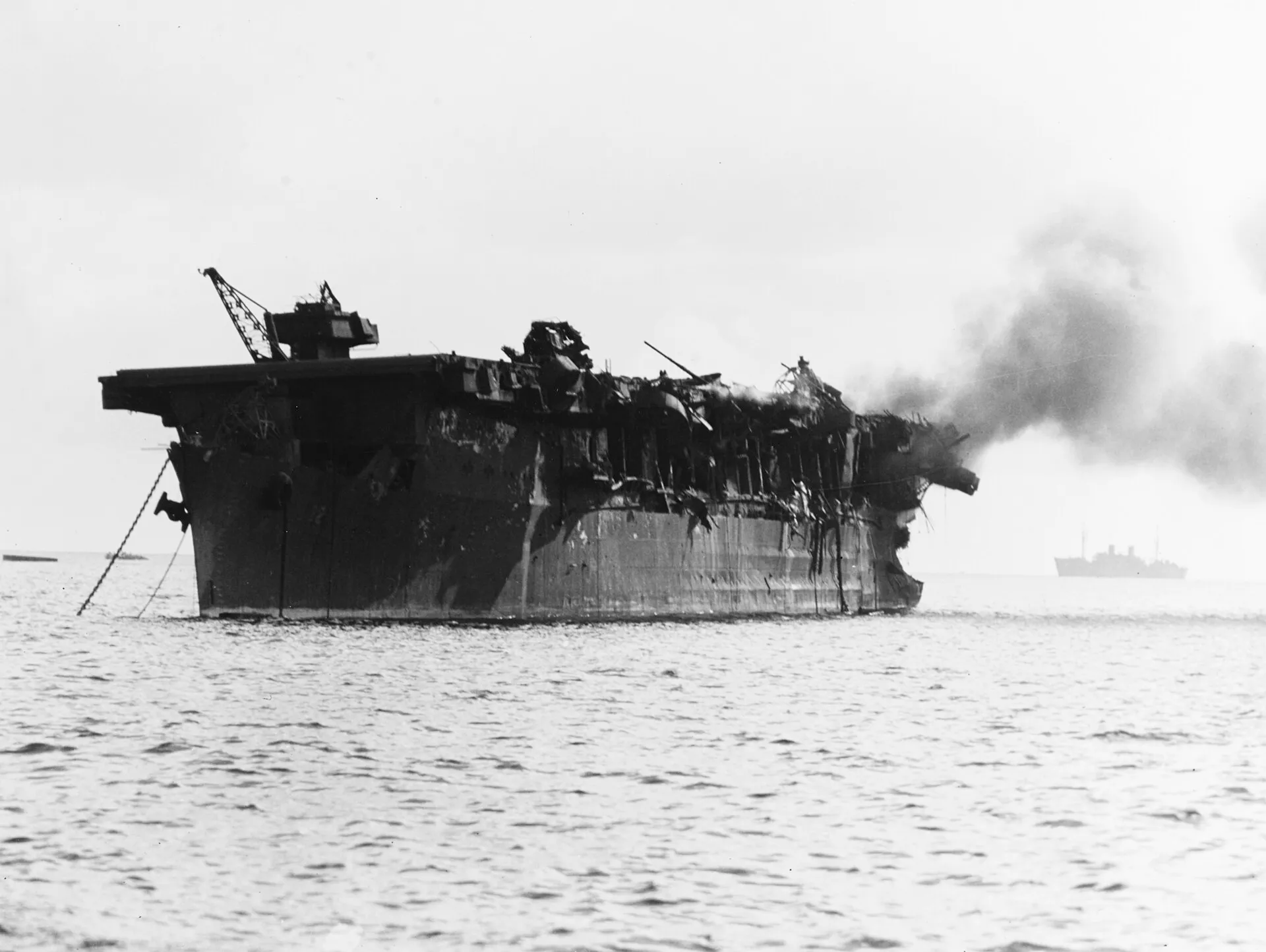
The bomb exploded near the attack transport Gilliam, which sank in 79 seconds. Five ships were sunk in all. They were Gilliam, Sakawa, Carlisle, Anderson and Lamson. Another 14 were seriously damaged. Fires damaged the carrier Saratoga, but she stayed afloat. Radioactivity was a short-term problem, and nearly all the surviving ships were boarded again within a day. Some observers who ignored the protective instructions reported hearing a “poom”.
Baker: 25 July 1946
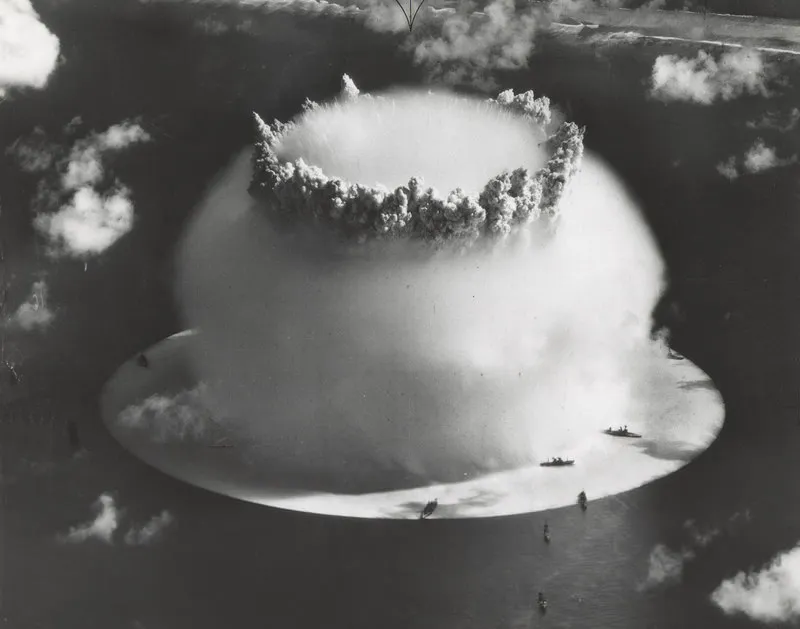
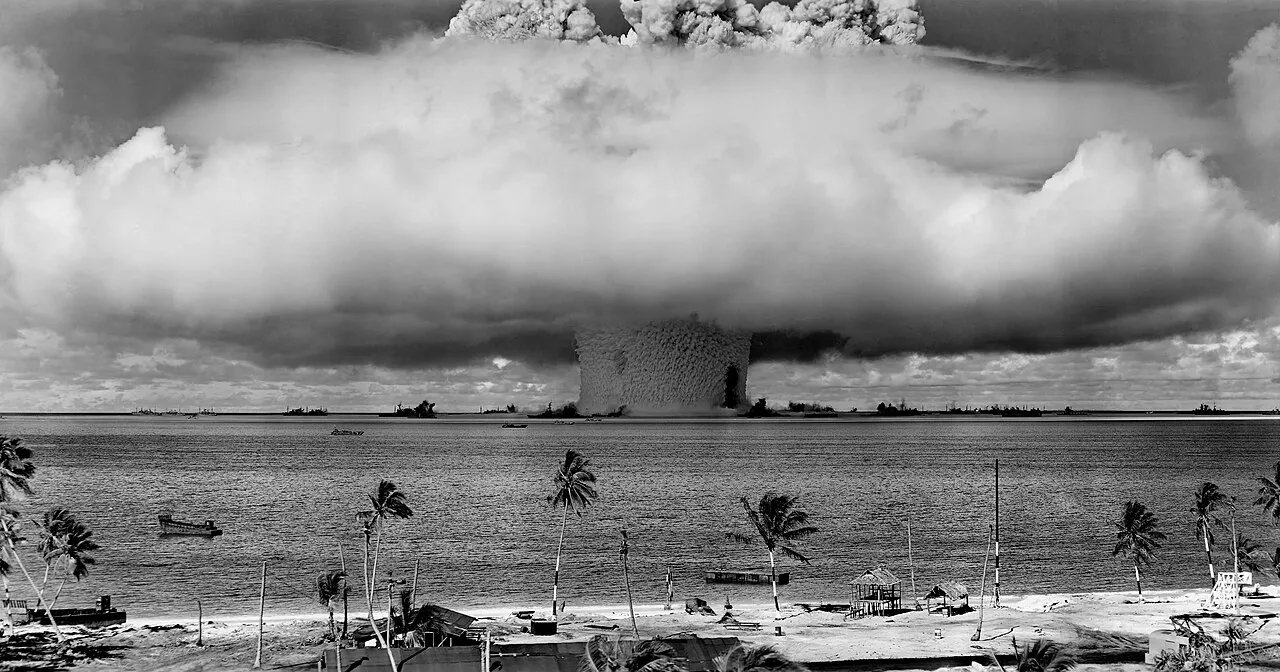
Baker was a different kind of test. The weapon was a second Fat Man-type bomb, known as Helen of Bikini, sealed in a watertight steel caisson and hung beneath the landing craft LSM-60 in the middle of the fleet. It was set off at 8:35 a.m. local time at a depth of 90 feet, in water about 180 feet deep. The yield is given as anything from 20 to 23 kilotons, depending on the source.
The result was unlike anything seen before. A dome of spray burst through the surface at around Mach 2.5, and a column of water rose to roughly 5,000 to 6,000 feet, with walls hundreds of feet thick and a hollow centre. An estimated million to two million tons of water went up, and when it fell back it formed a ring of mist, a base surge, that swept outward across the lagoon at over 60 miles an hour. A huge white condensation cloud, called a Wilson cloud, formed around the column. Waves broke on the beach at Bikini, reaching a height of about 15 feet according to Wikipedia.
LSM-60, directly above the bomb, was vaporised. The battleship Arkansas capsized and sank, the first ship sunk by an atomic bomb, with her hull crushed nearly flat in the account of the archaeological survey. The carrier Saratoga, nearest to the burst, listed and settled and took about seven and a half hours to sink. Others lost were the submarines Apogon and Pilotfish, the dry dock ARDC-13 and the oil barge YO-160. The Japanese battleship Nagato stayed afloat for four days and sank at night, unobserved.
The totals are counted differently across sources. Wikipedia’s table lists nine ships sunk at Baker, while its text and a Navy summary give eight and ten. The Naval History and Heritage Command says eight were sunk and more were damaged than at Able, and an article in the US Naval Institute’s Proceedings says that the two tests together sank 22 ships and irradiated 73 others.
A lagoon that would not wash
The worst effect of Baker only appeared afterwards. Able had been an air burst, and its radioactive products rose with the cloud and dispersed. Baker was an underwater burst, so its fission products and the unfissioned plutonium stayed in the water and fell back on the ships. Wikipedia gives about 3 pounds of fission products and about 10.6 pounds of scattered unfissioned plutonium. Most of the target fleet was contaminated, and for several weeks most ships were too radioactive to stay aboard for more than a short time. The surface of the water at the point of the explosion read a lethal 730 roentgens in the first day, and Bikini Island, about three miles away, could not be safely landed on for a week.
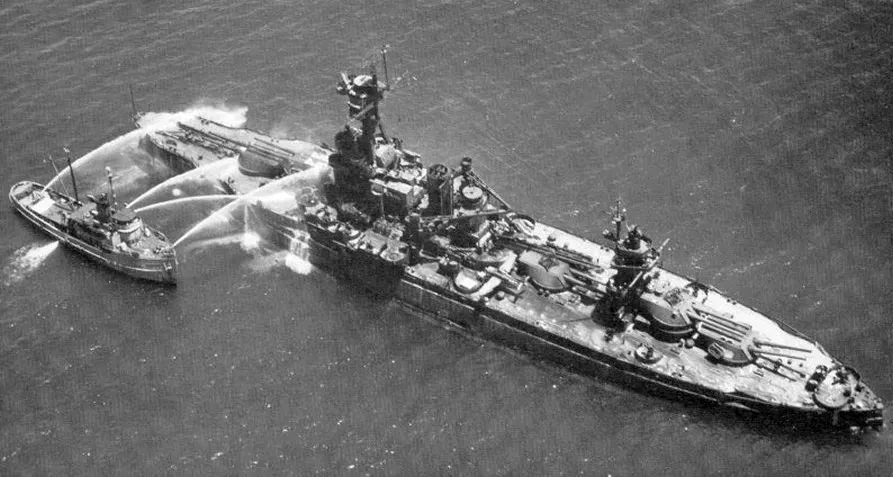
The Navy tried to clean the ships. Crews hosed them down with salt water and foam and scr믭 them by hand with soap and lye. The effort largely failed. According to Wikipedia only sandblasting to bare metal was effective, and thorough treatment would also have meant stripping wood and treating brass and copper with acid, which was not practical for a whole fleet. Rear Admiral Thorvald Solberg, in charge of decontamination, had believed that the ships could be washed and sailed home. Workers hit their daily limits of radiation quickly, contaminated water was carried back to the clean ships, and marine growth on hulls and in seawater pipes concentrated the radiation in the support fleet as well.
The standard that governed the work was 0.1 roentgen a day, the same figure that had been used in the Manhattan Project. Of the 18,875 film badges issued, about 15 percent of the workforce wore one. The highest dose recorded was 3.72 roentgens, received by a radiation safety monitor. Wikipedia counts 67 overdoses between 6 and 9 August.
On 10 August Blandy stopped the decontamination. Plutonium had been found in samples, which the Geiger counters then in use could not detect, and the Army colonel in charge of radiation safety, Stafford Warren, pers귭 the admiral to stop. The surviving target fleet was towed to Kwajalein Atoll, where the water was clean, over the following weeks. The Navy summary says that the contamination of Baker had put the whole operation’s success at risk. The Nobel chemist Glenn Seaborg, according to Wikipedia, called Baker the world’s first nuclear disaster.
The third test that never happened
A third shot, called Charlie, had been planned for early 1947. It was to be an underwater test of depth-charge effects against ships that were not moored. It was cancelled because of the decontamination delays and because the American stock of bombs was small. The official reason given was the success of Able and Baker. Operation Wigwam, off Baja California in 1955, later took over its functions.
Where the ships went
The ships that survived were scattered. Eight major ships and two submarines were towed to the United States and Hawaii for inspection, and twelve lightly contaminated vessels were remanned and sailed home. The rest were sunk off Bikini, off Kwajalein or near Hawaii between 1946 and 1948. Only nine ships were eventually scrapped, according to Wikipedia. The carrier Independence was towed to San Francisco and scuttled off the Farallon Islands on 29 January 1951. The submarine Skipjack was the only sunken ship raised at Bikini. Prinz Eugen survived the tests but was too radioactive to repair, and capsized at Kwajalein on 22 December 1946.
The support ships needed cleaning too, and the work, mainly at Navy yards in San Francisco, took considerable experimentation. A formal resurvey of Bikini was made in summer 1947 to study the long-term effects.
What the Navy took away
The Navy’s own summary reads as a list of problems solved by trial and error. The contamination from Baker made it hard to inspect or clean much of the target fleet, and the service concluded that moving contaminated ships to uncontaminated water was the way to finish the work. The support ships had become contaminated through marine growth on their hulls and their seawater piping, so procedures for decontamination and clearance had to be worked out as the job went on. Eight major ships and two submarines went to the United States and Hawaii for radiological inspection, and the sailors who cleaned the cleared ships at Navy yards learned as they went.
The lasting design change was the countermeasure wash-down system, added to new ships after Baker, a pipe network that sprays the exterior to wash fallout from the deck and hull. It is a modest result for an operation that cost so much, but it came directly from what happened in the lagoon.
What happened to the Bikinians
The islanders’ story ran on for decades. On Rongerik the food ran out. They lived on gruel, the lagoon had few edible fish, and an anthropologist, Leonard Mason, who visited in 1948 found a water ration of a bucket per family per day. A journalist wrote that the people were literally starving. In July 1946 Juda travelled to Bikini with an American delegation to see the results of Baker, and returned to Rongerik to report that the island looked the same.
In March 1948, 184 malnourished islanders were moved to Kwajalein, where they lived in tents beside the airport runway. In November 1948 they moved to Kili, a one-third-square-mile island with no lagoon, a place where waves of 10 to 20 feet often stopped fishing and supply boats. It was their third move in two years. Some called it a prison island.
Bikini itself became a test site for a dozen years. Between 1946 and 1958 the United States set off 23 nuclear devices there, including the 15-megaton Castle Bravo on 1 March 1954, with a combined yield of about 77 megatons. In 1968 President Johnson promised the 540 Bikinians that they could go home. A few families returned in the early 1970s, but scientists found strontium-90 in well water in 1977 and rising caesium-137 in people’s bodies, and 139 to 178 residents, depending on the source, were evacuated again in September 1978.
Money followed. A trust fund of $3 million was set up in 1975 and a resettlement fund of $20 million in 1982. The Compact of Free Association provided $75 million in damages, and in 2001 the Nuclear Claims Tribunal awarded $278 million for loss of use of the land and $251.5 million to restore the atoll. Congress has not funded those awards. By March 2023 the resettlement fund was down to about $100,000. A 1998 expert group advised against permanent resettlement, and today about 5,400 Bikini islanders, according to a 2016 count, live on Kili, Majuro, Ejit, elsewhere in the Marshalls and abroad.
The bikini
On 5 July 1946, four days after Able, the French designer Louis Réard unveiled a new two-piece swimsuit at the Piscine Molitor in Paris and called it the bikini. He hoped it would have an explosive commercial and cultural effect like the tests. Fashion editor Diana Vreeland later called it the atom bomb of fashion. The name outlived the memory of the tests that gave it its meaning.
Veterans and legacy
Tens of thousands of servicemen took part. A study of the veterans in 1996 found mortality 4.6 percent higher than expected by 1992, about 200 extra deaths, equal to about three months of lost life expectancy. Veterans formed the National Association of Atomic Veterans in 1978, and a 1988 law eased the proof needed for radiation-related cancer claims. The Navy added countermeasure wash-down systems to its new ships after Baker. A 1948 book by David Bradley, No Place to Hide, brought the contamination to a wide public.
The wrecks themselves have become a heritage site. The National Park Service and the Navy surveyed 11 vessels in 1989 and 1990, the first major archaeological study of a nuclear test site, and found negligible residual radiation. UNESCO listed Bikini Atoll Nuclear Test Site as a World Heritage Site on 3 August 2010, the first in the Marshall Islands, citing it as an outstanding example of a nuclear test site and a symbol of the nuclear age. Divers can now visit the Saratoga and the Nagato on trips run by the Bikini Council. The numbers are small, fewer than a dozen divers a week, and the cost runs above $5,000.
Conclusion
Crossroads was meant to settle an argument about warships. It settled a different one. An atomic bomb could be made to do what its designers wanted only some of the time, a bomb could miss by hundreds of yards, and the real danger was not the blast but what the blast left behind. The Navy that had arranged the fleet so carefully spent the rest of the summer failing to clean it.
The people who paid most were not on the ships. The Bikinians left for what they were told would be a short time, in a language that had no word for what was about to happen to their home. Their descendants now number several thousand and almost none of them live on the atoll, and the lagoon where the fleet went down is now a dive site and a World Heritage listing.
Did you know?
- The Able bomb was decorated with a photograph of Rita Hayworth and nicknamed Gilda.
- The Able bomb missed its aim point, the battleship Nevada, which had been painted bright orange to be seen.
- The attack transport Gilliam sank in about 79 seconds after the Able burst.
- The Baker bomb was hung beneath a landing craft, LSM-60, which was vaporised.
- The battleship Arkansas was the first ship sunk by an atomic bomb.
- Eight B-17 bombers were converted into remote-controlled drones to fly through the Crossroads clouds.
- The test generated about 50,000 still photographs and about 1.5 million feet of motion-picture film.
- The French swimsuit called the bikini was unveiled on 5 July 1946, four days after Able.
- Bikini Atoll became the first World Heritage Site in the Marshall Islands on 3 August 2010.