The city that was not first
Nagasaki was never the first choice for anything on 9 August 1945. The primary target that morning was Kokura, a city on the northern tip of Kyushu with a large army arsenal. Nagasaki was the second name on the list, and it had only been on the list since 25 July, when it replaced Kyoto. This post picks up where the Hiroshima post stops: three days after the first bomb, with the second. The decision to use a bomb at all, the Hiroshima mission and the first atomic city’s story are told there and are not repeated here.
What follows is the story of a port with a long, odd history, a mission that went wrong in almost every way, a bomb that fell in the wrong place, and a Japanese government that argued through the same hours without agreeing. It also covers the people who lived on in the valley, because Nagasaki’s legacy has a character of its own.
A harbour town and its hidden Christians
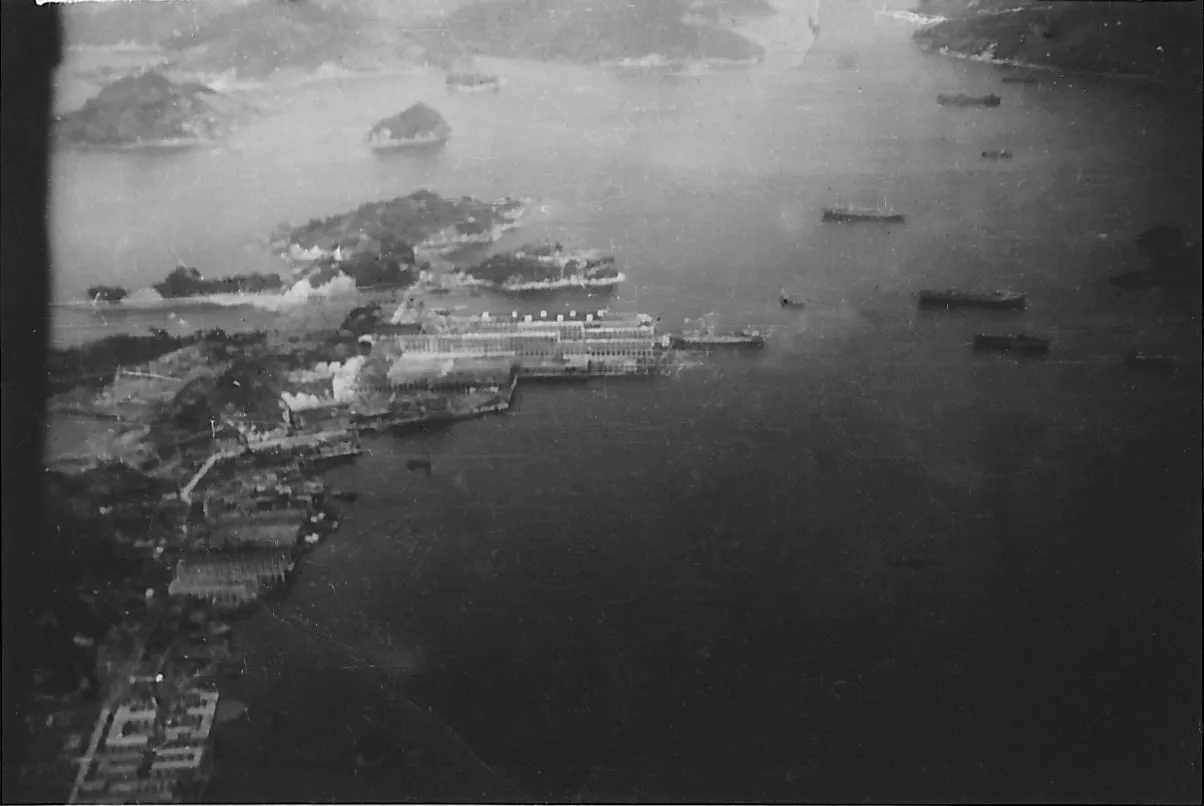
Nagasaki sits at the head of a deep, narrow harbour on the west coast of Kyushu, ringed by hills. For more than two centuries, while Japan was largely closed to the outside world, it was the one place where foreign trade was allowed: Dutch merchants on the artificial island of Dejima, and Chinese traders in their own quarter. By 1945 it was a major port with shipyards, steelworks and munitions plants. The Mitsubishi shipyards, electrical shipyards, arms plant and steel and arms works together employed about 90 percent of the city’s workforce and made up about 90 percent of its industry.
It was also the centre of Japanese Christianity, and that matters for what happened. The Urakami valley, north of the harbour, was home to families who had kept their faith in secret for generations after Christianity was banned. In 1865 a French priest, Bernard Petitjean, found that almost all the villagers there were Christian. The ban was still in force, and the newly revealed community was persecuted. From 1869 to 1873 the new Meiji government exiled more than 3,600 of the villagers, and about 650 of them died in exile. They returned in 1873.
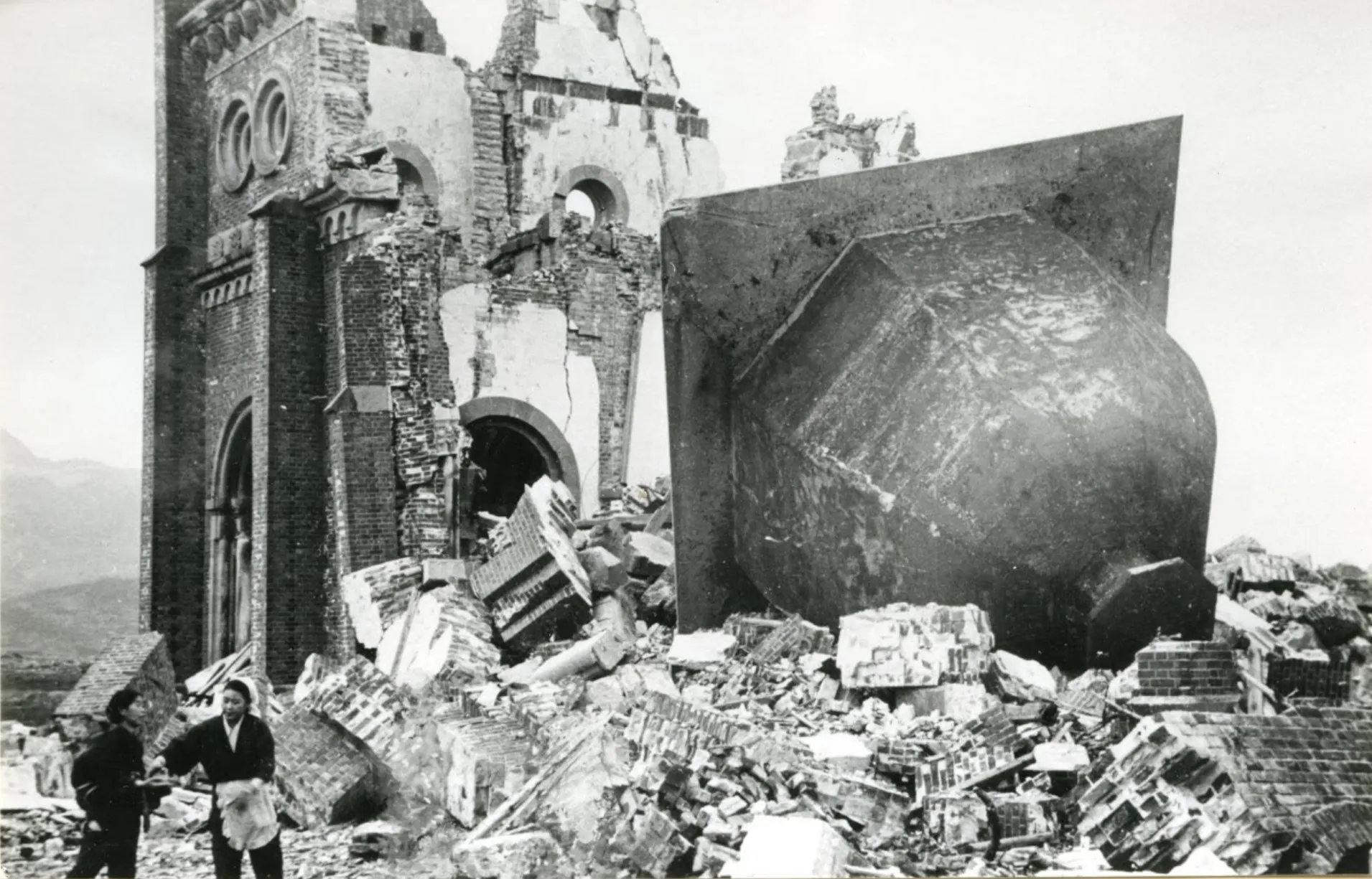
They then did something remarkable. On the land of the village chief, where for about two centuries the authorities had held the annual interrogation in which people were made to tread on images of Christ, they built a church. Work on the brick cathedral began in 1895 and finished in 1925, and at the time it was the largest Christian church in Asia. It stood in the valley not far from where the bomb would fall.
The city had been bombed lightly five times before August 1945, but not seriously, and it was not firebombed. Part of the reason was geographical: the hills and the harbour made it hard to pick out on radar at night. Its people had no particular reason to expect what came.
The Soviet card
The second bomb fell in the middle of a chain of events that Hiroshima’s post leaves out, and which matters for Nagasaki’s place in history. The Japanese government had been looking for a way out of the war on terms short of unconditional surrender, and its hope was that the Soviet Union, with which it still had a neutrality pact, would mediate. Moscow had been giving no answer.
On 8 August, at 5 p.m. Moscow time, Foreign Minister Vyacheslav Molotov told the Japanese ambassador, Naotake Sato, that the Soviet Union considered itself at war with Japan. The time was 11 p.m. in the Trans-Baikal region, and one minute after midnight on 9 August, Soviet forces attacked in Manchuria on three fronts at once. The Soviet Far East Command had about 1.5 million men, more than 5,500 tanks and self-propelled guns and over 3,700 aircraft against roughly 665,000 Japanese soldiers and sailors in Manchuria, and the Japanese were largely caught by surprise. The commanders of the Kwantung Army were away from their forces for the first hours, and communication with forward units was poor.
So the hours of 9 August were, in Tokyo, the hours of two shocks, not one. Historians still argue about their relative weight, and the argument is one of the longest in the study of the war’s end. Some say the Soviet entry ended any hope of Moscow acting as a mediator and so did more to force the surrender than the bombs. Others say the bombs mattered more. The evidence has not settled it, and the document trail does not point to one cause alone.
Bockscar
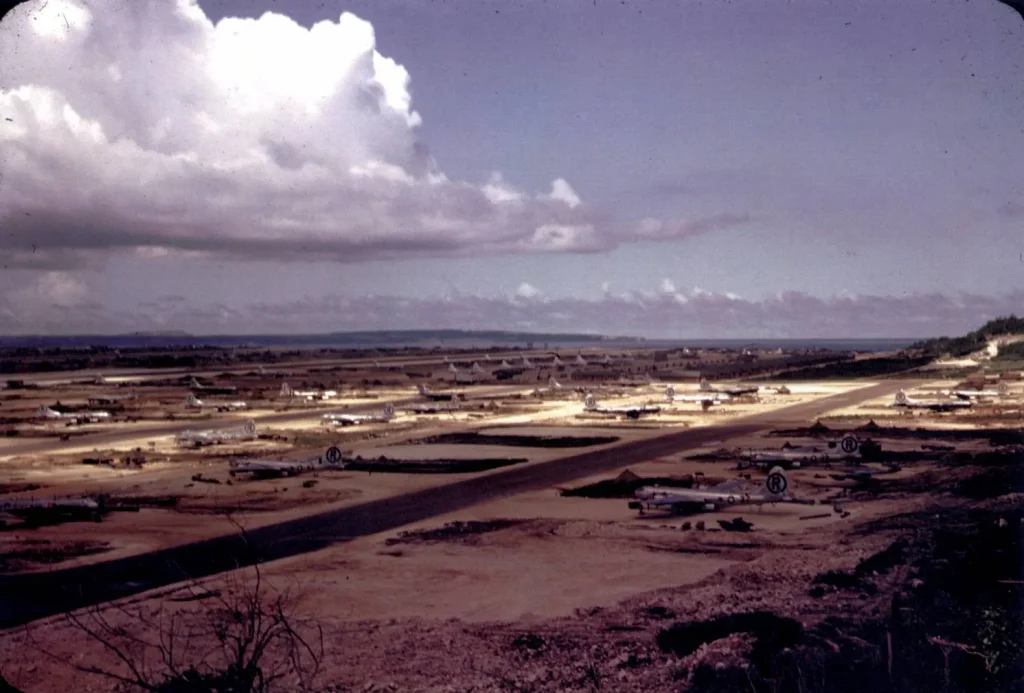
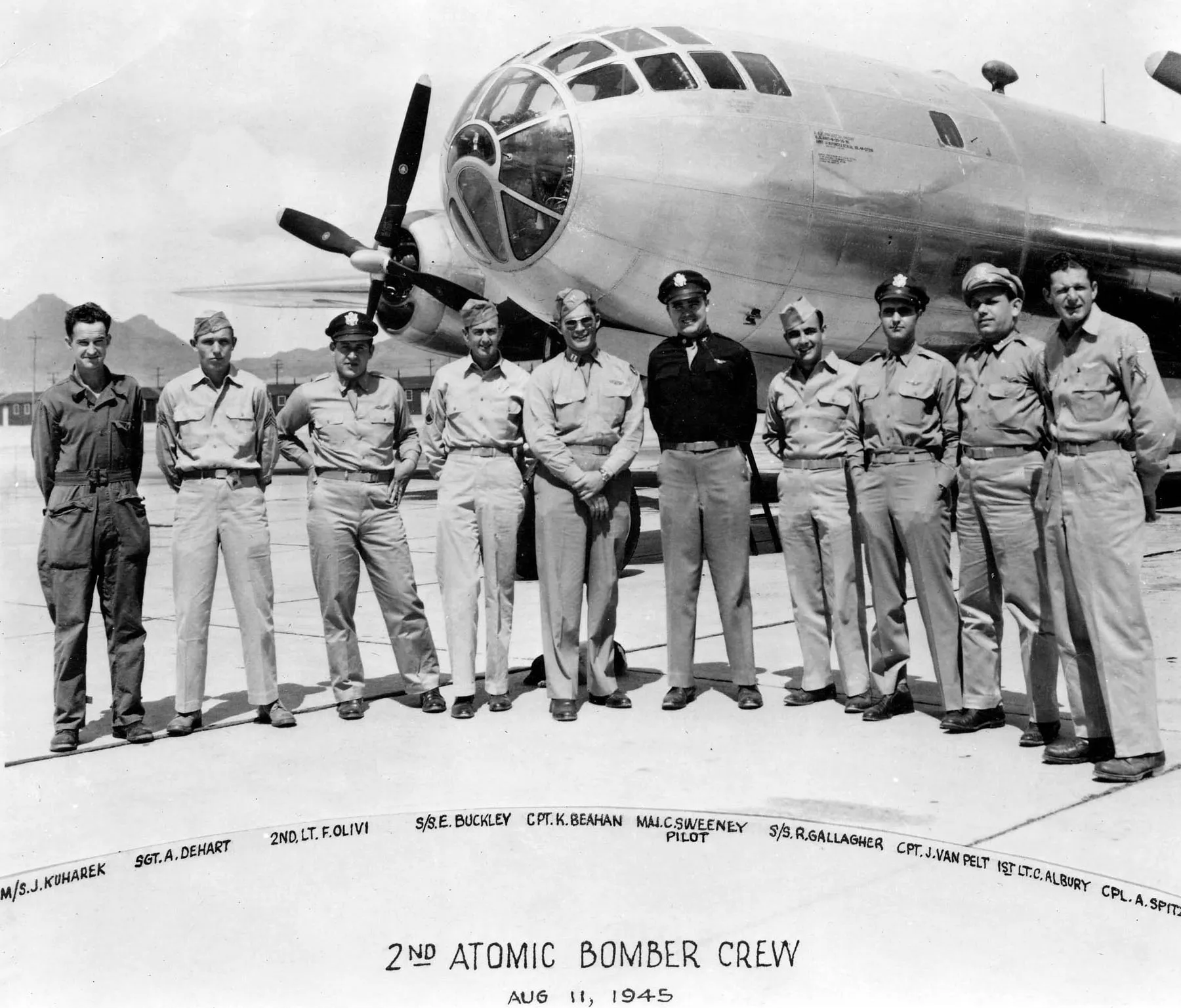
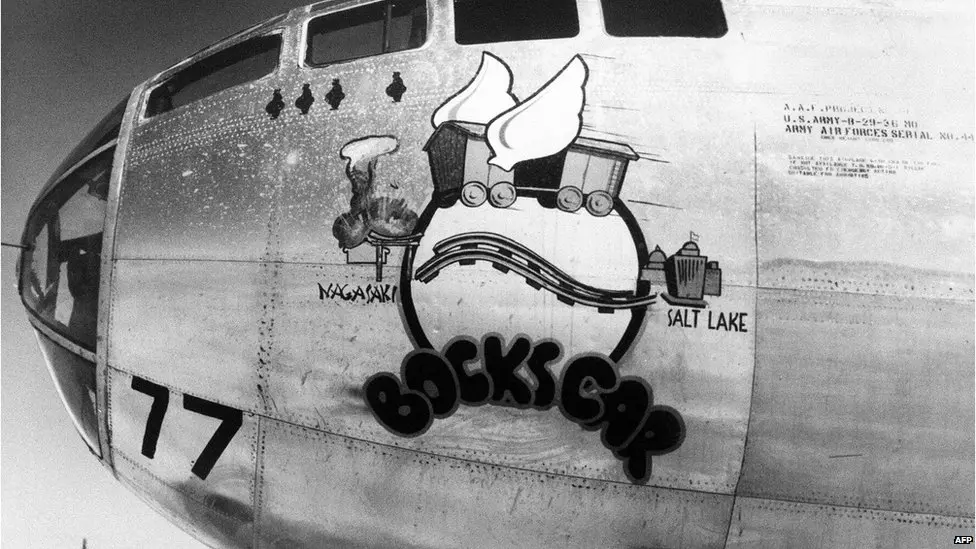
The aircraft assigned to the second mission was a B-29 named Bockscar, flown that day by Major Charles Sweeney, who normally flew The Great Artiste. The two crews had swapped aircraft so that the instruments could be carried in the aircraft Sweeney knew best. The names cause confusion even in 1945: William Laurence of The New York Times, who flew in another aircraft, reported that Sweeney was in The Great Artiste and gave the number 77, which was in fact Bockscar‘s. The Great Artiste, number 89, was flown that day by Captain Frederick Bock.
Besides Sweeney, the crew included Captain Charles Donald Albury as co-pilot, Captain James Van Pelt as navigator and Captain Kermit Beahan as bombardier. Commander Frederick Ashworth of the Navy was weaponeer and in charge of the bomb, with Lieutenant Philip Barnes as his assistant. Lieutenant Jacob Beser, who had also flown to Hiroshima, monitored Japanese radio.
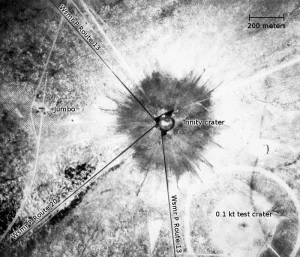
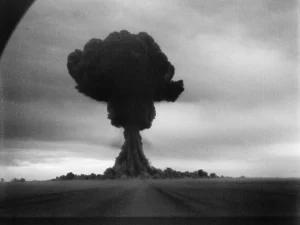
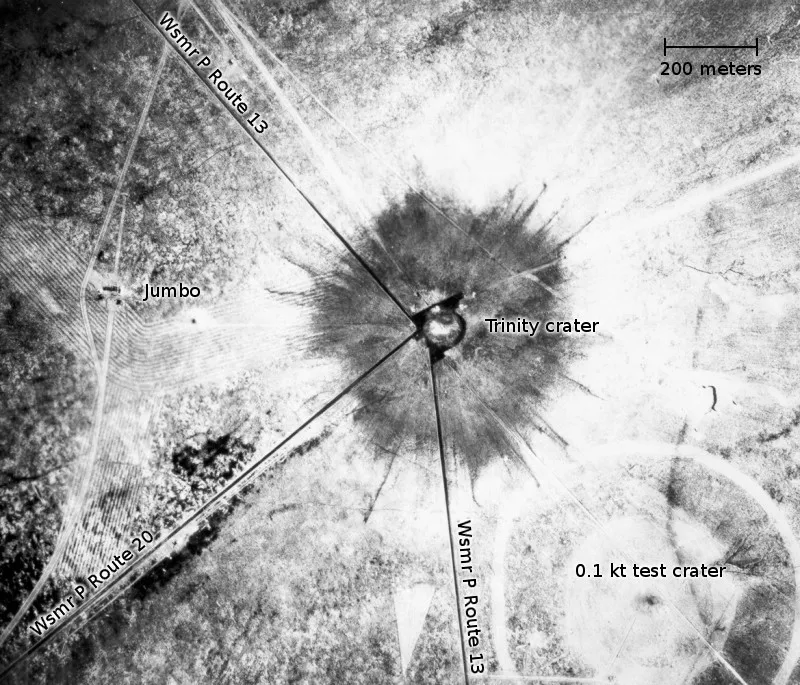
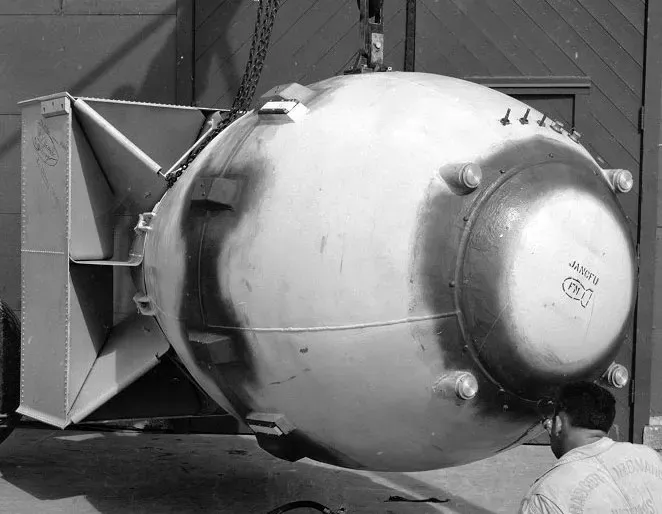
The bomb was Fat Man, the plutonium implosion weapon of the kind exploded at Trinity, built around a core of about 5 kilograms of plutonium. Its design is covered in the Trinity Test post. The second bomb was not a refinement of the first. It was a different weapon.
Trouble started before the aircraft left the ground. A fuel transfer pump had failed, which meant that about 640 US gallons of fuel in a reserve tank could not be used, though the aircraft still had to carry it. Swapping the pump or moving the bomb to another aircraft would have taken too long and been risky, so Sweeney and Tibbets, who was at Tinian, decided to go ahead. Bad weather also moved the rendezvous point from Iwo Jima to Yakushima, an island off southern Japan, and the aircraft climbed to a higher cruising altitude than planned, which burned more fuel.
The three aircraft left Tinian at 03:47 local time. At Yakushima, the third aircraft, Big Stink, flown by Major James Hopkins, never joined up. Sweeney had been ordered to wait no more than 15 minutes. He waited about 40, and Ashworth had to urge him to go on.
Three passes over Kokura
Over Kokura the crew found 70 percent of the target covered by cloud and smoke. Part of it was haze from the previous day’s firebombing of nearby Yahata, and part was smoke from coal tar that workers at the Yahata steelworks had been burning. The orders were to bomb visually, and Beahan could not see the aiming point.
Sweeney made three runs over about 50 minutes. Anti-aircraft fire grew closer on each pass. The fuel gauge was dropping. After the third pass Sweeney and Ashworth agreed to try the secondary target. Ashworth said that, if Nagasaki was covered too, he would accept a radar approach, a departure from the visual-only orders. The fuel calculation showed that the aircraft could no longer reach Iwo Jima after the drop and would have to land on Okinawa.
The people of Kokura never knew. What is documented is that Kokura was saved by weather and smoke, and that the crew turned and flew on towards another city.
11:02
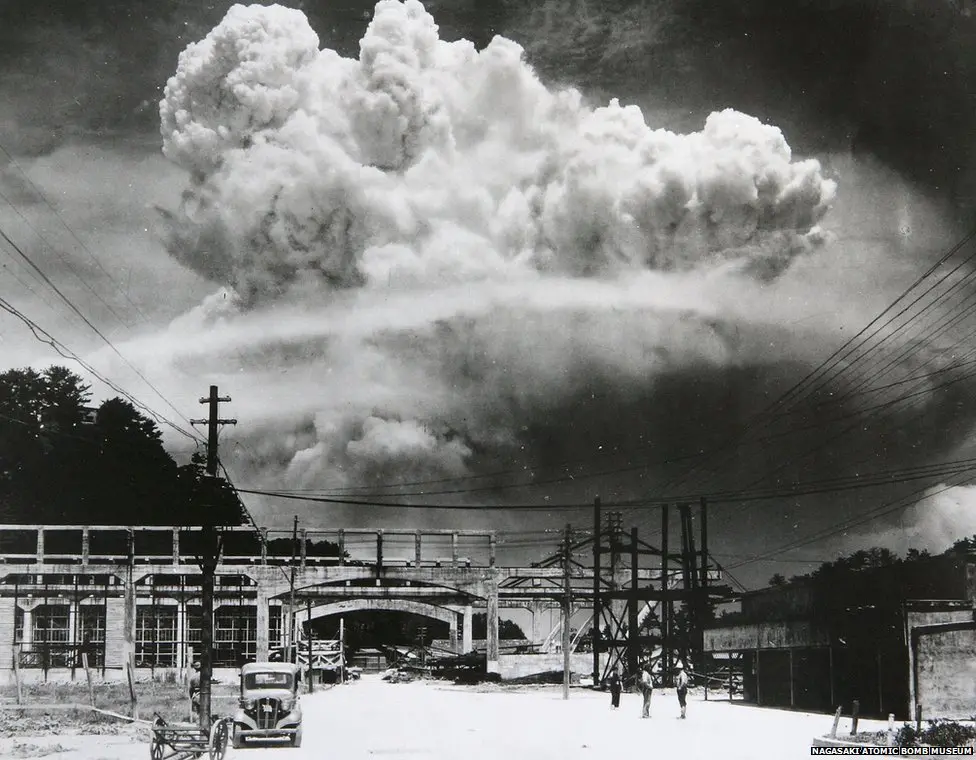
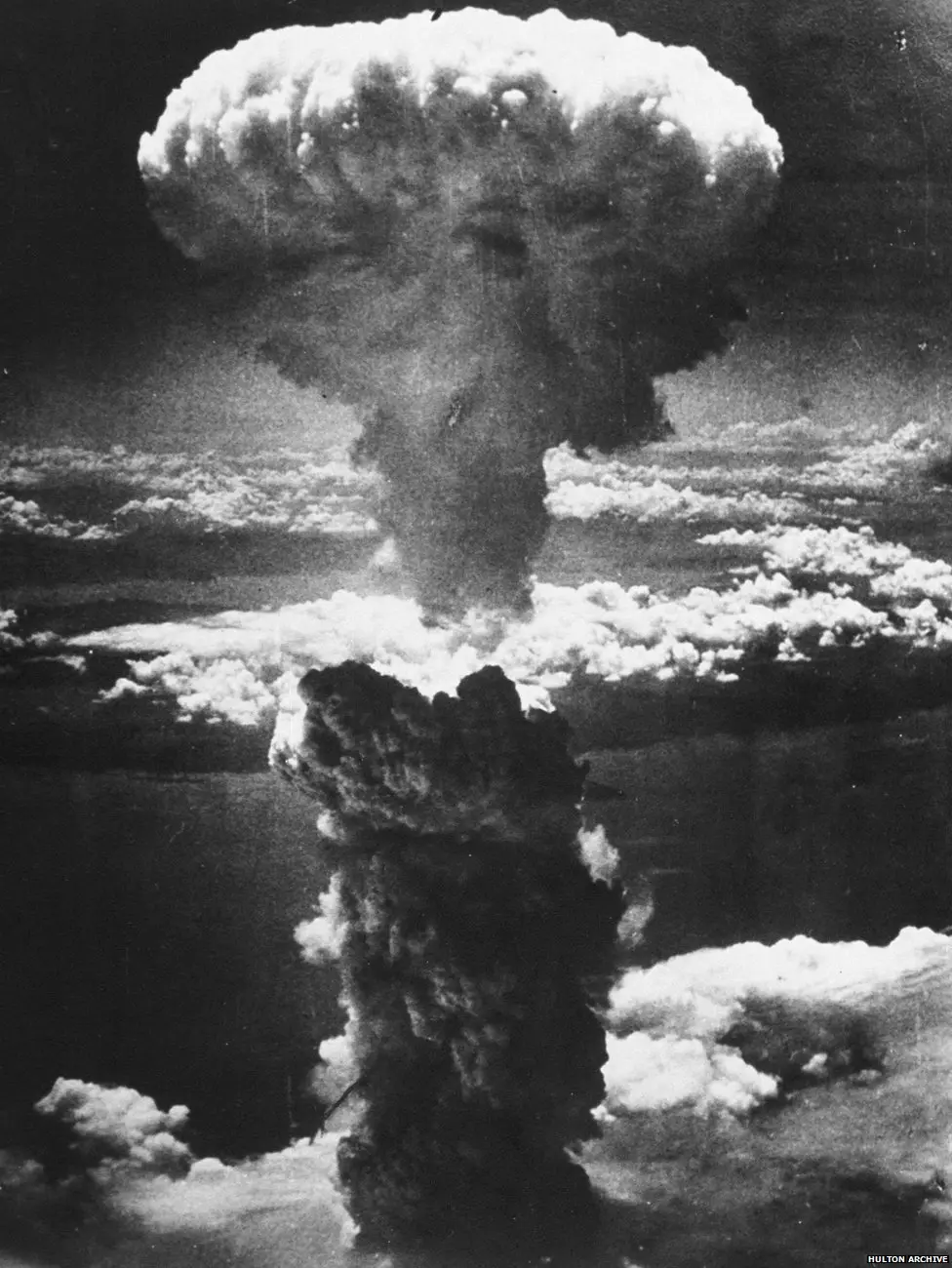
Nagasaki was partly under cloud too. On the first run, Beahan saw nothing. Then a gap opened, and he picked out landmarks and released the bomb visually. Accounts differ on the time of release, 10:58 by one and 11:01 by another, and the explosion was at 11:02 local time. Fat Man fell for 43 to 47 seconds and burst at about 503 metres (1,650 feet), with a yield of about 21 kilotons.
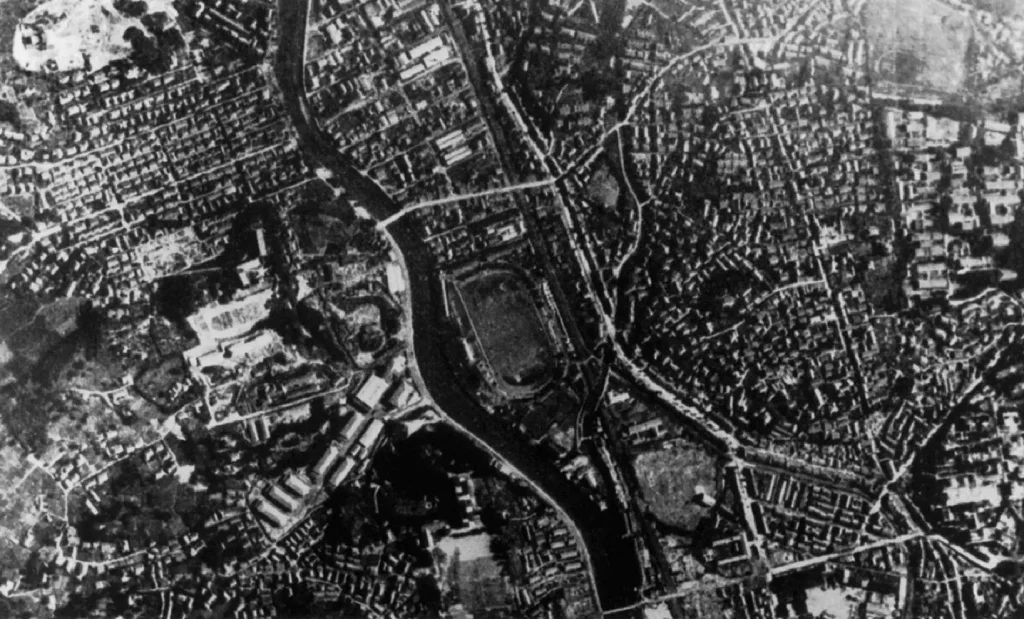
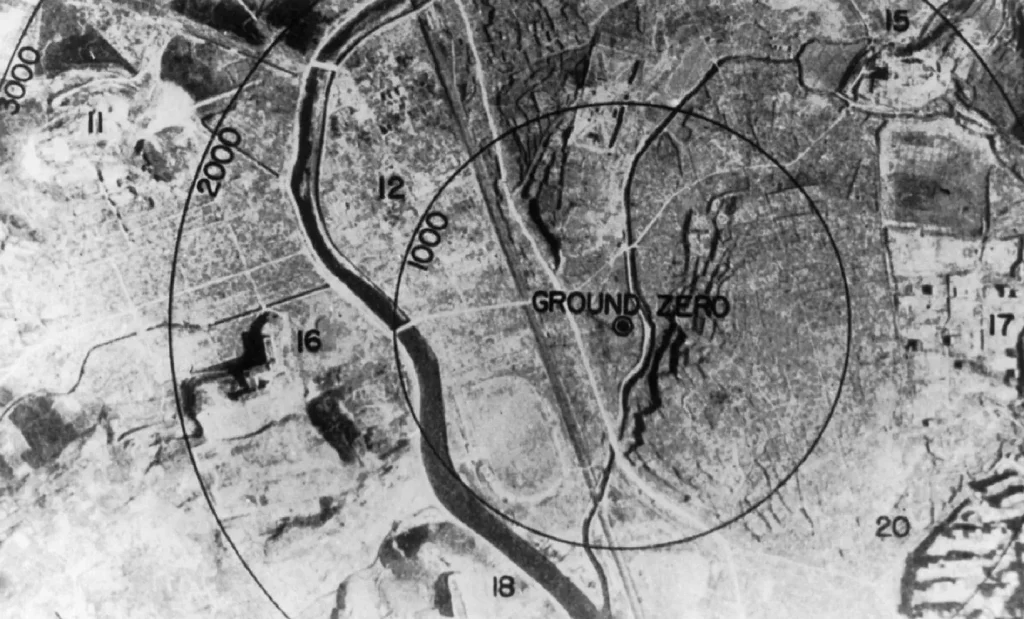
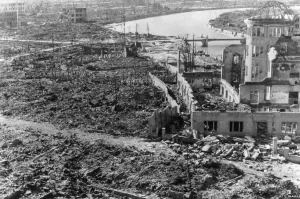
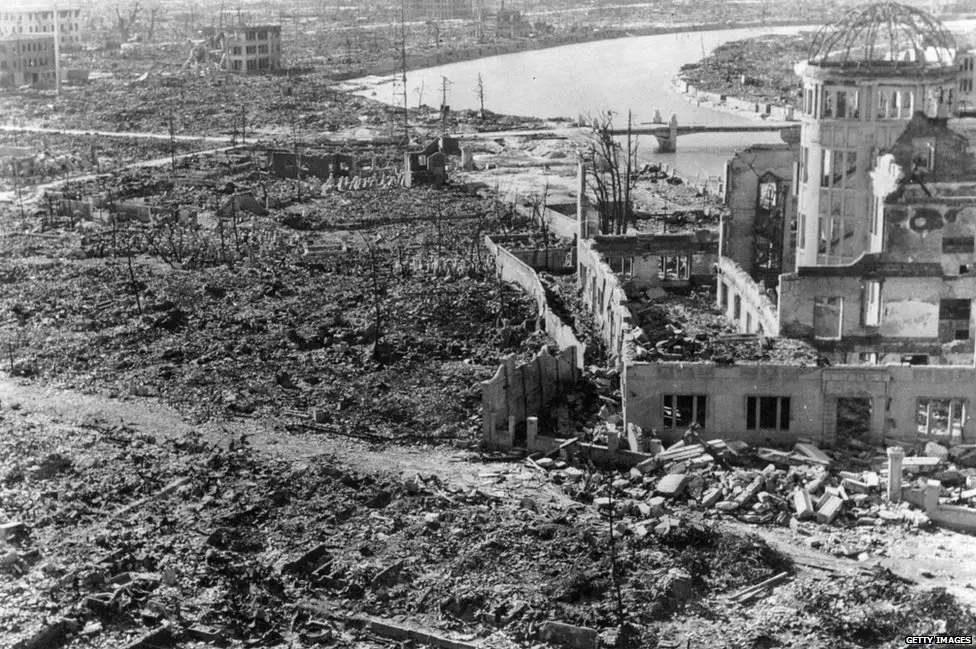
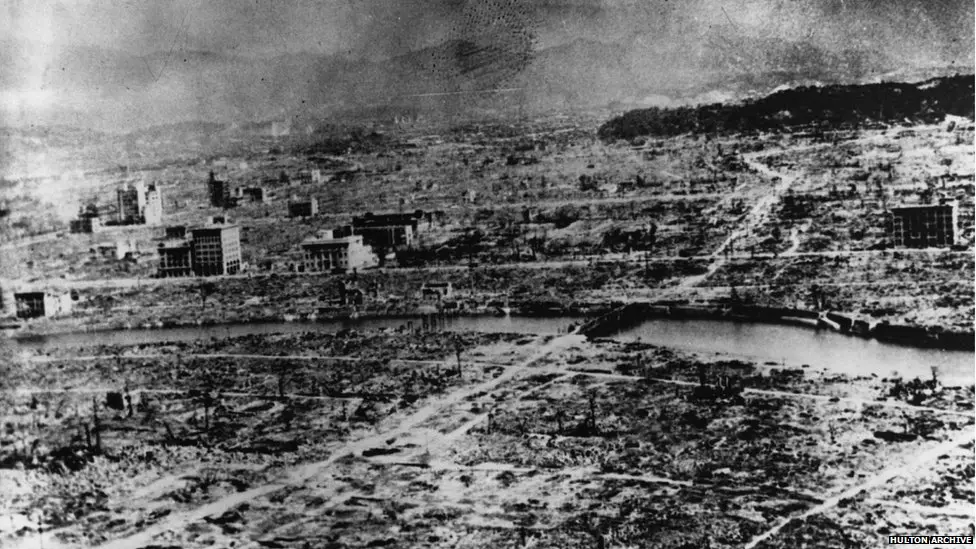
The bomb exploded nearly 3 kilometres northwest of the aiming point in the middle of the city. The hypocentre was above a tennis court in the Urakami valley, between the Mitsubishi Steel and Arms Works and the Nagasaki Arsenal. That made a big difference. The hills that rise around the valley sheltered much of the rest of the city, and the blast was largely confined to the valley. It destroyed the Urakami end of the city with great force, while the commercial district around the harbour was spared much of it. Had the bomb gone where it was aimed, the effect on the city would have been far wider.
The radius of total destruction was around 1.6 kilometres, and fires extended about 3.2 kilometres to the south. No firestorm developed as it had at Hiroshima, because the damaged areas did not have enough fuel density, but wind drove fire along the valley. About 20 minutes after the explosion black rain fell for an hour or two, with the consistency of mud or oil.
At the same moment, in the air, the crew dropped a canister of instruments with a letter addressed to a Japanese physicist, Ryokichi Sagane, a message from American physicists who had known him before the war, urging him to make the nature of the weapon known. The letter was not handed over until a month later.
Landing on fumes
While the city burned, Bockscar was in trouble of its own. With fuel too low for Iwo Jima, Sweeney flew to Yontan airfield on Okinawa. Nobody there was expecting them. He circled for about 20 minutes without answer from the tower, fired flares, and came in at a higher speed than normal. One engine quit on final approach, the aircraft touched down hard and swung towards a line of parked B-24s, and a second engine died before it stopped. The flight engineer estimated that less than five minutes of fuel remained.
Today Bockscar is on permanent display at the National Museum of the US Air Force in Dayton, Ohio, where it was flown in 1961 and restored to its original markings. A replica of a Fat Man stands beside it.
Inside the Urakami valley
The city had about 263,000 people that day, including some 240,000 Japanese residents, around 10,000 Korean residents, about 2,500 conscripted Korean workers, 9,000 Japanese soldiers, about 600 conscripted Chinese workers and some 400 Allied prisoners of war. The people of the valley were concentrated in the places the bomb hit hardest. Of 7,500 Japanese employees of the Mitsubishi munitions plant, 6,200 were killed. Another 17,000 to 22,000 people working in other war plants also died.
Schools and hospitals were hit as hard as factories. A payroll office in the Shiroyama Elementary School building lost 138 of the 158 people inside, and more than 850 people were killed at the Nagasaki Medical University site. Allied prisoners were among the dead: at least eight (an RAF corporal and seven Dutch prisoners) and possibly as many as 13. One American prisoner, Joe Kieyoomia, survived behind concrete walls, and all 24 Australian prisoners survived. Between 1,500 and 2,000 Koreans were killed.
The death toll in Nagasaki, like Hiroshima’s, depends on who counted and when. The Manhattan Project’s 1946 report put it at about 39,000 dead and 25,000 injured, and a 1951 joint commission gave 39,214 and 25,153. Later Japanese studies raised the figure to about 70,000 dead by the end of the year, and the Radiation Effects Research Foundation uses a range of 60,000 to 80,000 for the city’s roughly 250,000 to 270,000 people. A smaller number, about 150 Japanese soldiers, died instantly.
The cathedral and the doctor
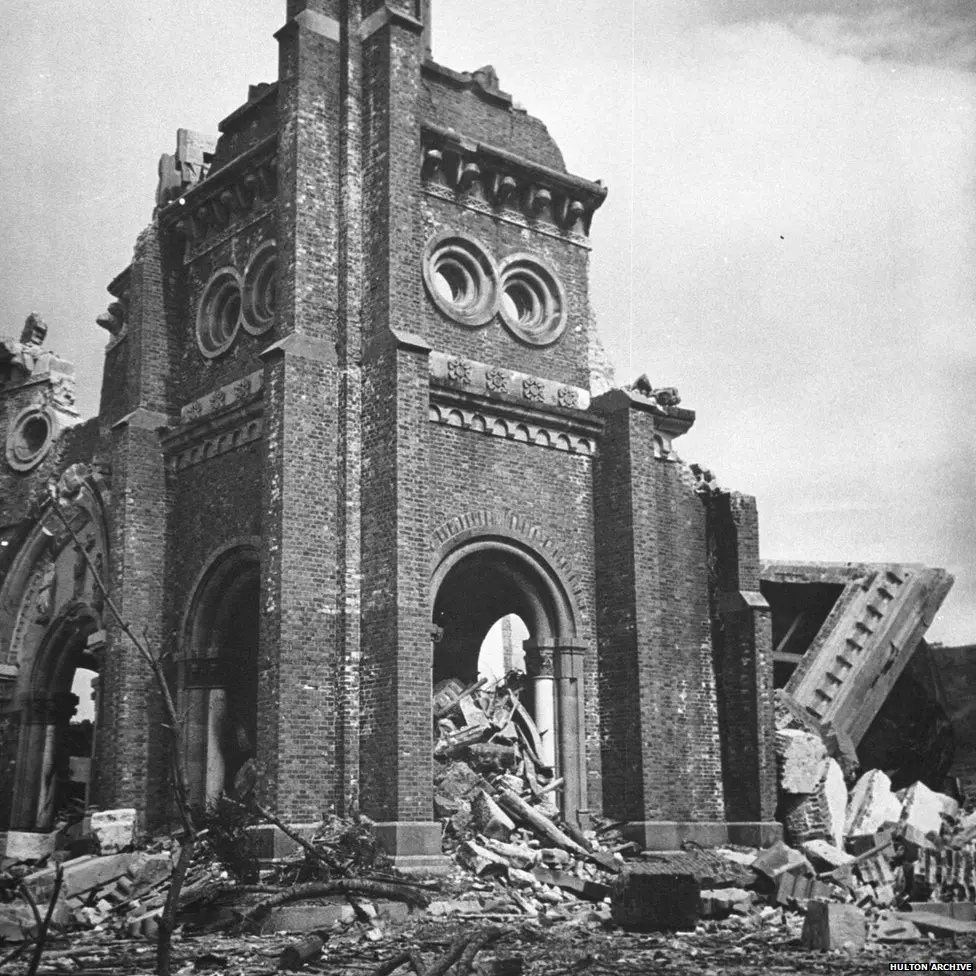
Urakami Cathedral stood about 500 metres from the hypocentre, and on the morning of 9 August, the eve of the feast of the Assumption, worshippers were gathering inside. The brick building was destroyed, and the people in it were killed in the collapse and the heat. For a community whose ancestors had been exiled, tortured and made to tread on sacred images, the symbolism was heavy. In January 1958 the Catholic community proposed rebuilding on the same site in reinforced concrete. The city accepted, the new cathedral was finished in October 1959, and in 1980 it was remodelled with brick tiles to look more like the original. A French Angelus bell damaged in the bombing is on display on the grounds, and one of the twin bells was repaired by volunteers and rang again for the 80th anniversary.
One survivor who became the voice of the valley was Takashi Nagai, a Catholic radiologist who was working at the Nagasaki Medical College Hospital when the bomb struck. His right temporal artery was severed, and he was seriously injured, but he stayed to treat victims. When he reached his home on 11 August, it was destroyed, and his wife Midori was dead. He already had leukaemia, which the biography attributes to years of exposure to X-rays in his work. He wrote The Bells of Nagasaki, finished by the first anniversary of the bombing, which became a bestseller and the basis of a 1950 film. In 1947 a local charity built him a tiny two-tatami hut that he called Nyokodo, “As-Yourself Hall”, where he spent his last years in prayer. He died on 1 May 1951 at the age of 43, and his cause for canonisation was opened in 2021.
On 23 November 1945, at a memorial mass among the cathedral ruins, he spoke of the dead as a sacred offering that had bought peace. The speech is one of the best-known texts to come from the city, and it has also been debated, because it turns a mass killing into a religious sacrifice. We have only a secondary summary of it, so we do not quote it here, but it is worth reading in full.
Six days
In Tokyo, 9 August opened with the Soviet declaration, and the news of Nagasaki arrived while the leaders were already deliberating. The cabinet met at 14:30 and argued over surrender until 17:30 with no decision. A second cabinet meeting at 18:00 ended at 22:00 without unanimity. The army minister, General Korechika Anami, held out for four conditions, including that Japan handle its own disarmament and war-crimes trials and that no occupation take place, and four ministers backed him. An imperial conference opened at 23:50.
By 02:00 on 10 August there was still no consensus, and the Prime Minister, Kantaro Suzuki, did something unusual: he asked the Emperor to decide. Hirohito gave what became known as his “sacred decision”, authorising the Foreign Minister to accept the Potsdam terms with a single condition, that the status of the Emperor be preserved. It was not the end. The reply from the Allies on 11 August did not satisfy the hardliners, and on 12 August the Emperor told the imperial family of his decision. He recorded the surrender announcement on 14 August, despite an attempted coup by militarists, and it was broadcast on 15 August. In a rescript on 17 August he described the Soviet declaration of war as endangering the very foundation of the Empire’s existence.
The Emperor’s broadcast gave the bomb as one reason for the surrender, referring to a new and most cruel weapon, and gave the Soviet entry no mention at all. How much each event counted is for the historians. What is clear is that Nagasaki was bombed in the middle of the government’s deliberations, not before them, and that no one in the room changed their position because of it alone.
The third bomb that never came
The Americans did not stop to see whether Japan would give in. General Groves expected another Fat Man core to be ready for shipment around 19 August, with more in September and October. A second Little Boy would not be available until December 1945. Then the war ended.
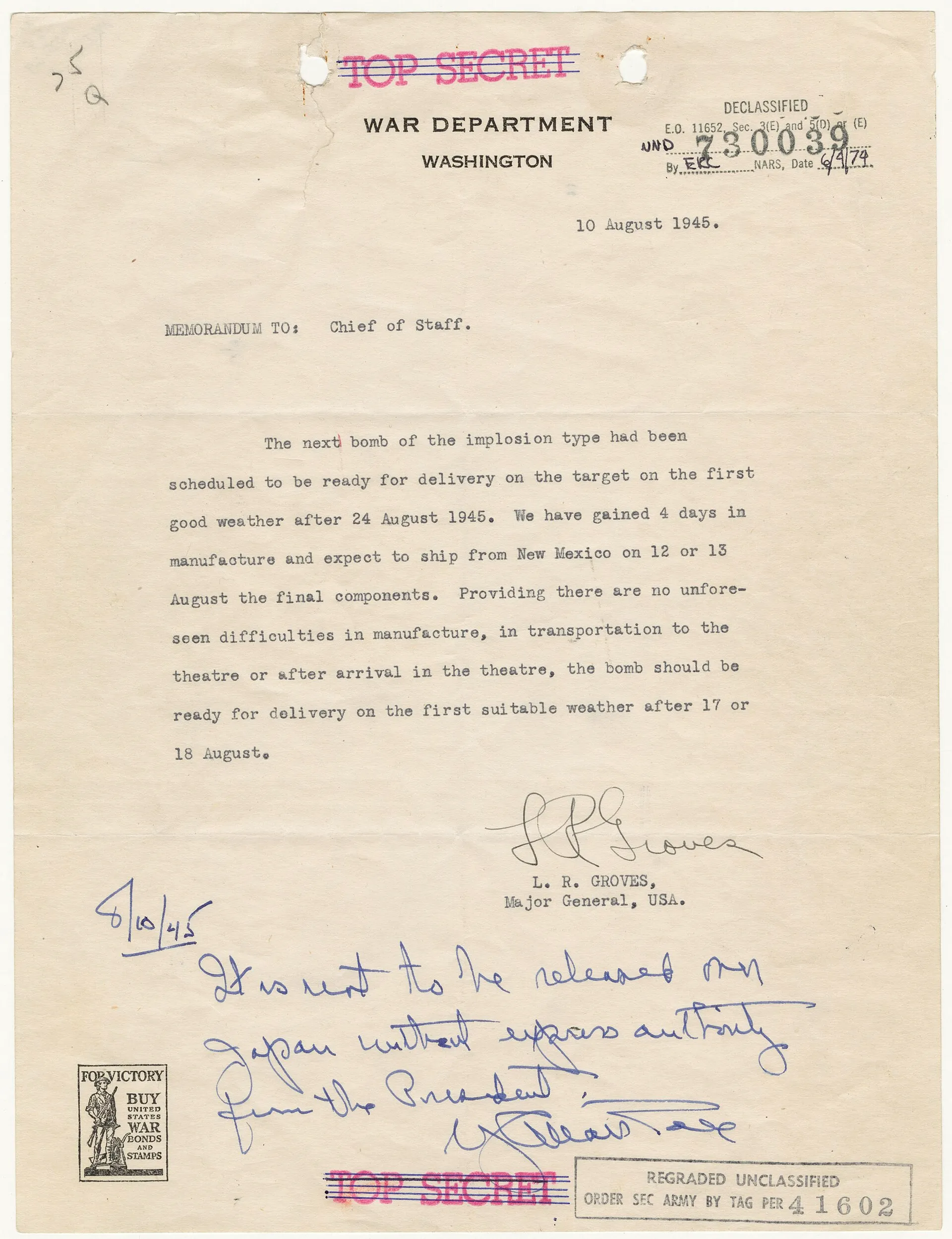
On 10 August, General George Marshall wrote on a memo that the bomb was not to be released over Japan without express authority from the President. James Forrestal recorded that Truman told the cabinet there would be no further dropping of the atomic bomb, though that is Forrestal’s paraphrase. On 13 August Groves, unable to reach Marshall, ordered on his own authority that a plutonium core not be shipped. Two bombs had been used, and a third was never shipped.
The survivors
The word for the survivors is hibakusha, the bomb-affected people. The Japanese government has recognised about 650,000 across the two cities, and as of 31 March 2025 about 99,130 were still alive. At Nagasaki’s memorial, names of hibakusha, including those who died later, run to 201,942 as of August 2025.
One man was both. Tsutomu Yamaguchi was in Hiroshima on business on 6 August, was burned, and returned home to Nagasaki, where he was in the city on 8 and 9 August. The government officially recognised him as a double survivor in 2009.
The photographer Yosuke Yamahata took pictures in Nagasaki the day after the bombing, and they were published in the Mainichi Shimbun on 21 August. American forces then censored such images in Japan until 1952.
The Atomic Bomb Casualty Commission was established in spring 1948 to study the survivors, and it examined 6,621 people in Nagasaki, mostly within 2 kilometres of the hypocentre. It became the Radiation Effects Research Foundation on 1 April 1975. The Nagasaki data matters to scientists in a specific way. The explosive shell around the Fat Man core, called Baratol, filtered the neutron output, so for people exposed in the womb the dose came mostly from X-rays and gamma rays. In Hiroshima the dosimetry is less certain. For researchers, Nagasaki is often the cleaner dataset.
The park
Nagasaki was rebuilt under the Nagasaki International Culture City Reconstruction Law of May 1949. The Peace Park opened in 1955, at the north end of which stands Seibo Kitamura’s 10-metre Peace Statue, with a raised right hand pointing to the bomb and a left hand outstretched for peace. A black stone monolith marks the spot about 500 metres below the burst. The Peace Fountain, built in August 1969, honours people who died looking for water, and its plaque carries a poem by Sachiko Yamaguchi that begins “I was thirsty beyond endurance.” There is a black marble vault with the names of the dead, including those who died of later effects.
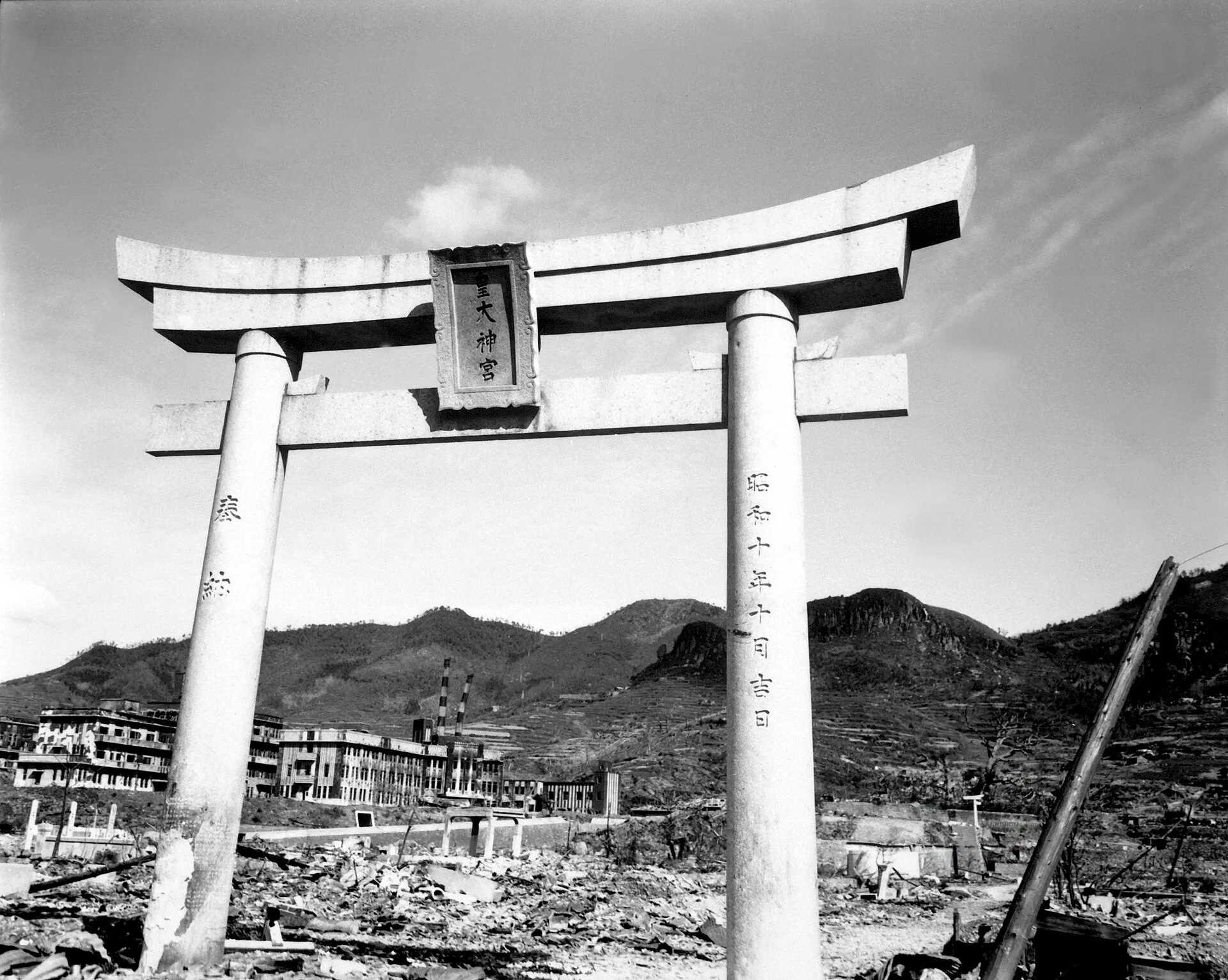
From 1978 on, many countries donated monuments to a Peace Symbols Zone, and in 1979 a Monument for Korean Atomic Victims was unveiled in the park. Fragments of the old city were left as memorials: a one-legged torii at Sanno Shrine and the remains of the cathedral’s wall near the hypocentre. Four such sites were registered in 2013, and they were made, with the hypocentre, a National Historic Site in 2016. Every 9 August the mayor reads a Peace Declaration in front of the statue.
Conclusion
Nagasaki’s story is usually told as the footnote to Hiroshima: a second bomb, three days later, and then the surrender. The record shows something stranger. The city was chosen only because Kyoto was removed, saved from the primary target by smoke from another city, missed by 3 kilometres, spared the worst of the blast by its own hills and attacked in the same hours the Soviet Union entered the war. Its victims included Japanese Catholics whose ancestors had been exiled for their faith, Korean and Chinese labourers and Allied prisoners of war.
After all that, the valley kept speaking. Its survivors wrote, photographed, were studied and, every 9 August, are remembered. The figures for the dead still range from 39,000 to 80,000, and the arguments over what ended the war have not stopped. What is not in dispute is the minute, 11:02, and the place, a tennis court in a valley that nobody had aimed at.
Did you know?
- Nagasaki replaced Kyoto on the target list on 25 July 1945.
- Kokura was the primary target on 9 August, and smoke from a firebombing raid on nearby Yahata hid it.
- Bockscar could not use about 640 US gallons of fuel because of a failed transfer pump.
- Bockscar landed at Okinawa with less than five minutes of fuel left.
- The bomb burst about 3 km northwest of the aiming point, over a tennis court in the Urakami valley.
- Urakami Cathedral was built by descendants of Christians who had been exiled from the valley.
- About 6,200 of 7,500 Mitsubishi munitions employees were killed.
- Takashi Nagai wrote The Bells of Nagasaki and lived out his life in a two-mat hut called Nyokodo.
- Tsutomu Yamaguchi was officially recognised as a survivor of both bombings in 2009.
- Marshall's note of 10 August barred further use of the bomb without express authority from the President.
- Because of the Baratol shell, Nagasaki's in-utero radiation dose is thought to be cleaner to study than Hiroshima's.
- Nagasaki's Peace Park opened in 1955 and its Peace Statue is 10 metres tall.