A ship that did not need to sail
Most warships are measured by what they do. The Tirpitz was measured by what the enemy feared she might do. She was the biggest battleship the German navy ever built, a sister of the Bismarck, and from the day she reached Norway in January 1942 she sat in a fjord and waited. She fired her main guns in anger once, at a weather station on Spitsbergen in 1943. Yet for nearly three years the British Admiralty planned its Arctic convoys around her, kept battleships in reserve at Scapa Flow in case she sailed, and sent aircraft and crews to attack her again and again. Winston Churchill is said to have called her “The Beast”.
That is the paradox at the heart of the story. A ship that did almost nothing tied down an enormous amount of effort, and the effort killed people on both sides. The campaign against her ran for nearly five years, through 24 operations, and cost more than 200 Allied dead, with two Victoria Crosses among the honours. On the German side, her last day on 12 November 1944 killed several hundred times that many men in about ten minutes.
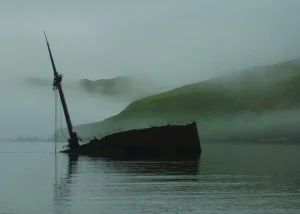
We want to tell the story of the place where she ended: a stretch of shoreline on the island of Håkøya, a few kilometres from Tromsø, where the sea is shallow enough that a concrete platform and a field of rusting debris can still be seen. It is also the story of how she came to be there, and what has happened to the site since.
Building a symbol
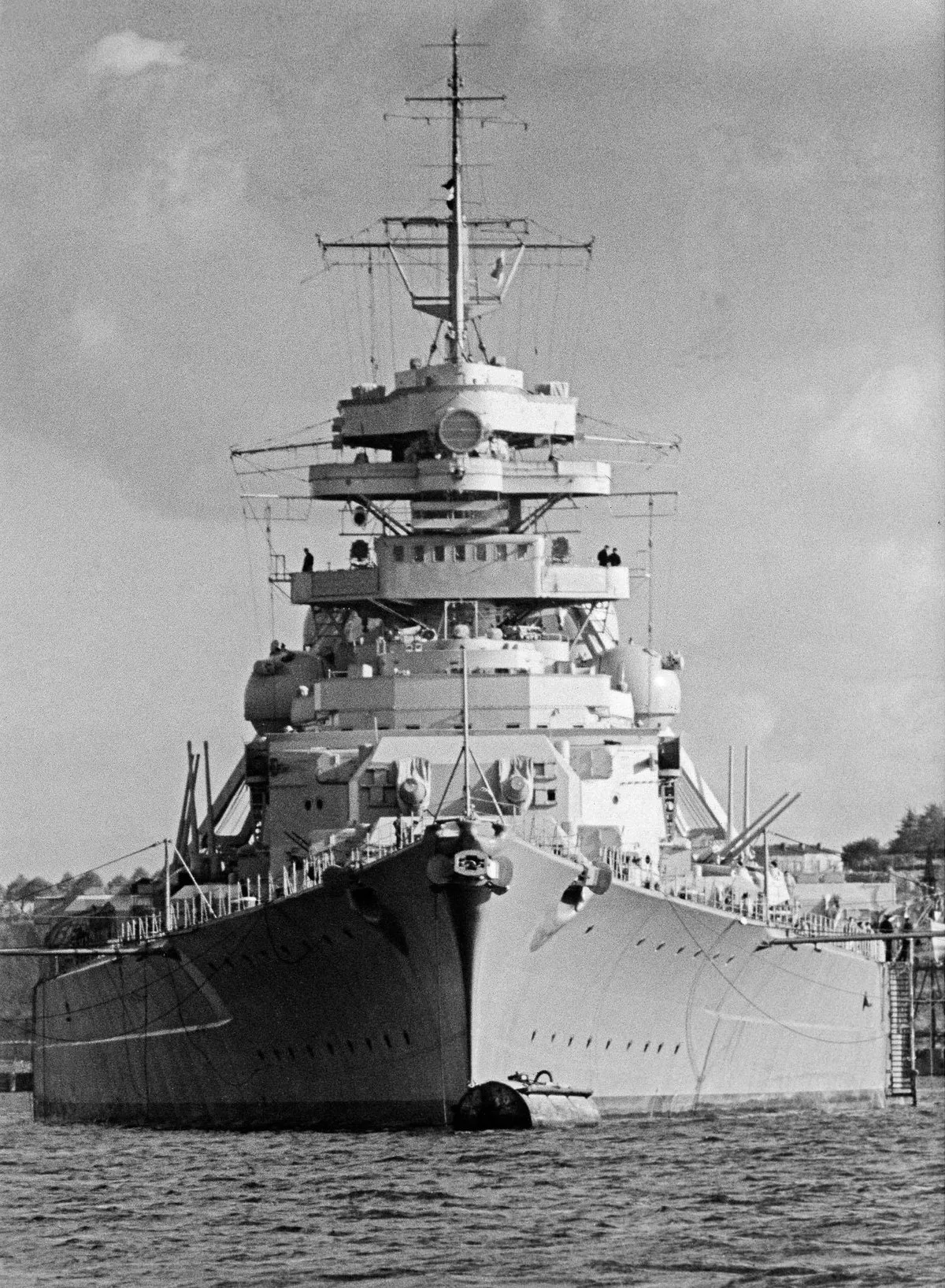
The Tirpitz was named after Alfred von Tirpitz, the admiral who built the Imperial German Navy before 1914. Her keel was laid at the naval yard at Wilhelmshaven in autumn 1936, and she was launched on 1 April 1939 by Admiral Tirpitz’s daughter, Ilse von Hassell, with Adolf Hitler attending. She was commissioned on 25 February 1941 and spent that year in the Baltic on trials and exercises. Her main armament was eight 38 cm guns in four twin turrets, named Anton, Bruno, Caesar and Dora. She could reach about 30 knots and carried a crew of more than 2,600, including some 100 officers.
In November 1941 Germany’s naval commander-in-chief, Erich Raeder, proposed sending her to Norway, and Hitler agreed. The reasoning was twofold. From Norwegian waters, she could threaten the Allied convoys carrying supplies to the Soviet port of Murmansk. And her presence would deter an Allied invasion of Norway, which Hitler feared. She left Wilhelmshaven on 14 January 1942 and reached Trondheim.
Hiding in the fjords
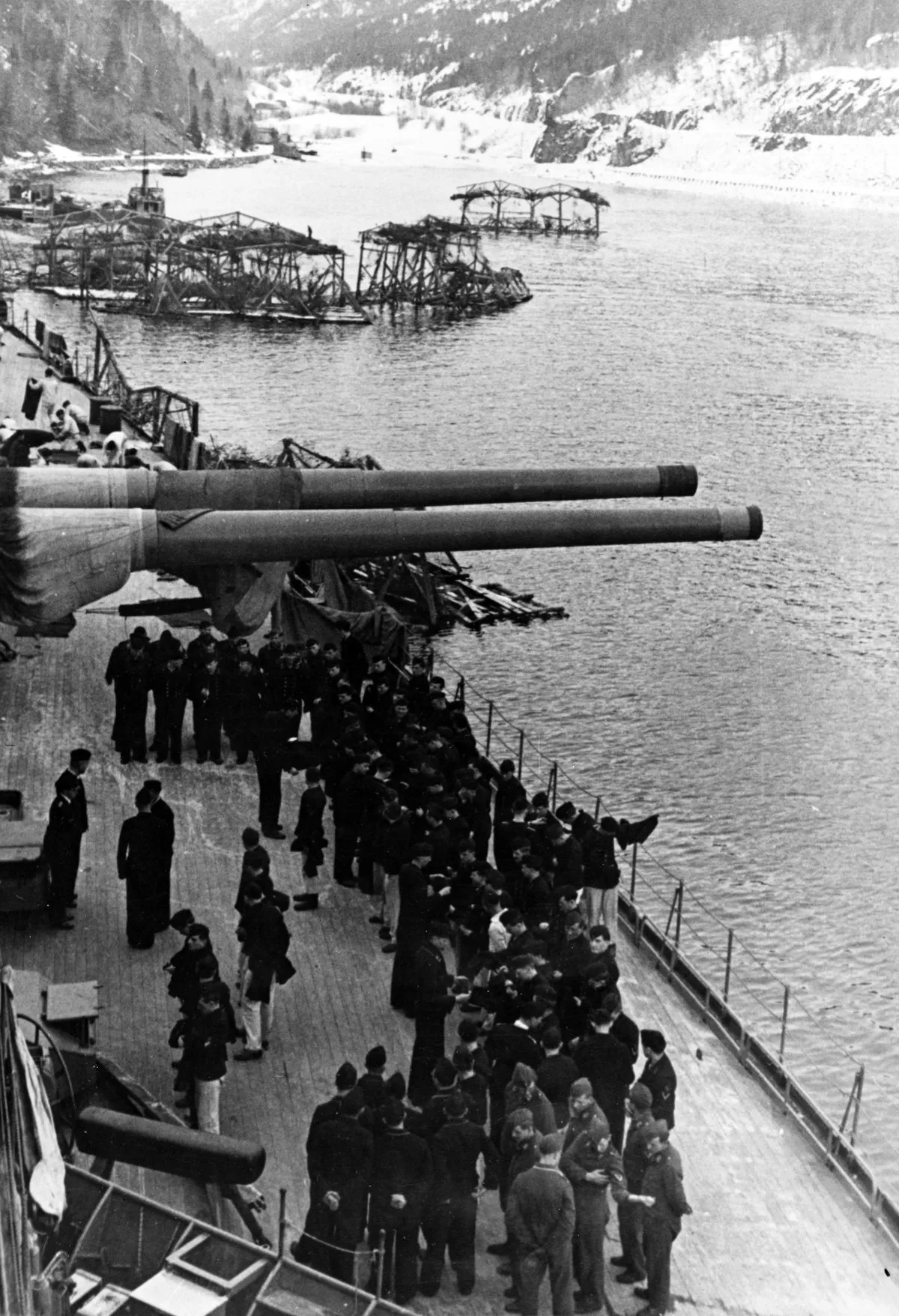
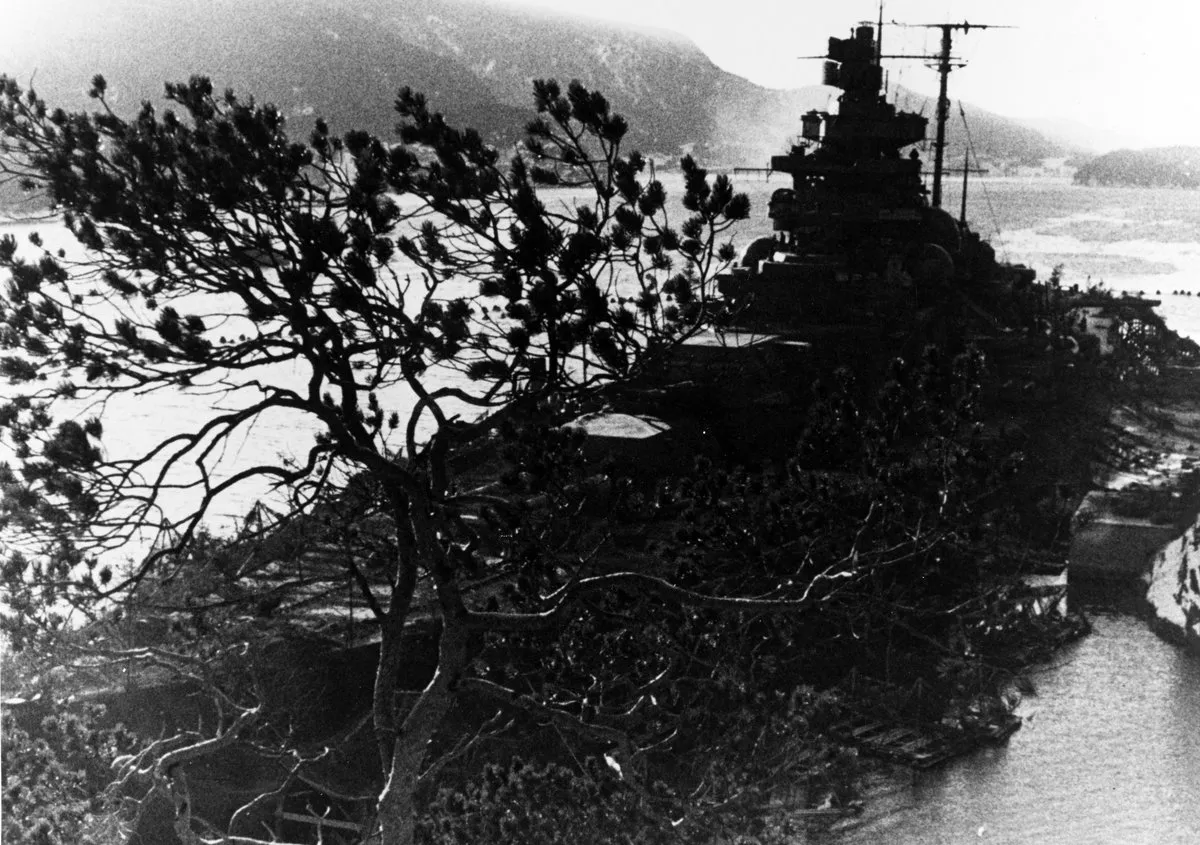
For the Allies, the problem was where she was and how hard she was to reach. In the first weeks she was found by British reconnaissance in the Trondheim area and was moved to a smaller fjord called Fættenfjord. Her moorings there were covered with cut trees and artificial fog, and a sustained effort went into camouflage. A local history notes that pine trees near the ship’s former anchorages grew poorly afterwards, and attributes it to the gases released by the fog generators, though the claim rests on that one telling.
The first British attack, in March 1942, failed. On 9 March twelve Fairey Albacore torpedo bombers attacked, and the ship dodged the torpedoes. Later raids by Halifax bombers, in late March and April, scored no hits. In June and July 1942 she sortied against the Arctic convoy PQ 17, but the operation was cancelled when the Germans learned that the British were aware of her movement. The convoy had, in the meantime, scattered on orders from London, because the British believed she was coming. Most of its ships were then lost to aircraft and submarines. The Tirpitz never reached them. Of 34 ships, only about 11 are said to have arrived, though other counts record 21 of the 34 sunk, and the Tirpitz never sailed toward them at all. Either way, the lesson for the Admiralty was that the mere threat was enough.
From March 1943 she spent most of her time in Kåfjord, a branch of the Altafjord in the far north, because of a fuel shortage and because the location was far from Britain by air and well protected by mountains. In Norway, the local resistance watched her. A small number of agents had been parachuted in or landed in the Alta area to report on her. Local history records Knut Moe and Anton Arild, who were dropped by parachute, Torstein Råaby, sent with radio equipment in September 1943, and two men called Rolf Storvik and Tryggve Suklæt, who reported ship movements from a place called Porsa. How much their reports contributed is not fully recorded, but ship movements and attack plans in northern Norway depended on that sort of information.
September 1943: the midget submarines
The most daring attack was Operation Source on 22 September 1943. The Royal Navy sent six X-craft, 51-foot midget submarines each with a crew of four, up the fjord towards Kåfjord. They had to get past defences, including anti-submarine nets and mountain batteries. Ten of the craft are said to have been assigned to the operation and eight to have reached Kåfjord, but the details are disputed. What is clear is that the midget submarine X5 was detected about 200 metres from the nets and sunk, while X6 and X7 got in and laid mines under the ship.
The mines exploded. Estimates of the damage differ. A local tourism account describes an 18-metre gash in the hull, while a detailed history of the ship’s career says the mines flooded around 1,430 tonnes of water, threw the main turret Dora off its bearings, and destroyed both floatplanes. All agree that the ship was not sunk. She was out of action for about six months, and repairs by the repair ship Neumark were completed by 2 April 1944. The repair was a considerable feat of naval engineering for a ship lying in a remote Arctic fjord.
Carriers, bombers and the Tallboy
The next attack came the day after the repairs were finished. On 3 April 1944, in Operation Tungsten, Barracuda dive-bombers from the carriers Victorious and Furious and escort carriers, with fighter escort, struck at 05:29 and again after 06:30. They scored 15 direct hits. German losses are put at 122 killed and 316 wounded in one calculation and 132 killed and 270 wounded in another. Two of the secondary turrets were destroyed, but the ship was not crippled. Further carrier raids in the summer were hampered by bad weather.
The RAF’s answer was the Tallboy. This was a 12,000-pound bomb, about five tonnes, designed by the engineer Barnes Wallis to penetrate deeply into hard targets before exploding. It was dropped from high altitude by specially modified Lancasters of No. 617 Squadron, the unit best known for the dam raids of 1943, and No. 9 Squadron. The bomb did not need to hit a ship to hurt it. A big enough explosion in the water beside the hull could break a ship’s back.
The first Tallboy raid, Operation Paravane, was on 15 September 1944. Kåfjord was too far to reach from the UK, so the bombers flew out to Russia and attacked from a base at Yagodnik near Archangel. Twenty-three Lancasters took part, seventeen with Tallboys, and one hit the bow, passed through the hull and exploded in the seabed. The ship took on 800 to 1,000 tonnes of water and was reduced to a speed of 8 to 10 knots. The Germans decided she could no longer serve as a seagoing ship. She was repaired enough to move, and on 15 October 1944 she steamed under her own power to Tromsø, her last voyage. She was to be used as a floating battery, to defend the town against an expected invasion.
Håkøya
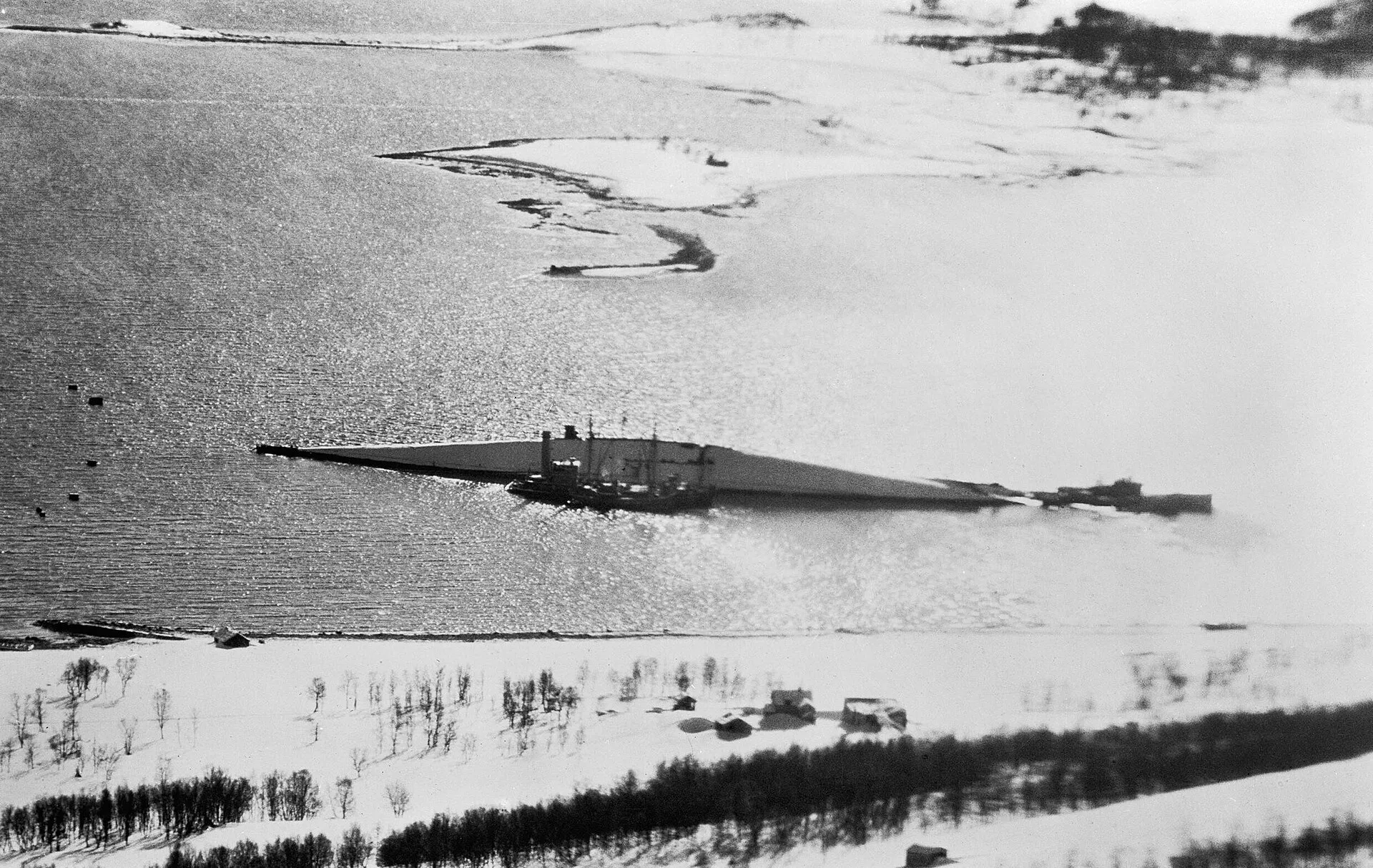
The Germans chose to moor her off Håkøya, an island at the entrance to Tromsø’s waters. The next day, 16 October, she was towed into position. Sand and stone were put beneath her hull to stop her sinking or capsizing if hit. The bank was meant to be built up to provide a firm base for her guns, and it was still incomplete in November. The crew was cut from about 2,600 to 1,600, and 700 or so men were moved ashore.
From Tromsø, the Lancasters could reach her from bases in Scotland, though only just. On 29 October, in Operation Obviate, 32 Lancasters from the same two squadrons attacked her with Tallboys, and one near miss damaged the port rudder and shaft. Weather had hampered the attack. A fortnight later they returned.
A strange detail of this period was the failure of coordination on the German side. The fighter units at Bardufoss, 70-odd kilometres away, had not been told that the ship had moved from Kåfjord to Håkøya. The fighters were not within range of the new position in the way they had been, and no warning system was built around the new anchorage. This was to matter on 12 November.
12 November 1944
The planning for Operation Catechism was careful. The weather at Håkøya was uncertain, and the route was long: from northern Scotland across the Norwegian Sea, over the coast and across northern Sweden, so that the bombers approached Tromsø from the south-east, a direction the Germans did not expect. They took off from Lossiemouth, Kinloss and Milltown in the early hours: No. 617 between 2:59 and 3:25 a.m., No. 9 between 3:00 and 3:35 a.m. In total 32 Lancasters were dispatched, 18 from 617 and 13 from 9, and a film aircraft from No. 463 Squadron RAAF. Some were held back: seven aircraft of No. 9 Squadron could not take off because snow and ice had formed on them overnight, and two others failed to reach the rendezvous.
The bombers crossed the coast through a gap in German radar coverage. Over Torneträsk, a lake in Sweden, they met up, in violation of Swedish neutrality, and climbed to about 14,000 feet to clear the mountains. The weather over Tromsø, which had been uncertain, was clear. Wing Commander Willie Tait, who led the attack and commanded 617 Squadron, spotted the ship from some 20 miles away. He later described a snow-covered landscape with a still fjord, and the ship lying in the middle of it.
Like a spider in a web.
Wing Commander Willie Tait, 617 Squadron, on the Tirpitz at Håkøya
The German warning system failed in several ways. Observation posts saw the bombers between 7:39 and 8:50 a.m., but few reports reached the ship in time. The siren at Tromsø sounded at 8:51. The ship asked Bardufoss for fighters at about 9:15, and the Luftwaffe ordered a scramble at 9:18, but takeoffs did not begin until about 9:32, and a Ju 52 transport that landed on the runway delayed the rest. About 38 fighters of the fighter wing JG 5, recently moved from Kirkenes, were disorganised and mostly flown by inexperienced pilots. The major in command, Heinrich Ehrler, took off first and searched alone. The smoke screen was not switched on in time. The Tirpitz opened fire with her main guns at 9:38, but the fire did not disrupt the formation.
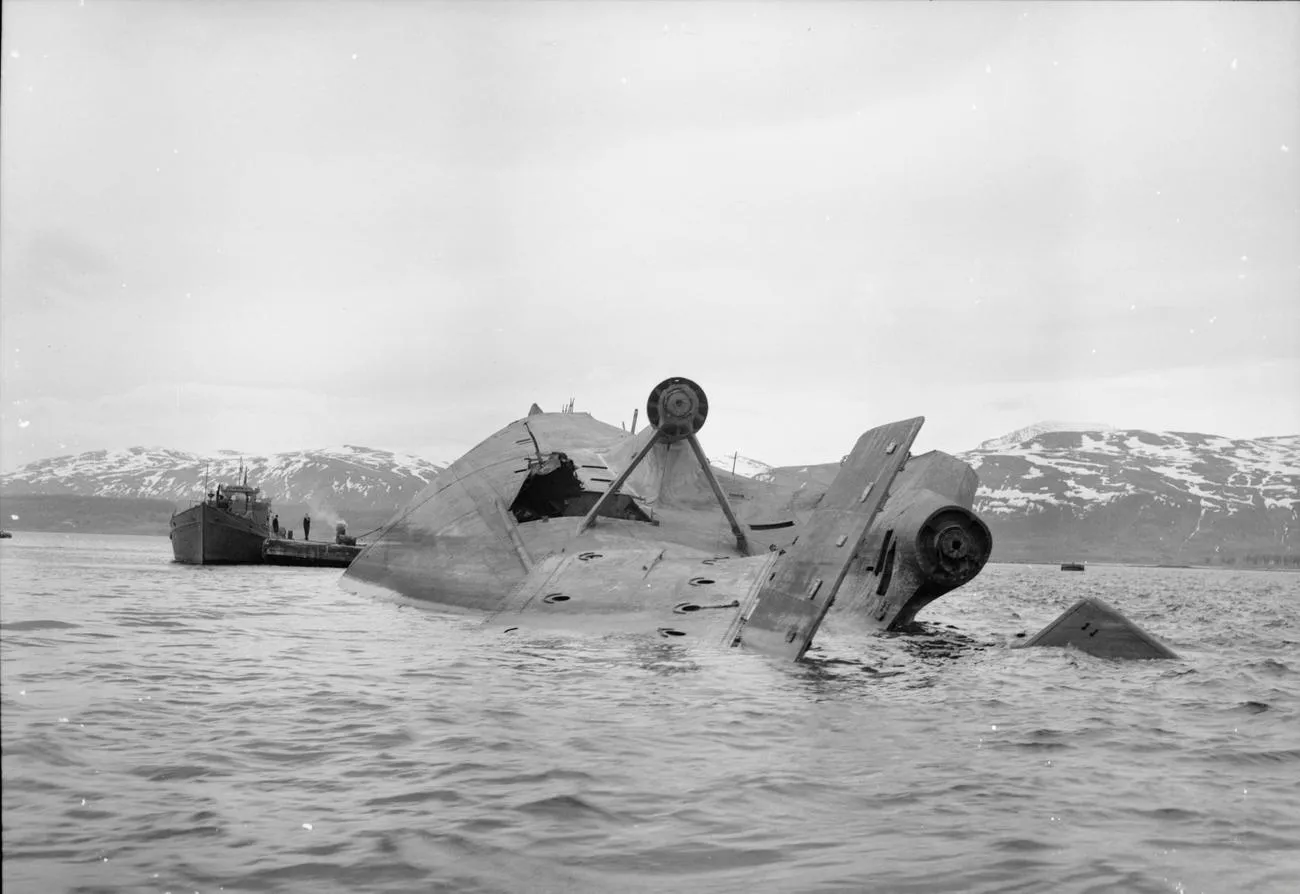
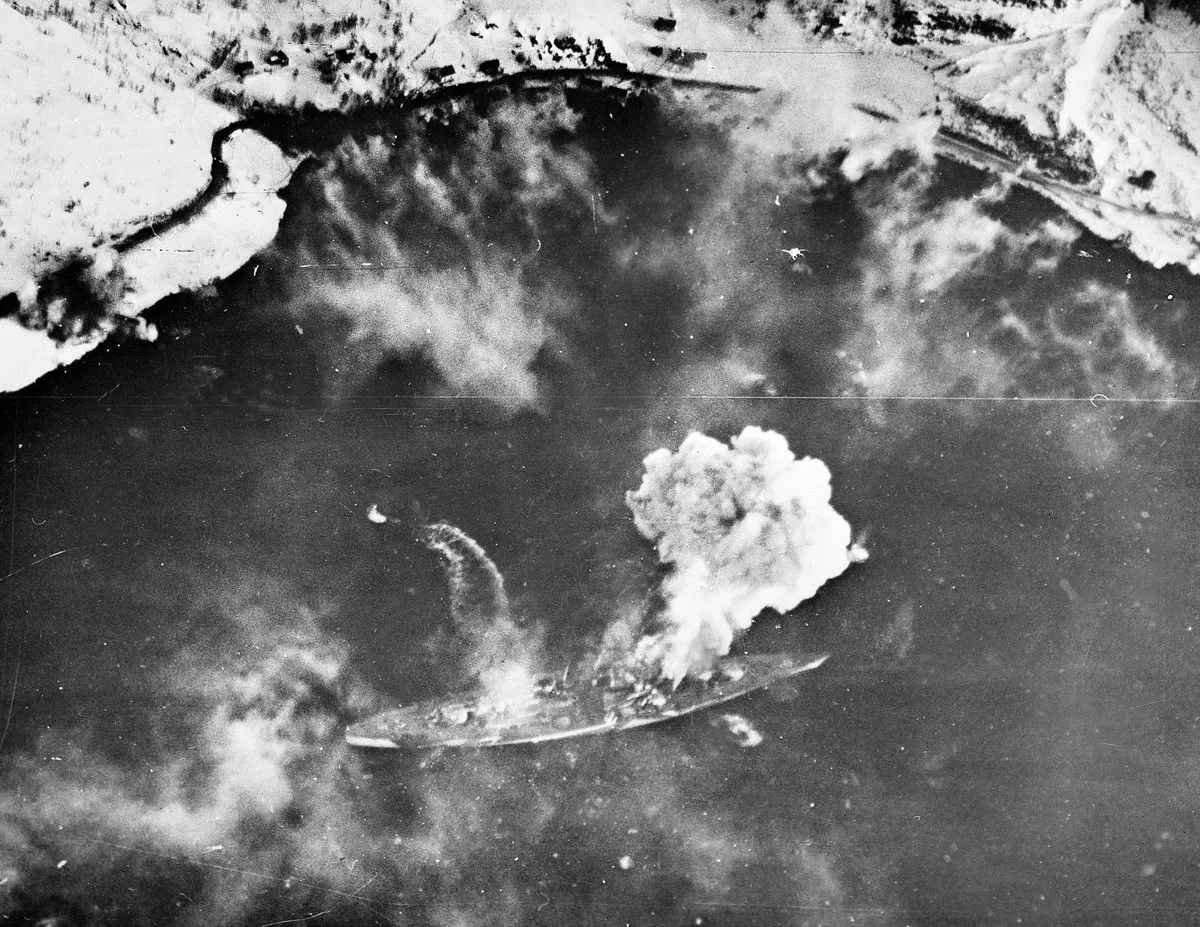
The attack began at 9:41, with Tait’s Tallboy the first released. No. 617 finished at 9:44, No. 9 began at 9:45, and the last bomb fell at 9:49. Altogether 29 Tallboys were dropped. Two penetrated the armoured deck. One hit to port of the Bruno turret and did not explode. The other, Tait’s own by most reckonings, hit the port side amidships near the aircraft catapult tracks, and burst over the port boiler room. Other bombs landed close alongside, and their blasts also tore at the hull and, by removing the sand and stone that had been placed beneath it, took away the support the ship needed.
Within minutes, the ship was listing at 15 to 20 degrees, then 30 to 40 degrees. Captain Robert Weber ordered the lower decks cleared and then the crew to abandon ship, but the list was too fast. At about 9:50 a magazine in the Caesar turret exploded. The blast is said to have thrown the roof and part of the turret structure some 25 metres and landed on men swimming for the shore. At 9:52 the ship rolled over, with her superstructure driven into the seabed. From the first bomb to the capsize was about eleven minutes. On the British side there were no casualties, although one No. 9 Squadron Lancaster was hit by anti-aircraft fire and crash-landed in Sweden, and the crew were interned and later repatriated.
The men inside
About 1,700 men were aboard that morning, a count that excludes the 700 or so who had been sent ashore. The death toll cannot be given as one number. A figure of 971 is used by the Tromsø Defence Museum and several others, a Norwegian local history gives 916 dead and 807 rescued, and published naval histories give figures between 940 and 1,204. All of them are in the same region of roughly a thousand, and that is as far as agreement goes. Captain Weber and almost all his senior officers were among the dead.
Within two hours, 596 men had been rescued from the water or had swum ashore. Many more were trapped inside the upturned hull. Rescuers began cutting into it. Acetylene torches were scarce, because Norwegian civilians who owned them had hidden them, and only one could be found. Eighty-seven men were freed from inside the hull in the first 24 hours. Cutting continued for two more days, with no more survivors. It is said that the trapped men were alive for hours inside the dark hull, knocking, until air or time ran out. The detail is told restrainedly even by those who record it, and the numbers are all that can be stated with confidence. The most senior survivor was Captain-Lieutenant Alfred Fassbender, who received the German Cross in Gold.
It is worth stopping here. The ship was a symbol, and the story of how she was hunted has often been told as a triumph for the Allied air forces, which it was. But the men inside were conscripts and sailors, many of them young. The Tirpitz Museum in Alta holds personal effects recovered from the wreck, including letters, uniforms and photographs of young German sailors, and the Tromsø Defence Museum has just received a wallet found washed ashore in 2026, which we return to below.
Blame
In Germany, the inquiry that followed was a search for someone to hold responsible. Major Heinrich Ehrler, the fighter commander, was court-martialled in Oslo on a charge of cowardice, for leaving his operations room in the hands of a non-commissioned officer, and was sentenced to three years. He was released after about a month, demoted and sent to another unit. Later historians have argued that he was a scapegoat. His pilots had not been told that the ship had moved. He was killed on 4 April 1945. The shallow, half-prepared berth at Håkøya is also widely blamed for the speed of the capsize.
On the British side, the raid was treated as the end of a long campaign. Air Commodore Ralph Cochrane recommended Tait for the Victoria Cross and Air Chief Marshal Arthur Harris of Bomber Command supported it, but it was not awarded; Tait received a third bar to his Distinguished Service Order. Film shot by a camera aircraft from No. 463 Squadron RAAF was widely shown afterwards. The Australian pilot Bruce Buckham flew over the sinking ship at low altitude to film it.
Scrapping the wreck
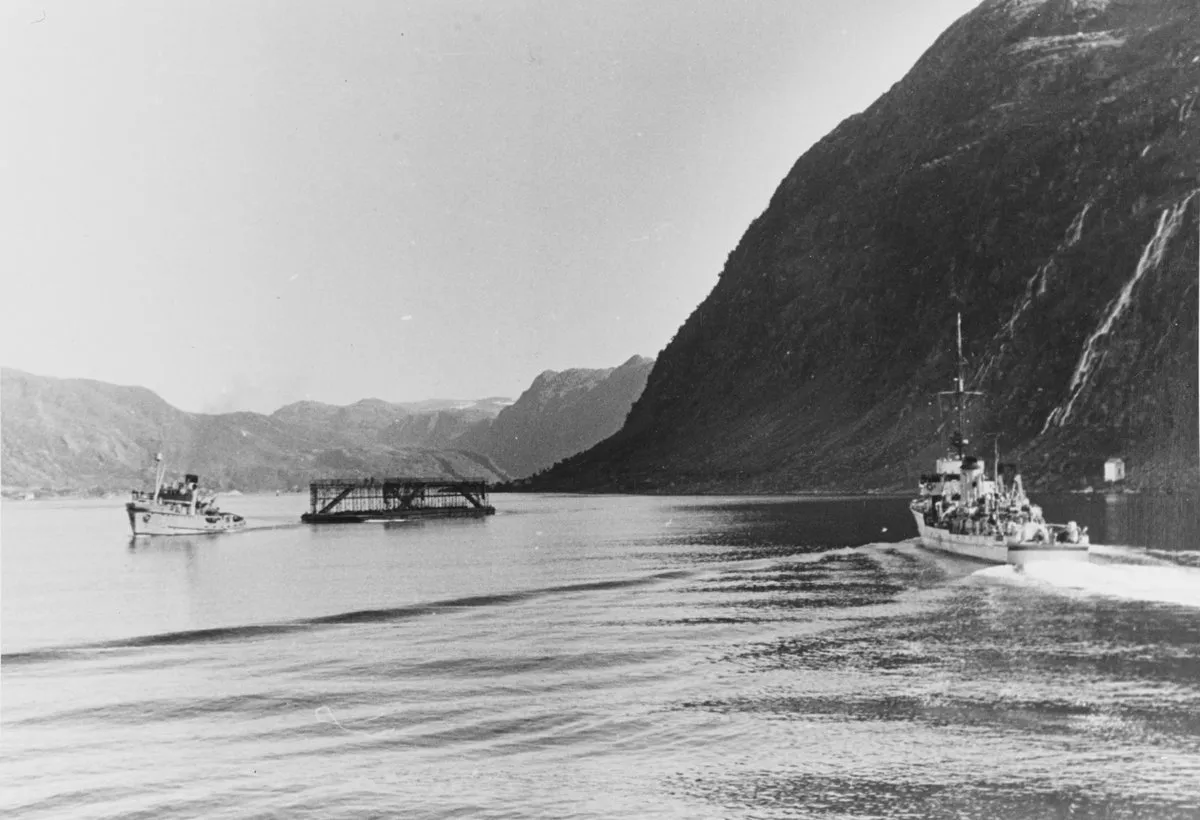
The ship lay upside down in the shallows. She was sold in 1948 to a scrapping company, Høvding Skipsopphugging, which paid the state a sum recorded as 120,000, and the work lasted until 1957, or from 1947 to 1958 by a wider reckoning. A concrete platform was built at the site to support the work, and the steel was cut up and sold. The German navy had recovered very little, since the ship went down during the evacuation of Finnmark and northern Troms.
The steel went to some surprising places. The city of Oslo bought many of the armour plates, which were used as temporary road decking during road works, and as of 2024 are reported to show almost no wear. A deck tank from the ship was installed in 2003 as a pipe at the outlet of a river in Kvæfjord. Anchor chains hang by the stairs of a hall in the old Olavsgruva mine at Røros. A bulkhead from the wreck was given to the RAF in 1950 and became a trophy contested by Nos. 9 and 617 Squadrons, and it was handed over to the RAF Museum in 2002. Fragments were sold as souvenirs. An unexploded 38 cm shell, 800 kg, thought to have been fired during the 29 October attack, was found at Sjursnes in Ullsfjord in 1967, defused, and turned into a memorial.
What is left
The question of what you can see at Håkøya has two answers, because the evidence disagrees. Older tourism and travel pages say the hull remained largely in place under the surface just off the concrete platform, that part of it could break the surface at extreme low tide, and that about 400 bodies were still inside, which is why diving is permitted but taking anything is not. A 2026 scientific paper says the opposite: the ship itself has been removed.
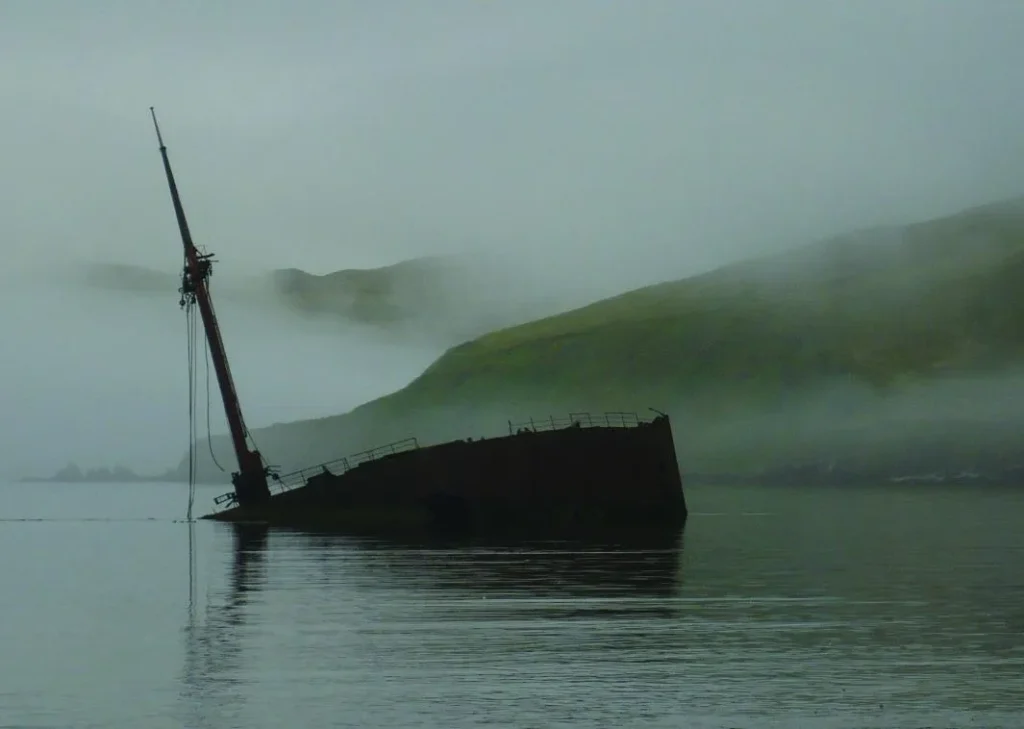
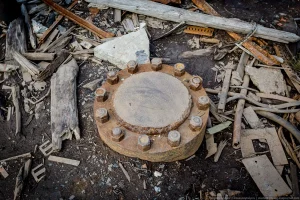
That paper, published in the journal Remote Sensing in December 2025 by Gareth Rees, Olga Tutubalina and colleagues from the University of Cambridge’s Scott Polar Research Institute and UiT The Arctic University of Norway, is the most recent careful look. In March 2023 the team flew a drone over the shallows off the south shore of Håkøya and took 976 images. They mapped the wharf, which is about 52 metres long and 10 metres wide, lying at around five metres depth and partly exposed at low tide, and the debris piles around it, which they estimated at about 700 cubic metres in volume. Their estimate of the steel was in the order of 1,900 to 2,400 tonnes, which they say is a minimum and amounts to about 5 per cent of the ship’s mass. Their reading is that the wharf and debris are the main visible remains, and that the platform is often mistaken for the ship.
The project, called the Tirpitz Site Project, is meant to record and monitor the site, consider its heritage value and assess the environmental risk from the wreckage and from the material dumped on the seabed after the war. An attempt to give the site specific legal protection was dropped in 2016 after opposition from divers and others. Norwegian local history says the wreckage, together with the wreck of the Blücher, was temporarily protected in 2014. Both may be true: a temporary order, then a failure to make it permanent.
On land, there is a memorial on a beach, about 100 metres from the shore at one point, made partly from steel from the ship. Tromsø municipality put up a Tirpitz memorial on Håkøya in 1984, and visitors in 2015 found candles and flowers at it. Not far away, in a horse paddock by the beach, there is a crater from a Tallboy that hit the land. Many of the dead were first buried on Tromsøya and moved in the 1970s to the German war cemetery at Botn. Every five years a boat carries wreaths out to the site. For the 50th anniversary, the Tromsø museum brought together survivors from both sides, and Germans and Britons shook hands. By the 80th anniversary in 2024, the last of the Tirpitz and Lancaster crew had died, and relatives travelled from as far as New Zealand and Canada.
Museums and memorials
There are two museums on the ship. The Tromsø Defence Museum, founded in 1993, is in a former German coastal fort just outside the town and has a permanent Tirpitz exhibition, with photographs, newspaper cuttings and salvaged objects. Its deputy director, Sten Helge Eilertsen, spoke in 2026 about the most recent addition: a wallet containing two condoms and tobacco ration cards, washed ashore after years at sea and believed to have belonged to a sailor of the Tirpitz. The museum does not know whether he survived. It is waiting for a conservator to examine the wallet, which is discoloured and brittle. A small find like that says more about the ordinary lives aboard than any statistic.
The Tirpitz Museum in Alta, in a former German barracks building at Kåfjord, covers the earlier phase of the ship’s life. It has a scale model, wartime photographs, a film of about 30 minutes about the final attacks, and a memorial outside, a stone of Alta slate on a plinth made from a 12.5 cm armour plate. On the road between Alta and the museum is a crater from a British bomb that fell short of its target, a short walk from a car park. At Fættenfjord, near Trondheim, a memorial honours the British airmen who died attacking the ship.
One discovery from December 2025 shows how much material is still out there. A bomber wreck found at about 185 metres in a northern Norwegian fjord during pipeline work, identified as a Halifax, is believed to have taken part in a 1942 attack on the Tirpitz and made an emergency landing on the water after anti-aircraft fire. Four of the six crew survived and were handed to the Germans, and the other two are believed to have drowned. The site has been protected as a war grave.
Visiting
Håkøya is reached by road from Tromsø, and the memorial and the wharf can be seen from the shore. Please treat the area as what it is, a war grave as well as a historic site. The wreck is described in several places as a burial site, and diving there is controversial, so do not remove anything. The Tromsø Defence Museum is closed from October to April, and the Tirpitz Museum in Alta is open only in summer (June to August, 10 a.m. to 5 p.m. in 2024), so check current hours before travelling. Current prices are not confirmed.
Conclusion
The Tirpitz is often described as a ship that failed. She never destroyed a convoy, never fought a surface battle against the Royal Navy, and ended capsized in a Norwegian fjord. But the usual measure is the wrong one. Her real function was to be somewhere, and she did that very well. As long as she lay in a fjord, with her guns and her crew of more than two thousand, the British kept a fleet waiting, built a special bomb, sent midget submarines into a heavily defended fjord and flew bombers to Russia and back. It was only when the ship was moved to a shallow, half-prepared anchorage, and the Lancasters had a clear sky, that the long hunt ended.
What remains is modest. A concrete platform that people mistake for the ship, a field of rusted debris under five metres of water, a stone on a beach with flowers on it, a crater in a paddock and a wallet in a museum. Accounts disagree about how much of the hull is still down there and how many men are still with it. What nearly all of them agree on is the scale of the loss: roughly a thousand men in about ten minutes, in a fjord a long way from home.
It is a good place to think about the gap between how a weapon is seen and what it is. To the Admiralty, she was a monster. To the people who died in her, she was a ship and a job. The wharf at Håkøya does not tell you which is right, but the memorial is there, and the flowers on it were put there by people who knew.
Did you know?
- Tirpitz was launched on 1 April 1939 by Ilse von Hassell, daughter of Admiral Alfred von Tirpitz, with Hitler present.
- She fired her main guns at a surface target only once, against Spitsbergen in September 1943.
- The Tallboy bomb weighed 12,000 lb (about five tonnes) and was designed by Barnes Wallis.
- In September 1943 British midget submarines laid mines under the ship in Kåfjord and put her out of action for about six months.
- Operation Paravane in September 1944 flew from a base in Russia to reach her.
- On 12 November 1944, 32 Lancasters left Scotland and approached Tromsø across northern Sweden.
- Two Tallboys hit her and the rest exploded close alongside, and she capsized in about eleven minutes.
- The most commonly cited death toll is 971, though published figures range from about 940 to 1,204.
- Eighty-seven men were reportedly freed from inside the upturned hull in the first 24 hours.
- Major Heinrich Ehrler was court-martialled over the failure to defend her, and many believe he was a scapegoat.
- Armour plates from the wreck were used as temporary road decking in Oslo.
- A 2023 drone survey found a 52-metre concrete wharf and about 700 cubic metres of debris at the site.
- A wallet with two condoms and ration cards from a Tirpitz sailor washed ashore and was reported in 2026.