A fog that would not lift
For weeks in the late autumn of 1949, a group of men at Hanford waited for the weather. They were not farmers or forecasters by trade. They were health physicists, engineers and Air Force officers, and what they wanted was a particular kind of night: cold air lying close to the ground, no rain, no fog or low cloud, and a light wind from the west or south-west that would carry something away from the plant and spread it thin. The Columbia Basin in December rarely gave them that. Fog and inversions sat over the Palouse for days at a time, and the schedule slipped again and again.
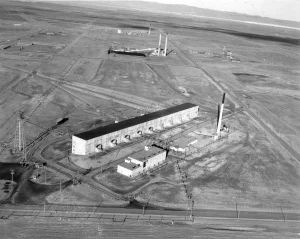
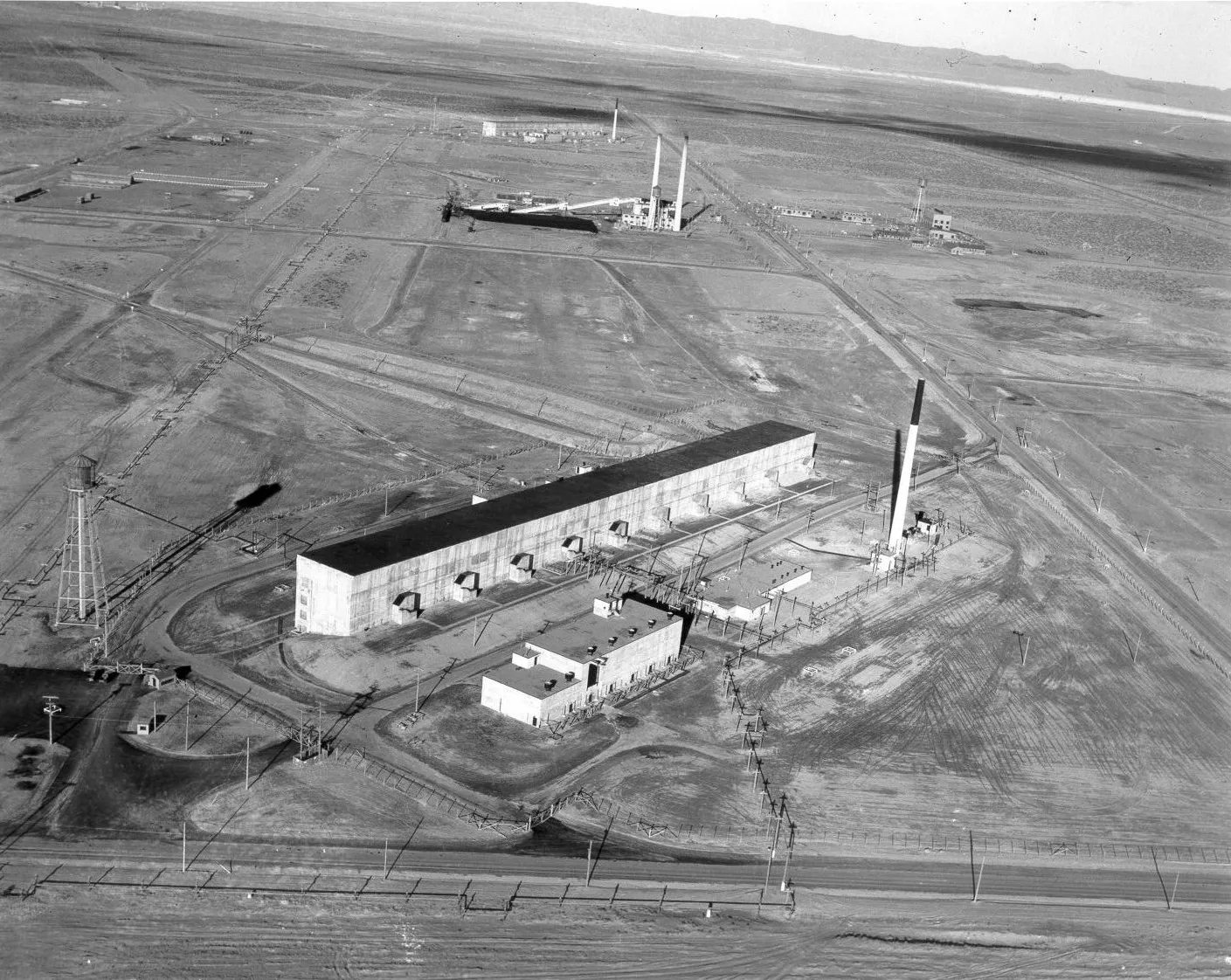
The something they planned to release was radioactive iodine. They meant to release it on purpose, from a stack at the T Plant in the 200 West Area, without the filters that normally caught most of it and without warning anyone downwind. The operation was called the Green Run, after the “green” uranium fuel it processed, and it stayed secret for almost forty years. We want to tell the story of that night and the decisions around it. The wider history of Hanford, its reactors and its river belongs to our post on B Reactor, and the cancers and lawsuits that followed appear here only as far as the Green Run touches them.
Learning to see a bomb factory
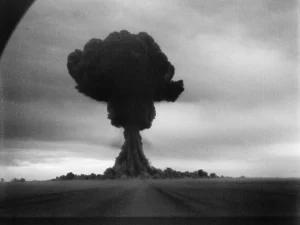
The Green Run only makes sense against the autumn of 1949. On 29 August the Soviet Union had tested its first atomic bomb, which our post on First Lightning describes, and American officials were suddenly aware that they had very little way of knowing what the Soviets would do next. Knowing a bomb had been tested was one thing. A plutonium plant that was running quietly was another matter. Reactors and separation plants release gases when they work, and in principle an aircraft downwind could sample the air and read the signature. The question was how far away that could be done.
The Air Force’s long-range detection effort had already tried. Between November 1948 and February 1949 aircraft flew around the plutonium separation plant at Oak Ridge, which dissolved fuel after only five days of cooling, and picked up radioactivity out to about 17 miles. In March 1949 the same exercise was tried at Hanford, with disappointing results: the aircraft could not find anything even at the airfield at Richland, about 35 miles from the plant. The investigators blamed crude equipment and newly fitted filters, since they had expected to detect plumes at hundreds of miles. A report from that spring, known as ORNL-341, recommended repeating the test with the filters disconnected and the releases made much larger. The Green Run was that repetition.
There was a precedent, too. Declassified documents later showed that the Army Corps of Engineers had deliberately released several hundred curies of iodine-131 at Hanford in 1944, without public warning, to learn how far the wind would carry it and how well instruments could pick it up. And in the routine running of the plant, far more went up the stacks: one later estimate put Hanford’s iodine-131 emissions over three years at about 450,000 curies, with 340,000 of them in 1945. By Hanford standards the amount in the Green Run was not unusual. What was unusual was that it came out in a single burst, on purpose, from an operation designed to be as dirty as possible.
The plan
On 25 October 1949, representatives of the Air Force, the Atomic Energy Commission and General Electric, Hanford’s operating contractor, met at the site and agreed on a plan for a deliberate release. The detail of what they decided survives in a handful of engineering papers. Fuel from the F Reactor would be dissolved at the T Plant after only 16 days of cooling, when the normal period by 1949 was somewhere between 83 and 101 days. The shorter cooling meant there would be far more of the short-lived iodine-131 still in the fuel, so more of it would come out. The scrubbers that normally removed about 90 percent of the radioiodine would not be run. Everything would go up the stack as it was.
The intention was to test detection in two ways: ground sampling of the contamination from an operating plutonium plant, and tracking of the plume by aircraft. The scientists predicted a release of about 4,000 curies of iodine, and a team led by Jack Healy of General Electric’s Health Instrument Division drew up the local plans. The Air Force took responsibility for the weather. A set of conditions was written down. There had to be a cold, stable layer near the ground, no rain, winds below 15 miles an hour at 200 feet, blowing from the west or south-west, and all of it holding long enough for the release to finish and be measured.
Even then, how the test was authorised is not clear. Two contractor officials gave the Government Accountability Office opposing accounts. One said contractor officials had judged the weather acceptable, and the other said that the Atomic Energy Commission did not want to go ahead and the Air Force decided to. The Health Instrument Division had day-to-day authority over when fuel could be processed. Healy has said he recalls no Air Force pressure, although others have suggested there was. Carl Gamertsfelder, a radiation control manager at Hanford, later said that he and his groups recommended against running it.
They wanted to run anyway, and they did run.
Carl Gamertsfelder, Hanford radiation control manager, recalling the decision in a 1995 oral history
The Hanford historian Michele Gerber is reported to have described the Defense Department waiting weeks for a clear day and not getting one. That remark has reached us only second-hand, so we give it as a paraphrase and not as a quotation.
The night of 2 and 3 December
The plan called for a window starting at one o’clock on the morning of 3 December. In the end the release began about eight in the evening of 2 December, several hours earlier. The records say that Healy decided on the evening of the 2nd to go ahead even though the weather had not come out as expected. The discharge ran for between 12 and 17 hours, and the amounts differ depending on which later study you read.
The weather did not cooperate. Rain and snow fell over Spokane and Walla Walla on 2 and 3 December. The winds calmed at about two in the morning and then, instead of carrying the plume away from the river valley, shifted south along the Columbia. At sunrise on the 3rd, Air Force pilots reported sudden wind changes and an inversion that nobody had planned for. The cloud, expected to stretch thin over a great distance, was instead measured at about 200 miles long and 40 miles wide, containing roughly double the iodine that had been predicted. Why it behaved so differently is not recorded.
The measuring went no better. A weather balloon was lost. Some of the air pumps failed. And the monitoring and laboratory equipment was itself contaminated by the release, which raised the background readings and made it hard to interpret anything. Douglas C-47 aircraft tracked the plume, and the Air Force set up an air sampling station at Spokane. The test report says the airborne instruments detected the gases more than 100 miles away under the worst weather, and that under favourable conditions the range might have been extended by up to a factor of ten. But the plume had stalled. It lingered over the local area for several days before a storm front finally pushed it north and north-east, and long-distance tracking, the whole purpose of the exercise, was not possible.
How much went up the stack
Nobody agrees exactly on how much was released, and the differences are large enough to be worth showing. The Government Accountability Office’s 1994 fact sheet gives about 7,800 curies of iodine-131 and about 20,000 curies of xenon-133, and the Advisory Committee on Human Radiation Experiments, a presidential panel that reported in 1995, puts the iodine at roughly 8,000. A later reconstruction by Maurice Robkin estimates about 11,000 curies of iodine and between 16,000 and 29,000 of xenon, the xenon figure varying with the account. The contemporary 1950 estimates run lower, from about 4,000 to 7,780 curies. The range cited most often is 5,500 to 12,000.
The advisory committee’s report adds a useful comparison. The release was about one percent of Hanford’s radioiodine emissions in the three years 1945 to 1947, but it was probably larger than any other single-day release, even in wartime. Hanford as a whole released roughly 739,000 curies of iodine-131 between 1944 and 1972. The point for the Green Run is that a single night’s release was a significant fraction of what an entire year of routine running put out.
What the instruments found on the ground
The plume was invisible, and the evidence of where it went is a series of readings of iodine on grass. Iodine-131 settles on vegetation, cows eat the vegetation and the iodine concentrates in milk and then in the thyroid. In 1949 that chain was not understood. The main route by which radioiodine reached people, milk from cows grazing on contaminated pasture, had not been identified, and no regulatory limits for the public existed yet.
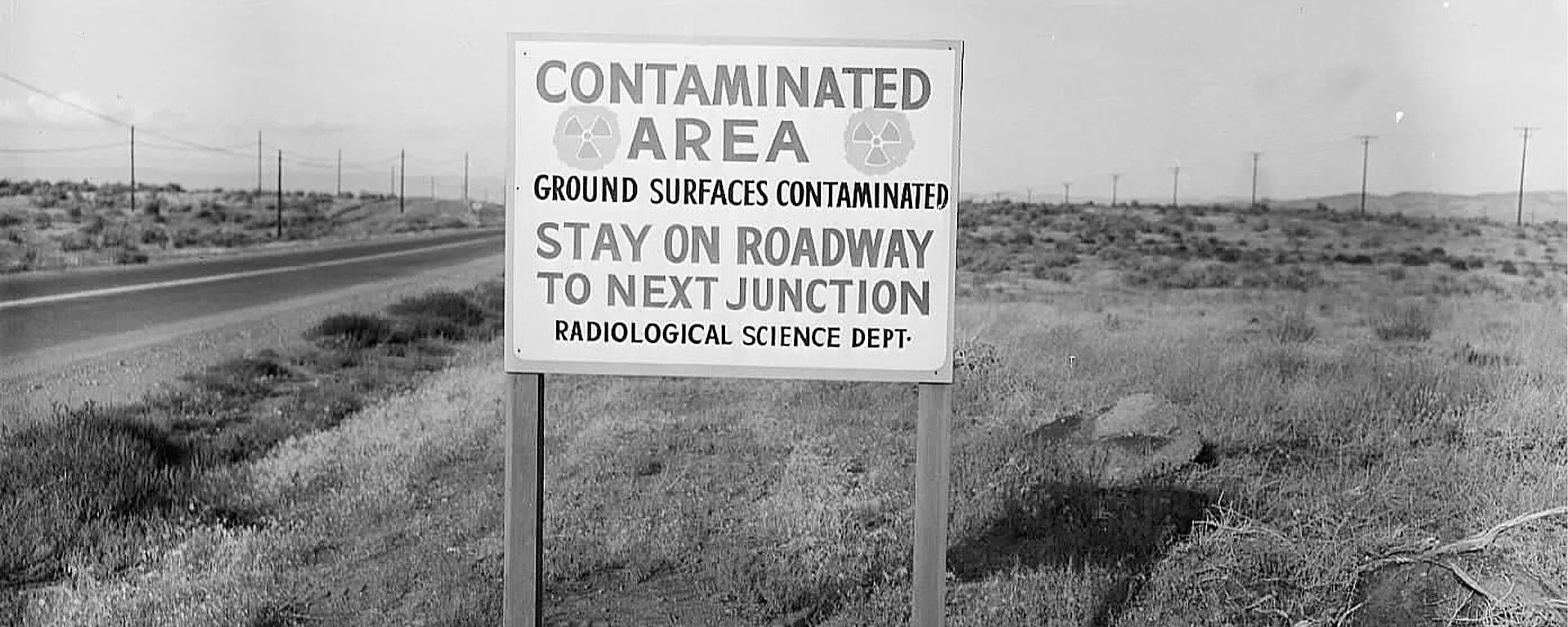
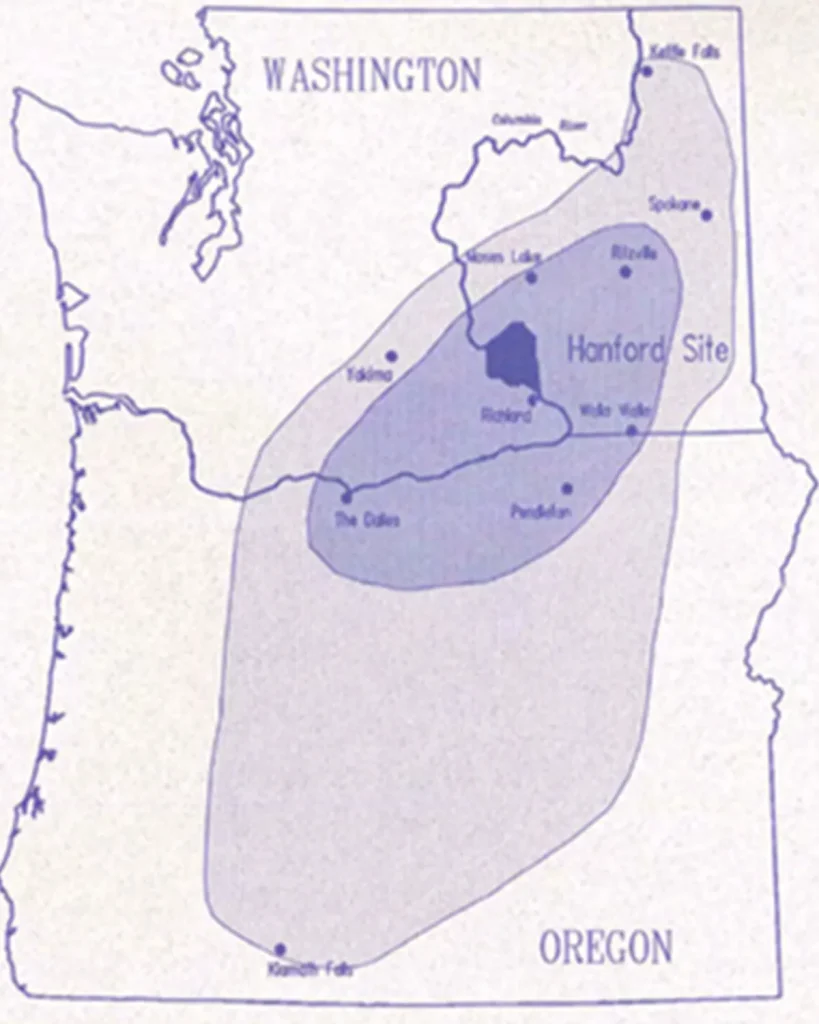
Measurements taken afterwards show how far the iodine spread. Samples of animal thyroids on the Hanford site reached about 80 times the maximum permissible level for permanently maintained radioiodine concentration, and sampling along the path of the plume found levels some 400 times higher in places. Readings on vegetation temporarily exceeded the then-tolerable concentration in Yakima, The Dalles, Spokane and the Blue Mountains. Vegetation at Kennewick is variously reported at 600 times the tolerable amount and at 400 times, and the two figures cannot be reconciled. Figures reproduced by the GAO give levels in picocuries per gram of vegetation of about 530 in Spokane, 35 to 55 in Pendleton, 50 to 260 in Walla Walla and up to 800 in Richland. Those figures are far above a modern guidance level of 50, though no such guidance existed in 1949, and the GAO was careful to say it could not tell whether the test would exceed present off-site dose limits.
The spread, as mapped afterwards, ran from Richland north about 214 miles to Kettle Falls, Washington, south about 374 miles to Klamath Falls, Oregon, and south-east about 27 miles to Kennewick, against the wind. Nobody in those places was told. No one was evacuated and no one was warned.
Reports and reassurances
The people running the test did not consider it dangerous. Participants thought it safe and within the standards of the time, and the off-site dose to the public was not estimated. Herbert Parker, reporting on it in his monthly report for December 1949, judged the risk to personnel negligible. But he also said that the operation had come close to significant levels and that the cloud had not spread as predicted, and that the Health Instrument Division would resist a repetition. Further planned releases were suspended until 1962.
The government’s own later reviews were less comfortable. The advisory committee’s report said that the Green Run did not conform to Hanford’s public-safety practices of 1949, or even to its wartime practices, and the committee questioned whether the planners had considered that they might not fully understand the risks to nearby communities. It is worth saying, in the same breath, what the committee and the GAO did not find. The GAO saw no evidence that the test was a radiation warfare experiment or a human radiobiological study, and the committee’s table estimates about 0.04 expected fatal cancers among roughly 30,000 people exposed. Its own conclusion was that the actual public health effects were probably quite limited. The later dose reconstruction covered Hanford’s releases from 1944 to 1972 as a whole, so no illness can be traced to this one night.
The question the committee kept returning to was not the dose but the secrecy. It accepted that national security can justify keeping the purpose and methods of a release secret. It also pointed out that secrecy comes in three kinds, covering the fact that a risk exists, its purpose, and the means used, and that public notice of a hazard may be possible even when other details stay hidden. It did not claim to be equipped to judge whether the secrecy around the Green Run was justified. It could judge the result: distrust among Hanford’s neighbours has grown as the secret history has come out, and the government’s credibility as a source of information about risk has suffered with it.
The cover lifts
The Green Run stayed classified until 1986. It had left a faint trace in Hanford’s records, since two periodic reports mentioned the processing of “green” fuel elements, but nobody outside could have known what that meant. The details emerged through Freedom of Information Act requests, led by the Hanford Education Action League and by the reporter Karen Dorn Steele of The Spokesman-Review. The first disclosures came in the spring of 1986, and the Atomic Energy Commission’s classified report of May 1950 was largely declassified in 1989. The Air Force declassified further sections in 1991, and in August 1992, after another request, most of the April 1949 report that had recommended the test.
The names of those who ordered the test and carried it out were still withheld from the released papers. In 1992, Jim Thomas of the Hanford Education Action League said that nobody still knew who had authorised the Green Run or the earlier tests, and the identities were still classified as of the year 2000. In the meantime, Washington State had begun a Hanford health effects study, and in 1988 the Hanford Environmental Dose Reconstruction Project began to work out what the plant’s releases from 1944 to 1972 had done. Up to 5,000 complaints were filed in what became known as the Downwinder litigation, six cases reached a federal jury, and the last lawsuit was settled by the federal government in 2015. The Department of Energy lists the Green Run among the 14 most significant safety incidents in Hanford’s history.
Many of the people who lived downwind carry the story as personal history. Connie Nelson, who grew up in Garfield, Washington, and has thyroid cancer, described her community in words that stay with a reader.
We are like a sacrificed group.
Connie Nelson, Hanford downwinder, quoted by the National Park Service
It is fair to remember, as the dose reconstruction work does, that no single case can be traced to a single night. The Green Run was one release among the thousands that Hanford made. But it is the one that was made on purpose, with the protection removed, by officials who went ahead although the weather was not what they had planned, and that is why it has become the emblem of the others.
What kind of experiment was it?
The advisory committee recorded the Air Force’s own view of the value of the Green Run, and it is thin. The committee could not judge how important the test was to national security. The Air Force’s classified histories never mention it, and an Atomic Energy Commission report of 1952 lists it only as an occasion when an instrument was used. And the Green Run itself, with its fog, its stalled plume and its contaminated equipment, did not deliver the long-distance tracking it was meant to test.
There is a larger lesson in how little the planners seem to have worried. They were intelligence officers and engineers, working under pressure after the Soviet test, and they made their calculations on the basis of what they knew. What they knew was incomplete, and in particular they did not understand the route through milk. They also did not ask the people who lived downwind. The committee listed the questions that citizens may reasonably ask of such an operation: whether a release was needed given the alternatives, whether the risks were minimised, whether notice was given as early as possible and whether records were kept. The record suggests that in 1949 the answers were mostly no.
The ordinary Cold War arithmetic explains some of it. Hanford had restarted B Reactor in 1948 during the Berlin Airlift, and after the Soviet bomb the pressure went up. Truman authorised the hydrogen bomb programme, new reactors were approved and the site went on to nine reactors and five reprocessing plants at its peak. It was an expanding place in a hurry. Everything about the Green Run is typical of that hurry, except the deliberate choice to make the dirtiest release the plant could.
Where it happened today
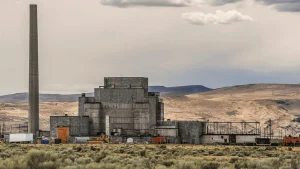
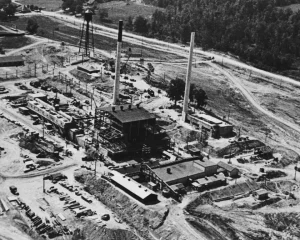
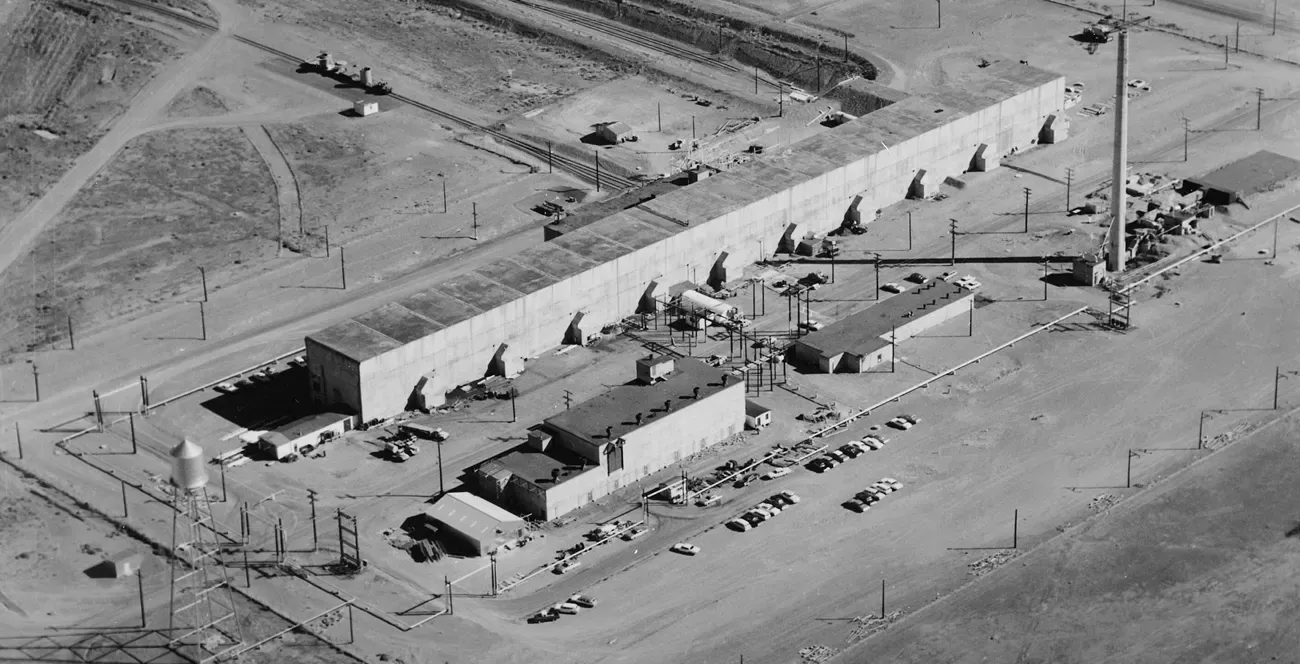
The T Plant, from whose stack the iodine rose, is one of the few Hanford buildings still in use. It began as a plutonium separation canyon and was later turned into a facility for storing, packaging and decontaminating radioactive waste, and it is described as the longest-operating nuclear facility in the world. It lies inside the secure 200 West Area, and we know of no public tour that stops there. The nearest accessible place is the B Reactor, which is part of the Manhattan Project National Historical Park and is open on guided tours that must be booked ahead, as our B Reactor post describes. The landscape downwind, the Palouse wheat fields, the Yakima valley orchards and the towns of Richland, Kennewick and Spokane, looks as it always did, and nothing marks the night.
Cleanup at Hanford is the largest environmental clean-up in the United States, and employs over 10,000 people. All but one of the production reactors have been or will be entombed. The residents still ask the same sorts of question. For anyone who wants to read the main documents, the Advisory Committee’s report and the GAO fact sheet are both public, and the Green Run section in the Washington Department of Health’s later publication on Hanford releases gives a good account of the technical detail.
Conclusion
The Green Run is easy to describe and hard to weigh. On one side is a small group of men in a tense year, trying to learn to see a Soviet plutonium plant from the air, trying a method that did not give them what they hoped for. On the other is a cloud of iodine let out on purpose over a region where roughly 30,000 people were exposed, with the filters off, in weather that did not follow the plan, and with nobody told.
The numbers will go on being argued. It may be that the direct harm of one night was small, and that the real harm was to trust. What is not in dispute is that it happened, that it was kept secret for nearly four decades, and that the people who gave the order are still not named in the documents. The night is easiest to picture through one small detail in the records: at sunrise on 3 December, Air Force pilots reported that the wind had turned.
Did you know?
- Green Run fuel was dissolved after 16 days of cooling, against a normal 83 to 101 days.
- The scrubbers that normally removed about 90 percent of the radioiodine were not run.
- The scientists predicted about 4,000 curies of iodine, and later estimates put the release at about twice that.
- The release began about eight o'clock on the evening of 2 December, hours before the planned window.
- Rain and snow fell on Spokane and Walla Walla while the plume was in the air.
- Monitoring equipment was itself contaminated by the release, which raised background readings.
- Vegetation was contaminated from Kettle Falls, Washington, to Klamath Falls, Oregon.
- In 1949 the route from pasture to milk to thyroid had not yet been identified.
- The Green Run stayed classified until 1986, and the Atomic Energy Commission's 1950 report was largely declassified in 1989.
- The Hanford Education Action League and a Spokesman-Review reporter led the Freedom of Information requests.
- Up to 5,000 complaints were filed in the Downwinder litigation, and the last lawsuit was settled in 2015.
- The Department of Energy lists the Green Run among the 14 most significant safety incidents in Hanford's history.