


A cliff between two beaches
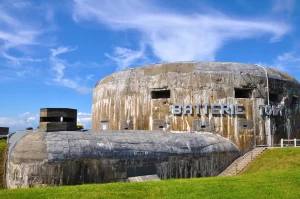
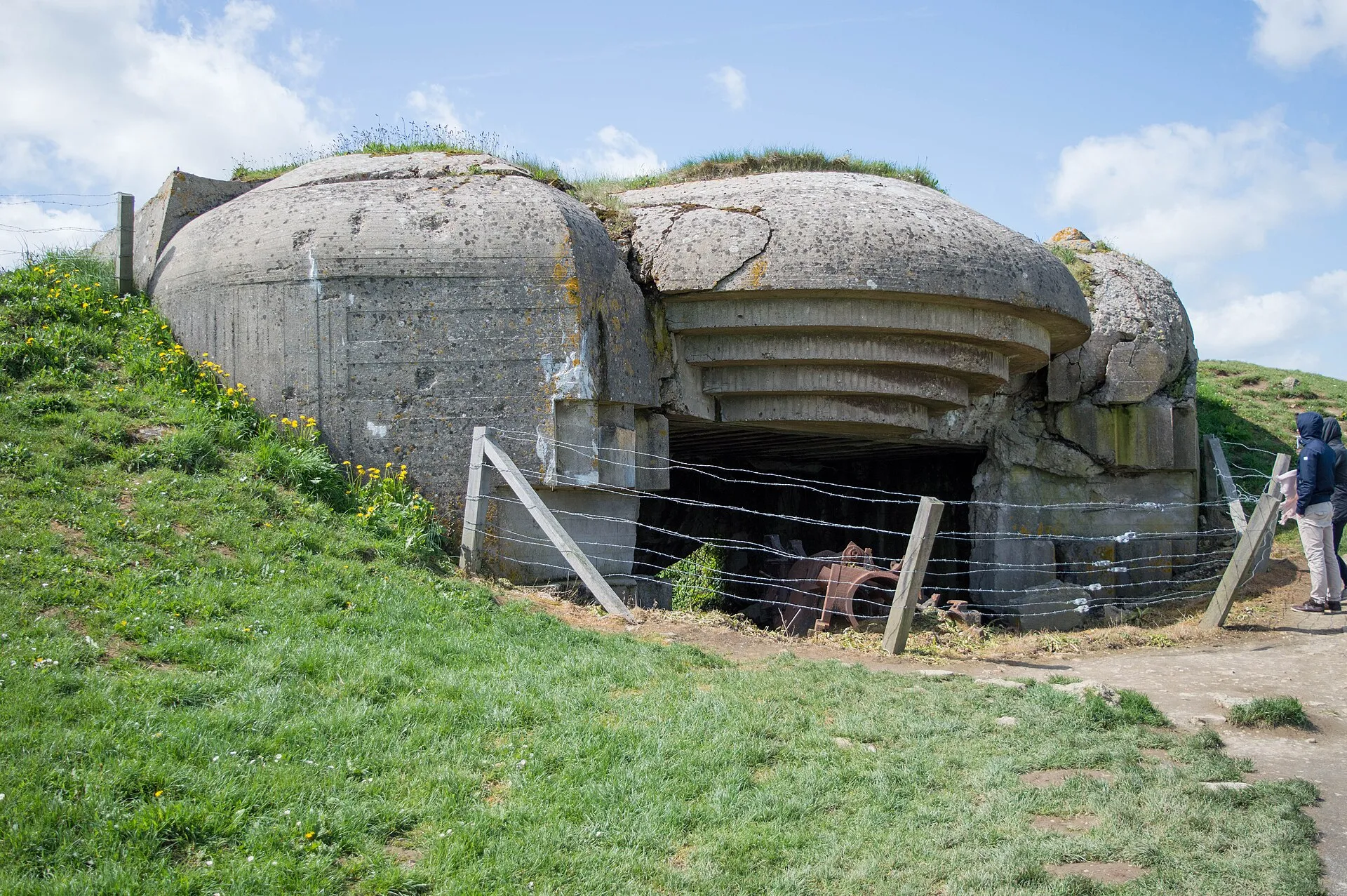
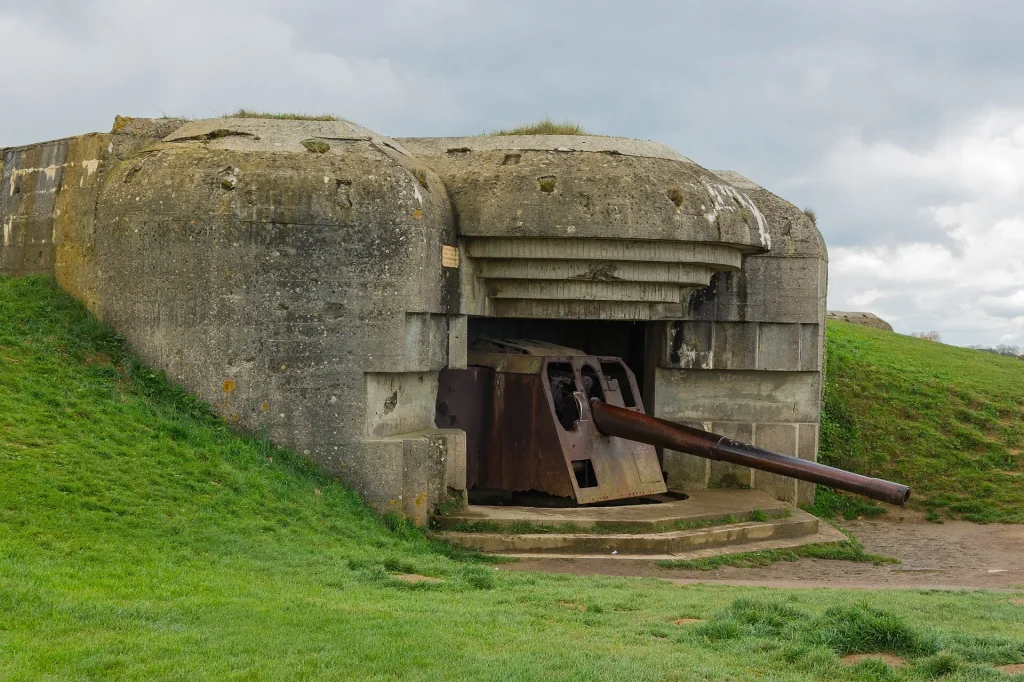
Most of the Atlantic Wall guns in Normandy are gone. They were broken up for scrap, buried under rubble, or left to rust until the sea took the cliff from under them. At Longues-sur-Mer, a few kilometres north of Bayeux, the guns are still there. You walk across open ground, down a short path, and look into a concrete gun house, and there it is: a steel barrel, a rusting shield and the mount it turned on, still inside the concrete that was poured around it in 1943 and 1944.
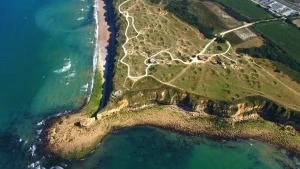
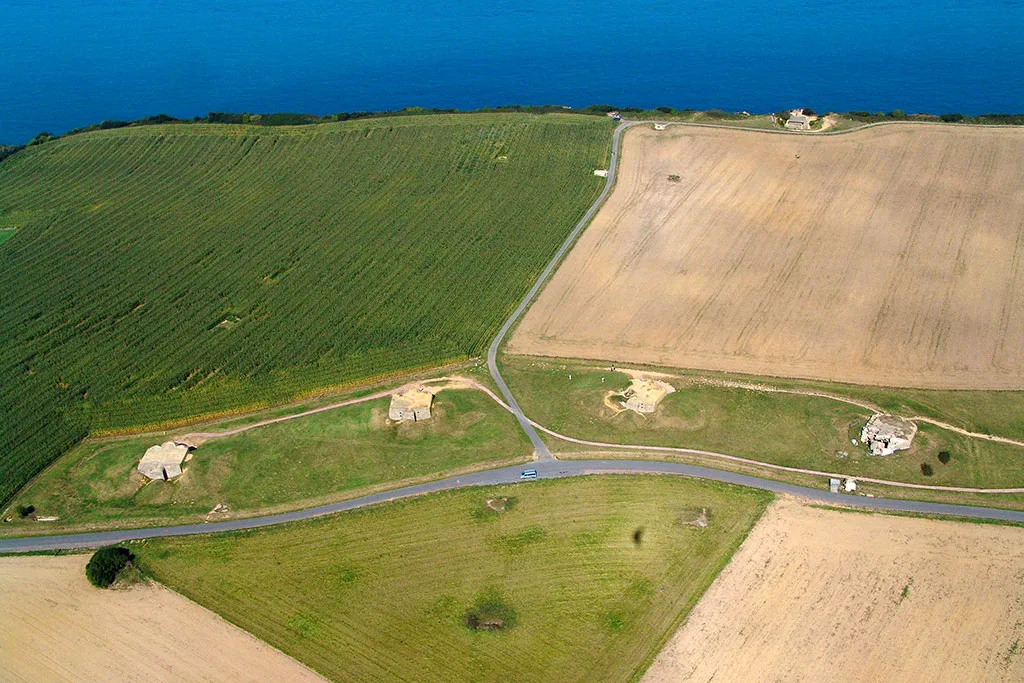
The battery sits on a plateau about 60 to 65 metres above the Channel, roughly halfway between the fishing harbour of Port-en-Bessin and the little resort of Arromanches. That position was chosen on purpose. From the cliff edge the gunners could see east towards the British beach the Allies called Gold and west towards the American beach called Omaha, and four guns that could reach about 20 kilometres could cover both of them and the water in front. In the planning of the Atlantic Wall it was a small battery of the second rank. In the story of D-Day it became one of the best known, because it was close enough to the fleet to be a genuine threat and well enough built to survive all the effort that was put into destroying it.
We want to tell the story of the place: how it came to be, what was built, who ran it, what happened to it on the first two days of the invasion, and how it has survived since. The invasion itself is told in our post on the D-Day landings, and the nearby clifftop assault at Pointe du Hoc has its own post. What we can add here is the detail of one battery, a few dozen metres of concrete and the men who lived in it.
Before the guns
The plateau was not empty before the big guns came. The ground was first held by a small post, designated Wn 22, with two machine guns and a handful of soldiers. At that stage it belonged to the 323rd Infantry Division, a static division spread thin over a long stretch of coast. In 1943 the 716th Infantry Division took over the sector and added a 5 cm mortar and a portable searchlight. The post was held by about ten men under a non-commissioned officer, with mines and barbed wire around it. When the numbering of the strongpoints was changed in early 1943, Wn 22 became Wn 48, the name the site carries in most Allied documents.
A few of those first fortifications are still in the ground. One of the small concrete machine-gun pits, a type known as a Tobruk, carries an inscription by someone signing as “P. Muttz”, together with some carved horses. It is a tiny reminder that individual people left their marks here, and the kind of detail that survives only because the battery was never bulldozed.
Then the Germans decided to put real guns here. The Atlantic Wall had been promised since 1942, but it was thin along most of the coast until late 1943, when Field Marshal Erwin Rommel was put in charge of inspecting and strengthening it. Longues was one of the places that got the heavy treatment.
Concrete in the cornfields
Construction began in September 1943. The work was done under the Organisation Todt, the Nazi state construction organisation, and the German contractor is named in French records as the firm Wiener and Trachte. The site was surveyed by German geologists, a pioneer company cleared the ground with excavators, and the concrete slabs for the four gun houses were poured within a few days. Three roads were laid across the fields to bring material in, and a water tower went up because of the huge volume of concrete mixing. Local labourers worked alongside German workers. Two sections of a naval fortress pioneer battalion arrived later to speed things up, though progress was slow, with shortages of tools and materials and at least one excavator that broke down at a bad moment.
Each of the four gun houses was a Regelbau M272, a standard design. Regelbau means, roughly, “regular building”, and the point of the system was that the same plans could be used again and again. The walls and roofs were about two metres of reinforced concrete. Each casemate is said to have taken about 600 cubic metres of concrete and four tonnes of reinforcing steel. A thick slab under each one was meant to stop the structure shifting if a heavy bomb landed nearby. On the roof were hooks for camouflage netting.
How fast it all went is disputed. By March 1944 only two of the casemates were finished and the whole battery was complete by May, according to some records; others say that all four were built by late April but were not fully operational, with the concrete for casemate 2 poured in mid-May. The honest summary is that the battery was in a rush right up to the invasion, and was only completed in the final weeks before June.
Around the guns the Germans built the usual defences: twelve small shelters for the crews, with more that were unfinished on D-Day, perhaps fifteen small Tobruk machine-gun pits spread around the perimeter, and trenches linking everything so that men could move around while the guns fired. A belt of barbed wire and minefields ran around the whole site. For defence against aircraft there were three 20 mm Oerlikon anti-aircraft guns in open pits. A captured Soviet 122 mm gun was added to the site, and a 120 mm gun was used to fire illumination.
The French Resistance side of the story adds a tantalising claim: that some of the French workers on the site were members of the Resistance, that they passed the layout of the battery to the Allies, and that they deliberately weakened the concrete of one casemate. It rests on a single telling and cannot be confirmed, but it fits what is known of the Atlantic Wall generally. The Allies had a very good picture of the defences before the invasion, and a lot of it came from people who had worked on them.
The sector was also taken seriously at the highest level. Rommel himself is said to have visited, together with the artillery general Erich Marcks and Lieutenant-General Dietrich Kraiss. The date is not recorded, so we cannot say whether it came during construction or after, but it shows how much weight the Germans put on this stretch of coast.
The guns
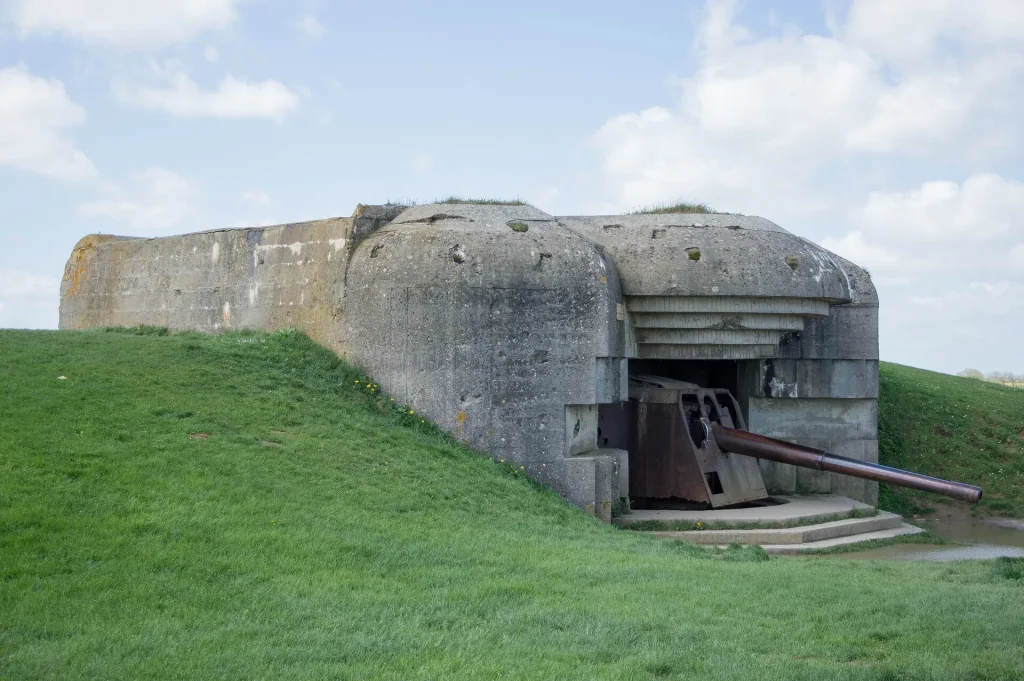
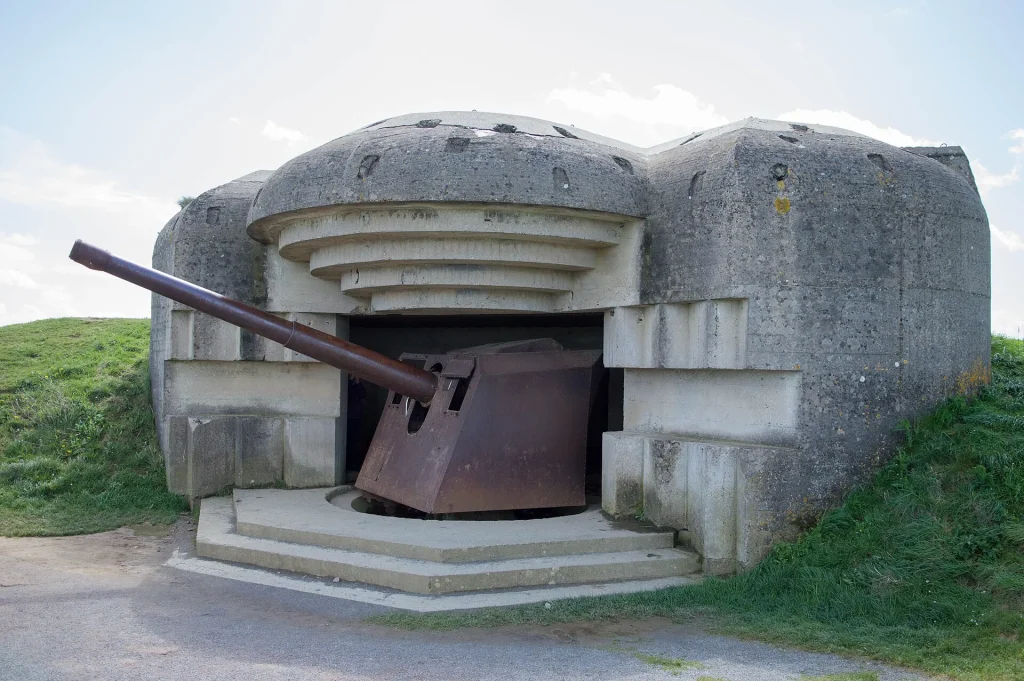
The main weapons were four 150 mm naval guns, officially the 15 cm TbtsK C/36. The abbreviation stands for a gun made for torpedo boats, and the idea was that a gun designed for a fast, small warship could be taken off its mount and used on land. They were made by Skoda in Pilsen, in occupied Czechoslovakia, on a central-pivot mount, which meant the barrel turned on a single column rather than on a fixed carriage. French records add that the guns were conceived at Krupp, and give their serial numbers as 199, 200, 261 and 262, though that detail rests on one source.
Each gun weighed about 7,200 kilograms, with its steel shield adding another 8,900 or so, for a total near 16 tonnes per position. The shield was a thin plate of 6 to 10 mm designed to stop fragments, not shells. The barrel could elevate from about minus 4 to plus 40 degrees. Maximum range was about 19.5 to 20 kilometres, and the shell weighed around 40 kilograms, though some give 45. Rate of fire is quoted as one round a minute per gun in some places and as six to eight rounds a minute in others; the second figure looks too high for a gun of this type, and we do not rely on it. What matters is that the guns were fast-firing by the standard of the time, and that the crews were trained sailors, not infantry.
Each casemate had two rooms behind it for ammunition, one for shells and one for powder charges, and each gun had two Zeiss telescopic sights. The sights turned out to matter, because on D-Day the calculating equipment in the fire-control post was out of action and the gunners had to fire by direct sight, which is much less accurate at long range.
It is worth saying that these were not heavy guns by naval standards. A single Allied cruiser carried at least as much weapon power as the whole battery, and the Allied fleet off the beaches was counted in the hundreds of ships. The battery was not built to stop an invasion. It was built to make an invasion fleet pay for staying close to the coast, to sink or scatter transports and disrupt the landings in the first hours. That was the plan, and it is why the Allies wanted it silenced before the first troops got ashore.
Eyes on the cliff
The fire-control post is the most unusual building on the site. It is a Regelbau M262, built into a hollow right at the cliff edge, about 300 metres in front of the casemates. A few accounts say 500, but the information board on site says 300, and we go with the board. It had two levels and eight rooms in all. The upper level was an open observation platform, with a roof of concrete 70 centimetres thick resting on four steel supports, where the rangefinding instruments were placed. The ground floor held seven rooms, including a calculation room, a telephone exchange and a rest room. The calculation room has a map of Port-en-Bessin carved into the concrete wall, which the gunners would have used to plot targets. Facing the sea, a long slit gave an observation view of more than 180 degrees.
The design idea was that men on the cliff measured the distance and bearing to a ship, passed the figures to the calculation room, worked out the aiming data, and phoned them to the four guns back in their casemates. In theory, it was the most modern electrical system on the Normandy coast. In practice, how complete it was is a matter of disagreement. The information board on site says the post was built very late and was not fully operational on D-Day, and French accounts agree that the calculating equipment was not in place. English-language accounts describe the fire-control system as one of the most advanced in Normandy and say that the bombing cut the armoured cable connecting it to the guns. Both may be partly right. The post was probably not finished, and the cable between it and the casemates was also destroyed by the bombing, with the result that the battery had to rely on visual signals and the guns’ own sights.
The men
The garrison is given as 184 men almost everywhere. It was a naval unit, and its crews were gunners and sailors from the Kriegsmarine, not soldiers. About half of them are said to have been over 40, which gives an idea of the kind of men who had been posted to the coast by 1944. French records name the battery commander as Oberleutnant Kurt Weil, assisted by Leutnant Herbert, and say the battery formed the fourth battery of an army coastal artillery battalion, which in turn belonged to a naval artillery group under Kapitänleutnant Karl Weise. That is about as much as is on record about the men themselves. Very few of their names survive, and none of their letters or diaries have come to light.
The command arrangements were awkward. The battery had been started by the navy, and in the last months it was handed over to the army, apparently to unify command of the coastal defences. One German officer interrogated after the war, Colonel Ocker of the 352nd Infantry Division, complained that because the navy had controlled the battery until the landings, almost no coordinated fire planning had been done between the battery and the infantry around it. Years afterwards a German prisoner is said to have remarked to a Devon veteran that he was a sailor, not a soldier, and that the bombing had left the crews feeling like sitting ducks.
A small detail from the site’s information boards makes the human side clearer. A letter from the prefect of Calvados to the mayor of Longues, preserved in the archives, announced that the Germans would hold firing exercises on 6 June 1944. It was an administrative notice that the sea would be closed to local boats on the day of the largest amphibious landing in history. Nobody in the village could have known.
The bombing
The Allies knew the battery was there, and they wanted it gone. It was one of the targets in the large air campaign against the Atlantic Wall in the weeks before D-Day, and there were repeated raids from the end of March through the first days of June. The heaviest were in the days just before the landings. Over 1,500 bombs are said to have fallen on the site in total, and some of the 2,000 kilogram bombs left craters seven metres deep.
The raids did not work, in the sense that the concrete stayed whole. A daytime raid by 48 Marauder medium bombers hit casemate 2 and destroyed the part of it where the ammunition was stored, though the gun survived, killing two men and wounding five. A second raid, lasting 22 minutes, put about 120 bombs into the area and caused no casualties. Photographs taken afterwards showed craters in front of casemate 1 and near-misses at casemates 2 and 3, while casemate 4 was untouched.
The decisive raid came on the night of 5 and 6 June. In that raid 99 four-engined bombers are said to have dropped 604 tonnes of bombs on the battery; a figure of 1,500 tons is also quoted, but that seems to fold the whole bombing programme into a single night, and we use the lower number with caution. The casemates survived, because the walls were two metres thick and the bombers, flying at night over cloud, were inaccurate. But the trenches and the underground cable to the fire-control post were destroyed, and the raids are said to have damaged the garrison’s morale.
6 June: the duel
The naval bombardment started in the early light. HMS Ajax, a British light cruiser, had been told to deal with this battery as one of its jobs, and she is recorded opening fire at 05:30 from about six nautical miles offshore, with her eight 6-inch guns. The battery fired its first shot, by most accounts, at 05:37, about twenty minutes before sunrise. Its first targets were off Omaha, the American destroyer USS Emmons and then the old battleship USS Arkansas, which was about 17 kilometres away. Arkansas fired back with her 12-inch guns. The fire there was heavy and the Americans had a lot of other things to deal with, but the first shots from Longues were aimed at them.
French accounts have the French cruiser Georges Leygues firing the opening shots at the battery at 05:37, a claim that conflicts with the British record, and we will come back to that argument in a moment.
About 20 minutes later, the battery turned east and fired at HMS Bulolo, the headquarters ship for Force G, the British naval force for Gold Beach. Bulolo carried the staff of the British XXX Corps, and the battery targeted it. The ship weighed anchor and moved out of range before it was hit. It was the battery’s best moment: a corps headquarters afloat was driven away from its station off the beach.
Then the cruisers closed in. Ajax and the light cruiser HMS Argonaut came in close, to something like 11 kilometres from the cliff, and opened fire in earnest. By a French count Ajax fired 114 rounds in about 20 minutes. The battery went quiet, and the ships’ crews believed it had been destroyed. It had not been. The Germans took cover, repaired what they could, and when the American landings at Omaha began they started firing again.
One of the more revealing records is a conversation between the ships. A British captain named Weld and the French Admiral Jaujard are said to have exchanged sharp signals over whose target the battery was. Weld claimed it for Ajax, and the French cruisers ignored him and carried on firing. One British officer, Commander Edwards, later credited the neutralisation to what he called Ajax’s “exhibition shooting”. The French, equally, claim the credit for their own ships.
At about 08:45 the battery went silent again. By this reckoning the ships had knocked out two of its guns and damaged the other two. But the afternoon told a different story. One gun, repaired by the crew, opened fire again towards Omaha, and the French cruisers Georges Leygues and Montcalm, with Arkansas, returned fire. French accounts say the French destroyed one gun with a direct hit and damaged two more. Reports differ on how many guns were hit, and the numbers are plainly confused by the fact that several ships fired at once. Ajax is recorded as firing until about 17:00, and Georges Leygues took over until about 19:00. Gun 1 is said to have been finally put out of action at 18:00.
How much did the battery actually fire? The figures range from 115 rounds to about 150, and as many as 170 are quoted. More than a thousand rounds were found in the magazines after the capture, so the battery was not short of shells. In the whole day no Allied ship was sunk or badly damaged by the battery, though Bulolo and a few others had to move. For a position that had been built to disrupt an invasion fleet, that is a poor return. It is also fair to say that nothing the battery did stopped a single landing craft.
Who silenced the guns?
The argument about credit is a small thing, but it says something about D-Day. The Royal Navy says Ajax did the work. The French say the credit is theirs, and that Ajax only stopped the battery around midday, after the French had begun. Some of the shell fragments found when the British took the battery were reported to be of French origin. The Americans might point out that Arkansas also fired at it, and the cruiser Argonaut can claim a share too.
The truth is that the battery was beaten by the combined weight of several ships, with different ones silencing different guns at different times, and nobody on any of them could see exactly which shells were hitting. It is a good example of how hard it was, even in a well-organised operation, to know who had done what. The war diary of the infantry battalion that finally took the position describes Ajax’s shooting as “first class”, with two direct hits on the guns, and the diarist believed the gun crews had been killed at their posts. That did not match what the Devons found the next day, when over a hundred men came out alive.
7 June: the Devons
On the morning of 7 June the 2nd Battalion, the Devonshire Regiment, part of the 50th Northumbrian Division, which had landed on Gold Beach the day before, was ordered to take the battery. The battalion’s war diary gives a calm account. At 05:30 the battalion moved to an intermediate objective, which it occupied about 07:00 without opposition. C Company was to lead, with B Company in support. When the officers first saw the battery they doubted it was still occupied, until two Germans walked slowly across the site.
A brigade commander offered fire support. Ajax would shoot until 08:45, a squadron of fighter-bombers would bomb for five minutes, and a machine-gun platoon of the Cheshire Regiment, under Captain Bill Williams, would give direct support. A last raid by B-17 bombers at about 09:00 is mentioned in French records, though the timing does not fit neatly with the Devons’ own account. The infantry attack was timed for 09:00.
C Company went through the village of Longues and attacked from the south, remembering the minefields from the air photographs. Its commander is given in the battalion diary as Lieutenant Frank Pease, while another record says Lieutenant Michael Holdsworth, and we cannot say which is right. Another account says one German gunner walked down a path towards the Devons with his hands up, and then over a hundred came out of the concrete.
There was no sound from it.
Lieutenant Holdsworth, 2nd Devonshire Regiment, describing the approach to the battery
Not every German gave up at once. Some fired machine guns and rifles at the Devons, and the company cleared the position methodically. The casemates were linked by underground tunnels, which made clearing them dangerous, and men from the headquarters of the 50th Division helped drive the last Germans out of the tunnels. Captain “Nobby” Clark was killed during the mopping up on the cliff edge, and the battalion diary says his loss was a severe blow to all ranks. No other British deaths in the action are recorded.
By about 10:53 the battery was reported captured. The number of prisoners is variously given as 90, over 120 and about 120, and they were described as very shaken. A 76 mm field gun was taken with them. The battalion’s objective for D-Day had been reached, as the diary notes, twelve hours late.
The airstrip and the explosion
The war did not leave Longues straight away. Within two weeks of the capture, RAF engineers built an airstrip beside the battery, about 300 metres to the east, known as Advanced Landing Ground B-11. It had a single runway about 1,200 metres long and 40 metres wide. It was built between 18 and 21 June and used from 21 June to 4 September 1944 in some records, and from 26 June to 5 September in others. It was used by Spitfire squadrons of the Second Tactical Air Force, including Australian and Canadian squadrons, and the French pilot Pierre Clostermann flew through it. Its life was short, because the front moved quickly inland and the aircraft moved with it, and nothing of the strip remains.
The airmen used the casemates as stores. An anti-aircraft gun was placed on the roof of one of them, and a large quantity of ammunition was kept inside. At some point it exploded. Accounts do not agree on which casemate, number 1 or number 4, the easternmost, and they do not agree on the number killed: two, four, or “several”. In one version the blast was caused by the ammunition of the anti-aircraft gun on the roof; in another it was set off after the war by guards experimenting with a fuse. In all versions the casemate was wrecked, and it is the one that is a ruin today, which is why only three of the four gun houses still hold intact guns.
A museum before museums
When the war ended, the guns were simply left. From 1946 the site was open to local residents, and the guns remained in place. That was fortunate: the French heritage record notes that this is the only battery on the Normandy coast to have kept its guns.
In 1984 part of the site came under the protection of the Conservatoire du littoral, the French public body that buys coastline to protect it. Twenty-six of its sixty hectares, including the guns and the fire-control post, now belong to it. The battery was listed as a historic monument in 1994 and fully classified on 25 October 2001. The official record describes a fire-control post and four casemates, three of them intact with their guns and one reduced to remains.
Visitors came long before there was a visitor centre. The casemates and Tobruk pits were partly buried and flooded for years. They were opened up for tourists in 2004, for the sixtieth anniversary of the landings. A concrete visitor building, a car park and an interpretive trail were added later, at a reported cost of 2.5 million euros, paid by the state, the Conservatoire, the Normandy region and the commune. A footbridge to the fire-control post was built around 2010 to 2012. The coastline here is eroding, and a study by the French technical agency Cerema has recommended keeping the coastal path well back from the edge, so the seaward part of the footbridge has been closed.
The film
The 1962 film The Longest Day used the site. The fire-control post appears in it, though not in its original role. The information board on the site says one of the most famous scenes in the film was shot here, and French accounts say it was the scene in which Major Werner Pluskat watches the invasion fleet through binoculars. At least one other record says that the scene was in fact filmed near Sainte-Honorine-des-Pertes, because the real position was not available during filming. Either way, the film helped fix Longues in the public mind as the place where the German gunners saw the fleet.
Visiting
The site is open all year and free to enter, and it is outdoors, so check the weather. There is a car park about five minutes’ walk from the guns, with a reception building holding a tourist office, a shop and toilets. Guided tours in French and English are offered through the local tourist office, and a 2024 guide gave the price as 6 euros, free for children under 10. Check the current price before you go. You can walk round the site in about an hour. The ground is mostly gravel and grass, and the narrow stairs into the underground rooms are harder going if you have trouble walking. It is best to avoid school holidays, 6 June and Memorial Day, when it is crowded.
You can step into the casemates and stand beside the guns. Look at the thickness of the walls and the way the openings face out to sea. The fire-control post has a viewing platform over the bay, and from there you can see how the battery commanded the water: Gold to the east, Omaha beyond the headland to the west, and in clear weather, the remains of the Mulberry harbour at Arromanches. Roughly half a million people are said to visit each year.
By public transport it is awkward. A bus from Bayeux stops at Manvieux, and from there it is a walk of a little over three kilometres. By car it is about 15 minutes from Bayeux. Some organised day tours of the D-Day beaches include it.
Conclusion
It is tempting to think of Longues-sur-Mer as a story about a battery that failed. It fired for a day, hit nothing important, and gave up when infantry walked across the fields. But that misses what makes the place worth visiting. It is a rare chance to see what an Atlantic Wall battery actually was, as built, with the guns still in it. The gun shields have rust where the paint used to be. The concrete is pitted. The telephone exchange, the calculating room and the carved map of Port-en-Bessin are all where the crew left them.
It is also a place that shows how modern war scrambles memory. Accounts differ about who fired first, how many shells were fired, how many guns were hit, how many men surrendered and what blew up the fourth casemate. Every one of those questions had a clear answer at the time, in someone’s logbook or someone’s memory, and the answers do not match. What we are left with is a picture of a battery that was bombed, shelled by half a dozen ships, partly repaired and fired again, and finally walked into by infantry who were not even sure it was still manned.
The people who built the battery, the sailors who manned it and the soldiers who took it are mostly nameless, and only a few survive in the record. An inscription and some carved horses on a concrete pit, signed “P. Muttz”, are among the few traces of a German voice. A captain called Nobby Clark, killed on the cliff edge on 7 June, is another trace, on the other side. Both are at the same site, a short walk apart, and both are part of what Longues still tells visitors: that the great set pieces of D-Day came down to small groups of ordinary men on both sides, on a cliff, in the concrete, for a day or two.
Did you know?
- The battery stands on a cliff about 60 to 65 metres above the Channel, between Gold and Omaha beaches.
- The site was first a small strongpoint called Wn 22 with two machine guns, later renumbered Wn 48.
- The four main guns were 150 mm torpedo-boat guns made by Skoda in occupied Czechoslovakia.
- The casemate walls and roofs were about two metres of reinforced concrete.
- The garrison was 184 men, and one source says about half of them were over 40.
- A prefect's letter announced German firing exercises for 6 June 1944, the day of the landings.
- The battery's best moment was driving the headquarters ship HMS Bulolo out of range.
- British, American and French ships all fired at the battery, and the French and British still disagree on who silenced it.
- More than a thousand rounds were reportedly found in the magazines after the capture.
- The 2nd Devons took the battery on 7 June, and the battalion diary says the D-Day objective was reached twelve hours late.
- An RAF fighter strip, ALG B-11, was built beside the battery within weeks of its capture.
- One casemate was destroyed in a post-war ammunition explosion, which is why only three still hold their guns.
- It was classified as a historic monument on 25 October 2001, and is the only Normandy battery that kept its guns.